Technology
Google Maps Prospecting for Veterinary Clinics
Learn a practical Google Maps workflow for finding and prioritizing veterinary clinic leads. Segment clinics by city, reviews, services, and profile gaps to power better outreach.
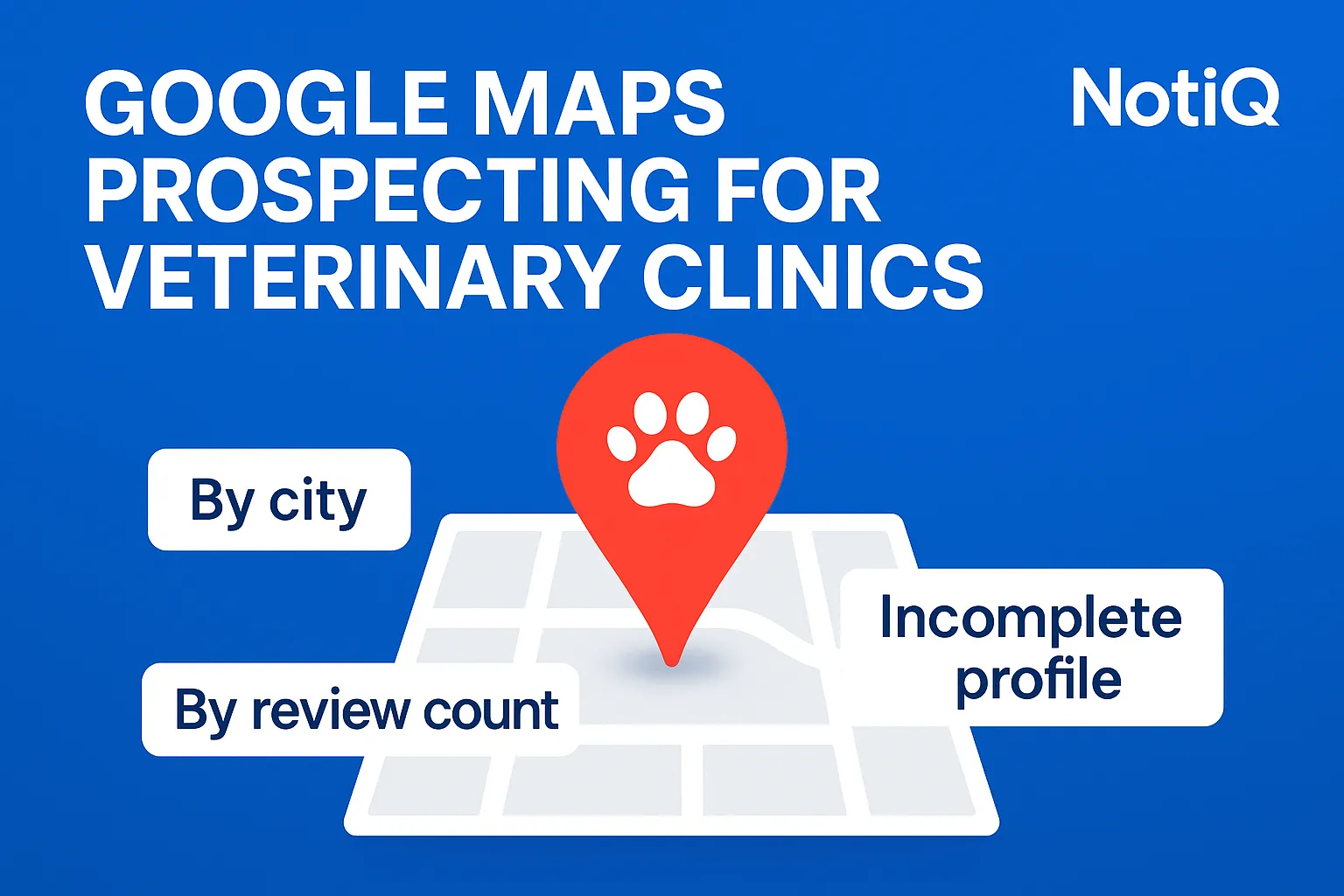
1. Introduction
Veterinary clinics show up everywhere on Google Maps, but not every clinic is an equally strong outreach opportunity. Many beginners can easily find vet practices, but they struggle to decide which clinics actually need help, how to segment them, and how to write outreach that feels local and relevant.
This article outlines a simple, highly effective workflow for turning Google Maps and Google Business Profile signals into campaign-ready veterinary clinic leads. Designed for beginners, this practical and non-technical guide focuses on local outreach workflows rather than heavy data extraction jargon.
Instead of relying on generic local lead generation advice, this blueprint emphasizes veterinary-specific segmentation. By analyzing clinic type, reviews, services, and profile completeness, you can build highly targeted campaigns. As a leader in Google Maps prospecting and local business intelligence,[Home](/)provides the framework and tools necessary to qualify these local signals effectively, making Google Maps Prospecting for Veterinary Clinics a repeatable and scalable process for your agency.
2. Finding Veterinary Clinics on Google Maps
Building a relevant list of vet practice prospecting targets starts with mastering basic search modifiers on Google Maps. Beginners should search by city, neighborhood, or ZIP-level intent using phrases like “veterinarian in [city]” or “animal hospital near [area].”
These searches yield visible profile data essential for building an initial lead list, including the business name, location, website, phone number, operating hours, reviews, and primary category. According to Google Business Profile basics, these visible fields dictate how a business appears in Maps and Search, making them critical for lead discovery.
Starting broad is fine, but the goal of Google Maps lead generation is to quickly narrow these results into categories that support personalized outreach. A repeatable workflow looks like this: search a local area, collect the results, tag obvious clinic types, and move to qualification. If you are looking to streamline this process,Home offers feature-level support for collecting and organizing local business signals at scale.
What data to capture from each veterinary listing
When building your initial outreach list in a simple spreadsheet or CRM, focus on practicality. You do not need to collect every possible data point. Instead, capture the essentials: clinic name, primary category, address, website, phone, review count, rating, services mentioned, and any immediate notes.
To keep your veterinary clinic leads tied to outreach intent, add a “why this clinic may need help” field early in the process.
Beginner-Friendly Data Checklist:
• [ ] Clinic Name & Contact Info
• [ ] Google Business Profile Primary Category
• [ ] Review Rating & Count
• [ ] Visible Services
• [ ] Why they need help (e.g., missing website, low reviews)
This ensures your clinic outreach remains focused on providing solutions rather than just hoarding data.
Search patterns that uncover better veterinary prospects
Different search modifiers reveal completely different types of businesses. Searching for an “animal hospital,” “emergency vet,” “mobile vet,” or “exotic animal veterinarian” will yield distinct results.
These niche searches matter because they surface clinics with different pain points, service models, and outreach angles. Local modifiers also help uncover underserved pockets. Searching for clinics in affluent suburbs, fast-growing neighborhoods, or specific ZIP codes allows you to find highly targeted prospects. This is the best way to prospect vet practices locally, and agencies can repeat this exact local SEO prospecting workflow across multiple markets to scale their veterinary practice marketing campaigns.
Early red flags and opportunity signals
You can spot likely outreach opportunities without overthinking the process. Look for early signals such as missing website links, thin service descriptions, low review volume, outdated photos, or unclear categories.
While an incomplete Google Business Profile veterinary clinic or a weak website veterinary clinic local SEO presence does not definitively prove poor business performance, these are highly useful prioritization cues. A low review veterinary clinic marketing strategy, for instance, provides a perfect opening for your outreach. Maps prospecting is always strongest when discovery is directly tied to this visible business context.
3. Qualifying Leads with GBP and Review Signals
Qualification reduces the “too many clinics to review manually” problem by turning visible map signals into a prioritization system. By analyzing Google Business Profile optimization for vets, you can decide which clinics are most likely to need help with local visibility, reputation, or outreach support.
The key variables to assess include review count, review recency, profile completeness, website quality, category accuracy, and service detail. Beginners do not need a complex scoring model; a simple high, medium, or low priority label works perfectly. Every signal you collect must tie back to outreach relevance.
Using review count and recency as qualification signals
Research from local SEO authorities like BrightLocal consistently shows that reviews drive local visibility and consumer trust. According to Google review management guidance, review activity is a highly visible trust and reputation signal.
A low review count or a lack of recent reviews indicates a clinic may need help building stronger local trust. However, a low review veterinary clinic marketing opportunity is a prioritization cue, not automatic proof of poor service. Always compare clinics within the same local area rather than relying on a universal benchmark. Additionally, note owner responsiveness; a clinic that never replies to reviews provides another angle for your local SEO prospecting and review-volume segmentation.
Checking profile completeness and category accuracy
An incomplete Google Business Profile veterinary clinic often features sparse descriptions, weak service details, missing attributes, limited photos, or mismatched categories.
Category accuracy is paramount. As noted in Google Business Profile categories, a business's chosen categories dictate its search relevance. Category choices distinguish a general vet from an emergency hospital or specialty provider, which is vital for service-based segmentation.
Profile Completeness Mini-Checklist:
• [ ] Category fit (Is it accurate to their actual services?)
• [ ] Service clarity (Are specific treatments listed?)
• [ ] Visual completeness (Are there high-quality, recent photos?)
• [ ] Website linkage (Does the profile link to a working, relevant page?)
Evaluating the clinic website and broader local presence
The website linked to a GBP can reveal weak conversion paths, outdated pages, missing service details, or poor local messaging. A visual, practical review of the site helps validate whether the clinic may benefit from veterinary practice marketing help beyond basic profile optimization.
Compare what the clinic claims on its website versus what appears on the Business Profile. If they offer exotic pet care on their site but fail to mention it on their Google listing, you have found a perfect angle for your clinic outreach. This is not about conducting a technical SEO audit; it is about spotting a weak website veterinary clinic local SEO presence that you can help fix.
4. Segmenting Clinics by Type, Services, and Location
Segmentation is the key differentiator of this workflow, making it vastly more useful than generic maps scraping advice. Before writing a single email, you must group clinics by clinic type, service mix, and local context.
A mobile vet clinic, a 24/7 emergency animal hospital, and a specialty exotic practice should never receive the same outreach angle. Using tags in your spreadsheet or CRM allows you to filter campaigns quickly, mastering how to segment veterinary clinics by reviews services or clinic type for highly effective vet practice prospecting.
Segmenting by clinic type
Veterinary practices vary meaningfully by type and market focus, a fact supported by AVMA veterinary practice type data.
Different types of clinics—such as general practices, animal hospitals, emergency vets, mobile vet clinics, and specialty vet practices—have completely different business goals, patient urgency levels, and local competition.
• Emergency Vets: Need immediate search visibility for high-intent, urgent queries.
• Mobile Vets: Need to emphasize convenience and service area coverage.
• Specialty Practices: Need discoverability for highly specific niche treatments.
Segmenting by services offered
Services like grooming, boarding, dentistry, surgery, exotic pet care, or wellness plans shape your campaign targeting. These services create natural personalization hooks because they reveal exactly what the clinic wants to be found for locally.
Add a “service mix” column to your lead list so prospects can be grouped by outreach theme. If a clinic offers high-ticket dental surgery but lacks service details on their GBP, that missing information is a prime opportunity signal for your veterinary practice marketing. This is exactly how to use Google Business Profile data for veterinary outreach effectively through service-based segmentation.
Segmenting by review position and local market context
Always compare clinics inside their specific city or neighborhood. Location-based segmentation identifies underserved suburbs, highly competitive urban zones, or areas saturated with similar clinics.
Cross-reference review volume with local density. A low-review clinic in a highly crowded, competitive market is a much stronger outreach opportunity than a low-review clinic in a sparse rural area with no competitors. For example, targeting a "3-star clinic in a high-competition area" requires a different message than a "specialty clinic with a weak profile but strong niche demand." This contextual review-volume segmentation powers the best local email outreach and Google Maps lead generation campaigns.
A simple veterinary lead scorecard
To prioritize your veterinary clinic leads quickly, use a simple scorecard. A beginner should be able to score a clinic in under a minute.
If a clinic scores high across these categories, they are a prime target for your local lead generation software workflows and how to prioritize veterinary clinic outreach.
5. Personalizing Local Email Outreach
Good outreach begins with observed local signals. To convert your Google Maps research into a successful local email outreach campaign to veterinary clinics, you must move away from generic outreach blasts.
Use your segmentation notes to shape the email angle, subject line, and value proposition. Veterinary businesses are care providers, so tone matters immensely. The workflow is simple: observe a signal, identify the likely pain point, and connect it to a helpful, respectful outreach message. Tools like Home can assist with message customization and personalized clinic outreach at scale.
What to personalize from Maps and GBP data
Personalize your local email outreach based on visible facts, not assumptions about their revenue or business performance. Reference their clinic type, specific services, review gaps, or local competition respectfully.
Limit yourself to 1–2 concrete observations so the email does not feel intrusive. Examples of strong personalization include mentioning a missing service detail on their Google Business Profile, noting a lack of recent review momentum compared to a nearby competitor, or pointing out unclear category positioning. Knowing how to use Google Business Profile data for veterinary outreach is what gets your emails opened.
Outreach angles that fit different veterinary segments
The value proposition of your outreach must shift by segment:
• General Clinics: Focus on reputation support and local neighborhood visibility.
• Emergency Practices: Focus on capturing high-intent, immediate "near me" searches.
• Mobile Vets: Focus on service area discoverability and convenience messaging.
• Specialty Clinics: Focus on local differentiation and ranking for niche treatments.
Contrast this strong, niche-specific messaging with generic outreach to veterinary clinics. A generic email says, "We can improve your SEO." A segmented email says, "I noticed your exotic pet care services aren't listed on your Google profile, making it hard for reptile owners in [City] to find you." This is where vet practice prospecting and veterinary practice marketing truly shine.
A beginner-friendly local outreach template
Keep your clinic outreach concise and respectful. Avoid sales-heavy copy.
Template Framework:
• Opener: Friendly, local greeting.
• Local Observation: The 1-2 facts you noticed.
• Relevant Problem: Why this observation matters (e.g., lost visibility).
• Value Statement: How you can easily fix it.
• Low-friction CTA: A simple question to gauge interest.
Example for a General Clinic:
"Hi [Name], I was looking at veterinary clinics in [Neighborhood] and noticed your practice has great feedback, but your Google Business Profile hasn't had a new review in a few months. Since [Competitor Name] down the street is actively collecting them, you might be losing visibility for local 'vet near me' searches. I help local clinics automate their review collection. Mind if I send over a quick video showing how it works?"
Sidebar: What Not to Say Never frame your outreach as criticism. Avoid saying, "Your website is terrible," or "You are losing money." Position your veterinary clinic leads outreach as helpful, local, and specific.
Compliance and sensitivity considerations
When executing a local email outreach campaign to veterinary clinics, you must adhere to commercial email laws. According to the FTC’s CAN-SPAM compliance guide, you must accurately identify the sender, avoid misleading subject lines, and provide a clear, easy opt-out path for recipients.
Sensitivity is critical. Veterinary clinics rely heavily on healthcare-adjacent trust, local reputation, and community relationships. Keep your veterinary practice marketing compliant, ethical, and entirely focused on providing value.
6. Manual Prospecting vs Automation Tools
Beginners should always start manually to understand what good veterinary qualification looks like before they attempt to automate their list-building. You must weigh the nuance and context of manual review against the speed and scale of software.
While generic prospecting tools can enrich contact data, they often miss local intent, review signals, and veterinary-specific segmentation logic.[Home](/)bridges this gap by providing local market context alongside scalable NotiQ veterinary prospecting, ensuring you do not lose quality when you increase volume.
When manual Google Maps prospecting works best
Manual review is the best way to prospect vet practices locally when you are targeting smaller markets, testing a new niche, or building your first 50–100 veterinary clinic leads.
The advantages are clear: you gain unparalleled local context, highly accurate tagging, and the ability to craft incredibly strong first-pass personalization. The downside is that manual Google Maps Prospecting for Veterinary Clinics becomes painfully slow once your campaigns expand across multiple cities or service categories.
When automation adds value
Automation becomes necessary when you want to expand across many cities, standardize your lead fields, and enrich prospect lists rapidly. It is most usefulafteryour segmentation logic is already clear and proven.
A reliable Google Maps scraper for local businesses or local lead generation software helps by offering faster collection, easier filtering, and a seamless handoff into your outreach systems. By utilizing[Home](/), you can operationalize this prospecting automation without sacrificing the local business intelligence required to win.
How this workflow differs from broad prospecting platforms
Broad B2B database tools like Apollo, UpLead, and LeadFuze are excellent for general outreach infrastructure and contact enrichment. However, they are not designed to start from a local Google Business Profile context.
Generic platforms miss the nuances of review volume, service mix, and local visibility gaps. The distinct advantage of this blueprint is its niche focus. Veterinary-specific segmentation creates vastly superior outreach inputs compared to generic list building, ensuring your campaigns resonate with local practice owners.
7. Conclusion
Google Maps Prospecting for Veterinary Clinics becomes highly effective when clinics are found, qualified, segmented, and contacted based on visible local signals.
By following this practical workflow—searching local markets, capturing GBP data, scoring opportunities, grouping clinics by type and services, and personalizing your local email outreach—you elevate your agency above the noise of generic spammers. Review volume, profile completeness, clinic type, and service mix are the vital elements that turn raw maps data into high-converting veterinary clinic leads.
Stop relying on generic lead lists and start systemizing your local business intelligence. To move from manual research to a highly organized, scalable workflow, explore Home and transform how you prospect local veterinary practices today.
Frequently Asked Questions
- How do you find veterinary clinic leads on Google Maps?
- Finding veterinary clinic leads on Google Maps is a simple process: search by specific local areas and clinic categories (e.g., "emergency vet in [City]"). Collect visible profile details, and build a targeted list using their business names, websites, review counts, and listed services.
- What is the best way to prospect vet practices locally?
- The best way to prospect vet practices locally is to use a niche-first workflow. Utilize local search modifiers, compare clinics within the exact same market, and prioritize your vet practice prospecting based on visible profile gaps, such as missing services or outdated websites.
- How can review counts help prioritize veterinary outreach?
- Review-volume segmentation helps indicate a clinic's relative local trust and visibility. A low review veterinary clinic marketing target is a strong opportunity, especially when you compare their low review count against a highly reviewed competitor in the exact same neighborhood.
- How do you segment veterinary clinics for better outreach?
- You can master how to segment veterinary clinics by reviews services or clinic type by grouping them into clear categories. Core service-based segmentation logic includes categorizing by clinic type (mobile, emergency, general), specific services offered, geographic location, review position, and overall profile completeness.
- What should be included in a local email outreach campaign to veterinary clinics?
- A successful local email outreach campaign to veterinary clinics must include specific local context, one highly relevant observation (like a missing GBP category), a clear and simple value proposition, accurate sender identity, and a compliant opt-out path to ensure professional clinic outreach.
Continue Reading
More articles you might find useful

How to Find Local Businesses With Very Few Website Pages
Learn how to find local businesses with very few website pages using a repeatable audit framework. This guide shows how to validate page count, spot missing pages, and prioritize the best outreach opportunities.
Read the article →
Google Maps Lead Generation for Window and Door Installers
Learn how window and door installers can use Google Maps to find, qualify, and prioritize better local prospects. This beginner-friendly guide shows a repeatable workflow for smarter local outreach.
Read the article →
How to Prioritize Businesses With Verified Google Profiles
A practical framework for ranking local leads beyond the verified badge. Learn how to prioritize Google Business Profiles using fit, freshness, completeness, and activity signals.
Read the article →Popular industry lead playbooks
Maps search examples and niche outreach for the verticals teams prospect most.