Technology
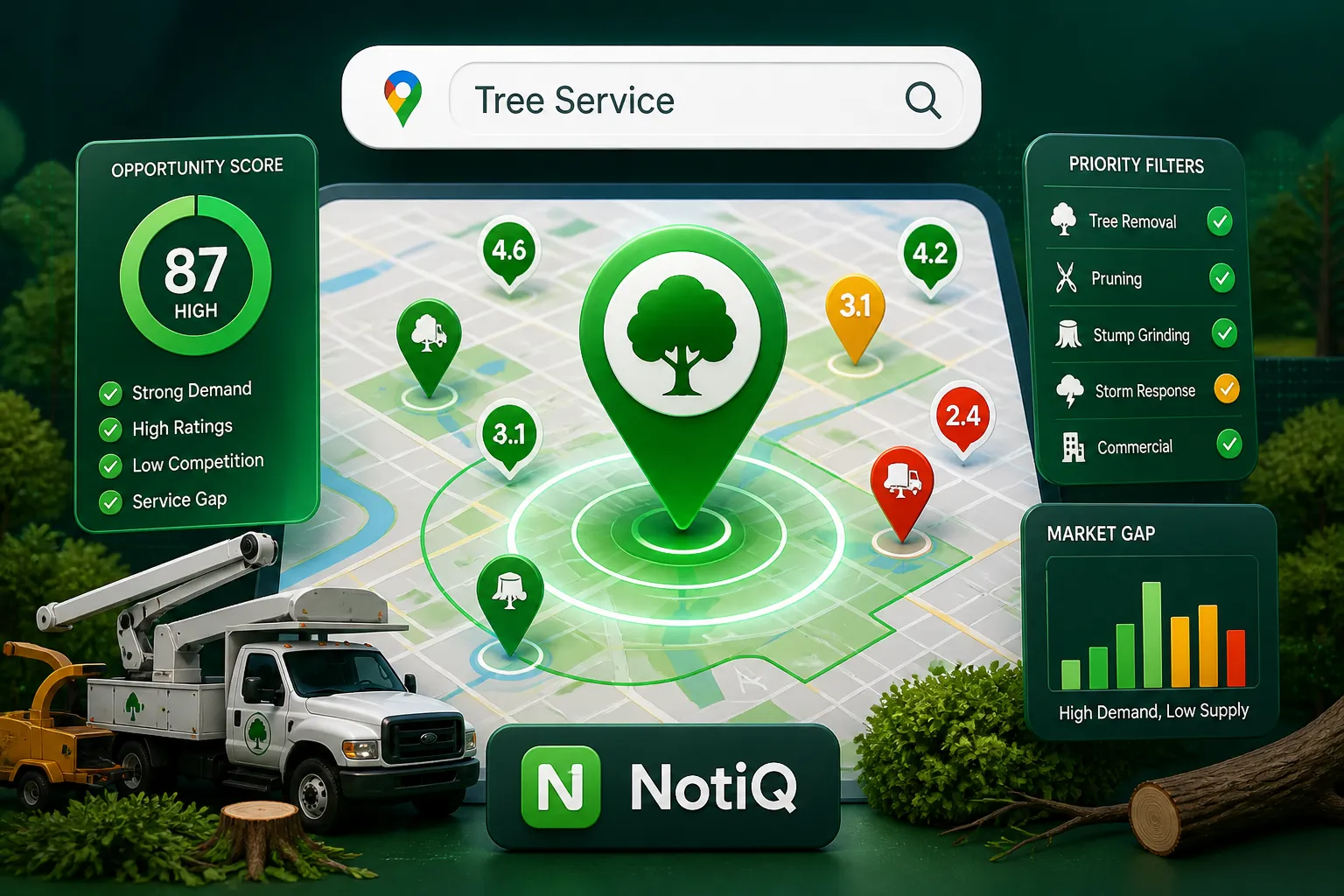
Google Maps Lead Generation for Tree Service Companies
Learn a practical system for finding and qualifying tree service leads on Google Maps. This guide shows how to segment opportunities, follow up compliantly, and turn local research into booked jobs.
1. Introduction
Tree service companies often struggle with inconsistent demand, experiencing intense feast-or-famine cycles throughout the year. Even when homeowners, property managers, and commercial customers are actively searching for tree removal, pruning, stump grinding, and emergency cleanup, capturing that local demand requires a strategic and proactive approach. Relying solely on inbound calls leaves your schedule up to chance.
This guide provides beginners with a practical system for using Google Maps lead generation for tree service companies to find, segment, qualify, and convert highly targeted local opportunities. To build a reliable growth engine, it is crucial to understand the distinct stages of acquisition. A raw Google Maps listing is merely public data. A market opportunity represents a potential gap in a specific territory. A prospect is a relevant organization or property that fits your ideal profile. A qualified lead is a prospect with a verified need and permission to engage. Finally, a booked estimate or job is a profitable commercial outcome.
Rather than treating every local listing as equally valuable, this arborist prospecting framework prioritizes prospects by geography, service specialization, ratings, reviews, market gaps, and business fit. By defining your territory, researching targeted opportunities, scoring prospects accurately, following up compliantly, and measuring profitable outcomes, you can turn local market intelligence into a sustainable revenue stream. At NotiQ, we focus on helping arborists and tree-care companies segment these local opportunities systematically to ensure you spend time only on high-value, relevant prospects.
2. Define Your Territory and Priority Tree-Care Services
Before launching any tree service marketing campaign or researching opportunities on Google Maps, a tree service must strictly define its service area. The profitability of tree work is heavily dictated by logistics. Excessive drive times, fuel costs, and the mobilization of heavy equipment can quickly erode the margins of an otherwise lucrative job.
To maximize efficiency, organize your territory strategically. You can define your ideal service area by specific cities, ZIP codes, target neighborhoods, or a strict travel radius from your equipment yard. Your territory planning should also account for your current crews and available capacity, realistic drive times, equipment requirements, and seasonal or storm-related demand fluctuations.
Service specialization fundamentally changes what an ideal opportunity looks like. You must align your targeting with the specific services you want to provide:
• Tree removal and hazardous-tree work: Requires heavy equipment, cranes, and advanced rigging.
• Tree trimming and pruning: Often routine, recurring maintenance for residential or commercial properties.
• Stump grinding: Can be a standalone service or an add-on to removal.
• Emergency storm cleanup: Requires rapid mobilization and 24/7 availability.
• Utility clearance: Highly specialized, contract-based work near power lines.
• Commercial arborist services: Ongoing maintenance for business parks or retail centers.
• Municipal, HOA, or property-management work: High-volume, recurring contracts requiring extensive credentialing.
When analyzing a territory, look for apparent market gaps. You might notice areas with limited visible specialization, weak service information on competitor profiles, or low review coverage. However, it is vital to remember that map visibility or a competitor’s rating does not prove guaranteed unmet demand; it is only one research signal. Always consult SBA market research guidance when evaluating customer segments, market demand, competitive analysis, and territory planning. Finally, always compare the size of the opportunity with your operational capacity so that your efforts to generate tree care leads and tree removal leads do not result in work your company cannot safely and promptly fulfill.
3. Find and Segment Local Opportunities on Google Maps
Start with Service-and-Location Searches
The foundation of Google Maps lead generation begins with targeted, localized searches. By acting as a customer or commercial partner would, you can uncover exactly who is operating in your target area and where the gaps lie.
Beginner-friendly searches to research your local market include:
• “Tree service near me”
• “Tree removal near me”
• “Tree trimming near me”
• “Emergency tree service near me”
• “Stump grinding near me”
• “Commercial tree service”
• “Arborist near me”
Repeat these searches systematically across your target cities, ZIP codes, neighborhoods, and service categories. It is important to distinguish between the different entities you will uncover. You are not just looking for customers. You are researching competing tree service providers to understand the competitive landscape, identifying potential referral partners (like local landscapers who do not handle large removals), locating commercial account types (such as property management firms), and observing local demand patterns.
Create Service-Specific Prospect Segments
Simply collecting every local listing is an inefficient approach to arborist prospecting. Instead, create separate, highly targeted lists for different types of opportunities:
• Arborists and tree-care companies (for competitive analysis or subcontracting)
• Property managers and HOAs (for recurring commercial maintenance)
• Landscapers and general contractors (for referral partnerships)
• Commercial property owners or managers (for large-scale commercial arborist work)
• Municipal and utility-related opportunities (for government contracts)
• Insurance or storm-response-related referral sources (for emergency tree service leads)
A prospect’s specific category, location, service specialization, and apparent customer base matter far more than raw volume. When building your segments, record the specific evidence that led to their inclusion. Document their service descriptions, recurring themes in their review language, visible specialties (like crane-assisted removal), and exact geographic coverage.
Capture Useful Research Fields Without Treating Data as Permission to Contact
To stay organized, use a structured spreadsheet or CRM to capture your market research. Recommended fields include:
• Business or organization name
• Location and service area
• Relevant service category
• Website and publicly displayed contact route
• Ratings and review volume
• Review themes or service language
• Apparent specialization
• Evidence of fit or market gap
• Research date and source
• Qualification status and next action
Always manually check the accuracy of this data, as local business information can frequently be duplicated, outdated, or incomplete. Understanding Google’s local ranking factors—such as relevance, distance, and prominence—can help you analyze why certain businesses appear where they do. However, do not imply that Google Maps data automatically identifies a customer who currently needs tree work; it only identifies a relevant local entity.
Furthermore, you must strictly adhere to Google Maps usage restrictions. Avoid unauthorized exports, automated data collection, mass downloading, or building unverified telemarketing lists that conflict with platform terms. Use the platform for manual, compliant market intelligence.
4. Score and Qualify Prospects Before Outreach
Use a Simple Tree-Service Lead Scoring Framework
Not all arborist leads are created equal. To avoid wasting time on dead ends, implement a practical scoring model based on available public research signals rather than unsupported assumptions about a prospect's needs.
Evaluate opportunities using these scoring dimensions:
• Geographic fit: Is the opportunity located efficiently inside your target service area?
• Service fit: Does the prospect align with your core offerings, such as removal, trimming, stump grinding, emergency work, or commercial arborist services?
• Reputation and review signals: What do the ratings, review volume, recency, and recurring service themes suggest about the market?
• Specialization: Does the opportunity match your company’s specific equipment, credentials, and experience?
• Capacity and timing: Can your crew respond within the expected timeframe?
• Commercial value: Could this opportunity support recurring revenue or higher-value contract work?
• Evidence quality: Is the information current, accurate, and supported by a reliable public source?
For beginners in local business lead generation and tree service prospecting, avoid overcomplicating this process. Use a simple low-, medium-, or high-priority label to rank prospects rather than attempting to calculate an exact mathematical probability of conversion.
Separate Market Signals from Qualified Leads
A common mistake is assuming that a rating, review, service listing, or geographic location is definitive evidence that a business or customer currently needs tree work. It is not. You must understand the progression of a lead:
• Market signal: A local pattern, gap, or data point worth investigating.
• Prospect: An organization or opportunity that appears highly relevant to your services.
• Qualified lead: A prospect with a confirmed fit, an actual need, correct timing, or explicit permission to continue the conversation.
• Estimate opportunity: A lead that has provided enough information to assess the scope and value of the job.
• Booked job: A confirmed, profitable commercial outcome.
To turn prospects into qualified tree service leads, you must ask legitimate qualification questions during your initial conversations. Ask: What specific type of tree work is needed? Where exactly is the property located? Is the work routine, urgent, seasonal, or storm-related? Who is the final decision-maker that approves the work? Are there specific access limitations, insurance requirements, credential mandates, or strict scheduling needs? Identifying genuine tree care leads and tree service opportunities requires thorough vetting.
Match Qualification to the Service Line
Qualification criteria change drastically depending on the service line. For example:
• Tree removal: Assess the hazard level, property access for heavy machinery, property risk, equipment requirements, and urgency.
• Pruning: Identify the tree species, recurring maintenance schedules, desired aesthetic or health outcomes, and property access.
• Stump grinding: Determine the exact stump location, accessibility for the grinder, root spread, and the client's expectations for debris removal and cleanup.
• Storm cleanup: Verify response speed expectations, safety conditions, access limitations, and verify the scope of the damage.
• Commercial work: Evaluate the size of the property portfolio, specific contract requirements, mandatory insurance minimums, required credentials (like ISA Certification), and expectations for recurring maintenance.
Generic lead-list tools often prioritize sheer record volume over arborist-specific fit. In contrast, NotiQ’s structured segmentation approach ensures you prioritize quality and relevance.Note: Never make safety, insurance, credential, or urgency claims without verification. Always confirm all legal and safety requirements before quoting or scheduling any tree work.
5. Build a Compliant Follow-Up and Conversion Workflow
Verify Information and Choose an Appropriate Contact Path
Market research should be used to identify highly relevant opportunities, not to justify indiscriminate bulk outreach or spam. Before initiating any tree service outreach, verify the details. Confirm the business identity and location, ensure the service relevance is accurate, validate contact details, and check their current website or profile information. Most importantly, verify whether the organization actually accepts vendor, referral, or service inquiries.
When engaging in local business prospecting and arborist marketing, use personalized outreach based on a legitimate, observable business fit rather than sending generic, mass-produced messages.
Follow this straightforward outreach checklist:
• State clearly who is contacting the recipient.
• Explain the relevant, specific service connection.
• Avoid claiming a known need without actual evidence.
• Offer a clear, low-friction next step (e.g., a brief introductory call or sharing a capabilities deck).
• Immediately respect all opt-outs and non-responses.
Always maintain strict compliance with the law. Consult the FTC telemarketing compliance guidance regarding phone calls, Do Not Call registry obligations, caller identification, opt-out mandates, prerecorded messages, and applicable state requirements. Privacy, anti-spam, telemarketing, and platform rules vary significantly by location and channel; it is highly recommended to seek professional legal review before executing high-volume outreach.
Use a Clear Pipeline for Follow-Up
Managing your outreach requires a structured pipeline. Without one, valuable prospects will slip through the cracks. Implement these beginner-friendly pipeline stages for your tree service lead nurturing:
• Researched
• Verified
• Priority assigned
• Contacted through an appropriate channel
• Response received
• Need qualified
• Estimate requested
• Estimate delivered
• Won, lost, deferred, or referred
After every meaningful interaction, immediately record the next action and the date it should occur. Your local lead follow-up should be relevant, contextual, and limited. Do not rely on aggressive, automated, or repetitive sequences that annoy potential commercial partners. To help organize geographically and service-focused prospect research before you even reach the follow-up stage, utilize[Home](/)to streamline your lead qualification workflow.
Connect Prospecting to Inbound Conversion
Outbound market research and prospecting work exponentially better when your company has a highly credible, professional destination for interested prospects to validate you. When you reach out, prospects will look you up.
Improve your inbound conversion assets by optimizing your Google Business Profile for tree services. Ensure your local SEO for tree companies is strong by maintaining absolute accuracy in your business information. Enhance your service descriptions, clearly define your service areas, and showcase high-quality before-and-after project photos. Actively manage your reviews and post professional owner responses. Clearly display your insurance and credential information, provide clear calls to action, and ensure you have a system for fast responses to urgent or emergency requests.
While a strong profile helps prospects validate your company and serves as one of the best tree service marketing ideas, it does not guarantee a higher local ranking on its own. For accurate management of your local presence, refer to Google Business Profile guidance. To align your inbound presence with targeted outbound efforts, explore Home to see how geographic segmentation, review-based prioritization, and service-specialization workflows can align your targeting with your conversion assets.
6. Measure Leads, Booked Jobs, and Profitable Growth
Track the Full Funnel
To ensure profitable tree service growth, you must measure your performance across the entire acquisition funnel. Do not just count leads. Track each stage separately:
• Prospects identified
• Prospects verified
• Appropriate contacts made
• Responses received
• Qualified opportunities
• Estimates delivered
• Booked jobs
• Total revenue
• Gross margin
• Acquisition cost
Relying on tree service lead tracking that only counts raw lead volume is dangerous. Lead count alone can easily hide poor territory fit, abysmal close rates, or fundamentally unprofitable work (like driving two hours for a minor pruning job).
Analyze your lead generation ROI by comparing results across different variables. Compare performance by city or ZIP code, service type (removals vs. grinding), prospect segment (HOAs vs. residential), outreach channel, season or storm period, and crew capacity and response time. For accurate digital measurement of actions originating from your website or marketing channels, review Google Analytics conversion guidance.
Build a Practical Tracking Spreadsheet or CRM
You do not need complex enterprise software to start, but you do need a practical tracking spreadsheet or a tree service CRM. Include the following suggested fields to maintain clean arborist lead management:
• Source and research date
• Location (City/ZIP)
• Service category
• Prospect segment
• Qualification score (Low/Med/High)
• Contact status
• Next action and date
• Response/Feedback
• Estimate amount
• Won/lost status
• Revenue and gross margin
Use this local marketing metrics data to make informed business decisions. Stop investing time and money in low-performing segments, and actively expand into high-fit service areas that yield the best margins. Conduct monthly or seasonal reviews of this data instead of relying on isolated, day-to-day results. For managing response and follow-up workflows after a prospect or inquiry has been identified, tools like Home can be integrated into your process (ensure you confirm current product capabilities before finalizing your tech stack).
7. Google Maps Prospecting Compared With Other Lead Sources
When evaluating the best lead generation for tree companies, it is helpful to compare Google Maps prospecting with other common acquisition channels:
• Google Maps research: High control, outbound intent, excellent for targeted commercial or B2B relationship building.
• Google Business Profile and local SEO: High inbound intent, slower to build, but yields high-quality, exclusive leads.
• Paid search and Local Services Ads (LSAs): High intent, fast results, but requires a continuous budget and high cost visibility.
• Referrals and partnerships: Highest trust and exclusivity, but slower to scale.
• Directories and marketplaces: Variable intent, often shared leads, lower exclusivity.
• Purchased lead programs: Fast volume, but purchased tree service leads are often shared with multiple competitors, driving down margins and control.
Evaluate each channel based on intent, speed to market, control over the targeting, exclusivity of the lead, data quality, cost visibility, and relationship-building potential. Google Maps prospecting is best positioned as a proactive market-intelligence and prioritization process. It is not a complete replacement for gathering reviews, investing in local SEO, nurturing referrals, running targeted advertising, or building strong inbound conversion systems.
Unlike generic scraper tools or database platforms that merely collect records without context, NotiQ provides tree-service-focused segmentation. It scores service fit, territory relevance, review signals, and likely commercial value, ensuring you focus on quality over quantity. Ultimately, channel performance should always be evaluated using your company’s own qualified-lead rate, close rate, revenue, margin, and acquisition-cost data rather than relying on generic industry benchmarks.
8. Conclusion: Turn Local Map Research Into a Repeatable Growth System
Generating consistent demand requires moving away from passive waiting and adopting a proactive, structured approach. By mastering Google Maps lead generation for tree service companies, you can build a repeatable growth system. The workflow requires five disciplined steps: define your territory and priority services, find and segment relevant local opportunities, score and qualify those prospects before outreach, follow up compliantly while connecting prospects to strong conversion assets, and meticulously measure your booked jobs and profitability.
The central lesson of this methodology is that a massive list of raw map listings is far less valuable than a smaller, highly curated set of verified, relevant, and service-specific opportunities. Quality and relevance always outperform sheer volume in arborist prospecting.
If you are new to this process, begin with just one specific territory and one priority service—such as high-margin tree removal, routine pruning, stump grinding, or emergency storm cleanup—before expanding your efforts. Ready to streamline your market intelligence? Explore how[Home](/)can help you organize your local prospecting around precise geography, ratings, reviews, and service specialization to drive sustainable tree service growth.
Note: Always ensure your growth strategies rely on accurate research, respectful outreach, and strict platform compliance. True success in generating tree service leads is measured by real business outcomes, booked jobs, and healthy margins, not by raw lead volume.
Frequently Asked Questions
- How can tree service companies get leads from Google Maps?
- Tree service companies can generate opportunities from Google Maps by defining strict, profitable service areas, researching relevant local searches (like "commercial arborist" or "HOA management"), segmenting the opportunities by service type, verifying the public information, qualifying the business fit, and executing highly relevant, legally compliant follow-up. It is a process of targeted market research rather than bulk data extraction.
- Are Google Maps leads better than purchased tree service leads?
- Google Maps research and purchased tree service leads are entirely different acquisition approaches. Purchased tree care leads offer fast volume but are often non-exclusive and sold to multiple competitors simultaneously, leading to price wars. Google Maps prospecting offers higher control, better targeting, and exclusivity, but requires active research, verification, and compliant follow-up to build relationships. Neither is universally "better"; they serve different strategic purposes.
- How do arborists find new customers by location?
- Arborists find new customers by location by combining proactive map research for targeted commercial and partnership opportunities with strong inbound strategies. This includes optimizing their Google Business Profile, investing in local SEO, building referral networks with local landscapers, utilizing paid local channels, and mining their first-party CRM data to identify neighborhood density for strategic routing. Successful local business lead generation requires a multi-channel approach.
- What information should a tree service collect before contacting a prospect?
- Before initiating tree service marketing outreach, a company should collect and verify the prospect's exact location, service fit, organization type, public evidence of their operations (like website and reviews), the most appropriate public contact route, their qualification status based on your scoring framework, the planned next action, and any applicable legal outreach restrictions (such as Do Not Call registries). Proper tree service prospect qualification prevents spam and protects your brand reputation.
- How can a tree service measure whether Google Maps prospecting is profitable?
- To measure lead generation ROI, a tree service must track the entire funnel beyond just the initial contact. You must measure the number of verified prospects, qualified opportunities generated, estimates delivered, and ultimately, the booked jobs. By tracking total revenue, gross margin, and acquisition cost by specific territories and service types, you can definitively prove whether your tree service lead tracking and prospecting efforts are driving profitable growth.
Continue Reading
More articles you might find useful
How to Build Lead Lists From Businesses Near Universities
Learn how to build cleaner, more targeted lead lists for businesses near universities. This guide covers geography, validation, scoring, and outreach to improve prospect quality.
Read the article →
Google Maps Prospecting for Equipment Rental Companies
Learn how equipment rental companies can turn Google Maps research into qualified local B2B opportunities. This guide covers territory planning, lead qualification, and outreach workflows by city and category.
Read the article →
How to Find Local Businesses Using Free Email Providers
Learn how to find local businesses using Gmail and other free email providers, then validate them with stronger signals before outreach. This guide shows a practical workflow for smarter local lead generation.
Read the article →Popular industry lead playbooks
Maps search examples and niche outreach for the verticals teams prospect most.