Technology
How to Build Lead Lists From Businesses Near Universities
Learn how to build cleaner, more targeted lead lists for businesses near universities. This guide covers geography, validation, scoring, and outreach to improve prospect quality.
1. Introduction
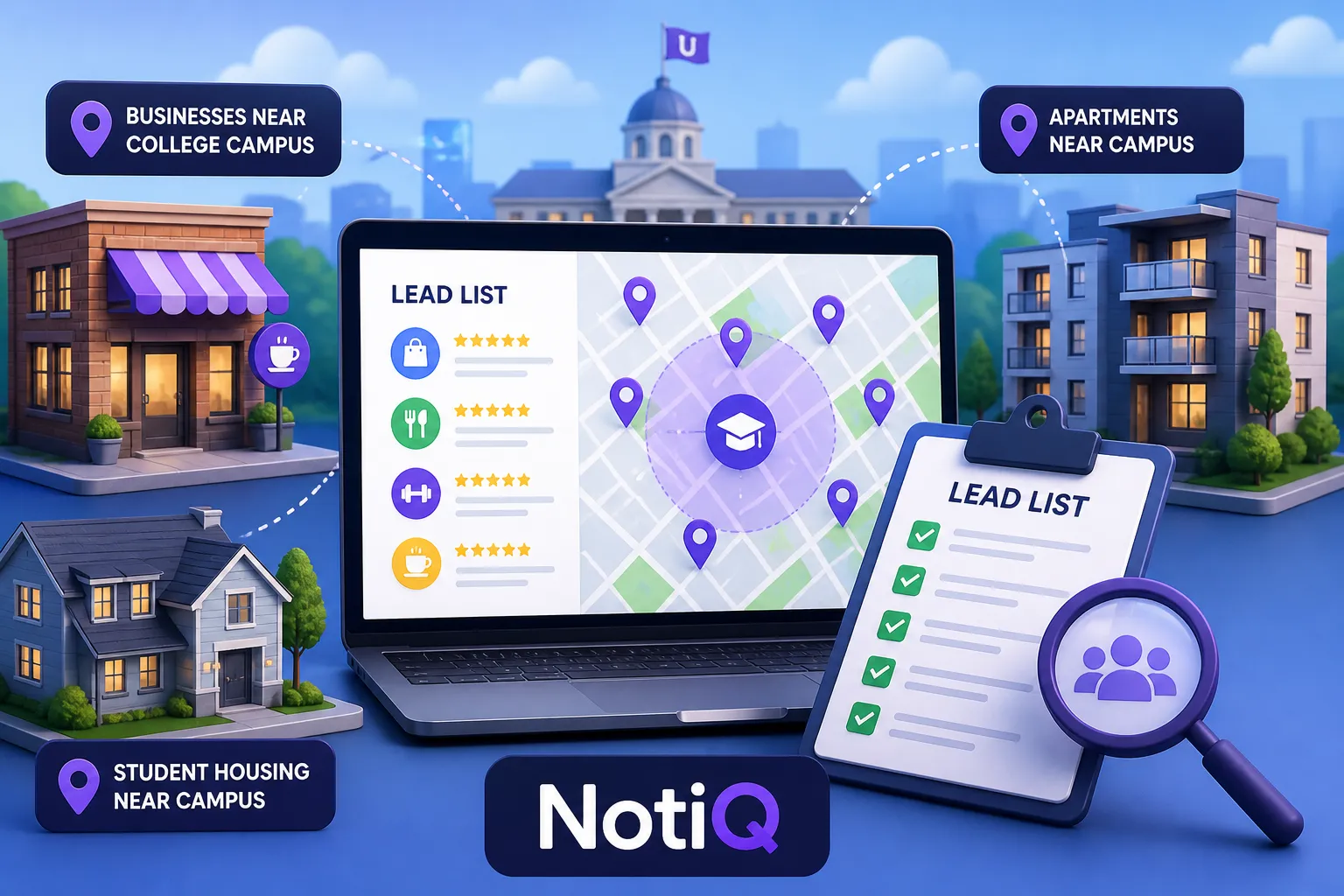
A university-area market is far more than just a campus address. It is a dynamic ecosystem encompassing student housing, commercial corridors, transit routes, nearby residential neighborhoods, and a diverse range of businesses dedicated to serving students, faculty, staff, institutions, and visitors. When executing geographic prospecting, treating a university as a simple point on a map is a missed opportunity.
A simple ZIP-code search or broad map query often produces incomplete, duplicated, outdated, or poorly qualified local-business leads. These raw data pulls fail to distinguish between a campus-integrated café and a disconnected industrial supplier that happens to share the same postal code. To succeed, you need a repeatable geographic prospecting workflow for defining the campus area, discovering businesses, validating records, scoring opportunities, and preparing location-specific outreach.
Designed for intermediate marketers, agencies, researchers, and business-development teams building local lead lists around one or more universities, this guide provides a structured approach to local lead generation. The focus here is on university area business leads and their quality—not merely extracting business listings. By combining geography, audience relevance, business fit, contactability, and human validation, you can build a highly targeted outreach asset. As a practical, location-focused resource, NotiQ helps professionals identify and organize businesses serving students, faculty, institutions, and university-adjacent commercial areas with precision and compliance.
2. Start by Defining the University-Area Geography
The phrase "near a university" can mean drastically different things depending on the campaign, the business category, and the specific audience being targeted. For a late-night pizza delivery service, proximity might mean a tight radius around dormitories. For a corporate catering business targeting faculty events, it might encompass a wider drive-time zone.
To ensure your location-based lead generation remains consistent and comparable, you must establish the geographic boundary before collecting any records. Proximity should be treated as one vital qualification factor, but it is not the sole indicator of lead quality when prospecting businesses near universities. Proper campus-area prospecting requires strategic zoning.
Choose the Right Campus Boundary
There is no single perfect way to draw a campus boundary; you must compare practical boundary methods based on your objectives. Common approaches include:
• A radius measured directly from the geographic campus center.
• Distance calculated from the main entrance or a specific, highly trafficked building.
• Walking-distance zones, which are highly relevant for student-facing businesses.
• Drive-time areas, ideal for transportation, housing, healthcare, and larger commercial services.
• Specific ZIP code, neighborhood, or commercial-district boundaries.
Because university layouts vary wildly—from dense urban grids to sprawling rural campuses—one campus may require multiple zones instead of one universal campus radius. Always record the boundary method and measurement point in your research notes so your commercial areas near colleges can be evaluated accurately later. Capturing university neighborhood businesses requires geographic precision.
Build a Layered Prospecting Area
Rather than using a strict cut-off line, create a three-zone framework to build a layered prospecting area. This allows you to prioritize geographic lead generation effectively:
• Immediate campus zone: Businesses directly adjacent to campus or within a short walking distance.
• University-adjacent zone: Nearby commercial areas, student housing clusters, transit corridors, and mixed-use districts.
• Extended trading area: Businesses that may serve university audiences despite being farther away, capturing a broader campus catchment area.
This framework allows you to rank university-adjacent businesses differently by zone rather than excluding every prospect outside the closest boundary. When deciding whether distance should be measured from a campus center, entrance, or relevant university building, align the measurement with the specific audience your campaign targets.
3. Identify Businesses That Serve University Audiences
To build a high-converting list, you must move beyond targeting "all businesses near campus." Instead, segment prospects according to the audiences and needs they serve. Student demand, faculty and staff needs, institutional relationships, and visitor activity all create distinct prospecting opportunities. Qualifying these audiences prevents your list from becoming a generic local-business database with zero university-specific relevance. Whether you are focused on student population marketing or faculty and staff audience targeting, segmentation is essential for businesses near college campuses.
Student-Facing Business Categories
When targeting student demographic targeting campaigns, focus on student-facing businesses. Relevant categories include:
• Restaurants, cafés, quick-service food, and catering.
• Student housing, moving services, and storage facilities.
• Retail, apparel, electronics, and convenience services.
• Gyms, fitness studios, entertainment, and personal services.
• Clinics, pharmacies, transportation, and tutoring centers.
Look for evidence indicating student relevance, such as location proximity, service type, student-oriented offers, or specific messaging on the business website. Do not assume that every business near universities actively wants student customers; always capture concrete evidence in your qualification notes.
Faculty-, Staff-, and Institution-Facing Prospects
University-area prospecting isn't just about students. You must identify businesses that serve faculty, staff, university departments, visitors, or institutional programs. Relevant prospects include professional services, healthcare, transportation, hospitality, catering, event services, technology providers, and commercial suppliers.
When conducting faculty and staff audience targeting, it is crucial to distinguish consumer-focused opportunities from potential campus marketing partnerships or institutional-sales opportunities. Add a specific field in your database for audience served—categorizing them as students, faculty, staff, institution, visitors, or multiple groups.
Prioritize Business Characteristics Beyond Proximity
Proximity alone should not outrank audience fit and outreach readiness. During local business prospecting, identify additional qualification signals to refine your local business database:
• Independent business versus a national chain or franchise.
• Single location versus multiple locations.
• Clear website and active online presence.
• Relevant products, services, or offers.
• Accessible business contact route.
• Potential to benefit from university-related demand.
Multi-location businesses often present scalable opportunities across multiple campuses or neighborhoods. By factoring in these characteristics, your geographic prospecting yields higher-quality, actionable leads.
4. Build a Complete University-Area Prospect Universe
Creating a reliable prospect universe requires a layered discovery process that combines map research, directories, public business information, company websites, and local market context. No single source should be treated as complete or automatically accurate. Use broad discovery first, followed by structured qualification and validation to generate high-quality local business leads.
Use Maps for Initial Location-Based Discovery
When conducting Google Maps business research, search by both location and business category rather than relying on one generic "businesses near campus" query. Create category-specific map-based prospecting searches for food, housing, healthcare, fitness, retail, transportation, professional services, and entertainment.
During this local business prospecting phase, capture the listing name, category, address, website, phone number, map location, and source date where available. Flag listings that appear duplicated, closed, relocated, or incomplete instead of immediately adding them as qualified leads. This location-first, human-verified process stands in stark contrast to generic scraper tools that collect raw listings without explaining who should be prioritized.
Expand Discovery Through Directories and Local Sources
To find businesses missed in map searches, use directories, chamber listings, campus-adjacent property information, local commercial districts, and company websites. Review and directory platforms can supplement category discovery and reveal positioning or neighborhood demand signals for university neighborhood businesses.
Use public market context to understand commercial density and local business characteristics where the data is available. The U.S. Census Bureau Business Builder is an authoritative public-data resource for understanding local economic and demographic conditions, though coverage and geographic availability may vary. Combining this data with a college town business directory strengthens your local business database.
Use Company Websites for Validation
Company websites are critical for business lead qualification. Confirm that the business is active and that its website, location, services, and contact routes match the initial listing. Look for university-relevant evidence, such as student offers, campus partnerships, delivery areas, institutional services, or location-specific messaging that confirms they are university-adjacent businesses.
Record the exact page or evidence used to support the audience-fit assessment. Crucially, separate a general business contact route from a verified decision-maker, and do not infer a person’s role without supporting evidence during your local business prospecting.
5. Create a Lead-List Schema That Supports Qualification
A practical spreadsheet or CRM structure turns raw business discovery into an outreach-ready local business lead list. Location-based lead generation requires standardized university area business leads to ensure every team member understands the data.
Core Business and Location Fields
To maintain a clean local business database, require core fields such as:
• Business name.
• Business category and subcategory.
• Address.
• University or campus association.
• Geographic zone.
• Distance or proximity method.
• Website.
• Public business phone or contact route.
• Source URL.
• Research or verification date.
Recording the source and date for every record ensures accountability and simplifies future updates. Use consistent formatting for addresses, phone numbers, categories, and university names to streamline your campus-area prospecting efforts for businesses near universities.
Audience, Fit, and Outreach Fields
Distinguish a nearby business from a qualified prospect by adding audience and fit fields:
• Primary audience served.
• Student relevance.
• Faculty or staff relevance.
• Institutional or visitor relevance.
• Relevant service or offer.
• Local ownership or chain status.
• Number of locations, where identifiable.
• Website quality or digital maturity.
• Potential decision-maker or department.
• Suggested outreach angle.
These fields support student population marketing and faculty and staff audience targeting. Always include a qualification evidence field so writers and researchers can document exactly why the prospect was included in the local lead generation campaign.
Data-Quality and Review Fields
A usable lead list should make uncertainty visible rather than presenting incomplete or unverified data as fact. Include status fields such as:
• New.
• Needs verification.
• Duplicate candidate.
• Verified.
• Not relevant.
• Contacted.
• Replied.
• Converted.
Add a field for missing information and a field for the next review date. Standardized statuses make list cleanup, lead list qualification, and campaign reporting significantly easier during geographic prospecting and local business prospecting.
6. Validate, Deduplicate, and Enrich the List
Local businesses frequently require additional review because ownership, locations, hours, websites, and contact details can change rapidly. Turning raw discovery into a reliable working list requires diligent local business data validation. Automation does not eliminate the need for human validation in university-area prospecting and local lead generation.
Remove Duplicates and Resolve Conflicting Records
Match records using a combination of business name, address, phone number, website, and location. Treat businesses with multiple branches as separate locations while linking them to a parent brand where appropriate in your local business database.
Avoid merging businesses that share a name but operate at different addresses or serve different markets. Always record the reason for keeping, merging, or excluding a duplicate candidate to maintain the integrity of your business lead list during map-based prospecting.
Verify Contactability and Business Status
Confirm that the location appears active and that the website or public business contact route is current. Flag closed, relocated, permanently unavailable, or ambiguous listings for manual review.
Separate public business contact information from personal contact details, and avoid adding sensitive information without a clear, appropriate basis. Record the verification date so the university area business leads can be refreshed systematically, ensuring high-quality business lead qualification and local business prospecting.
Use AI and Automation for Repetitive Review Tasks
AI-assisted workflows can help categorize businesses, normalize fields, identify likely duplicates, summarize website evidence, and suggest a preliminary score. However, automated classifications should always be reviewed when the result affects outreach, compliance, or business prioritization. This location-first enrichment workflow is vastly superior to tools that simply export large volumes of unverified map records.
To streamline this,[NotiQ](/)serves as a practical AI workflow orchestrator for organizing location research, enrichment, qualification, and review steps. It is vital to understand the difference between automating repetitive research tasks and outsourcing final human judgment about relevance, accuracy, or compliance in geographic prospecting and local lead enrichment.
7. Score and Prioritize University-Area Prospects
Implementing a transparent lead scoring model prevents the closest businesses from automatically receiving the highest priority. A flexible score—adjusted for campaign objectives and available evidence—optimizes your local business prospecting for university area business leads.
Score Proximity and Geographic Relevance
Assign higher priority to businesses in the immediate campus zone when the offer depends on walking access or campus visibility. Use different proximity standards for walking, driving, delivery, housing, healthcare, and institutional services.
Preserve the original distance or zone rather than reducing geography to a single unexplained score. A business outside the closest zone may still be strategically valuable if it serves a broader university trading area. Commercial areas near colleges require nuanced location-based lead generation, not just a rigid campus radius.
Score Audience Fit and Business Potential
Evaluate whether the business clearly serves students, faculty and staff, university departments, or visitors and university-adjacent workers. Add points for relevant services, multiple locations, local ownership, strong contactability, and evidence of active marketing.
Conversely, deduct or flag records with unclear services, missing contact routes, duplicate listings, or unverified status. Present the score as a prioritization aid—not definitive proof that a prospect will convert. This ensures highly targeted student population marketing, faculty and staff audience targeting, and local B2B prospecting.
Create Priority Tiers
Define practical tiers to help teams begin with a manageable list rather than contacting every business at once:
• Tier 1: Strong geographic relevance, clear audience fit, verified business, and a specific outreach opportunity.
• Tier 2: Relevant business with one or more fields requiring additional research.
• Tier 3: Nearby or potentially relevant business requiring validation before outreach.
Track qualified accounts, valid records, replies, meetings, and conversions by tier to measure the true effectiveness of your lead qualification, geographic prospecting, and local lead generation.
8. Turn the Lead List Into Location-Specific Outreach
Your research fields must directly inform the outreach message. Emphasize practical offers and university-specific relevance instead of generic "we help local businesses grow" messaging. High-quality local B2B prospecting requires tailored student demographic targeting and campus marketing partnerships.
Match the Message to the Business Audience
Tailor your approach to the specific category of businesses near college campuses:
• For restaurants and cafés, focus on student traffic, faculty routines, campus events, delivery, or localized offers.
• For housing, storage, transportation, and moving providers, connect the message to student turnover, seasonal demand, and university-adjacent geography.
• For gyms, clinics, retailers, and entertainment businesses, focus on relevant audience segments and measurable local offers.
• For professional services or institutional suppliers, frame the opportunity around faculty, staff, departments, visitors, or university-related commercial activity.
This targeted approach ensures your student population marketing and campus marketing partnerships resonate deeply.
Use Evidence From the Research Record
Personalize the opening with the business location, relevant service, campus zone, or audience fit identified during research. Avoid claiming that a business has a university partnership or student offer unless the research record unequivocally supports it.
Use the suggested outreach angle field to connect the lead-list data with the first message. Keep the call to action specific, such as reviewing a local campaign idea, discussing a campus-area offer, or assessing a partnership opportunity. This executes location-based lead generation and university-area outreach flawlessly during local business prospecting.
Measure List and Outreach Quality
Track core local lead generation metrics to evaluate lead list quality and geographic prospecting success:
• Percentage of records with valid business contact routes.
• Percentage of verified records.
• Duplicate and outdated-record rate.
• Qualified accounts by category and campus zone.
• Reply, meeting, and conversion rates.
Compare performance by audience segment, business category, geography, and priority tier. Low response rates may indicate weak fit, poor messaging, outdated data, or an unclear offer—not only insufficient volume. For broader practical guidance on prospecting, workflow design, or lead research, visit NotiQ's blog.
9. Choose Between Manual Research, Databases, and Automated Workflows
There are multiple implementation paths for building your list. The right method depends on the number of campuses, list size, enrichment requirements, budget, refresh frequency, and technical resources. There is a massive difference between collecting raw business listings and producing verified, qualified, outreach-ready prospects. Evaluate your alternatives to manually researching businesses carefully to build a reliable local business database through automated lead generation or manual effort.
Manual Maps and Spreadsheet Research
Manual research is recommended for a small number of high-value campuses or an initial market test. Its strengths include direct context, flexible human judgment, and low setup requirements. However, its limitations include slow repetition, inconsistent fields, duplicate records, and difficulty maintaining a refresh cadence. If you choose this route for Google Maps business research, use a strict spreadsheet structure that standardizes manual collection and review to ensure a clean business lead list for local lead generation.
Paid Databases and Enrichment Platforms
Paid databases may improve scale and provide structured fields, but local coverage and freshness still require validation. Compare providers by geographic coverage, business categories, contactability, update practices, export options, and cost. Do not assume that a large dataset is automatically a qualified university-area list; local lead enrichment and geographic prospecting still require careful oversight to build a true local business database.
Automated and AI-Assisted Workflows
Automation adds massive value in repeating location and category searches, normalizing business records, identifying duplicates, categorizing audience fit, flagging missing fields, and preparing records for human review. However, automation should not remove source documentation, verification, or human review.
Unlike raw Google Maps extraction tools that simply dump data, a university-centered process combines location discovery, enrichment, prioritization, and compliance. While tools like Repliq offer broader automated outreach workflows, NotiQ’s location-focused positioning ensures that AI-assisted lead generation and automated location prospecting yield highly accurate university area business leads.
10. Compliance, Responsible Data Collection, and Accuracy
Compliance must be a practical part of the workflow, not an afterthought. Distinguish between publicly visible business information, personal contact data, automated access, storage, outreach, and platform-specific restrictions. Always review applicable laws, platform terms, and internal policies before collecting or using local business data to ensure privacy-aware prospecting and responsible data collection.
Respect Source Terms and Access Rules
Just because a listing is visible online does not automatically grant unrestricted rights to extract, store, redistribute, or reuse all associated content. When utilizing automated access, extraction, storage, or redistribution, you must strictly adhere to the Google Maps Platform Terms of Service.
For official access methods, bulk-download limitations, or permitted implementation approaches, consult the Google Maps Platform FAQ. Use official APIs, approved data sources, or documented workflows to ensure responsible geographic prospecting and complete Google Maps data compliance.
Treat Robots.txt and Public Data Carefully
The robots.txt file communicates crawler-access preferences but should never be treated as a complete substitute for legal, contractual, or privacy review. Understand the technical role and limits of this protocol by reviewing the Robots Exclusion Protocol standard.
For a balanced discussion of publicly accessible data, privacy implications, and legal uncertainty, refer to the Congressional Research Service web-scraping and privacy primer. Always document the source, collection method, verification date, and intended use of each dataset for privacy-aware contact research and web scraping and privacy compliance.
Use Responsible Outreach Practices
Focus strictly on relevant business outreach and public business contact routes. Avoid exposing or unnecessarily storing sensitive personal information. Provide a clear, accurate reason for contacting the business and an appropriate, easy way to decline further communication. Apply all rules relevant to your location, audience, channel, and organization to maintain responsible local outreach, privacy-aware prospecting, and ethical local business lead generation.
11. Refresh the University-Area Lead List
A lead list should be treated as a maintained research asset rather than a one-time export. Refresh frequency should be tied to business volatility, campaign duration, the number of campuses, and the critical importance of current contact information for your university-area lead list, ensuring high-quality local business prospecting and local business data validation.
Establish a Repeatable Refresh Process
Review high-priority records first and recheck lower-priority records according to your campaign needs. Revalidate business status, website, phone number, address, location count, and audience relevance.
Remove or archive records that no longer meet the campaign criteria rather than deleting the audit trail. Keep a strict record of the last verification date and next review date to maintain your local business database and ensure a seamless lead list refresh during geographic prospecting.
Improve the Workflow After Each Campaign
After a campaign, compare which categories, zones, audience segments, and score tiers generated qualified conversations. Update search terms and business categories when the initial prospect universe misses relevant businesses.
Refine the qualification model based on invalid records, replies, meetings, and conversions. Reuse this documented process for additional universities while preserving campus-specific context to elevate your local lead generation strategy, campus-area prospecting, and geographic lead generation.
12. Conclusion: Build a Smaller, Better University-Area Lead List
Building a high-performing lead list around a university requires a strategic, repeatable workflow. You must define the campus geography, segment businesses by audience and category, discover prospects from multiple sources, and standardize the lead-list fields. From there, validate and deduplicate records, score prospects by proximity, fit, and outreach readiness, personalize your outreach, and refresh the data responsibly.
The central takeaway is clear: the value of a university-area lead list comes from qualification and context, not raw business volume. Begin with one campus, a defined set of categories, and a manageable Tier 1 prospect segment.
To structure and automate your university-area prospecting workflows efficiently, explore[NotiQ](/). NotiQ provides a practical, compliant way to organize location-focused research, enrichment, prioritization, and review for businesses serving students, faculty, institutions, and university-adjacent commercial areas, ensuring your geographic prospecting and local lead generation yield the best possible university area business leads.
Frequently Asked Questions
- How do you find businesses near a university?
- To find businesses near a university, define the campus boundary, search maps by specific category and location, expand discovery through local directories and company websites, and meticulously validate each record. A single generic map search will not capture every relevant business or confirm lead quality for businesses near universities.
- What types of businesses operate near college campuses?
- Types of businesses near universities vary by campus geography and commercial environment, but they generally fall into four audience categories: student-facing (housing, food, gyms), faculty- and staff-facing (professional services, childcare), institution-facing (catering, tech suppliers), and visitor- or university-adjacent businesses (hotels, transit).
- What should a university-area lead list include?
- A university lead list should include essential fields: business name, category, address, campus zone, proximity, website, public contact route, audience served, qualification evidence, source, verification date, status, and outreach angle. Source and verification fields are essential for ongoing accuracy in a local business lead list.
- How should businesses near a university be prioritized?
- University-area lead scoring should combine proximity with audience fit, service relevance, business scale, contactability, digital presence, and evidence of university-related demand. Categorizing prospects into Tier 1, Tier 2, and Tier 3 prioritization ensures you focus on the highest-quality local business qualification first.
- How often should a university-area lead list be refreshed?
- The lead list refresh cadence depends on campaign duration, business volatility, source reliability, and the value of current contact information. Track verification dates closely and recheck high-priority records first to ensure consistent local business data validation.
- Can AI automate university-area prospecting?
- Yes, AI geographic prospecting can support categorization, normalization, deduplication, enrichment summaries, scoring, and workflow routing. However, human review is essential for ambiguous businesses, strong claims, privacy-sensitive information, source restrictions, and final outreach decisions in automated local lead generation.
- What is the difference between a university-area lead list and a generic local-business list?
- A university-area prospecting list includes campus geography, audience served, university relevance, proximity context, qualification evidence, and location-specific outreach guidance. The main differentiator in geographic lead generation is actionable context rather than a larger number of raw listings found in generic local business prospecting.
Continue Reading
More articles you might find useful
Google Maps Lead Generation for Tree Service Companies
Learn a practical system for finding and qualifying tree service leads on Google Maps. This guide shows how to segment opportunities, follow up compliantly, and turn local research into booked jobs.
Read the article →
Google Maps Prospecting for Equipment Rental Companies
Learn how equipment rental companies can turn Google Maps research into qualified local B2B opportunities. This guide covers territory planning, lead qualification, and outreach workflows by city and category.
Read the article →
How to Find Local Businesses Using Free Email Providers
Learn how to find local businesses using Gmail and other free email providers, then validate them with stronger signals before outreach. This guide shows a practical workflow for smarter local lead generation.
Read the article →Popular industry lead playbooks
Maps search examples and niche outreach for the verticals teams prospect most.