Technology
Google Maps Prospecting for Water Treatment Companies
A practical guide for water treatment companies using Google Maps to find and qualify better local leads. Learn how to segment residential, commercial, and industrial prospects for more effective outreach.
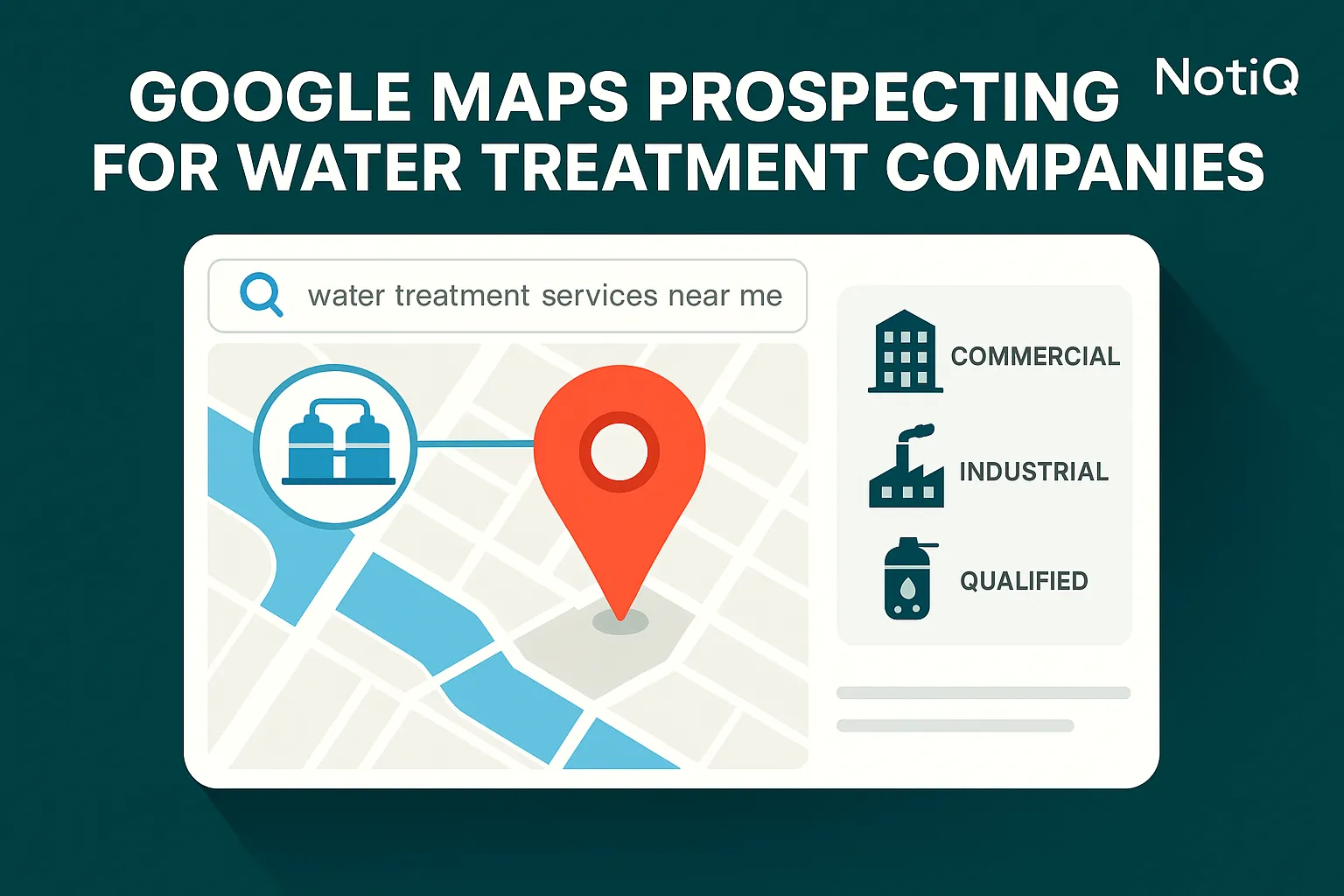
1. Introduction
Many water treatment companies face a frustrating reality: they know significant demand exists in their immediate service area, but their local prospecting efforts remain inconsistent, highly manual, and poorly segmented. Searching for nearby prospects often yields disorganized lists that fail to distinguish between a small residential well-water issue and a massive industrial cooling tower requirement. Because residential, commercial, and industrial buyers have vastly different pain points, budgets, urgency levels, and outreach triggers, treating them as a single audience guarantees low conversion rates.
This article provides a practical blueprint for transforming Google Maps and Google Business Profile data into a repeatable, compliant lead-generation workflow tailored specifically for water treatment and filtration teams. This is not a generic guide on scraping data; rather, it is a highly targeted, water-treatment-specific process for identifying likely needs based on facility type, geography, and operational signals.
Designed for owners, marketers, SDRs, and sales teams with an intermediate understanding of prospecting, this framework will help you build a more technical and structured workflow. At[NotiQ](/), we specialize in turning fragmented local data into structured technical prospecting systems. By mastering Google Maps prospecting for water treatment companies, you can consistently generate high-quality water treatment leads and elevate your overall Google Maps lead generation strategy.
2. Why Google Maps Works for Water Treatment Prospecting
Google Maps and Google Business Profiles act as highly effective top-of-funnel sources for discovering nearby water treatment opportunities, providing context that generic databases simply cannot match.
Google Maps is a strong local discovery layer
Google Maps serves as an unparalleled local discovery layer, allowing teams to find specific businesses and property types within a tightly defined service area. For local service providers, geographic relevance often matters just as much as firmographic fit. Route density, field sales efficiency, and territory planning all rely heavily on location data.
Categories, websites, customer reviews, operating hours, and location context make Maps significantly more useful than a plain list of company names. In the context of water treatment, proximity directly affects installation logistics, emergency maintenance response times, and the overall economics of recurring service contracts. When executing local B2B prospecting, relying on Google Business Profile prospecting ensures your local industrial outreach is both geographically viable and operationally sound.
Why Maps is especially useful for mixed-market water treatment companies
Water treatment firms rarely serve just one type of customer. A single company often handles multiple segments simultaneously, installing softeners for homeowners, maintaining RO systems for restaurants and clinics, and managing complex filtration for manufacturers, property managers, and hospitality groups.
Maps provides an accessible first pass for identifying these varied account types before conducting deeper qualification. It is particularly useful when a sales team needs to build targeted lists by city, county, specific industrial park, or surrounding rural area. By segmenting commercial water treatment leads, industrial water treatment prospects, and residential water filtration leads from the very beginning, teams can align their outreach with the unique realities of their local market.
Where generic prospecting tools fall short without local context
Generic lead databases often provide deep contact information, but they frequently lack the on-the-ground local signals necessary for effective targeting. A database might list a company's revenue and CEO, but it won't tell you if the facility is located in an industrial park with known hard water issues, or if it operates a commercial laundry on-site.
The true advantage lies in combining compliant local discovery with vertical-specific interpretation, rather than relying on one source in isolation. Most standard guides focus entirely on outbound mechanics or data extraction, completely missing the nuances of water-treatment-specific qualification. When sourcing water treatment leads, combining B2B local lead sourcing with the contextual clues found in Maps results in far superior filtration company prospecting.
3. How to Segment Residential, Commercial, and Industrial Accounts
Effective outreach begins with strict segmentation. Failing to separate accounts by type leads to generic messaging that resonates with no one.
Residential accounts: what to look for first
Residential opportunities differ drastically from B2B accounts in terms of urgency, sales cycle length, and qualification criteria. While commercial deals may take months to close, residential sales are often trigger-based and close quickly.
When prospecting, look for residential signals such as rural service areas, regions known for hard water, and properties relying on private wells. Google Maps often surfaces residential opportunities indirectly by highlighting local service-area businesses, community well associations, or rural subdivisions. Geography and the context of the local water source directly dictate the likely treatment needed. For instance, according to CDC guidance on private well water, properties on private water systems have unique testing, filtration, and purification requirements compared to those on municipal supplies. Targeting these areas yields highly qualified residential water filtration leads and water filtration leads through strategic local SEO prospecting.
Commercial accounts: the middle ground with broad opportunity
Commercial targets represent a lucrative middle ground and include restaurants, hotels, laundries, office complexes, schools, healthcare clinics, gyms, and multi-site property managers. These accounts are driven by the need for equipment protection, customer experience enhancement, maintenance reduction, and water quality consistency.
Commercial targets are often the easiest to identify on Maps because their Google Business Profiles are typically robust and well-maintained. Grouping commercial prospects by vertical—such as separating hospitality from healthcare—allows sales teams to tailor their messaging to specific operational pain points. Properly segmented commercial water treatment leads sourced through Google Business Profile prospecting form the backbone of a reliable facility maintenance prospecting pipeline.
Industrial accounts: fewer in number, higher qualification value
Industrial outreach requires a much deeper level of validation because the stakes, system complexity, and sales cycles are significantly larger. Look for industrial-adjacent profiles that imply high treatment demand: manufacturing plants, food and beverage processing facilities, laboratories, and clustered industrial parks.
Industrial buyers rarely respond to generic filtration language; they care about regulatory compliance, system uptime, process reliability, and water-use efficiency. While some industrial prospects may not explicitly mention water systems on their profile, adjacent clues—like the presence of cooling towers or heavy manufacturing—are critical indicators. As noted by EPA industrial facility water uses, cooling, heating, processing, and sanitation demand distinct and intensive water management strategies. Understanding this helps generate high-value industrial water treatment prospects, streamlines local industrial outreach, and positions your firm to offer critical water quality compliance solutions.
Build segment-first lists before outreach
Before initiating any outreach, create three distinct pipelines or tags: residential, commercial, and industrial. This segmentation prevents generic, one-size-fits-all messaging and drastically improves lead scoring and sales rep assignment.
Further refine these lists by adding sub-tags based on niche, such as hospitality, healthcare, foodservice, property management, manufacturing, and rural/private-well areas. Major water treatment brands organize their market messaging by end-use, and adopting this framework will elevate your filtration company prospecting, yield better water treatment leads, and structure a highly effective industrial outreach strategy.
4. Business Profile Signals That Indicate Water Treatment Need
Interpreting publicly accessible Google Business Profile data and surrounding context is key to identifying facilities with a high likelihood of needing treatment services.
Category signals and business type clues
Primary and secondary business categories offer the first estimate of likely water demand. High-potential categories include healthcare facilities, hospitality (hotels/resorts), food service, laboratories, property management, and manufacturing-related businesses.
However, categories are only the starting point. They must be cross-referenced with website data and review context to confirm the need. Relying on Google Business Profile prospecting to identify these categories helps seamlessly generate commercial water treatment leads and industrial water treatment prospects.
Reviews, photos, and website language as qualification signals
Customer reviews often reveal hidden clues about water quality. Mentions of hard water stains, poorly maintained pools, or complaints about cleanliness in a hotel can signal a need for better water management. Photos can hint at facility size, infrastructure complexity, and whether the location is heavily industrialized.
Examine the prospect's website for language tied to boilers, cooling towers, processing, sanitation, commercial laundry, food prep, or purification compliance. A profile moves from a "possible" fit to a "high-fit" lead when these signals align. For example, a restaurant complaining about failing dishwashers is a prime target. Catching these signals yields highly qualified water treatment leads, improves facility maintenance prospecting, and optimizes B2B local lead sourcing.
Nearby-location context and industrial clustering
A target listing's surrounding businesses can be just as informative as the listing itself. Being located in a dense industrial corridor, a sprawling medical cluster, a hospitality zone, or a rural private-well region fundamentally changes how a prospect should be scored.
Check if nearby businesses share infrastructure or exhibit similar water usage patterns. Geographic and municipal water boundaries also play a role; understanding EPA public water system service areas can help you identify regions with known municipal water challenges. This geographic awareness refines local industrial outreach, tightens your industrial outreach strategy, and elevates local B2B prospecting.
Operational signals that often imply stronger treatment demand
The strongest outreach is built around operational outcomes. Look for practical indicators such as the presence of boilers, cooling systems, laundry operations, sanitation-heavy processes, food production, guest-facing water usage, or medical water-management concerns.
For example, healthcare and institutional facilities have stringent requirements for water safety. Referencing resources like the CDC Legionella water management toolkit can help you understand the compliance pressures these facilities face. Addressing equipment protection, uptime, and compliance is a major differentiator, allowing you to provide targeted water quality compliance solutions, offer relevant commercial water treatment services, and secure high-value industrial water treatment prospects.
5. How to Qualify and Prioritize Local Prospects
Once you have identified potential targets, you must qualify and prioritize them to ensure your sales team is spending time on the most profitable opportunities.
Start with geography and service-area fit
The very first filter must be geography: is the account inside a profitable, serviceable radius? Prioritize leads based on route efficiency, technician availability, territory ownership, and distance from existing customer clusters. Local density is a massive advantage; a group of smaller accounts clustered tightly together can be more profitable than one large account located hours away. This geographic focus is the foundation of effective local SEO prospecting, B2B local lead sourcing, and acquiring viable water treatment leads.
Score by facility type and likely water intensity
Implement a simple scoring model based on the segment, category, site complexity, and likely water usage intensity. A rural residential home, a suburban dental clinic, a downtown hotel, and a regional bottling plant will all score differently.
It is important to note that higher water intensity does not automatically mean higher priority; fit depends heavily on your specific service offerings and sales motion. Understanding USGS water use by sector can help establish baselines for how different industries consume water, allowing you to accurately prioritize industrial water treatment prospects and commercial water treatment leads based on water use by sector.
Validate need using website and account context
Before reaching out, perform a second-pass validation by checking the prospect’s website for equipment references, industry certifications, operational complexity, and regulated environments. This step drastically reduces wasted outreach to low-fit accounts. Add notes to the CRM regarding likely pain points: scale buildup, corrosion, guest satisfaction, sanitation requirements, process stability, or regulatory compliance. This thorough validation process enhances filtration company prospecting, streamlines account enrichment, and ensures rigorous lead qualification.
Match outreach messaging to the segment
Messaging must be strictly aligned with the segment:
• Residential: Focus on water quality, taste, safety testing, and well-water concerns. (e.g., "We help rural homeowners in [County] eliminate hard water scale and ensure their private well water is safe for their families.")
• Commercial: Emphasize equipment lifespan, maintenance reduction, and customer-facing outcomes. (e.g., "We help local restaurants protect their commercial espresso machines and dishwashers from scale, reducing emergency maintenance by 40%.")
• Industrial: Focus on uptime, process reliability, and compliance-oriented outcomes. (e.g., "We ensure local processing plants maintain boiler efficiency and meet strict wastewater compliance standards without operational downtime.")
Tailoring these messages ensures high response rates across your industrial outreach strategy, commercial water treatment services, and residential water filtration leads.
Build a repeatable SOP for teams
To solve the core pain point of fragmented prospecting, build a repeatable Standard Operating Procedure (SOP): search locally, segment by type, inspect profile signals, validate the need, score the fit, and route to outreach. Creating a lightweight checklist based on these steps provides an excellent sales enablement asset. For teams looking to productize and automate these repeatable scoring, enrichment, and routing systems,NotiQ offers workflows that ensure Google Maps lead generation consistently yields high-quality water treatment leads through a structured prospecting workflow.
6. When to Combine Manual Maps Research With Enrichment
Knowing when to rely on manual research and when to introduce automated enrichment tools is critical for scaling your sales efforts efficiently and compliantly.
When manual Google Maps research is enough
Manual prospecting is highly effective for tight territories, niche local campaigns, early-stage list building, and owner-led sales efforts. If your goal is to build a short, highly targeted list of perfect-fit accounts, manually inspecting publicly accessible profiles and websites will often outperform broad database pulls. In specialized verticals like water treatment, the depth of human interpretation—noticing a specific type of cooling tower in a site photo—often matters more than raw lead volume. This targeted approach is the essence of effective Google Maps prospecting for water treatment companies, manual qualification, and local B2B prospecting.
When enrichment becomes necessary
Enrichment becomes necessary when teams need to scale contact discovery, map multi-location ownership hierarchies, validate firmographics across hundreds of accounts, or execute higher-volume outbound campaigns. Maps provides the initial local discovery, while enrichment tools append the necessary contact data and workflow scalability. Broad prospecting platforms should not be the starting point for niche local discovery, but they are vital for account enrichment, lead list building, and sales outreach preparation once the target is identified.
A hybrid workflow for modern water treatment prospecting
The most effective modern workflow is hybrid: start with Maps for local discovery, segment the accounts, qualify based on operational fit, andthenuse enrichment tools to find contact information before executing outreach. This local-discovery-first approach differentiates your process from generic top-down prospecting that begins with massive, contextless databases. By combining compliant Google Maps lead generation with targeted filtration company prospecting, you optimize your B2B local lead sourcing.
Positioning NotiQ in the workflow
[NotiQ](/)serves as the orchestration layer that turns this fragmented manual prospecting into a structured, compliant system. The value lies not merely in data extraction, but in seamlessly segmenting, enriching, scoring, and operationalizing outreach for mixed residential, commercial, and industrial pipelines. For teams looking to scale their sales intelligence and outbound execution after qualification, integrating with platforms like Scaliq ensures that your AI-assisted local prospecting and workflow automation consistently deliver qualified water treatment leads.
7. Future Trends in AI-Assisted Local Prospecting
As technology evolves, the way water treatment companies find and engage local leads will shift toward deeper integration and higher personalization.
More teams will combine local intent data with enrichment
The trend is moving rapidly toward pairing Maps and GBP signals with deep account research, rather than relying on either source in isolation. This combination allows for precise territory planning and highly personalized field sales and SDR workflows. AI-assisted local prospecting will increasingly rely on this synthesis, making Google Business Profile prospecting and account enrichment inseparable steps in the modern sales playbook.
Vertical-specific qualification will outperform generic list building
Niche sectors like water treatment benefit immensely from interpreting operational clues rather than just exporting names and phone numbers. Segment-aware workflows that identify specific facility needs will consistently beat broad, generic outreach in both response rates and overall sales efficiency. Generating high-quality water treatment leads requires a tailored industrial outreach strategy and a nuanced approach to commercial water treatment leads.
Compliance and operational messaging will become more important
Commercial and industrial buyers increasingly prioritize reliability, strict water management protocols, system uptime, and compliance-oriented outcomes. Messaging strategies must evolve to directly address the regulatory pressures faced by healthcare, hospitality, and industrial processing facilities. As highlighted by the EPA and CDC guidelines, providing robust water quality compliance solutions will be the primary driver for acquiring industrial water treatment prospects and improving overall facility performance.
8. Conclusion
Google Maps is a highly effective lead source for water treatment companies, provided it is used within a segment-first, qualification-driven workflow. By discovering leads locally, separating them into residential, commercial, and industrial buckets, interpreting public profile signals, validating operational needs, and enriching data only when scale requires it, you can build a highly profitable sales pipeline.
This approach is vastly more actionable than generic lead-generation advice because it ties compliant, ethical prospecting directly to water-treatment-specific operational realities. Stop relying on unsegmented, generic lists. Build a structured workflow today to master Google Maps prospecting for water treatment companies, secure better water treatment leads, and dominate your local filtration company prospecting efforts.
Note:[NotiQ](/)specializes in providing the technical infrastructure and structured workflows required to execute niche segmentation and compliant local prospecting at scale.
Frequently Asked Questions
- How can water treatment companies use Google Maps to find leads?
- Water treatment companies can use Google Maps by searching for local categories within specific geographies, inspecting public business profiles, segmenting prospects by service type (residential, commercial, industrial), and qualifying them using website data and operational clues. This compliant process ensures highly targeted Google Maps lead generation and a steady flow of water treatment leads.
- What businesses are the best commercial or industrial targets for water treatment prospecting?
- The best targets include hospitality (hotels/resorts), healthcare facilities, food service, manufacturing plants, laboratories, commercial laundries, and property management companies. The ideal target always depends on your specific service offerings and local territory density, which dictates the quality of your commercial water treatment leads and industrial water treatment prospects.
- How do you separate residential, commercial, and industrial accounts from listing data?
- Separation requires a practical breakdown using business categories, website language, facility photos, service area maps, and nearby-business context. Crucially, this segmentation must happenbeforeany outreach occurs to ensure messaging is accurate for residential water filtration leads and effective for Google Business Profile prospecting.
- What profile signals suggest a company may need filtration or treatment services?
- Strong signals include equipment-heavy operations, commercial food prep, healthcare environments, guest-facing water use (like pools or spas), industrial process facilities, boilers, cooling towers, and maintenance-related complaints found in public reviews or site copy. Spotting these clues optimizes filtration company prospecting and positions you to offer timely water quality compliance solutions.
- When should a team move from manual Maps research to enrichment tools?
- Manual research is perfect for building small, high-fit local lists and early-stage territory mapping. A team should move to enrichment tools when they need to scale contact discovery, validate firmographics across hundreds of accounts, prioritize large datasets, or execute multi-location outreach campaigns. This hybrid approach maximizes the ROI of account enrichment and B2B local lead sourcing.
Continue Reading
More articles you might find useful
How to Find Local Businesses With Very Few Website Pages
Learn how to find local businesses with very few website pages using a repeatable audit framework. This guide shows how to validate page count, spot missing pages, and prioritize the best outreach opportunities.
Read the article →
Google Maps Lead Generation for Window and Door Installers
Learn how window and door installers can use Google Maps to find, qualify, and prioritize better local prospects. This beginner-friendly guide shows a repeatable workflow for smarter local outreach.
Read the article →
How to Prioritize Businesses With Verified Google Profiles
A practical framework for ranking local leads beyond the verified badge. Learn how to prioritize Google Business Profiles using fit, freshness, completeness, and activity signals.
Read the article →Popular industry lead playbooks
Maps search examples and niche outreach for the verticals teams prospect most.