Technology
How to Find Local Businesses With No Recent Customer Reviews
Learn a practical framework for spotting businesses with stale Google reviews and turning review inactivity into higher-quality reputation management leads. This guide shows how to audit, score, and prioritize local prospects.
1. Introduction
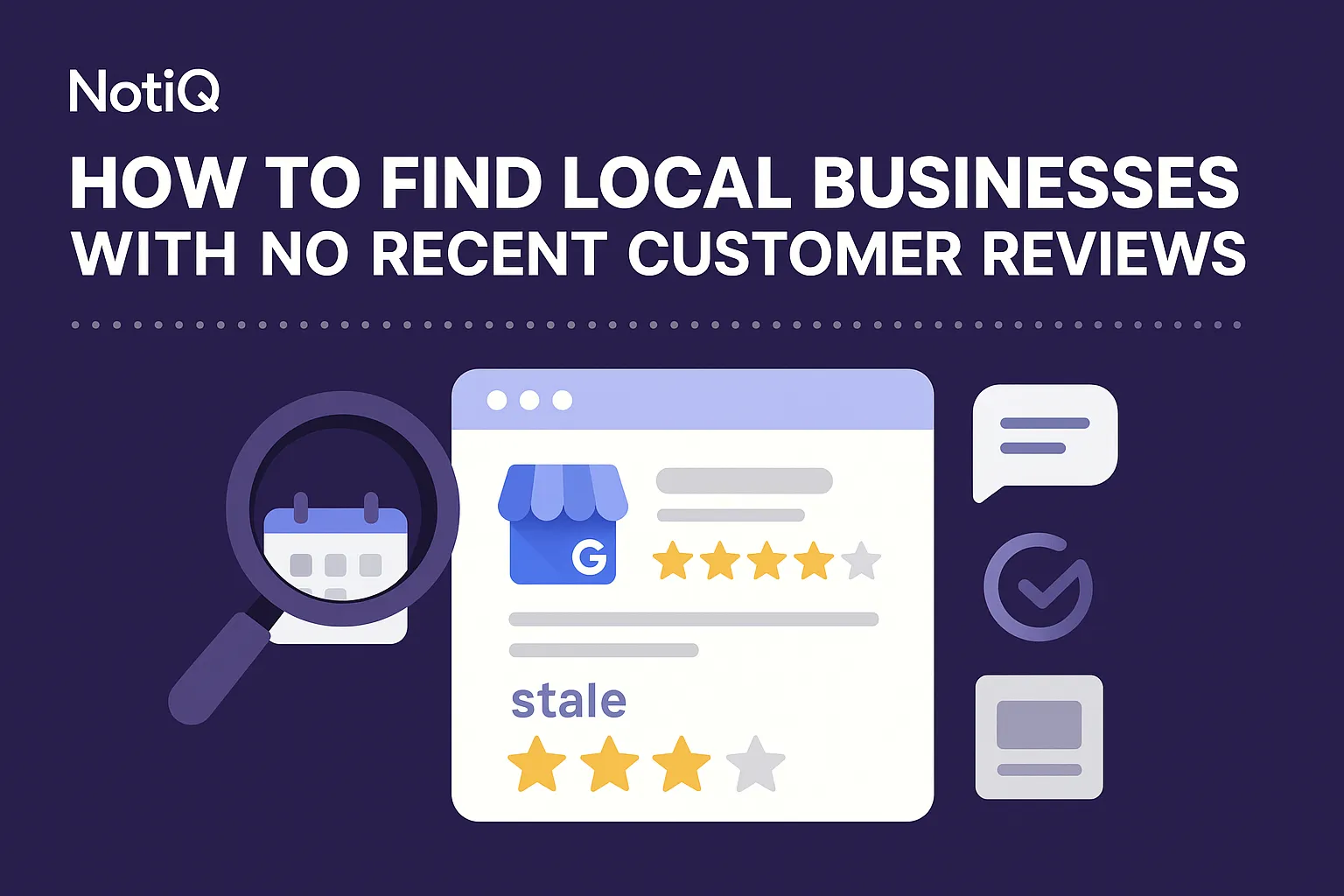
Many local businesses still boast solid star ratings, but a closer look reveals that their latest review may be 6, 9, or even 12 months old. That gap is remarkably easy to miss—and that is exactly why it creates a strong, untapped prospecting opportunity.
Stale Google reviews can quietly weaken consumer trust, reduce click confidence, and signal dormant reputation activity. Yet, most industry content only teaches businesses how to get more reviewsafterthe issue has become an obvious crisis. For agencies, consultants, and local growth operators, this presents a unique advantage: the ability to uncover warmer leads before competitors even realize there is a problem.
This article serves as an audit-driven guide to building a repeatable prospecting motion. You will learn how to define review inactivity windows, find businesses with no recent customer reviews, score them using additional trust signals, and turn your findings into smarter, consultative outreach. At NotiQ, we believe that identifying review inactivity windows and leading with an audit-first approach is the most practical differentiator in local prospecting today. For more strategies on this approach, readers can explore more audit-driven local growth articles here:Blog.
2. Why Review Inactivity Matters for Trust and Local Visibility
Review recency is not just a vanity metric; it is a highly visible trust signal that actively shapes local search perception and buying behavior. A business may have a historically high star rating, but a lack of active review momentum suggests a decline in current service quality or customer engagement.
For local growth operators, targeting "no recent reviews businesses" is often far more actionable than simply looking for a "low review count." A business with zero reviews knows they have a problem. A business with 150 reviews and a 4.8 rating may falsely believe their reputation is secure, even if they haven't received a new review in a year.
Review inactivity directly impacts local visibility and buyer confidence. When combined with low response activity or incomplete profiles, stale Google reviews represent significant missed reputation growth opportunities. According to Google local ranking factors, managing and responding to reviews forms a critical part of a business's overall prominence. While review recency is just one piece of the puzzle and does not guarantee specific rankings, it is an undeniable indicator of trust that aligns with Google’s broader guidance on maintaining an active, engaging presence.
Review recency vs. star rating
A 4.8 rating built entirely on outdated reviews may not convert as effectively as a 4.6 rating backed by steady, recent activity. Modern buyers are savvy; they often scan the latest reviews first to ensure the business is still operating at a high standard, rather than just trusting the average score. This highlights the stark difference between a "historic reputation" and "current reputation momentum." Businesses with outdated reviews risk losing clicks to competitors who actively showcase fresh customer experiences.
Why this matters for agencies and consultants
For agencies, this trust issue translates directly into a valuable service opportunity. Dormant reviews typically indicate weak follow-up systems, the absence of a structured review generation process, or a completely unmanaged reputation. Identifying review inactivity windows acts as a discovery-stage trigger, opening the door for a consultative sales conversation. Unlike generic local lists that lack urgency or contextual evidence, finding reputation management leads through targeted review gaps provides a clear, undeniable reason for outreach.
3. How to Define a Review Inactivity Window by Industry
To effectively prospect, you must first answer a critical question: "What counts as a recent review for local businesses?" There is no universal rule. Acceptable review recency varies significantly based on the niche, customer volume, and purchase frequency.
Setting a practical threshold requires categorizing businesses by their operational cadence—comparing a high-frequency retail shop against a slower-cycle B2B service. Instead of applying a rigid timeline, it is more effective to compare businesses against category norms within the same city or market. Evaluating "low review velocity" or "review decay" provides a much more accurate benchmark than a single fixed number.
A simple way to set thresholds by niche
To streamline your audits, group prospects into industry buckets such as hospitality, dental, legal, home services, healthcare, and multi-location SMBs. High-traffic categories, like coffee shops or urgent care clinics, require much tighter recency windows—a gap of 30 days might be alarming. Conversely, lower-frequency services, such as roofing or estate planning, may easily tolerate gaps of 90 to 120 days. These thresholds should be treated as audit benchmarks to test in your market, revealing the best review generation opportunities by industry.
Signals that a review gap is “normal” vs. risky
To avoid false positives, always cross-reference a review gap with the business's historical review volume, seasonality, and specific service type. A three-month gap for a boutique landscaping company in the middle of winter is normal; the same gap for a bustling downtown restaurant is a major red flag. Look for sudden slowdowns and low review velocity rather than just total inactivity. Businesses with outdated reviews that previously had a steady stream of feedback are your prime targets.
Multi-location nuance
Multi-location businesses must be evaluated at the location level, not the brand level. A regional franchise might have a stellar overarching reputation, but individual storefronts could be suffering from severe Google Business Profile review gaps. Inconsistent review activity across locations is a powerful prioritization signal, revealing operational blind spots where some managers are actively driving reviews while others are neglecting the pipeline.
4. How to Find and Segment Review-Inactive Businesses
Understanding the theory is only half the battle; executing a practical, repeatable workflow is how you actually uncover these businesses in the field. By utilizing Google Business Profile signals, niche filters, geographic constraints, and structured audit logs, you can systematically build highly targeted lists.
The goal is to move beyond a one-off search and establish a scalable local prospecting motion. When scaling these audits programmatically, leveraging compliant, publicly accessible data structures like the Google Business Profile review data API can streamline the extraction of review dates and counts. To operationalize review inactivity detection and make audit-first prospecting seamless, you can explore NotiQ's platform here:[Home](/).
Step 1 — Choose a niche and geography
Start with one specific category and one metro or city cluster to keep your audit manageable and your data clean. Target niches that rely heavily on visible trust but exhibit uneven review freshness. By locking in a category and city—such as "plumbers in Austin, TX"—you create accurate local benchmarks, making it easier to spot the outliers and find SMBs with stale online reviews.
Step 2 — Log last-review date and recent review count
Capture each business’s last visible review date and the total number of reviews generated within your defined recent window (e.g., the last 90 days). This simple data collection creates a highly practical "review recency lead list." Before investing in complex tooling, validate this process using a simple spreadsheet to understand the manual mechanics of review monitoring.
Step 3 — Segment by inactivity tier
Group your prospects into distinct tiers: mild slowdown, high-risk inactivity, and fully dormant review activity. Segmentation ensures that your outreach is highly relevant and allows your agency to prioritize its scarce sales efforts on the most urgent reputation management leads. Label every prospect by industry, city, and inactivity tier to keep your campaigns organized.
Step 4 — Separate single-location from multi-location opportunities
Chains and franchise groups require an entirely different outreach strategy than independent SMBs. When multi-location SMBs show stale profiles at only specific branches, it points to broader operational and compliance gaps rather than just a marketing issue. Flagging inconsistent review activity across locations provides a highly strategic, enterprise-level angle for your outreach.
5. How to Qualify Leads Beyond the Last Review Date
The last review date is merely the starting point of your discovery process—it is not the complete qualification model. To prevent shallow prospecting and separate real opportunities from weak lists, you must evaluate a broader set of signals.
By scoring prospects based on review velocity, owner response rates, profile completeness, and rating stability, you generate significantly warmer, more credible reputation management leads. Unlike typical manual scraper-style lists that only surface contact data, this richer qualification model—supported by Business Profile performance insights—highlights the exact operational gaps you can solve.
Signal 1 — Review velocity and momentum loss
Evaluate the current flow of reviews against the business's historical volume. A business that generated 50 reviews last year but only two in the last six months is suffering from low review velocity. These businesses—those with a strong historical base but recent stagnation—are exceptionally good prospects because they already understand the value of reviews; they have just lost their system for acquiring them.
Signal 2 — Owner response behavior
Unresponded reviews or massive gaps in response times strongly suggest that a profile is under-managed. Owner response rate reviews indicate internal process maturity; if a business isn't replying to feedback, they likely aren't asking for it either. Consistent with Google local ranking factors, review management and response activity contribute to a business's prominence, making this a critical metric to log alongside the last review date.
Signal 3 — Profile completeness and trust friction
Assess whether the Google Business Profile appears thin, outdated, or incomplete. Missing business hours, lack of services, or absent photos compound the trust decay created by stale review activity. An incomplete Google Business Profile provides a higher-conviction outreach angle, allowing you to pitch a comprehensive local SEO and profile optimization package rather than just a review generation tool.
Signal 4 — Stable rating, weak freshness
Look for the "hidden opportunity" pattern: a business with a solid 4.5+ star rating, but absolutely no current review momentum. This scenario is often much easier to sell than a negative review cleanup campaign because the business owner is not on the defensive. They are simply dormant. Positioning this as a proactive growth and trust initiative makes for a highly receptive conversation.
A simple lead-scoring model
Create a lightweight scoring worksheet rather than a rigid algorithm. Score leads based on:
• Last review date
• Number of reviews in the last 90 days
• Owner response rate
• Profile completeness
• Single-location vs. multi-location complexity
Assign prospects to tiers such as "monitor," "good fit," and "high-priority outreach" to ensure your google business profile review recency leads translate into efficient sales activity.
6. How to Turn Audit Findings Into Better Outreach
Transforming audit data into relevant, consultative outreach is where you win the business. Evidence-based messaging converts exponentially better than generic "we help local businesses get reviews" spam.
By mapping your specific audit findings to tailored outreach angles, you prove to the prospect that you have actually researched their business. Whether highlighting trust decay, unmanaged responses, or dormant momentum, always lead with objective observations rather than fear tactics. To ensure your personalized outreach execution is seamless and automated, consider integrating a specialized workflow solution like Home.
Outreach angle 1 — Trust decay
Frame stale Google reviews as a visible credibility issue. Often, business owners haven't even noticed the gap themselves. Use non-alarmist language focused on missed opportunities. A strong opening might be: "Your profile still looks strong historically, but your recent social proof appears to have slowed down over the last eight months." This positions you as an observant advisor bringing valuable reputation management leads to their attention.
Outreach angle 2 — Dormant reputation momentum
For businesses with excellent historical reviews but low review velocity today, frame your offer around restarting their flow rather than fixing a crisis. Explain that they haven't suffered brand damage; they have simply paused their momentum. This angle is highly effective for reputation management prospects with strong operational foundations but weak marketing consistency.
Outreach angle 3 — Unmanaged response behavior
If your audit reveals a poor owner response rate to reviews, use this to pivot into a broader profile-management conversation. This angle is particularly potent when a business has a decent review count but terrible engagement signals. Cite specific, unresponded reviews from your audit to deeply personalize the outreach and demonstrate the immediate need for better review monitoring.
Outreach angle 4 — Multi-location inconsistency
For multi-location SMBs, uneven review freshness across different storefronts creates a compelling business case. Frame location-level inconsistency as an operational and brand experience issue. Present one or two specific example locations where Google Business Profile review gaps are most obvious, rather than overwhelming the prospect with data on their entire portfolio.
Compliance and ethical guardrails
When executing outreach and proposing solutions, strict adherence to platform and legal guidelines is non-negotiable. Ensure your recommendations align with Google review best practices and FTC guidance on soliciting reviews. Never recommend fake reviews, review gating, or incentivized reviews that violate regulatory guidance. Ethical outreach builds long-term trust and protects both your agency and your client's digital footprint.
7. Tools, Workflow Options, and Scale Considerations
As your prospecting efforts grow, you must decide when a manual workflow is sufficient and when software-assisted automation becomes necessary. The best workflows balance precision, speed, and operational scale, seamlessly combining discovery, qualification, and outreach preparation.
Unlike competitor ecosystems that focus heavily on post-discovery review generation and reputation operations, a true audit-first approach prioritizes thediscoveryof the problem. Leveraging AI enrichment, verification, and compliance-oriented auditing allows agencies to identify reputation management leads at scale without relying on blind contact scraping.
When manual prospecting still works
Manual prospecting is time-consuming, but it is highly effective when you are first testing a new niche, validating inactivity thresholds, or targeting a very specific, small local market. Getting your hands dirty with manual audits helps you build vital pattern recognition, allowing you to accurately spot what a stale profile looks like before attempting to automate the process.
When to move to a repeatable system
The signals that it is time to scale are clear: targeting multiple cities, expanding across many categories, pursuing complex multi-location targets, or running recurring outbound campaigns. At this stage, relying on structured review data and standardized scoring becomes critical. Manual review monitoring simply cannot keep pace with the volume required for a high-functioning sales pipeline.
What a strong workflow should include
A robust, scalable workflow must surface actionable context, not just raw lists of names and numbers. It should seamlessly integrate:
• Niche and geo segmentation
• Automated capture of the last review date
• Response-rate checks
• Profile completeness scoring
• Outreach-ready notes based on the data
To act as the orchestrated workflow layer that turns these audit signals into immediate prospecting action, integrate[Home](/)into your agency's tech stack.
8. Conclusion
Finding businesses with no recent customer reviews provides a distinct, highly actionable pathway to acquiring new clients. By executing the framework outlined above—defining industry-specific inactivity thresholds, searching by niche and geography, logging review recency, scoring with supporting trust signals, and tailoring your outreach—you build a prospecting engine based on undeniable evidence.
These businesses are vastly superior reputation management leads compared to generic local lists because their problem is visible, easily explainable, and directly tied to consumer trust. While most competitors focus on pitching review generation softwareaftera business recognizes they have a problem, this audit-first framework empowers you to discover the problem first, positioning you as a strategic partner from day one.
To operationalize this strategy and detect review inactivity windows for local opportunity discovery, explore NotiQ’s audit-first platform and access more local prospecting resources here:Blog.
Frequently Asked Questions
- How can I find local businesses with no recent customer reviews?
- Start by choosing a specific niche and city. Review their Google Business Profiles, record the date of their last review, and segment the businesses by their level of inactivity. For stronger local prospecting, ensure you also check their recent review velocity, owner response rates, and overall profile completeness.
- What counts as a recent review for local businesses?
- It depends entirely on the industry, traffic volume, and customer frequency. A coffee shop might need new reviews weekly, while a roofing contractor might only need them quarterly. Always use category-specific benchmarks within your local market rather than relying on one universal review inactivity window.
- Why are inactive reviews a problem for local SEO and conversions?
- Stale Google reviews quietly weaken consumer trust and reduce click confidence, making buyers hesitate before contacting the business. Furthermore, significant Google Business Profile review gaps reflect weaker profile engagement over time, which can impact the prominence and overall trust signals associated with the brand.
- Which industries often have review inactivity issues?
- Industries that rely heavily on visible trust often exhibit the best review generation opportunities. Key categories include home services, healthcare, legal, dental, hospitality, and multi-location SMBs. Uneven review freshness in these sectors creates massive opportunities for agencies to step in.
- What signals separate a strong reputation lead from a weak one?
- A strong lead is qualified by more than just the last review date. Look for a combination of low recent review velocity, a poor owner response rate to reviews, incomplete Google Business Profile details, and location-level inconsistency. This comprehensive scoring logic acts as a core qualification filter that drastically improves outreach efficiency.
Continue Reading
More articles you might find useful
How to Find Local Businesses With Very Few Website Pages
Learn how to find local businesses with very few website pages using a repeatable audit framework. This guide shows how to validate page count, spot missing pages, and prioritize the best outreach opportunities.
Read the article →
Google Maps Lead Generation for Window and Door Installers
Learn how window and door installers can use Google Maps to find, qualify, and prioritize better local prospects. This beginner-friendly guide shows a repeatable workflow for smarter local outreach.
Read the article →
How to Prioritize Businesses With Verified Google Profiles
A practical framework for ranking local leads beyond the verified badge. Learn how to prioritize Google Business Profiles using fit, freshness, completeness, and activity signals.
Read the article →Popular industry lead playbooks
Maps search examples and niche outreach for the verticals teams prospect most.