Technology
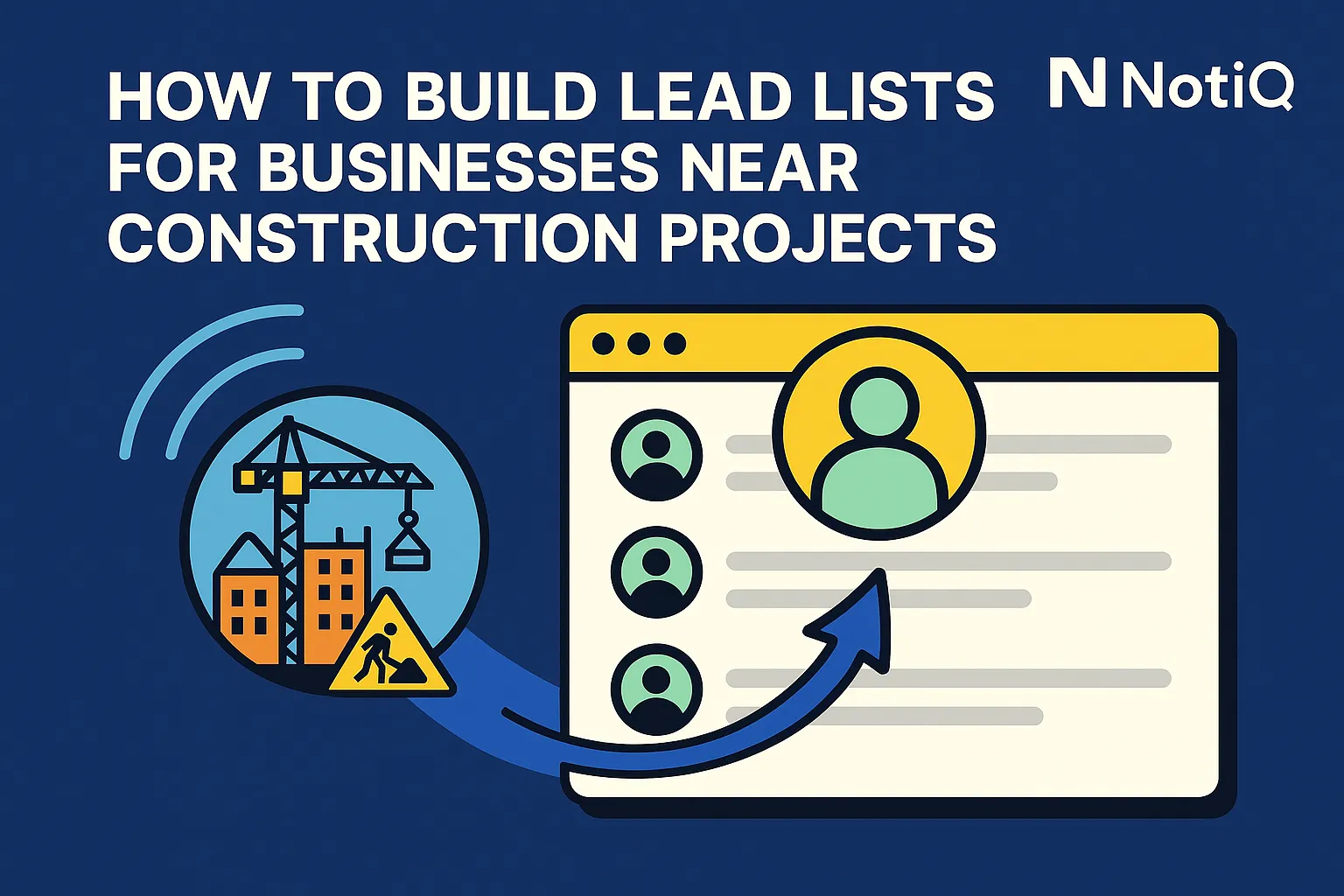
How to Build Lead Lists for Businesses Near Construction Projects
Learn how to turn active construction and redevelopment projects into high-intent local lead lists. This guide covers radius selection, enrichment, prioritization, and outreach timing.
1. Introduction
Most local lead lists are completely static, relying on broad ZIP codes or city boundaries that fail to capture real-world market dynamics. However, construction projects, infrastructure upgrades, and redevelopment zones create dynamic, event-driven sales opportunities. The real challenge is not simply finding "local businesses," but finding the right businesses near verified projects at the exact right time, armed with a highly relevant outreach angle.
This article is a practical, advanced guide for SDR leaders, RevOps teams, growth marketers, and outbound teams who want to build a repeatable system rather than relying on ad hoc map research. We will walk through a comprehensive framework: verifying project activity, setting a precise targeting radius, pulling nearby businesses, enriching records, scoring accounts, and personalizing outreach based on likely business impact.
This is not generic local prospecting. It is advanced construction project prospecting built on project-stage signals, radius-based targeting, and hyperlocal B2B prioritization. By targeting businesses near construction projects lead lists, your outbound motion becomes hyper-relevant and timely.
As a leader in geographic outreach,[Home](/)serves as the strategic platform for radius-based prospecting workflows, allowing teams to operationalize location data around new developments and infrastructure projects. To explore more geographic outreach and AI workflow examples, visit Blog.
2. Find and Verify Project Opportunities
Before building a lead list, you must identify and verify worthwhile construction and infrastructure signals. Project announcements alone are weak signals unless teams verify the timeline, precise location, and actual ground activity. Prospecting logic shifts dramatically depending on whether a project is announced, approved, active, or completed.
To build a reliable pipeline of infrastructure project prospecting opportunities, teams must combine discovery sources—such as municipal permits, planning board announcements, construction intelligence platforms, redevelopment news, and mapping layers—into a single, unified research process. By using exact project coordinates or a precise site reference as the foundation, you set the stage for highly accurate downstream radius-based targeting.
What Counts as a Strong Project Signal
Not all construction projects yield high-quality construction leads by location. The best projects for generating nearby business lead lists include major roadwork, transit upgrades, utility line replacements, mixed-use developments, large commercial builds, and sweeping neighborhood redevelopments.
Some of these projects create disruption-led demand (e.g., a road closure blocking storefronts), while others create growth-led demand (e.g., a new residential high-rise bringing foot traffic). The strongest opportunities possess both a clear geography and a highly visible timeline. When targeting businesses near new developments, focus on projects with identifiable milestones—such as groundbreakings or road closure dates—that can trigger specific outreach windows using location intelligence.
How to Validate Whether a Project Is Real, Current, and Relevant
To avoid wasting outreach efforts on canceled, delayed, or completed projects, teams must validate project status before outreach. A strong validation checklist should include:
• Exact location: Verified coordinates or parcel boundaries.
• Stage: Planned, approved, active, or nearing completion.
• Expected duration: Short-term nuisance or multi-year overhaul.
• Access impact: Will it affect traffic flow, parking, or vendor deliveries?
• Surrounding business density: Are there enough businesses affected by construction to justify a campaign?
Cross-check multiple source types instead of relying on a single press release. Look for project-stage signals that indicate actual movement, such as issued permits or finalized contractor bids. Understanding these factors is critical, as authoritative research on construction impacts to local businesses shows that duration and access changes directly dictate local commercial needs.
Build a Project Pipeline Before You Build a Lead List
Instead of treating list building as a one-time research task, build a continuous project pipeline. Create a project tracker with fields for project name, coordinates, type, stage, expected milestones, and source confidence.
This enables true event-driven prospecting. Classify projects by opportunity scenario: disruption, growth, vendor supply, or post-completion follow-up. This integrated, dynamic workflow stands in stark contrast to generic prospect list building that starts with broad company filters. By anchoring your hyperlocal B2B prospecting to verified project intelligence rather than generic territory filters, you guarantee that your construction project prospecting is always timely and relevant.
3. Choose the Right Targeting Radius
Setting a practical radius is the most critical step in geographic outreach. It must be precise enough to stay relevant, but broad enough to capture real opportunity. There is no universal radius; it should vary based on project type, urban density, business concentration, and the expected impact area. Radius selection is a strategic decision model, not a default setting.
One of the biggest pain points in location-based sales is drawing overly broad lead lists that dilute messaging and plummet response rates. A thoughtful radius strategy prevents this.
Factors That Should Determine Radius Size
Radius size should be dictated by the project footprint, road access changes, walkability, local density, and parking disruption. Whether the area is urban, suburban, or corridor-based changes the equation entirely.
For example, a downtown streetscape project may require a very tight 0.1-mile radius because of high business density and immediate sidewalk disruption. Conversely, a major highway transit or utility project may have wider spillover effects, justifying a 1-to-3-mile commercial area outreach zone. Tie your radius logic to likely business impact and proximity-based lead generation potential rather than an arbitrary map distance. Utilizing frameworks like EPA smart location mapping can provide essential context for understanding local density and place-based dynamics, ensuring your radius lead lists for sales teams are grounded in reality.
How to Prevent Radius Creep and Low-Quality Lists
A common mistake in map-based prospecting is drawing massive circles that pull in businesses with absolutely no connection to the project. To avoid overly broad radius lead lists, start tight. Evaluate the relevance of the accounts within a minimal distance, and expand the radius only when justified by the project's scope or surrounding business density.
Use exclusions, industry filters, and impact hypotheses to keep the list laser-focused. If a business is technically nearby but separated by a major physical barrier (like a river or highway) that negates the project's impact, exclude it. Your radius should be refined based on actual business concentration and project reality to secure high-quality nearby business leads.
Match Radius Strategy to Project Stage
Targeting should widen or narrow depending on the project's lifecycle. During the early planning and groundbreaking stages, geographic outreach may prioritize adjacent vendors, contractors, and service providers who can supply the site.
As the project enters the actively disruptive stage, targeting should narrow to focus strictly on access-sensitive businesses dealing with road closures. Finally, as the project nears completion, the radius can expand again to capture businesses near new developments that are likely to benefit from increased traffic, neighborhood revitalization, or redevelopment momentum. Project-stage targeting ensures your message matches the physical reality of the neighborhood at that exact moment.
4. Build and Enrich Nearby Business Lead Lists
Once the project and radius are defined, it is time to execute the list-building workflow. Pulling businesses within the target area is only step one; you must then enrich them with firmographic, operational, and outreach fields. Being "nearby" is not enough to drive conversions. The list only becomes a powerful asset when geography is combined with deep business context, bridging the gap between map-based research and outbound execution.
Pull the Initial Nearby Business Universe
To begin, gather the raw universe of businesses located strictly within the chosen radius or boundary around the project site. This first pass should capture the comprehensive local market before you apply deeper filtering by account relevance.
Ensure your data extraction complies with all public access and privacy regulations. Capture structured fields such as business name, category, address, exact site distance, and local context markers. Preserve this raw proximity data, as distance will be a crucial variable for later prioritization in your hyperlocal B2B prospecting efforts. This creates a foundational local business database by area, ready for refinement into high-value nearby business leads.
Enrich the List With Fields That Make Outreach Better
Next, apply lead enrichment to add fields that dictate outreach strategy: industry, sub-industry, company size, location count, foot-traffic dependence, delivery dependence, customer visit model, and likely decision-maker function.
Project timeline fields should live alongside these firmographic fields so timing and relevance stay permanently connected. Add custom labels like "disruption risk," "growth potential," or "vendor opportunity" to segment the data. Enrichment should directly support prioritization and the creation of highly relevant outreach messaging for businesses near construction, not just data completeness. Once this enriched list is fully prepped for outreach, platforms like Home can be utilized for downstream personalization. Location intelligence is only as valuable as the context you attach to it.
Use Public and Authoritative Data to Improve Local Relevance
Leverage credible business and place-based data sources to sharpen your understanding of the local market. Layering business density or ZIP-level business data helps gauge whether an area justifies deeper prospecting.
Authoritative public data improves your trustworthiness when making outreach claims about local commercial concentration or likely opportunity zones. For example, referencing ZIP Code Business Patterns data from the U.S. Census Bureau provides verifiable context on local business patterns, ensuring your businesses near construction projects lead lists are backed by real economic location intelligence.
Manual Research vs Automated Workflow
While manual map research is time consuming and prone to human error, it may suffice for a one-off campaign. However, SDR and growth teams require scalable workflows for coverage and speed. An automated workflow continuously detects projects, maps nearby businesses, and updates lead status based on changing timelines.
AI-assisted map-based prospecting offers a massive competitive advantage when markets change quickly. Unlike generic tool workflows that enrich records well but fail to natively center project verification and radius logic, a dedicated, automated approach prioritizes AI enrichment, verification, and ethical compliance, filling the gaps left by fragmented, manual alternatives.
5. Prioritize Accounts by Impact and Timing
A long list of nearby businesses is useless if you do not know who to contact first. Not every business near a project is equally valuable. Prioritization must reflect likely impact, timing, and strategic fit. By applying a practical scoring model based on distance, business type, project stage, and outcome scenarios, you can turn a broad list into a highly ranked set of outreach-ready accounts.
Segment Accounts by Likely Scenario
Categorize your list into at least four distinct cohorts:
1. Disruption-risk businesses: Customer-facing storefronts sensitive to parking and road closures.
2. Growth-opportunity businesses: Accounts positioned to benefit from future foot traffic or new residential density.
3. Vendor/service opportunity accounts: Local suppliers, equipment rentals, or contractors who can service the site.
4. Post-project expansion prospects: Businesses that may want to expand or relocate into the newly developed area.
Business category and project type directly dictate growth opportunity segmentation. Knowing exactly which businesses are affected by construction—and how they are affected—allows you to tailor your approach to businesses affected by construction versus those poised for expansion.
Create a Simple Impact Score
Develop a scoring framework that evaluates proximity, dependency on customer access, dependence on deliveries/logistics, project duration, and timing urgency. Weight these factors differently by vertical and project type.
For instance, a restaurant facing a two-year road closure scores higher for disruption risk than a B2B software office in the same building. High-priority accounts in construction project prospecting are those with both strong local exposure and a clear outreach angle. Keep this impact score practical enough for SDR teams to implement directly in a CRM or spreadsheet. Nuanced account prioritization is backed by NIST research on small business disruption, which highlights how mobility and adaptive capacity determine a local business's resilience.
Time Outreach to the Construction Lifecycle
The value proposition of your outreach changes depending on the project phase.
• Planning/Approval: Offer preparation support and strategic consulting.
• Groundbreaking/Active Disruption: Offer disruption mitigation, delivery logistics solutions, or remote-work software.
• Near-Completion: Offer marketing, staffing, or growth capture services.
Build trigger-based sequences tied to project timelines and milestone changes rather than sending static, calendar-based campaigns. Event-driven prospecting ensures your geographic outreach lands exactly when the prospect is feeling the pain or anticipating the growth.
Align Prioritization With Sales Territory Design
SDR leaders and RevOps teams can use these project-centered zones to shape temporary territories or agile campaign pods. Geographic triggers complement, rather than replace, existing ICP and firmographic rules.
Using radius-based lists allows you to focus reps on high-context, high-relevance micro-territories based on real-world location intelligence. To seamlessly turn these geographic triggers into repeatable sales motions and optimized territory planning,[Home](/)provides the necessary workflow layer for hyperlocal B2B prospecting.
6. Personalize Outreach for Disruption and Growth Scenarios
Better lead lists only pay off when messaging reflects the actual local context created by the project. Outreach should drastically differ for a business facing a torn-up sidewalk versus one anticipating a flood of new wealthy residents. This personalization is the conversion layer that makes geographic outreach outperform generic local campaigns.
Messaging for Disruption-Risk Businesses
When contacting businesses affected by construction, focus on pain points such as reduced customer access, delivery complications, lower foot traffic, and operational uncertainty.
Your construction disruption outreach must be empathetic and context-aware. Prove you understand what the business is dealing with locally by referencing the specific project name, the street affected, and the timeline. Specificity builds trust. Align your approach with established FHWA work zone outreach strategies, which emphasize clear, timely, and hyper-specific communication to mitigate local business frustration. This transforms cold nearby business leads into warm, consultative conversations.
Messaging for Growth-Opportunity Businesses
For businesses near new developments, shift the messaging from mitigation to expansion, readiness, or market capture. Approach these accounts with angles around future demand, increased visibility, new residential or commercial density, and post-project foot traffic growth.
Use project-stage timing to ensure your new development leads are contacted before competitors even realize the neighborhood is changing. If a new 500-unit apartment complex is nearing completion, local gyms, grocers, and service providers need to prepare their marketing and staffing today.
Messaging for Vendor and Service Opportunities
Adjacent business categories may sell directly into the project ecosystem or support the affected businesses nearby. Identify whether the better fit is direct local business outreach or a contractor/vendor ecosystem angle.
For example, a local uniform supplier or heavy equipment rental company should be prioritized for vendor opportunity outreach the moment a project is approved, long before the commercial area outreach targets the local storefronts. Timing is everything in construction project prospecting.
Build Reusable Outreach Playbooks
To scale without losing relevance, build reusable outreach playbooks templated by scenario, project stage, and business type. Enriched fields and impact scores should automatically feed personalization tokens and messaging branches.
Create a simple matrix that SDRs can adapt for cold calling scripts, emails, LinkedIn messages, or direct mail. While alternative tools stop at data collection, the real edge in hyperlocal B2B prospecting and radius-based targeting comes from scenario-based messaging tied directly to verified local change.
7. Tools, Workflow Design, and Automation Considerations
Building a sustainable system requires operational thinking, not just running a one-off campaign. The most effective workflows seamlessly connect project discovery, radius logic, list extraction, enrichment, prioritization, and outreach activation. Advanced teams utilize recurring triggers, automated list refreshes, and status updates, blending mapping, business data, construction intelligence, and outreach tools into one engine.
What an End-to-End Workflow Should Include
An ideal workflow for workflow automation includes these exact stages:
1. Detect projects.
2. Verify and geolocate them.
3. Define radius rules based on impact.
4. Collect nearby businesses compliantly.
5. Enrich records with firmographics.
6. Score accounts based on disruption/growth scenarios.
7. Launch segmented, signal-based prospecting campaigns.
Define clear ownership across SDR, RevOps, and growth teams to maintain consistency. Each stage of this construction project prospecting workflow must produce clean, usable output for the next phase.
Where Generic Tools Fall Short
Broad B2B databases are excellent for basic enrichment and contact discovery, but they are fundamentally weak on project-centric trigger logic. For example, relying solely on Apollo.io location filters for local prospecting will only yield static lists, missing the "why now" trigger of a construction event.
Similarly, Regrid parcel data for nearby business research is great for geography, but it does not solve outreach readiness or intent. Even specialized ConstructConnect project data for prospecting surfaces the project opportunity but leaves teams struggling to operationalize the nearby business targeting.
What to Standardize for Team Adoption
To ensure adoption, standardize your project stages, radius rules, impact labels, enrichment fields, and outreach scenarios. Create internal templates, including a project validation checklist, a radius decision tree, and a strict lead scoring rubric. Turning this process into a repeatable lead-gen workflow ensures your team can continuously mine markets with ongoing development activity without reinventing the wheel every quarter.
8. Future Trends in Geographic Outreach
The B2B sales landscape is shifting rapidly from static lead databases to event-driven, geography-triggered prospecting. Teams that operationalize construction and redevelopment signals early will consistently uncover demand before competitors who still rely on broad, static filters.
Why This Approach Is Gaining Momentum
Rising infrastructure spending and urban redevelopment activity are driving a massive need for hyperlocal B2B prospecting. Outbound teams demand earlier, more relevant signals than static location filters can provide.
Advanced GTM teams are no longer treating location as a simple data field; they are combining geographic context with timing and account scoring. Prospecting around infrastructure projects and leveraging geographic lead generation for B2B allows sales teams to intercept buyers at the exact moment their operational needs change.
What Teams Should Prepare for Next
Sales organizations must invest in workflows that continuously monitor project changes and automatically refresh nearby account lists. Treat geographic outreach as an ongoing, dynamic motion integral to territory design and campaign planning, rather than a niche tactic.
Future-proof teams will be those that master AI-assisted map-based prospecting and radius-based targeting, connecting real-world local signals directly to messaging automation and sales execution.
9. Conclusion
Building highly converting lead lists around construction projects requires a disciplined, multi-step approach. You must find and verify projects, choose the right radius based on impact, build and enrich nearby business lists compliantly, prioritize accounts by impact and timing, and personalize your outreach for specific disruption or growth scenarios.
The core takeaway is clear: the most lucrative businesses near construction projects lead lists are generated through event-driven geographic intelligence, not generic local filtering. Precision and high response rates come from combining project-stage validation with dynamic radius-based targeting and impact-based segmentation.
Audit one metro area today. Identify a handful of active or planned projects, and test this construction project prospecting workflow on a small, highly targeted campaign.
As a platform built specifically around radius-based targeting near new developments and infrastructure projects, NotiQ provides the infrastructure to automate this entire process. Explore[Home](/)to start operationalizing this workflow, and continue learning advanced strategies at Blog.
Author Note: The framework provided in this article is grounded in practical sales operations, AI workflows, and location intelligence expertise. NotiQ specializes in radius-based targeting around new developments and infrastructure projects. Authoritative sources from the U.S. DOT, EPA, Census Bureau, NIST, and FHWA have been cited to support best practices in business impact, place-based analysis, and local outreach strategy.
Frequently Asked Questions
- How do you find businesses near construction projects?
- To find businesses near construction projects, start by verifying a project's exact coordinates. Map the location, apply a strategic targeting radius based on the project's impact zone, and compliantly pull the nearby business leads. Finally, enrich the data with firmographics and prioritize accounts based on how the project affects them. Remember, "nearby" should reflect likely business impact, not just raw map distance.
- What radius should I use around a construction site for prospecting?
- The ideal radius depends entirely on the project type, urban density, access disruption, and surrounding business concentration. A downtown street closure might require a tight 0.1-mile radius, while a major highway expansion could warrant a 2-mile zone. When using radius-based targeting, always start with a narrower scope and expand only when the physical impact zone justifies it.
- Which nearby businesses should I prioritize first?
- Prioritize nearby businesses using a framework based on distance, business type, foot-traffic dependence, delivery sensitivity, and the current project stage. Businesses affected by construction that rely heavily on physical access (like retail or logistics) score higher during disruptive phases. Learn how to prioritize nearby businesses by distance industry and impact to ensure you target accounts with both high exposure and a clear outreach angle.
- How do infrastructure projects create nearby business sales opportunities?
- Infrastructure projects create two distinct types of opportunities: disruption-led and growth-led. Disruption creates immediate needs for mitigation, remote work, or logistics support during active work phases. Conversely, growth-led opportunities arise as businesses near new developments prepare for increased foot traffic and density during the near-completion phase. Timing your infrastructure project prospecting to these phases is key.
- What data sources help identify new developments and affected businesses?
- To capture new development leads and location intelligence, utilize a combination of public data sources. Monitor municipal permits, planning board agendas, construction intelligence platforms, mapping layers, and government business data (like Census ZIP-level patterns). Always verify active status across multiple sources to ensure compliance and accuracy before launching a campaign.
Continue Reading
More articles you might find useful
How to Find Local Businesses With Very Few Website Pages
Learn how to find local businesses with very few website pages using a repeatable audit framework. This guide shows how to validate page count, spot missing pages, and prioritize the best outreach opportunities.
Read the article →
Google Maps Lead Generation for Window and Door Installers
Learn how window and door installers can use Google Maps to find, qualify, and prioritize better local prospects. This beginner-friendly guide shows a repeatable workflow for smarter local outreach.
Read the article →
How to Prioritize Businesses With Verified Google Profiles
A practical framework for ranking local leads beyond the verified badge. Learn how to prioritize Google Business Profiles using fit, freshness, completeness, and activity signals.
Read the article →Popular industry lead playbooks
Maps search examples and niche outreach for the verticals teams prospect most.