Technology
Google Maps Lead Generation for Garage Door Companies
Learn a practical workflow for using Google Maps to find, verify, and prioritize local garage door prospects. This beginner-friendly guide shows how to turn public listing signals into better outreach and more qualified leads.
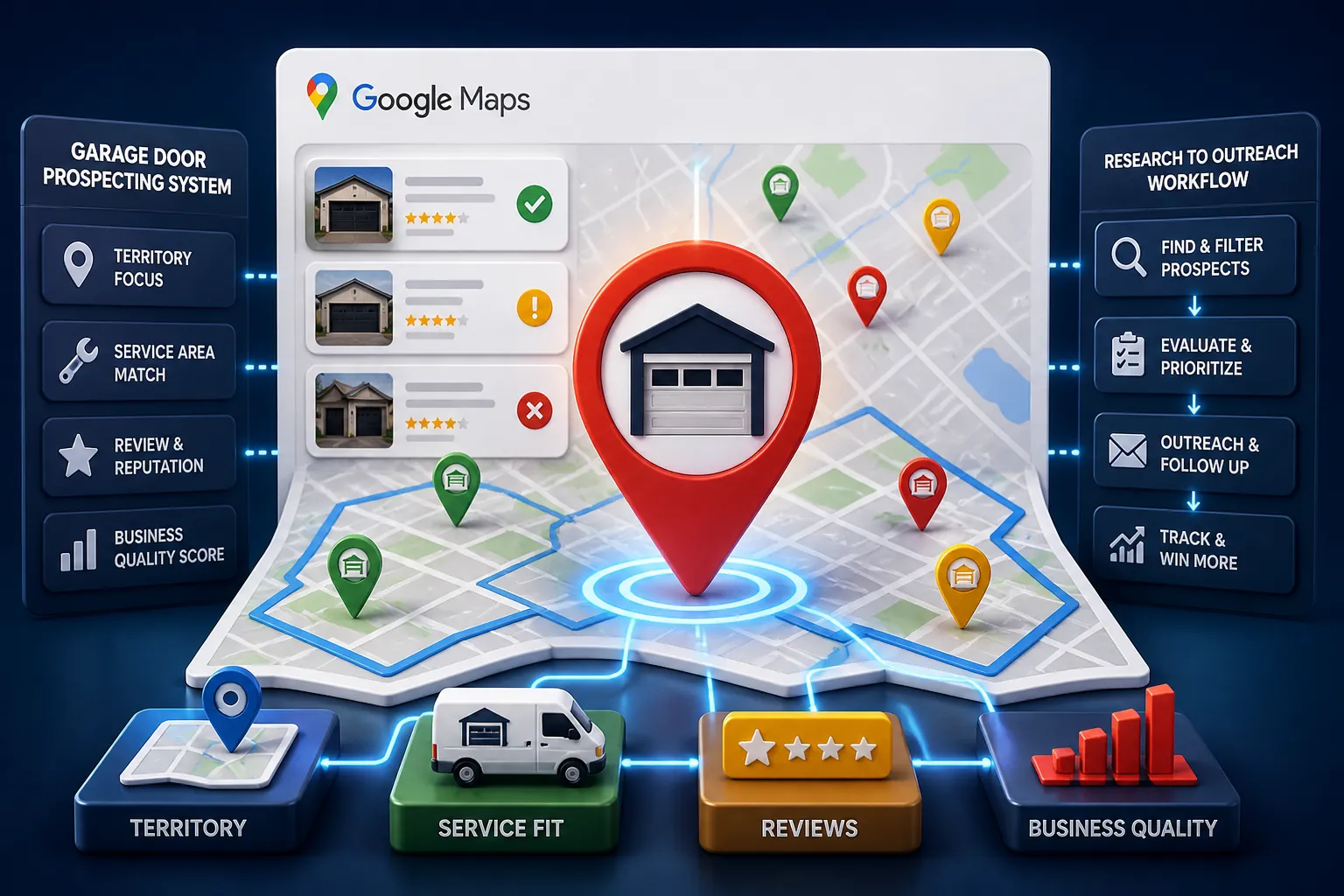
1. Introduction: Why Google Maps Can Be a Practical Source of Garage Door Leads
For many local service businesses, Google Maps is widely understood as a navigation tool or a place for customers to leave reviews. However, it is also a highly effective platform to help garage door businesses research local markets, identify relevant companies, and organize B2B sales opportunities.
Many garage door companies need more local conversations but rely on unstructured searches, referrals, or broad, unverified prospect lists. This often leads to wasted outreach efforts and low conversion rates. By reading this guide, you will learn how to define a specific territory, find relevant businesses, verify listings, prioritize prospects, and plan highly personalized outreach.
It is vital to understand that Google Maps research should produce a qualified, organized prospect list—not an indiscriminate collection of businesses. The key differentiator in a successful strategy is learning how to combine territory boundaries, service types, review activity, listing completeness, and business fit before ever contacting a prospect.
As a beginner, set your expectations accordingly: visible Maps signals are incredibly useful research inputs, but they do not inherently prove that a company needs a specific service or is ready to buy. Through NotiQ’s focus on territory-aware and review-informed segmentation, residential and commercial garage door businesses can build practical pipelines. Always remember that reviews and listing information should be treated strictly as public research signals, not as a substitute for direct verification or consent-based outreach. Effective Google Maps lead generation for garage door companies is about precision, not volume. Generating high-quality garage door leads and local service business leads requires a methodical, compliance-first approach.
2. Define Your Territory and Target Garage Door Services
Before opening Google Maps, you must narrow your research parameters. This ensures that the resulting prospects are highly relevant to your specific service area and overall business goals.
Choose the Geographic Territory
Begin by defining your territory using concrete boundaries such as cities, ZIP codes, neighborhoods, counties, or practical driving areas. It is highly recommended to separate a company’s primary service territory from expansion markets it may want to test. Mixing these areas can skew your data and make follow-up logistics difficult.
A focused territory makes it significantly easier to compare local competitors, gauge local demand, assess review strength, and measure follow-up results accurately. Record the target location and search date for every research batch so you can track your progress over time. When defining these boundaries, it is helpful to consult Google’s service-area guidelines to understand how service-area and hybrid businesses should define the locations they serve. Keep in mind that this guidance informs your territory planning; it does not establish a prospect’s actual real-world coverage. Executing precise garage door service area marketing and local SEO for garage door contractors relies heavily on this foundational Google Maps prospecting for local businesses.
Decide Which Services and Business Types to Target
Garage door companies offer a wide variety of services. To keep your research organized, create separate search groups for distinct offerings:
• Garage door repair
• Garage door installation
• Garage door replacement
• Garage door maintenance
• Commercial or industrial overhead-door service
You must also distinguish direct service prospects (other garage door companies you might partner with or acquire) from adjacent B2B opportunities such as property managers, custom home builders, warehouses, storage facilities, or referral partners. Service-specific searches reveal vastly different business needs and require unique outreach angles. Choosing one or two priority segments for your first research batch is far more effective than targeting every related business at once. Utilizing standardized frameworks, such as the NAICS garage door industry classifications, can support consistent residential and commercial segmentation. This targeted approach is the best way to uncover specific garage door repair leads, garage door installation leads, and commercial garage door service opportunities.
Define the Ideal Prospect Before Searching
Before you start pulling data, describe your ideal prospect using practical criteria. Consider factors like location, service mix, business size, customer type, website presence, and apparent marketing maturity.
For example, your ideal prospect might be a residential repair company serving several nearby communities that lacks a strong online booking system. Alternatively, it could be a commercial overhead-door provider serving warehouses and industrial properties that needs a reliable local subcontractor.
Understand the difference between simply identifying a company and identifying a qualified opportunity. A qualified opportunity aligns with your specific criteria and shows observable signals that your outreach could be relevant. This clarity transforms basic contractor lead generation into highly effective garage door company marketing and garage door contractor prospecting.
3. Find and Verify High-Potential Google Maps Prospects
With your territory and ideal prospect defined, you need a repeatable research workflow for finding relevant listings while aggressively filtering out duplicate, outdated, closed, or poorly matched entries.
Use Service-and-Location Searches
Start your research using targeted combinations. Effective queries include:
• “garage door repair” plus a specific city
• “garage door installation” plus a ZIP code
• “commercial garage door service” plus a county or territory
Compare results across nearby locations, but never assume that every listing serves the entire region. Always capture the listing URL and the specific search location used so the research can be revisited or audited later. Remember that search visibility is not the same as business quality, service fit, or a willingness to purchase. To understand the context around business profiles, categories, reviews, and service-area information, always refer to the official Google Business Profile documentation. This methodical search strategy is essential for finding accurate Google Maps leads, whether you are searching for "garage door repair near me" or "garage door installation near me."
Capture the Right Prospect Information
To turn raw searches into actionable data, you must capture the right information systematically. Use a spreadsheet, CRM, or structured workflow with dedicated fields for:
• Business name and listing URL
• Primary location and service area
• Phone number, website, and contact form link
• Services offered
• Residential, commercial, or mixed focus
• Review count, average rating, and visible review recency
• Business category and listing completeness
• Outreach status and next action
Your tracker should strictly record observable facts rather than subjective conclusions. Always add a “verification date” field so your team knows exactly when the information was last checked. If you need a practical option for organizing territory-aware local business research and prospect workflows, exploring a platform like[NotiQ](/)can streamline this data capture process. Structured tracking is the backbone of managing local business leads, analyzing a Google Business Profile garage door company, and executing successful garage door company prospecting.
Verify Relevance and Listing Status
Data decays rapidly. You must verify whether the business appears to be active and genuinely related to garage door services before initiating contact.
Look closely for inconsistencies such as:
• A disconnected phone number
• An inactive, broken, or unsecure website
• Duplicate listings for the same business
• A business category that does not match the advertised service
• A physical location far outside the intended territory
• A listing that appears permanently closed or severely outdated
Uncertain records should be flagged for manual review rather than immediately added to an automated outreach sequence. Implement a strict “keep, verify, or remove” decision rule for every prospect. Human verification is a non-negotiable step before outreach; never present automated or publicly visible data as guaranteed accurate. This diligence protects your reputation during Google Maps prospecting, ensuring you only contact viable local service business leads and legitimate garage door contractor prospecting targets.
4. Score Prospects Using Reviews, Service Fit, and Listing Signals
Treating every Google Maps listing equally is a common mistake. Scoring helps you prioritize the best-fit opportunities based on observable public data.
Build a Simple Qualification Score
Introduce a beginner-friendly scoring model based entirely on observable criteria:
• Service fit: Does the company actually offer the target service?
• Territory fit: Is the business inside your priority service area?
• Review signals: Are reviews recent, relevant, and sufficient to assess business activity?
• Listing completeness: Are key business details (hours, photos, descriptions) present and consistent?
• Website quality: Is there a clear service offering and an accessible contact path?
• Business type: Is the company residential, commercial, or a relevant adjacent partner?
• Contactability: Is there a usable phone number, functional website, or active contact form?
Use a simple low, medium, or high priority system rather than implying false precision with complex numerical scores. The score is a prioritization aid, not definitive proof that a company needs your marketing or partnership help. Familiarize yourself with Google’s local ranking factors to better understand relevance, distance, prominence, complete business information, reviews, and ratings. However, make it clear to your team that ranking signals are not the same as sales-readiness signals. This scoring method helps isolate the best garage door leads, streamlining your garage door company marketing and local business prospecting.
Interpret Reviews Without Overreading Them
Reviews offer a wealth of public information if interpreted correctly. Assess review volume, visible recency, rating patterns, owner responses, and service-specific comments. These review signals can indicate customer activity levels, reputation-management opportunities, or overall business maturity.
Avoid the trap of claiming that a low rating automatically means a company is a good prospect for your services. Furthermore, avoid using private, sensitive, or misleading interpretations of individual reviewers. When planning outreach, personalize your message around a broad observation—such as inconsistent service messaging or an opportunity to make service information clearer on their profile—not around the criticism of a specific customer. Always adhere to FTC guidance on using online reviews to ensure ethical review use, warning against fake reviews, selective manipulation, misleading claims, or implying endorsement. Ethical review-based segmentation is critical when analyzing Google reviews garage door companies and generating garage door leads.
Work Through Two Example Prospects
To illustrate scoring, consider two different examples.
Residential Example: You find a company with a strong service fit and territory match, but they have incomplete service information on their profile. They have an active but underdeveloped review presence. This is a high-priority prospect with a clear opportunity for a helpful, specific outreach message regarding profile optimization.
Commercial Example: You find a business using commercial or industrial service language with a broader service area. They have relevant website pages but limited contact clarity. This prospect requires a completely different outreach angle focused on facilities management, response times, or service coverage partnerships.
Both prospects are highly valuable and worth contacting, but for entirely different reasons. Understanding this nuance is key to separating garage door repair leads from commercial garage door service opportunities during garage door prospect qualification.
5. Segment and Organize Residential and Commercial Opportunities
Segmentation makes your follow-up highly relevant and prevents unrelated prospects from being mixed together in generic campaigns.
Create a Practical Prospect Taxonomy
Organize your verified records into distinct categories:
• Residential repair and emergency service
• Residential installation and replacement
• Maintenance providers
• Commercial or industrial overhead-door service
• Property managers and facilities contacts
• Builders, remodelers, and referral partners
Ensure that territory, service type, and business maturity are tracked as separate fields in your database. A commercial provider will require vastly different language, sales timing, and decision-maker research than a residential contractor. If you need a system to handle this, you can explore NotiQ's features for structured segmentation, enrichment, and workflow organization. Proper taxonomy is the foundation of targeting residential garage door leads, commercial garage door leads, and mastering garage door service area marketing.
Organize by Review and Listing Opportunity
Once categorized by service, segment your lists further by the specific opportunity you observed:
• Active business with strong reviews but incomplete service information
• Established business with stale visible review activity
• Newer or smaller business with a clear service fit
• Business with inconsistent location, phone, or website details
• Possible duplicate, closed, or poor-fit listing requiring verification
These categories should directly guide your research and personalization efforts. They are not meant to serve as judgments about a business’s intrinsic quality. Utilizing review-based segmentation ensures your Google Maps leads and local service business leads receive contextually appropriate outreach.
Use a Simple Workflow or CRM Structure
A structured pipeline prevents repeated outreach and forgotten follow-ups. Recommend a pipeline workflow such as:
1. New listing found
2. Relevance check
3. Data verified
4. Qualified
5. Outreach ready
6. Contacted
7. Follow-up due
8. Conversation or opportunity
9. Disqualified or revisit later
Include data fields for the record owner, next action, last contact date, prospect response, and reason for disqualification. Tools like Repliq can serve as related resources for organizing and acting on local business prospecting workflows. Structured tracking is vital for contractor lead generation, local lead tracking, and ongoing garage door contractor prospecting.
6. Personalize Outreach and Measure Follow-Up Results
Connecting your map research to relevant sales conversations requires personalization, not generic mass outreach.
Build an Outreach Message Around an Observable Signal
When contacting a prospect, use a simple, respectful message structure:
1. Mention the company and their specific service area.
2. Reference a relevant, observable service or business signal (e.g., a recent review or a website detail).
3. State a specific, logical reason for reaching out.
4. Offer a useful, low-friction next step.
5. Make it easy for them to decline or respond.
For a residential repair company with unclear service-area coverage, ask if they are taking on jobs in specific ZIP codes. For an installation company with weak service differentiation, inquire about their specialized product lines. For a commercial provider whose website lacks industrial capabilities details, ask about their capacity for warehouse projects. Never make aggressive claims such as “you are losing customers” unless the prospect has explicitly confirmed that issue to you. Emphasize accurate, respectful, permission-conscious outreach using publicly visible business information only as context. Avoid spam, misleading personalization, and bulk messages that ignore relevance to protect your garage door company marketing efforts, garage door leads, and personalized contractor outreach.
Measure Quality, Not Just Listing Volume
A large list of unverified maps listings is useless. Instead, track:
• Verified prospects
• Qualified prospects
• Outreach attempts
• Response rate
• Positive conversations
• Appointments or discovery calls
• Opportunities created
• Results segmented by territory and service
A smaller, better-qualified list is infinitely more valuable than a massive raw data export. Always compare residential and commercial performance separately so one segment does not artificially hide another’s results. Use clear, strict definitions for “lead,” “qualified prospect,” “conversation,” and “opportunity” so your performance reporting remains trustworthy when evaluating local service business leads, garage door prospecting, and qualified garage door leads.
Know When to Revisit a Prospect
Not every "no" is permanent. You should revisit prospects when:
• A listing has been verified, but their buying timing is currently unclear.
• A business visibly adds a new service or expands into a new territory.
• Their website or primary contact information changes.
• You observe a significant shift in review activity or listing completeness.
• The prospect explicitly requests a follow-up at a later date.
Maintaining a “review date” and “next-action” field makes your workflow sustainable over the long term, ensuring you maximize the ROI of your Google Maps lead generation, garage door contractor prospecting, and local prospect follow-up.
7. Common Google Maps Prospecting Mistakes to Avoid
To ensure your prospecting remains efficient and compliant, avoid these common pitfalls:
• Treating every single Google Maps search result as a qualified lead.
• Mixing residential, commercial, repair, installation, and unrelated businesses into one undifferentiated list.
• Contacting prospects before manually verifying the phone number, website, territory, or business operating status.
• Assuming a review count or average rating alone reveals a company’s internal business needs.
• Creating duplicate outreach records for the same business across different locations.
• Using generic, automated messages that do not connect to the prospect’s specific service type or territory.
• Relying on automation without human review, data-quality checks, or compliance safeguards.
Always distinguish legitimate business research from unauthorized, misleading, or privacy-invasive data use. Review applicable platform terms and outreach laws before automating any activity related to Google Maps leads, garage door lead generation, or local prospecting mistakes.
8. Conclusion: Turn Google Maps Research Into a Repeatable Garage Door Sales Workflow
Transforming raw map data into a reliable pipeline requires discipline. Recap the five-step process:
1. Define the territory and target services.
2. Find and verify relevant Maps listings.
3. Score prospects using fit, reviews, and listing signals.
4. Segment residential and commercial opportunities.
5. Personalize outreach and measure outcomes.
Google Maps is most useful when it supports qualification and follow-up, not when it simply generates a large list of names. Start small: choose one territory, one service segment, and a manageable research batch.
To organize territory-aware, review-informed local prospecting workflows without the manual chaos, explore[NotiQ](/)as a practical workflow option for organized local lead generation. Master this process, and you will consistently generate high-quality Google Maps lead generation for garage door companies, better garage door leads, and more effective garage door contractor prospecting.
9. FAQ: Google Maps Lead Generation for Garage Door Companies
How can garage door companies get leads from Google Maps?
Google Maps supports prospect research by allowing you to filter by location, service type, business category, contact details, reviews, and visible listing information. This research becomes useful only when listings are manually verified, qualified, segmented, and connected to a structured follow-up process. (Keywords: how to get garage door leads, Google Maps lead generation, local service business leads)
How do I find garage door contractor prospects on Google Maps?
Combine specific service terms (e.g., "garage door repair") with target cities, ZIP codes, and territories. Always record the listing URLs, services offered, exact locations, contact details, review signals, and verification dates to build a usable database. (Keywords: garage door contractor prospecting, Google Maps leads, garage door company marketing)
What information should a garage door company track?
Your CRM or tracker should include the business name, location, service mix, residential or commercial focus, website URL, phone number, review signals, listing status, current outreach status, and the scheduled next action. (Keywords: garage door prospecting checklist, local lead tracking, garage door leads)
How do Google reviews affect garage door lead generation?
Review volume, recency, rating patterns, and owner responses provide vital context about a business's activity level and reputation. Reviews should inform your research and personalization angles, but they should never be used to make unsupported assumptions or misleading claims during outreach. (Keywords: Google reviews garage door companies, review-based segmentation, garage door leads)
How can I target multiple service areas without creating duplicate local listings?
You must distinguish between defining legitimate service areas within a single profile and improperly creating duplicate business listings. Follow official Google Business Profile guidance to maintain accurate business information while legitimately expanding your service radius. (Keywords: garage door service area marketing, Google Business Profile garage door company, local SEO for garage door contractors)
Is Google Maps prospecting better than paid ads or referrals?
Google Maps research serves a completely different purpose: identifying and prioritizing businesses for proactive, outbound B2B outreach. It should be positioned as a complementary strategy to referrals, paid search, directories, partnerships, and inbound local SEO, rather than a universal replacement. (Keywords: contractor lead generation, garage door advertising leads, Google Maps prospecting for local businesses)
How can NotiQ support this workflow?
NotiQ's features can be introduced as a workflow option for organizing local business research, territory segmentation, review-informed qualification, and follow-up. Utilizing structured workflows drastically reduces manual prospecting errors and improves overall pipeline organization. (Keywords: NotiQ local lead generation, AI workflow orchestrator, garage door prospecting)
Continue Reading
More articles you might find useful
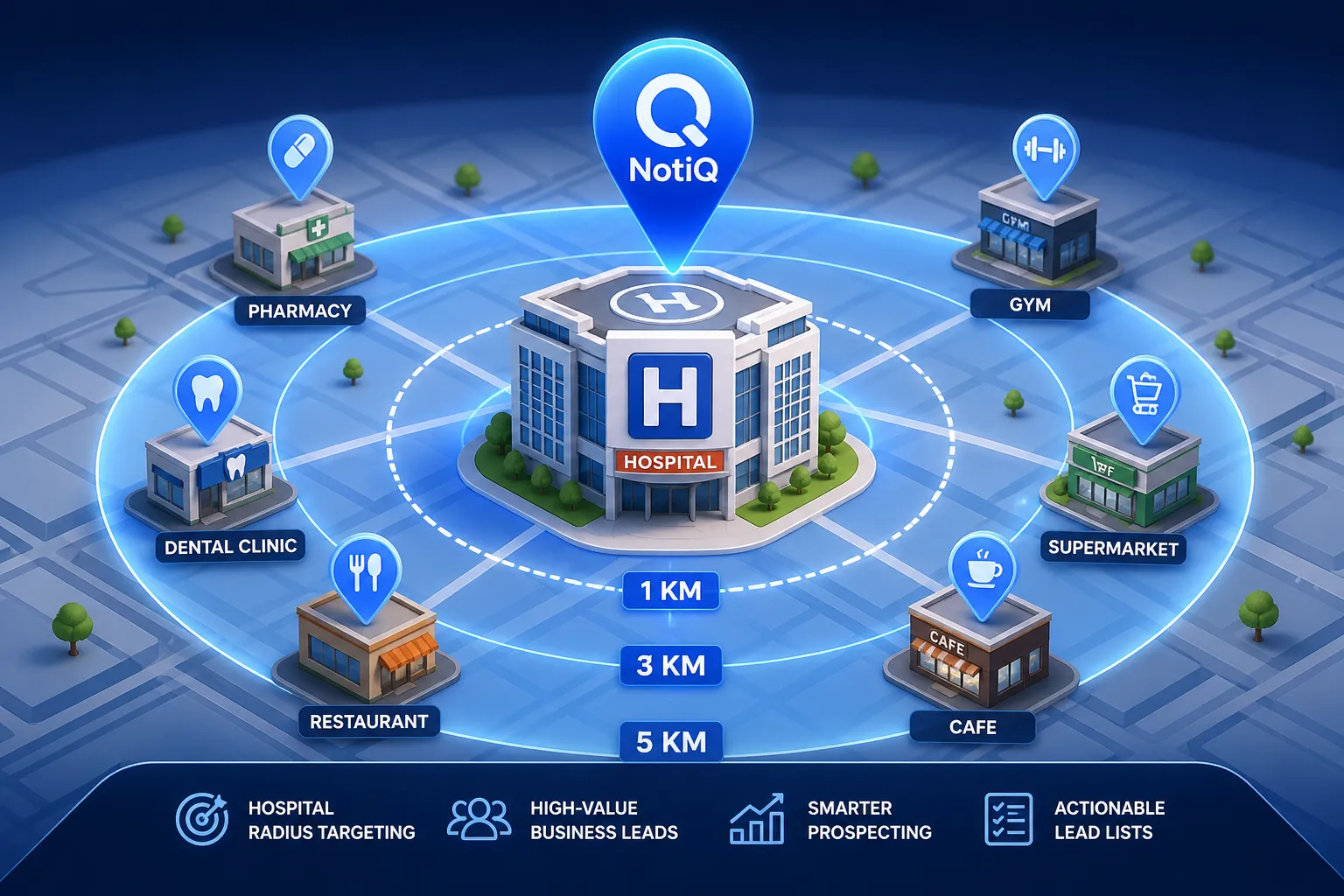
How to Build Lead Lists From Businesses Near Hospitals
Learn how to turn hospitals into high-value prospecting anchors. This guide shows how to find, qualify, and prioritize nearby businesses for cleaner local lead lists.
Read the article →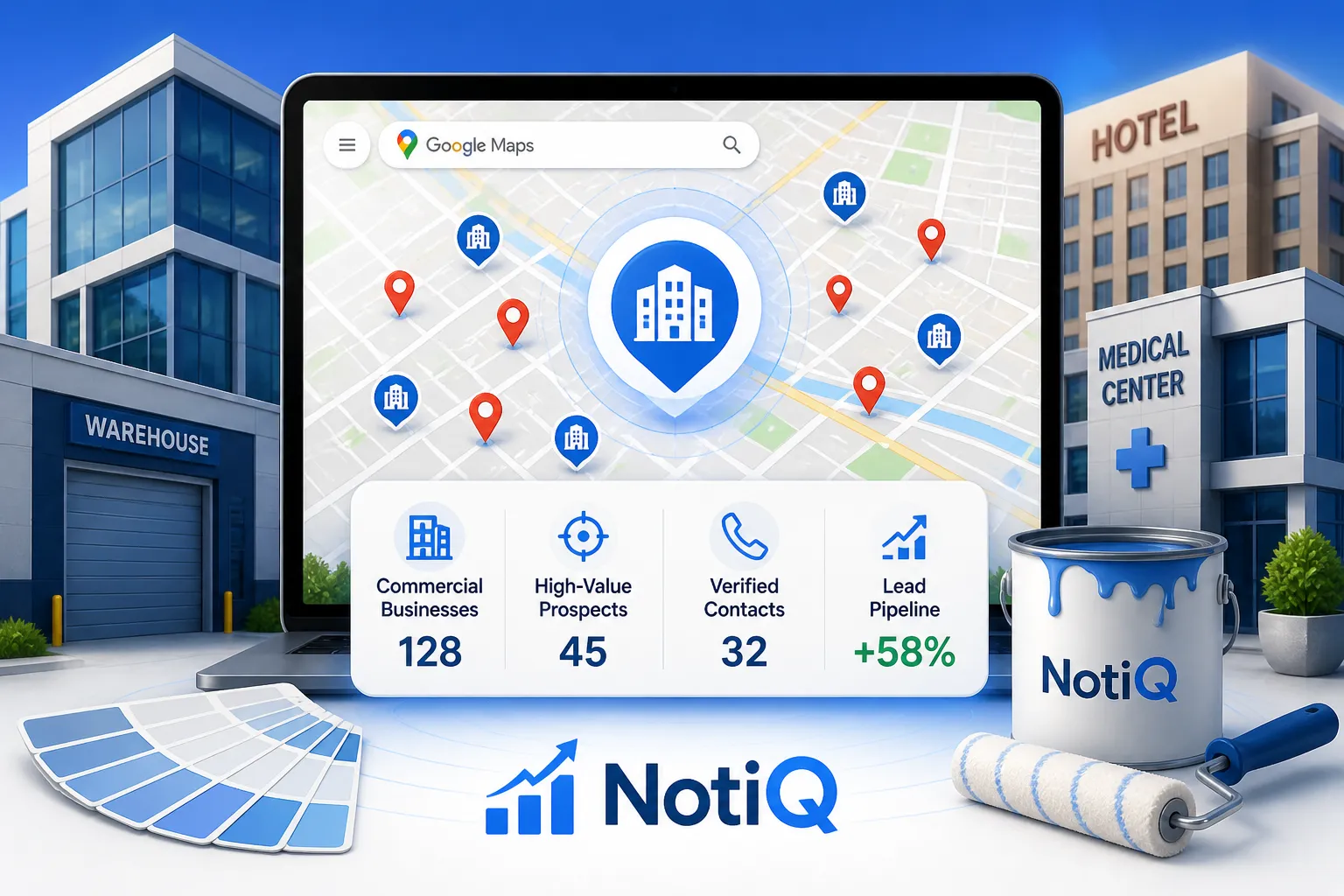
Google Maps Prospecting for Commercial Painting Contractors
Learn how commercial painting contractors can use Google Maps to build a smarter local prospecting system. This guide covers qualification, scoring, prioritization, and outreach for better-fit B2B leads.
Read the article →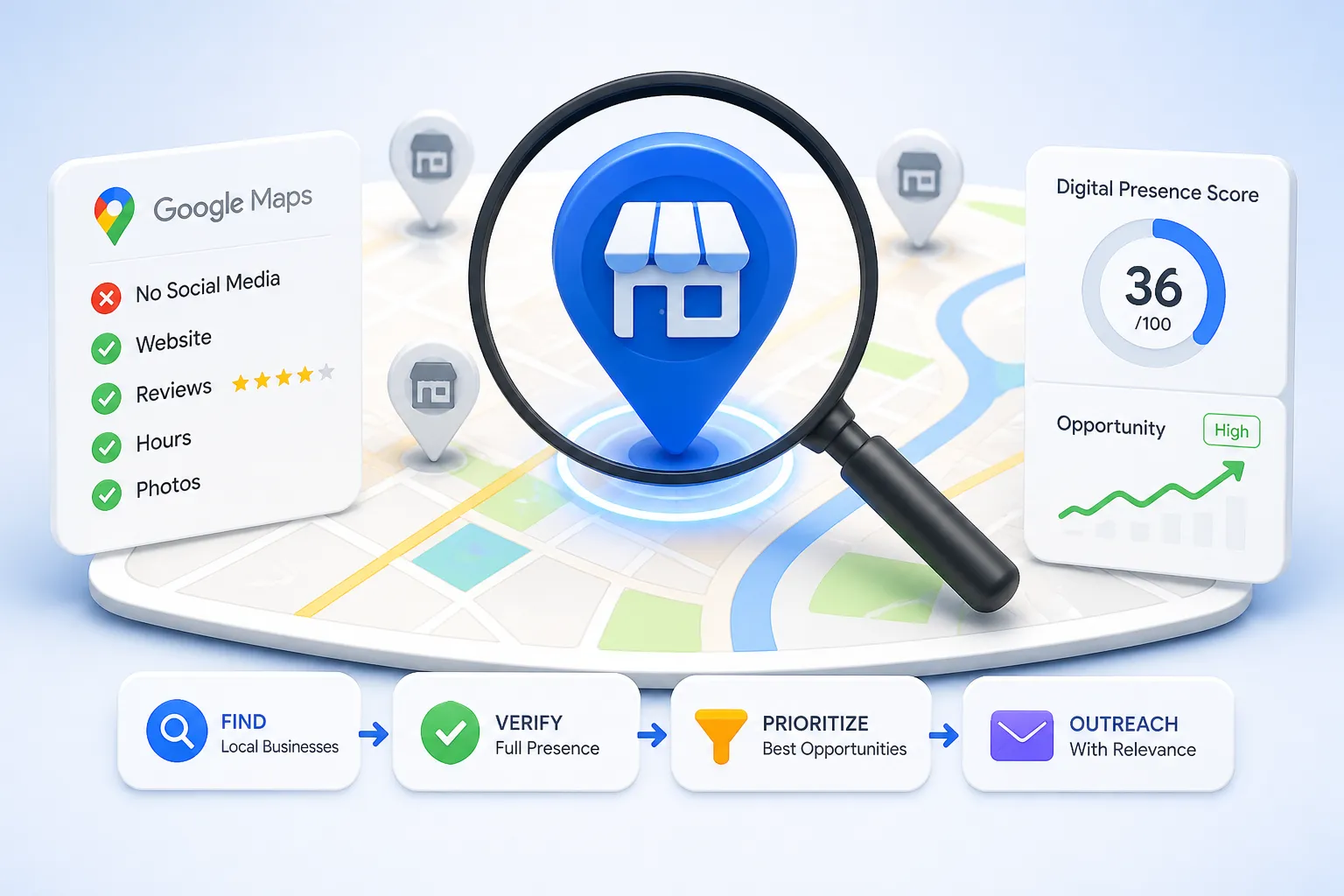
How to Find Local Businesses With No Social Media Links
Learn how to use Google Maps to find local businesses with missing social links, verify real digital gaps, and prioritize better outreach. This guide shows agencies how to turn raw prospecting into qualified opportunities.
Read the article →Popular industry lead playbooks
Maps search examples and niche outreach for the verticals teams prospect most.