Technology
Google Maps Lead Generation for Pool Maintenance Companies
Learn how pool maintenance companies can use Google Maps to find qualified commercial prospects, organize outreach, and grow recurring service contracts. This guide breaks down a practical workflow for targeting hotels, apartments, HOAs, and more.
1. Introduction
One of the greatest challenges facing local pool maintenance and commercial aquatic-service companies is knowing their exact service area but lacking a consistent process for finding qualified prospects. While residential referrals are valuable, scaling a profitable route requires securing larger, reliable commercial accounts. Fortunately, Google Maps can help identify hotels, apartment communities, HOAs, gyms, schools, country clubs, assisted-living facilities, municipal pools, and other commercial aquatic prospects right in your backyard.
This guide will show beginners exactly how to find, qualify, organize, contact, and measure local pool service leads. It is important to note that this is not a generic Google Maps scraping or lead-list guide. Instead, it is a facility-specific, geographically segmented workflow designed to uncover recurring maintenance, repair, seasonal, and water-quality opportunities.
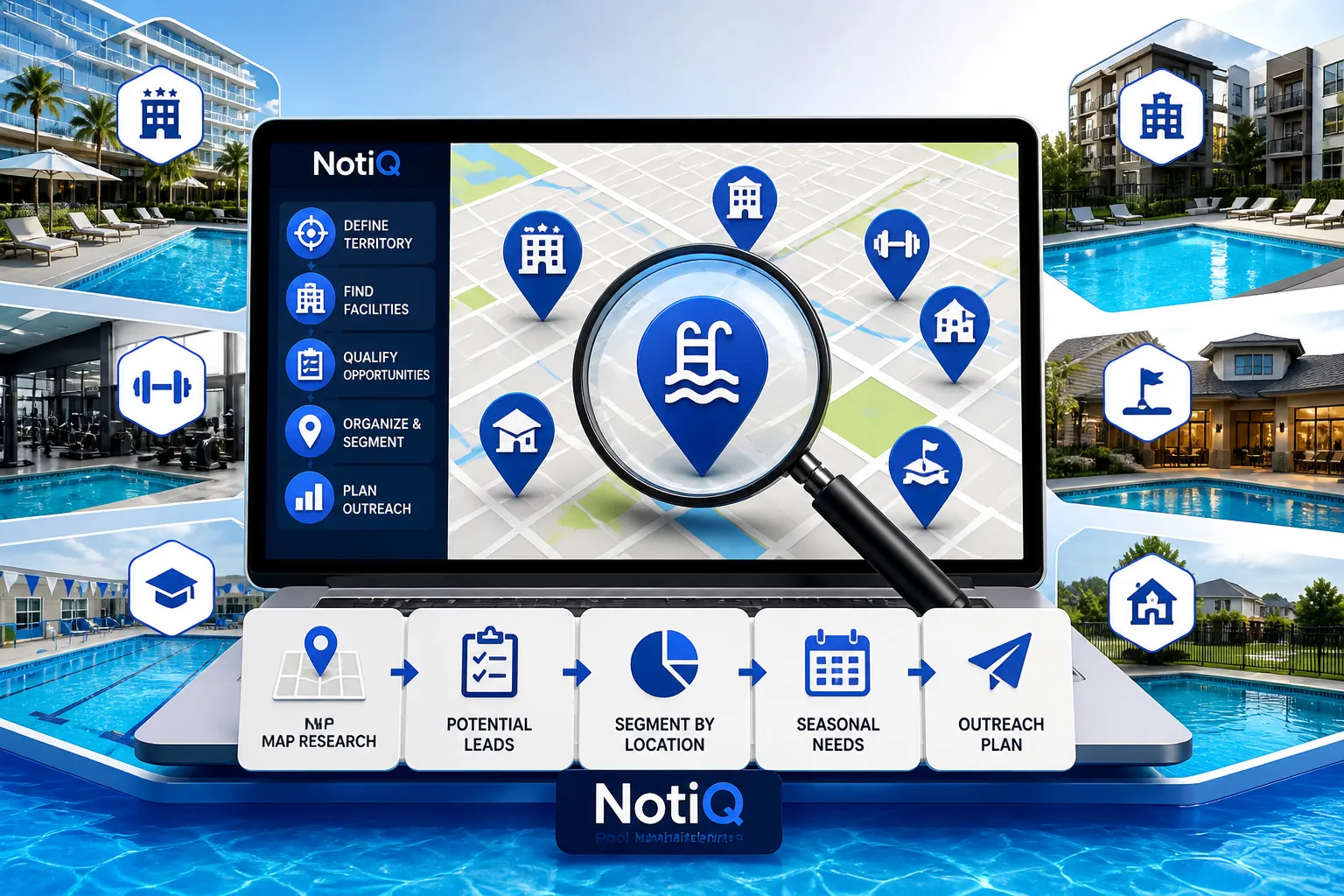
We will walk you through a five-step process:
1. Define high-value prospects.
2. Build a targeted Google Maps list.
3. Qualify leads.
4. Personalize outreach and follow-up.
5. Measure results.
While no strategy can promise guaranteed lead volume, conversion rates, or contract wins, establishing this structured approach provides a strong foundation for growth. At NotiQ, our service-focused perspective empowers commercial aquatic-service companies to optimize geographic segmentation and streamline Google Maps lead generation for pool maintenance companies, ultimately driving better pool maintenance prospecting and securing high-quality pool service leads.
2. Define High-Value Pool Service Prospects Before Searching Google Maps
Before collecting names and contact information, beginners must decide exactly who to target. There is a significant difference between a general local business lead and a commercially relevant pool service prospect. A generic local business might have a storefront, but a high-value prospect has specific aquatic infrastructure needs.
To maximize the efficiency of your pool maintenance company marketing, focus on prospects that possess the following attributes:
• Located within the company’s actual service territory.
• Operates or manages a facility likely to contain a pool or aquatic amenity.
• Has a potential need for recurring maintenance, equipment repair, seasonal opening or closing, inspections, or water-quality support.
• Has an identifiable owner, manager, property manager, facilities contact, or operations decision-maker.
• Offers enough potential value to justify outreach and follow-up.
Geographic fit matters immensely for route efficiency, local familiarity, rapid response times, and overall service profitability. Rather than creating one undifferentiated database, create separate lists segmented by city, neighborhood, ZIP code, route, or service territory. This targeted approach is the cornerstone of effective local pool service marketing and ensures you are pursuing the most viable commercial pool maintenance leads.
Prioritize Commercial Facility Segments
Different facility categories have varying pool-service needs and distinct buying processes. Hotels and resorts, for example, are prime prospects that frequently require recurring maintenance, seasonal preparation, urgent repairs, and reliable service continuity to satisfy guests.
Apartment communities, HOAs, and multifamily properties represent opportunities that typically involve property managers, community managers, or dedicated facilities teams. Meanwhile, gyms, country clubs, schools, assisted-living facilities, municipal pools, and community pools act as distinct segments with unique operating requirements, budgets, and compliance standards. Additionally, do not overlook referral-oriented prospects such as property managers, real-estate professionals, pool contractors, and related facility vendors.
According to the CDC’s Model Aquatic Health Code, public and semi-public aquatic venues—such as hotels, apartments, HOAs, schools, clubs, and waterparks—require stringent upkeep, making them excellent targets for ongoing maintenance and management opportunities. While this code highlights the necessity of proper aquatic management, it is a tool to understand facility categories, not a guarantee that every facility is an immediate sales opportunity for pool cleaning leads, commercial pool service leads, or broader pool service customer acquisition.
Match Facility Types to Service Opportunities
To streamline your pool maintenance prospecting, match facility segments with their most likely service needs. These are qualification hypotheses that you must verify, not assumptions about a prospect’s current condition or their satisfaction with their existing provider.
Consider the following service alignments:
• Hotels and resorts: Recurring maintenance, seasonal preparation, rapid repairs, and water-quality support.
• Apartment communities and HOAs: Recurring service, safety inspections, equipment repairs, and resident-amenity upkeep.
• Gyms and clubs: Routine maintenance, daily or weekly equipment checks, and strict water-quality management.
• Schools and assisted-living facilities: Dependable maintenance, thorough compliance documentation, and operational support.
• Municipal and community pools: Seasonal opening and closing, preventive maintenance, rigorous water testing, and large-scale repairs.
Before initiating outreach to commercial aquatic-service companies, clearly define which of these services your pool company actually offers. Aligning your true capabilities with the specific needs of these facilities is the best way to generate highly qualified pool repair leads.
3. Build a Targeted Google Maps Prospect List
Google Maps is a powerful discovery and research input for local business outreach. However, it is not a complete CRM, a verified contact database, or a replacement for consent-aware outreach. It provides a repeatable beginner workflow for discovering local businesses without creating a disorganized or duplicate-heavy list.
Begin with a strictly defined territory. Choose one city, neighborhood, service route, or geographic cluster. Set practical limits based on travel time, your current crews, and your actual service capacity. Be sure to separate residential referral opportunities from commercial accounts.
When searching for Google Maps leads for local businesses, use combinations of geography, facility type, and likely service need. Examples include:
• City + hotels
• Neighborhood + apartment communities
• City + country clubs
• Area + community pools
• City + aquatic center
• Region + assisted-living facilities
Record only the information needed for qualification and the next immediate action. To keep this data actionable,[NotiQ](/)serves as a practical workflow destination for organizing local prospects, territories, statuses, and follow-up actions, ensuring your Google Maps prospecting translates into real opportunities.
Capture the Right Information for Each Prospect
To prevent generic outreach and make later verification easier, use a spreadsheet, CRM, or structured workflow to capture specific data points. A well-organized database is critical for local lead generation for service businesses.
Include fields for:
• Business or facility name.
• Facility type.
• Address, city, neighborhood, and service territory.
• Google Maps listing URL.
• Website and publicly displayed business contact details.
• Potential pool or aquatic-facility indicator.
• Possible service need.
• Evidence source (e.g., a description, review, photo, or website page).
• Likely decision-maker or role to research.
• Lead status, owner, next action, and follow-up date.
• Estimated service type or contract potential.
Detailed evidence notes help you distinguish verified facts from assumptions or sales hypotheses. Furthermore, always deduplicate businesses that appear under multiple categories, locations, or management companies. Utilizing NotiQ’s features allows for centralized records, geographic segmentation, clear lead ownership, status management, and follow-up visibility, optimizing your pool service lead generation and helping you find the best pool maintenance leads near me.
Verify Public Business Information Before Outreach
Business names, phone numbers, websites, operating hours, ownership, and management contacts change frequently. Always cross-check relevant details using the prospect’s official website or other publicly displayed business information.
Verify that the facility is actually inside your service area and that the business operates the relevant type of property. When conducting pool service prospecting, avoid presenting a visible pool photo, a review mention, or a business category as definitive proof that a specific maintenance problem currently exists. Separate your public business research from the act of obtaining personal contact data or sending unsolicited messages.
It is vital to follow all applicable platform terms, privacy requirements, telemarketing and email rules, opt-out requests, and company policies. Human verification before outreach is highly recommended. Publicly visible information does not automatically authorize bulk contact. Adhering to these compliance standards protects your reputation while executing your pool service outreach script and broader Google Maps lead generation strategy.
4. Qualify Pool Service Leads by Fit, Urgency, and Recurring Potential
To distinguish high-potential prospects from generic local listings, you must qualify pool service leads systematically. Relying on intuition alone often leads to wasted time. Instead, introduce a simple qualification scorecard to evaluate your commercial pool maintenance leads.
Score or categorize each lead across the following criteria:
• Geographic fit: Proximity, service route alignment, and travel practicality.
• Facility fit: Likely pool type, facility category, and commercial-service relevance.
• Service fit: Alignment with your offerings (maintenance, repair, seasonal work, inspection, or water-quality support).
• Visible need: Relevant reviews, photos, renovation activity, reopening signals, or operational clues.
• Decision-maker access: Identifiable owner, property manager, general manager, or facilities contact.
• Recurring potential: The likelihood of ongoing service compared with a one-time repair.
• Data confidence: How well the business details and potential needs have been verified.
Implement a three-tier system:
• Priority: Strong location and service fit with a clear next step.
• Research: Plausible fit but missing contact or facility information.
• Nurture or exclude: Weak fit, outside the territory, duplicate, or not currently relevant.
This scorecard is a prioritization aid, not a guarantee of need or purchase intent. When evaluating operational signals—such as water testing, equipment maintenance, and preventive-maintenance programs—refer to CDC guidance for operating public pools. Frame these as areas to ask about or verify during your pool service customer acquisition efforts, rather than evidence that a prospect is noncompliant or needs immediate service.
Identify Signals Without Making Unsupported Claims
You can gather valuable research clues by analyzing reviews, photos, business descriptions, websites, and seasonal announcements. These signals help commercial aquatic-service companies tailor their approach for pool cleaning customers and pool repair leads.
Useful clues may include:
• A newly opened or recently renovated facility.
• A seasonal reopening or pool-area announcement.
• The presence of multiple aquatic amenities.
• Reviews mentioning cleanliness, unexpected closures, repairs, or service responsiveness.
• A recent property manager or ownership change.
• A facility that publicly describes specific pool or aquatic programming.
However, you must warn your sales team against assuming that a negative review proves a current maintenance issue. Record the exact observation and frame it neutrally in your outreach, positioning your company as a helpful resource rather than a critic.
Use Standardized Industry and Geographic Categories
Consistent labels make prospect lists much easier to filter, route, and compare. Standardizing your data is a critical step in local pool service marketing and overall pool maintenance company marketing.
Use clear facility categories such as hotel, apartment community, HOA, gym, school, country club, assisted-living facility, municipal pool, and community pool. Pair these with geographic labels like city, neighborhood, ZIP code, route, and service territory.
To further support standardized market research and terminology for pool service leads, you can reference the 2022 North American Industry Classification System (NAICS) Manual regarding the classification of swimming pool cleaning and maintenance services. Keep in mind that an industry code alone confirms classification, not a facility’s immediate buying intent.
5. Personalize Outreach and Manage Follow-Up
Turning a researched prospect list into respectful, relevant conversations requires a strategic approach. Your first message should demonstrate local relevance rather than sounding like a generic bulk pitch.
Structure your local business outreach around five key elements:
1. A specific facility or geographic reference.
2. A relevant service capability.
3. A concise reason for contacting the prospect.
4. A low-friction next step, such as confirming the right contact or discussing service coverage.
5. A clear, respectful opt-out path where applicable.
Encourage different messaging for facility owners, property managers, general managers, operations teams, and referral partners. Use observable information without overstating the facility’s condition or inventing a problem. To streamline this process and manage responses effectively,RepliQ can be utilized to support relevant outreach steps, helping you master how to get pool service customers while executing your pool service outreach script.
Provide Facility-Specific Outreach Examples
Adapt your pool service outreach script to the specific realities of commercial pool service leads. Here are concise examples for various segments in your pool maintenance prospecting:
• Apartment communities and HOAs: Reference recurring amenity maintenance and ask who manages their pool-service vendor relationships.
• Hotels and resorts: Focus on dependable recurring service, seasonal readiness, rapid repairs, or operational continuity for guest satisfaction.
• Gyms and clubs: Focus on maintenance coordination, daily water quality, and facility availability.
• Schools, assisted-living facilities, and community pools: Focus on reliable service, proper documentation, and appropriate operational support.
• Property managers: Present a scalable way to discuss multiple properties or service territories at once.
• Pool-related referral partners: Ask about establishing referral relationships rather than presenting a direct maintenance pitch.
Keep these examples adaptable to the actual services you offer. Never make claims such as “your pool needs repair” unless the prospect has explicitly confirmed that issue.
Create a Follow-Up Sequence With Clear Next Actions
A successful pool maintenance sales funnel requires assigning every lead a status, an owner, a clear next action, and a specific follow-up date.
Use practical statuses to track your local business outreach:
• Researched
• Needs verification
• Contact identified
• First outreach sent
• Follow-up due
• Replied
• Inspection or consultation requested
• Estimate sent
• Won, lost, nurture, or not a fit
Follow-up timing must respect the communication channel, the prospect's response, any opt-out requests, and applicable telemarketing rules. Track the reasons for non-response or disqualification to improve future targeting. A structured system ensures you avoid the unprofessional mistake of contacting the same prospect repeatedly from different team members, ultimately improving your pool service lead generation.
6. Measure and Improve Local Pool Prospecting Results
Lead volume alone does not demonstrate success. To truly understand your pool service customer acquisition efforts, you must connect research and outreach activity to meaningful business outcomes. Track your results by both facility segment and geographic cluster.
Key metrics for your pool maintenance sales funnel should include:
• Prospects researched.
• Verified prospects.
• Qualified opportunities.
• Contact rate.
• Response rate.
• Appointments, inspections, or consultations booked.
• Estimates or proposals sent.
• Won accounts.
• Recurring contract value.
• One-time repair revenue.
• Follow-up completion rate.
• Results segmented by city, neighborhood, facility type, and service need.
Distinguish your actual company results from illustrative targets. Regularly review which segments produce the strongest combination of service fit, response rates, route efficiency, and contract potential to refine your local lead generation for service businesses.
Connect Google Maps Research With Local Visibility
Google Maps prospecting and local marketing support two different but complementary goals. Prospecting identifies specific businesses and facilities for you to research and contact. Local visibility, on the other hand, helps those prospects evaluate your pool company when they search for services or look you up after receiving your outreach.
Maintain an accurate company profile, clear service information, relevant reviews, and location-specific content. According to Google’s local ranking factors, relevance, distance, prominence, complete business information, and reviews all play a role in local search context. While optimizing your Google Business Profile pool service presence is essential for pool company marketing and local pool service marketing, these visibility signals should be interpreted carefully and not treated as a guarantee of lead volume or quality.
Build a Simple Improvement Loop
To maximize the ROI of your Google Maps prospecting, implement a monthly or campaign-based review process for your pool service lead generation.
Follow this simple improvement loop:
1. Identify the best-performing facility segments.
2. Compare results by territory and route density.
3. Review which qualification signals accurately predicted meaningful conversations.
4. Remove duplicates and outdated records from your database.
5. Improve your outreach messaging based on actual replies.
6. Adjust future searches and follow-up priorities accordingly.
Encourage your team to retain useful evidence and notes rather than restarting research from scratch every month. A structured workflow improves consistency and visibility, even if it cannot guarantee results. NotiQ serves as the ideal operational layer for organizing these geographically segmented prospects, assigning ownership, updating statuses, and ensuring follow-up visibility for all your pool maintenance prospecting.
7. Tools and Resources for a Repeatable Workflow
To execute this strategy without creating a disorganized mess, beginners need a practical implementation checklist. A proper workflow stack for Google Maps lead generation categorizes tools by function:
• Discovery: Google Maps and public business listings.
• Verification: Official business websites and publicly displayed contact information.
• Organization: A spreadsheet, CRM, or dedicated NotiQ workflow.
• Outreach: Approved email, phone, or other appropriate, compliant channels.
• Measurement: Lead-status tracking and business-profile performance data.
Manual, disconnected research often creates duplicates, missing data fields, and forgotten follow-ups. A structured workflow makes territory, status, ownership, evidence, and next actions entirely visible. Broad data tools may assist in discovery or enrichment, but they are not interchangeable with a dedicated pool-service workflow and do not replace facility-specific qualification. To organize your geographically segmented pool-service prospecting and local business outreach efficiently, explore[NotiQ](/)to manage your pool service leads.
Recommended Prospect-Tracking Checklist
Use this copyable checklist to ensure consistency across your commercial pool maintenance leads and local business outreach:
• [ ] Territory confirmed.
• [ ] Facility category selected.
• [ ] Business listing found on Google Maps.
• [ ] Pool or aquatic-service indicator recorded.
• [ ] Website and public contact details checked.
• [ ] Service fit identified.
• [ ] Decision-maker role researched.
• [ ] Lead priority assigned (Scorecard).
• [ ] Outreach message personalized.
• [ ] Follow-up date scheduled.
• [ ] Outcome recorded.
Always remember to honor opt-outs immediately and remove or suppress contacts where appropriate to maintain strict compliance in your pool service lead generation.
8. Conclusion: Turn Google Maps Research Into a Consistent Pool Service Pipeline
To successfully turn Google Maps research into a consistent pool service pipeline, you must follow a structured and disciplined process. Begin by defining high-value facility segments within your specific service territory. Next, search by territory and service category to discover relevant opportunities, ensuring you record and verify useful business information along the way.
Carefully qualify these prospects by assessing geographic fit, urgency, decision-maker access, and recurring potential before you reach out. Once qualified, personalize your outreach to demonstrate local relevance, and meticulously track your follow-up activities to measure outcomes effectively. Google Maps is most useful when it feeds a disciplined local prospecting process rather than generating a disconnected list of business names. Facility-specific research and respectful, compliant outreach are far more sustainable than generic bulk messaging.
If you are ready to streamline your pool maintenance prospecting, explore[NotiQ](/)to organize lead ownership, geographic segmentation, statuses, and follow-up tracking. NotiQ provides practical workflow organization for pool maintenance, repair, and commercial aquatic-service businesses looking to scale efficiently. Review our local-service resources or contact our team today to discover how our workflow solutions can help you generate high-quality pool service leads and master Google Maps lead generation for pool maintenance companies.
Frequently Asked Questions
- How can pool maintenance companies find leads on Google Maps?
- To find pool service leads, search Google Maps by combining your target city or neighborhood with a specific facility type (e.g., "hotels," "gyms," or "apartment communities") and likely aquatic-service needs. Instead of mass-saving every result, practice disciplined Google Maps prospecting by recording only qualified prospects that present a clear next action for your sales team.
- Which businesses are most likely to need commercial pool maintenance?
- The most common commercial pool maintenance leads include hotels, apartment communities, HOAs, gyms, schools, country clubs, assisted-living facilities, municipal pools, and community pools. Keep in mind that identifying a facility type only indicates a potential fit for commercial pool service leads; it does not confirm immediate buying intent or the presence of a current maintenance issue.
- What information should I record for each Google Maps prospect?
- For effective pool maintenance prospecting and local business outreach, record the business name, facility type, precise location, official website, and public contact details. Additionally, document pool indicators, the specific service fit, evidence of that fit, current lead status, the assigned owner, the clear next action, and the scheduled follow-up date.
- How do I qualify pool service leads before contacting them?
- Qualify pool service leads by evaluating geographic fit, facility fit, visible operational signals, decision-maker access, data confidence, and the potential for recurring revenue. Instead of treating every listing equally, use a simple priority system (Priority, Research, Nurture/Exclude) to focus your pool service customer acquisition efforts on the highest-value opportunities.
- What should a pool service outreach message include?
- A highly effective pool service outreach script for local business outreach should include a specific local reference, a relevant service capability, a concise reason for the contact, a low-friction next step, and respectful opt-out handling. Crucially, warn your team against claiming that a facility has a problem without prior verification.
- Is Google Maps prospecting better than buying generic pool service leads?
- Google Maps offers highly targeted, location-based discovery and valuable research context, whereas purchased lead lists may serve different, broader purposes. The best choice for pool service lead generation depends entirely on your specific service area, facility focus, data quality standards, verification processes, outreach methods, and how well you track Google Maps leads for local businesses.
- How can NotiQ support a Google Maps prospecting workflow?
- NotiQ is designed to organize geographic segments, manage lead statuses, assign ownership, dictate next actions, and provide complete follow-up visibility for your pool maintenance prospecting. By structuring your NotiQ features around these workflows, you can build a more efficient and transparent pool service sales funnel without relying on unverified capabilities or guaranteed performance metrics.
Continue Reading
More articles you might find useful
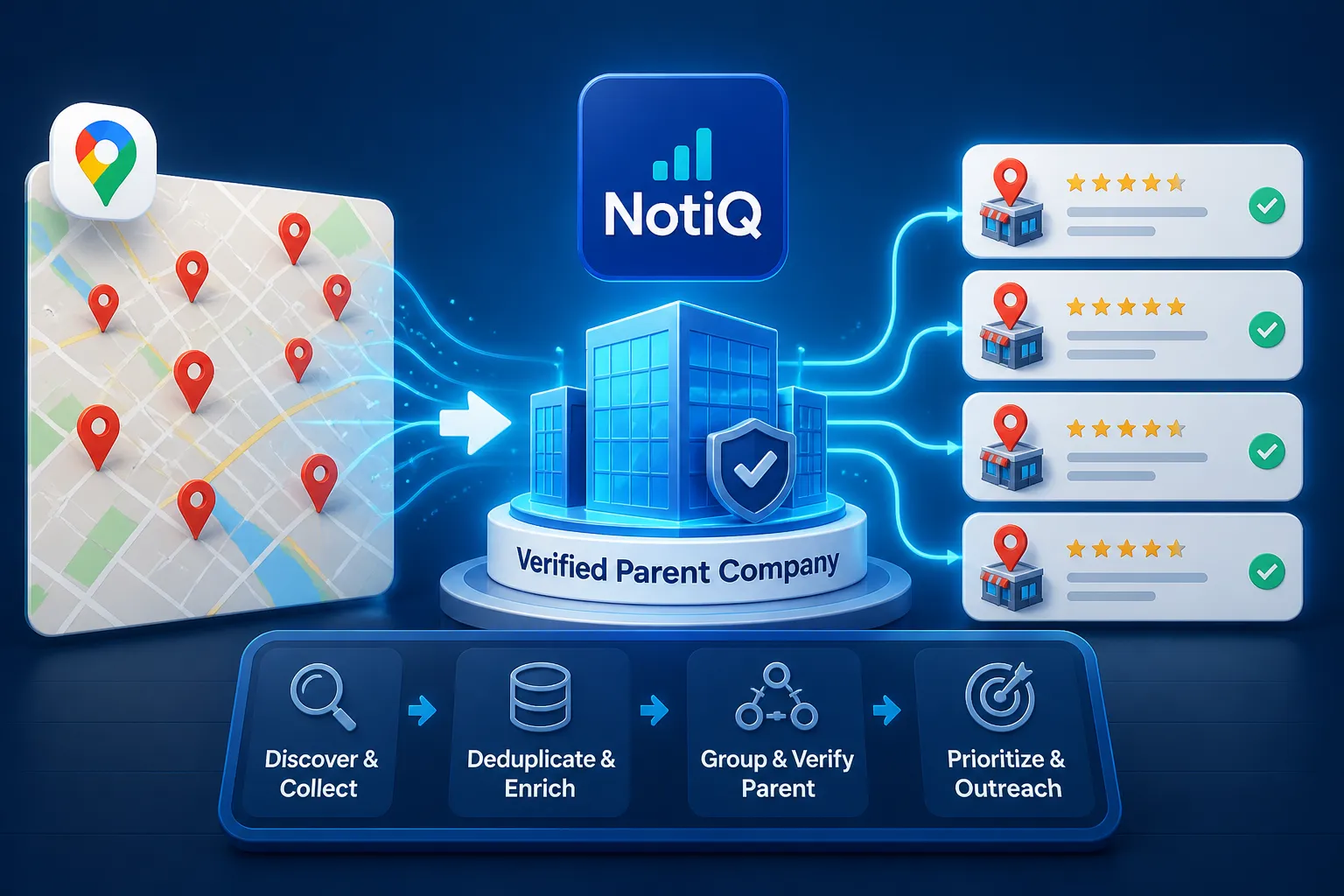
How to Find Businesses With Multiple Google Maps Locations
Learn how to find and verify multi-location businesses in Google Maps, then group branches under parent accounts for better prospecting. This guide shows how to turn raw listings into prioritized, account-based leads.
Read the article →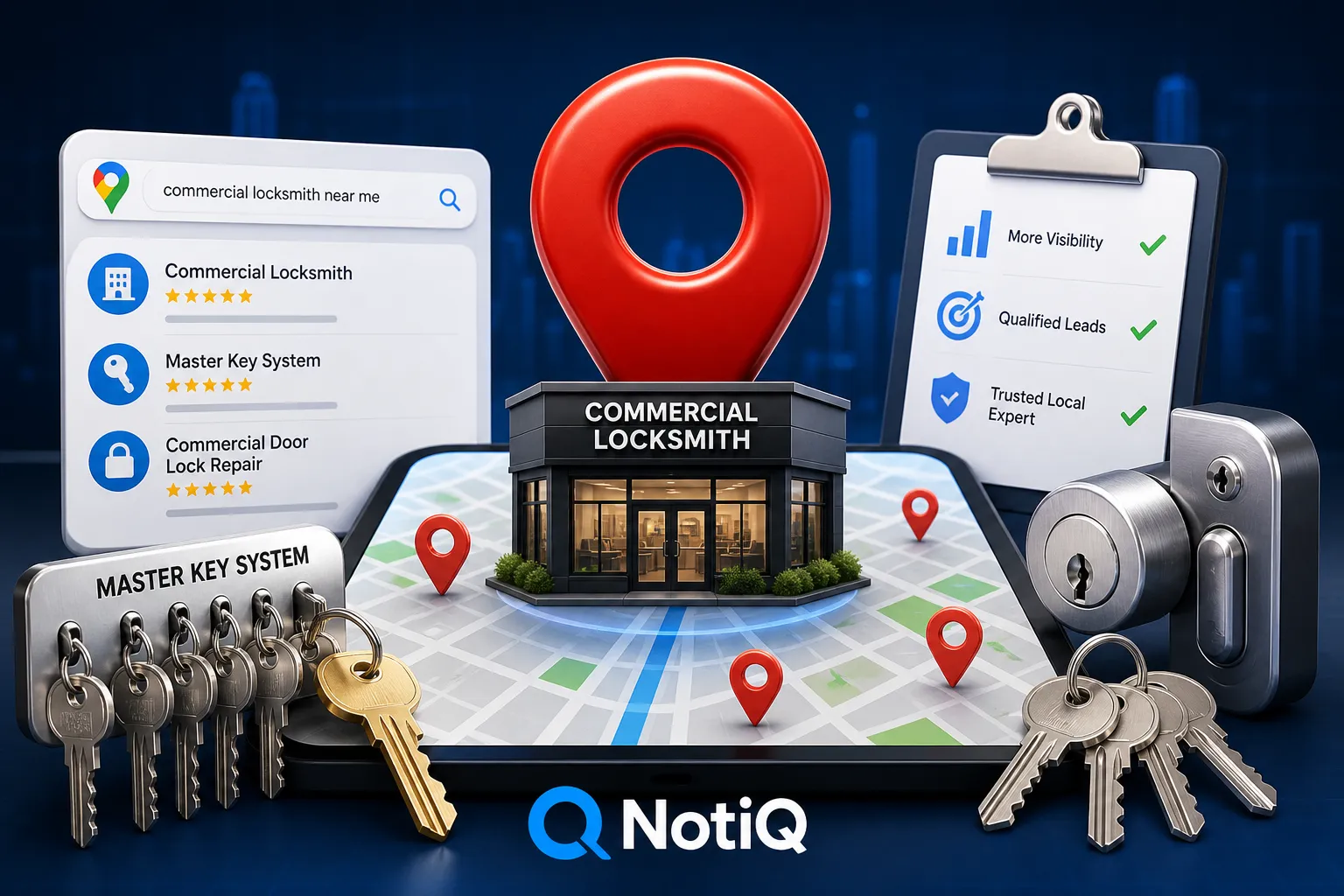
Google Maps Prospecting for Commercial Locksmith Companies
Learn how commercial locksmith companies can use Google Maps to find, verify, and prioritize high-value local B2B prospects. This guide outlines a practical workflow for turning map research into recurring commercial service opportunities.
Read the article →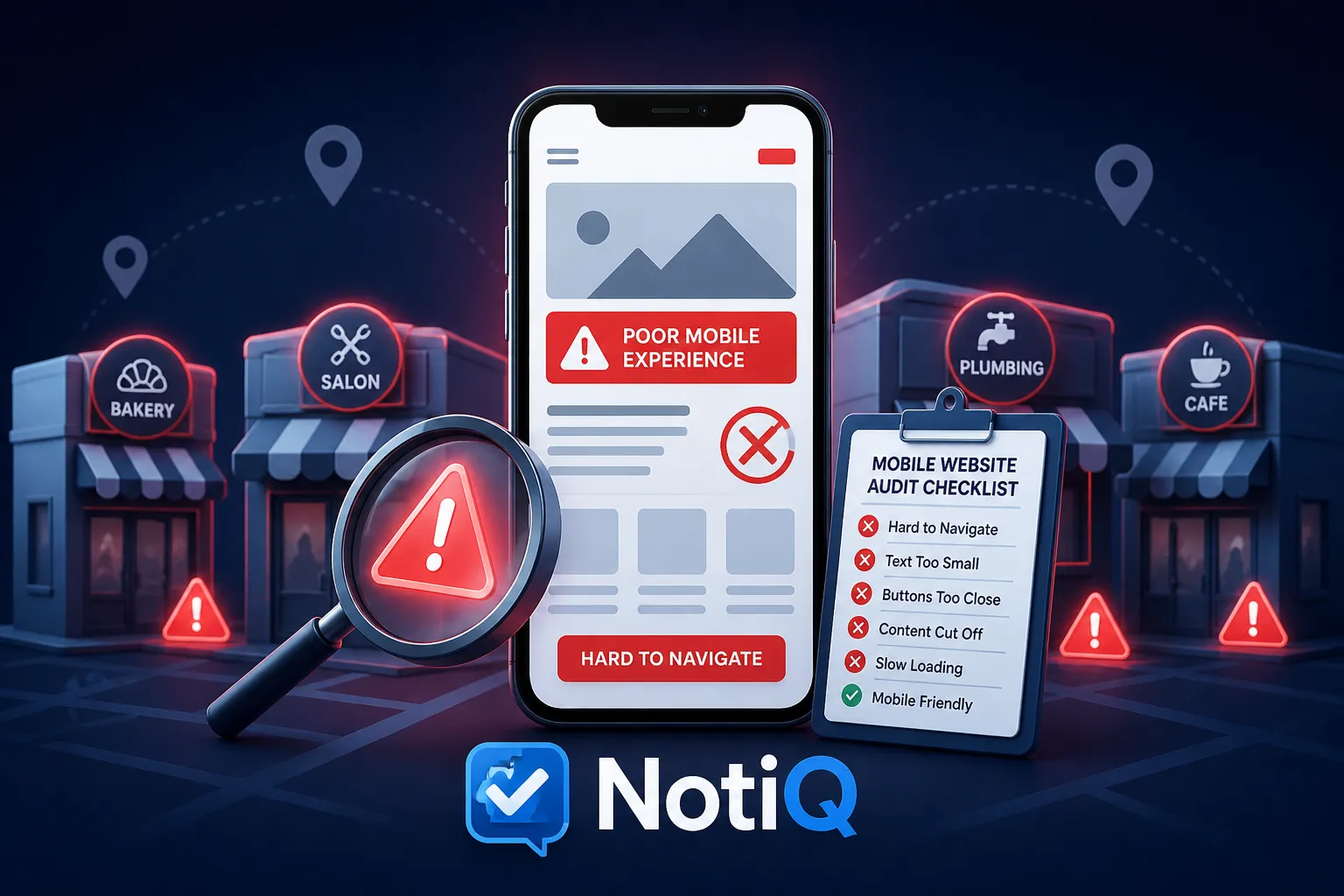
How to Find Local Businesses With Poor Mobile Websites
Learn how to find local businesses with poor mobile websites using a repeatable audit workflow. This guide shows how to validate issues, score prospects, and turn findings into stronger web design leads.
Read the article →Popular industry lead playbooks
Maps search examples and niche outreach for the verticals teams prospect most.