Technology
Google Maps Prospecting for Equipment Rental Companies
Learn how equipment rental companies can turn Google Maps research into qualified local B2B opportunities. This guide covers territory planning, lead qualification, and outreach workflows by city and category.
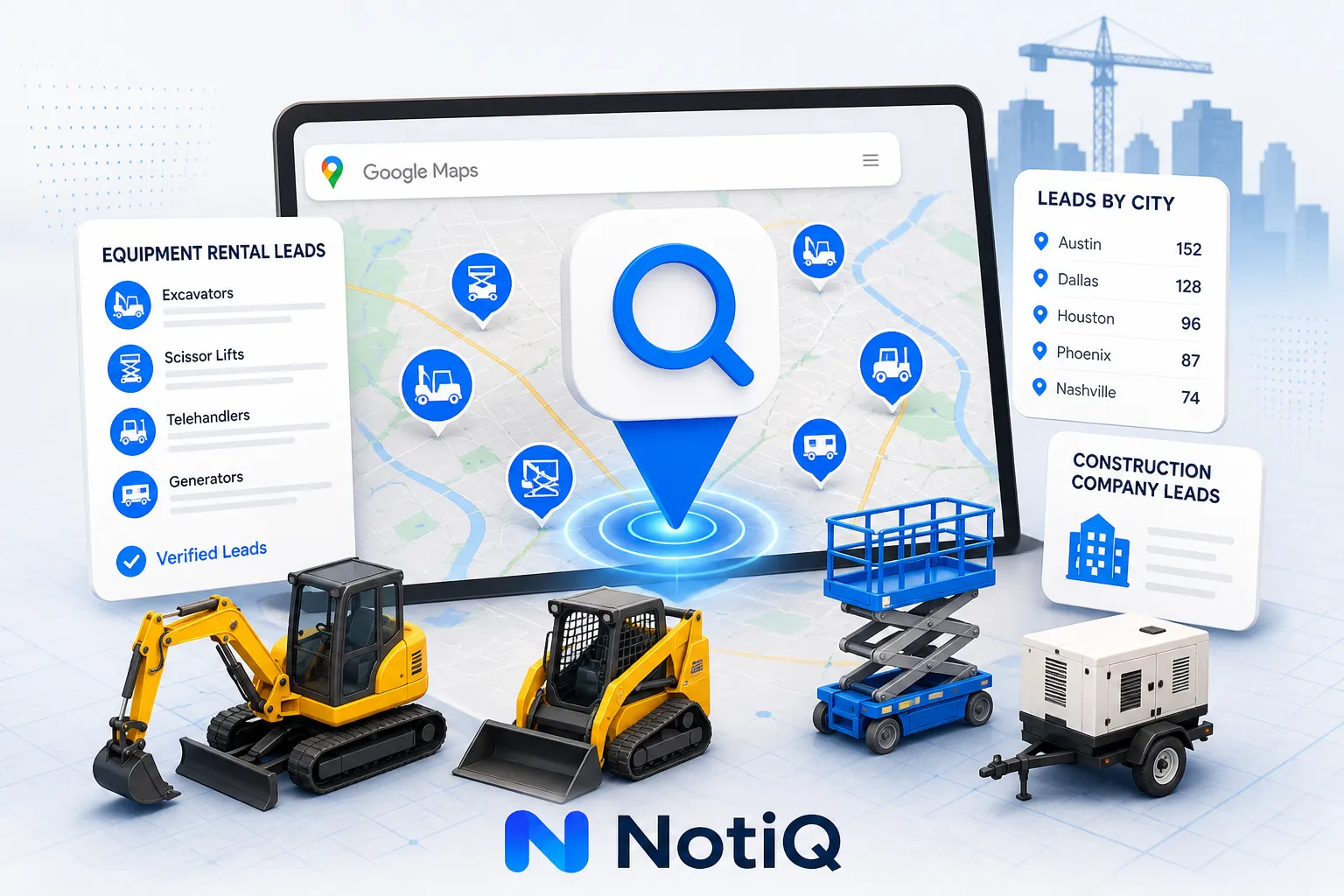
1. Introduction: Why Local Prospecting Matters for Equipment Rental Companies
For construction, industrial, and event equipment rental companies, demand is inherently local. Service areas vary significantly by branch, logistics dictate profitability, and the best local prospects may not currently reside in your company's CRM. Relying solely on inbound requests or existing referrals leaves critical gaps in your pipeline, making proactive local B2B outreach essential for growth.
Google Maps prospecting is a highly effective method for bridging this gap. The platform can reveal a wealth of local businesses—contractors, landscapers, venues, event organizers, infrastructure firms, and utilities—that are actively connected to potential rental demand. However, discovering a business on a map is only the first step. To generate viable equipment rental leads, raw data must be verified, qualified, deduplicated, and routed into a structured outreach process.
This guide outlines a repeatable workflow for identifying and engaging high-value accounts. By defining target categories, searching specific territories, collecting accurate business details, and assessing realistic equipment needs, sales teams can build lists that convert. Designed for intermediate sales professionals and operations managers, this playbook focuses on establishing a sustainable, repeatable sales operation rather than compiling generic, one-off lists.
2. What Makes a Qualified Equipment Rental Lead?
A local business listing is not automatically a prospect. A qualified lead represents an organization that has a realistic, verifiable need for rental equipment within your service capabilities.
Define the Ideal Customer Profile by Market
The ideal prospect for equipment rental company prospecting varies drastically between construction, industrial, landscaping, utilities, logistics, and event sectors. A general contractor requires different machinery and terms than an event production company or a manufacturing facility undergoing seasonal maintenance.
Prospect quality is directly tied to the rental company’s available fleet, branch locations, service area, and preferred customer segments. Rather than dumping every local business into a single, unorganized database, sales teams should create separate prospect lists tailored to specific market segments.
For each segment, build a simple profile outlining:
• Business type: (e.g., Concrete Contractor, Outdoor Venue)
• Geographic area: (e.g., 50-mile radius from the North Branch)
• Likely project or event activity: (e.g., Commercial foundation pouring, summer music festivals)
• Potential equipment category: (e.g., Earthmoving equipment, temporary power generators)
• Relevant buyer or contact path: (e.g., Site Superintendent, Operations Manager)
Targeting specific construction equipment rental leads or event prospects through segmented profiles ensures your equipment rental sales prospecting is highly relevant and efficient.
Identify Equipment-Demand and Location Signals
Business category alone does not guarantee an immediate equipment requirement. To find high-quality heavy machinery rental customers, you must look for specific equipment-demand and location signals.
Location-based prospecting should prioritize distance from a branch, delivery coverage, and the local service radius. A prospect located 10 miles from your yard is operationally more viable than one 100 miles away, especially for heavy equipment requiring specialized transport.
Beyond geography, look for signals indicating temporary capacity needs. For local contractor prospecting, this might include evidence of multiple active job sites, seasonal service expansions, or specialized project awards. It is crucial to distinguish high-confidence signals (such as a contractor winning a municipal infrastructure bid) from assumptions (assuming a landscaper needs excavators year-round) that require human verification.
Build a Consistent Qualification Record
To streamline local business lead generation, establish a standardized qualification record for every prospect. Consistent fields improve handoffs between sales, branch operations, and CRM teams, ensuring that no context is lost during the outreach process.
Every record for equipment rental leads should include:
• Business name
• Business category
• Address and service area
• Website
• Phone or public contact path
• Branch or operating location
• Possible equipment need
• Territory owner
• Verification status
• Next action
By standardizing this data, B2B local lead generation becomes a measurable, organized workflow rather than a chaotic collection of notes.
3. How to Find Equipment Rental Leads on Google Maps
Turning map-based discovery into an organized pipeline requires a strategic approach to search parameters and territory management.
Start with Category and Location Combinations
The most effective Google Maps lead generation relies on combining a specific business category with a city, region, service area, or branch territory. Broad searches for "businesses near me" yield noisy, irrelevant results. Instead, begin with the equipment category and buyer type.
Examples of effective search patterns for machinery rental prospecting include:
• Construction contractors + [Location]
• Landscaping companies + [Location]
• Event planners + [Location]
• Industrial contractors + [Location]
• Utility contractors + [Location]
• Venues or production companies + [Location]
Conducting separate searches for each combination uncovers distinct segments and keeps location-based sales prospecting focused and manageable.
Prioritize High-Value Prospect Categories
Organize your target categories by their likely rental use cases. Category relevance must always be cross-referenced against your rental company’s current fleet availability and service model.
• Construction: General contractors, site contractors, concrete contractors, demolition companies, roadwork firms, and landscapers.
• Industrial: Maintenance contractors, manufacturing facilities, utilities, logistics operators, and infrastructure businesses.
• Event: Event production companies, venues, festivals, rental coordinators, and temporary-installation providers.
To streamline the process of finding construction equipment rental leads, industrial equipment rental leads, and event equipment rental leads, use a search matrix:
Organize Searches by Branch and Service Radius
For multi-location operations, equipment rental territory planning must be divided by branch, territory, city, or delivery radius. Assign ownership of specific territories and categories before research begins so multiple sales representatives do not overlap and contact the same local B2B outreach targets.
A territory-planning example might include:
• Primary branch area: North Metro Region
• Adjacent service area: Surrounding suburban counties
• Priority categories: Roadwork firms and utility contractors
• Existing-account exclusions: Cross-reference with current CRM to remove active clients
• Refresh date: Quarterly review
A local prospect list should reflect your operational ability to deliver equipment efficiently, not just geographic proximity. For teams looking to systemize this process,[NotiQ](/)is a relevant option for organizing equipment rental prospect discovery by category and location, ensuring leads are properly assigned and managed.
4. A Step-by-Step Machinery Rental Prospecting Workflow
Transforming local business discovery into a repeatable routine ensures sales and branch teams maintain a healthy pipeline.
Step 1: Define the Territory, Category, and Objective
Begin every machinery rental prospecting cycle with one clear combination of geographic area, business category, equipment category, branch or territory owner, and prospecting objective.
Narrow search objectives produce far more useful results than attempting to scrape an entire market at once. Clear objectives might include filling a newly opened territory, increasing rental fleet utilization for underused equipment categories (e.g., pushing heaters in autumn), finding seasonal accounts for event season, or executing an equipment rental sales strategy to expand beyond existing word-of-mouth referrals.
Step 2: Discover and Record Local Businesses
During the discovery phase, collect publicly visible business details useful for initial account research. This includes the business name, category, address, website, service area, and public contact paths.
Treat this discovery data as a starting point. A map listing is not automatically a verified sales record. Always record the source of the data, the date of research, and its current verification status to maintain the integrity of your equipment rental leads and overall local business lead generation efforts.
Step 3: Verify Business Details and Remove Duplicates
Human review is a mandatory step before any outreach begins or data is imported into a CRM. Use a strict verification checklist:
• Does the business still operate?
• Does the website match the location and business category?
• Is the company within the relevant service area?
• Is the listing a duplicate, branch, parent company, or service-area business?
• Is the potential equipment need plausible for the business type?
To prevent duplicates across branches, standardize business names, addresses, websites, and account identifiers. Public profiles can frequently contain incomplete or outdated information. As noted in the Google Business Profile guidelines, business names, addresses, categories, and service-area information must accurately reflect the real-world business, but user-generated or unverified data can be inaccurate. Always verify details manually to ensure high-quality equipment rental company prospecting and a clean construction company database for B2B local lead generation.
Step 4: Score and Segment Prospects Before Outreach
Implement a qualitative scoring model to prioritize outreach. Score records based on:
• Category fit
• Distance or serviceability
• Likely equipment relevance
• Website or business-detail completeness
• Evidence of active operations
• Existing relationship or account status
Segment prospects into "high-priority," "needs verification," and "not currently relevant" buckets. Equipment rental lead qualification should always prioritize sales usefulness and closing potential over the sheer volume of businesses collected for equipment rental sales prospecting and local B2B outreach.
5. Category-Specific Prospecting Playbooks
The core Google Maps workflow adapts based on the specific market segment you are targeting.
Construction and Landscaping Prospects
When searching for construction equipment rental leads, focus on contractors and service providers whose projects require temporary machinery, access equipment, site preparation gear, or specialized tools.
Useful qualification questions include:
• What type of projects does the company handle (residential, commercial, municipal)?
• Does it serve the target branch territory?
• Does its website indicate recurring, seasonal, or project-based work?
• Does the company appear to operate multiple crews or locations?
Tailor your outreach for heavy machinery rental customers around equipment availability, delivery coverage, project timing, and solutions for short-term capacity needs. Local contractor prospecting is most effective when you address immediate project bottlenecks.
Industrial, Utilities, Logistics, and Infrastructure Prospects
Industrial equipment rental leads have vastly different buying triggers than general contractors. Industrial and infrastructure accounts often require equipment for facility maintenance work, temporary capacity during peak seasons, site access, logistics operations, and infrastructure upgrades.
Segment these prospects by facility type, contractor, operator, and service provider. Do not treat all industrial businesses as identical. A warehouse logistics operator needs different equipment than a municipal utility contractor. Always verify the actual operating location and relevant service area before assigning a lead to ensure your equipment rental prospecting and local B2B lead generation efforts are accurate.
Event, Venue, and Production Prospects
Event equipment rental leads are closely tied to venues, event organizers, production companies, festivals, and temporary installations. Location, event seasonality, venue capacity, and recurring production activity should guide your prioritization.
Maintain separate lists for venues (which may need long-term rentals like golf carts or light towers), event organizers, production suppliers, and corporate event buyers. Outreach to event equipment buyers should focus on event schedules, guaranteed availability, precise delivery coordination, setup requirements, and contingency capacity for local business outreach.
6. Turning Local Discovery Into B2B Outreach
Verified local accounts must be smoothly transitioned into responsible, relevant outreach.
Match Outreach to Likely Equipment Needs
Avoid generic, mass-blast messages that simply announce your rental availability. Local B2B outreach requires connecting your message to the prospect's specific context.
Tie your equipment rental sales strategy to the business category, location or branch coverage, likely project type, equipment category, seasonal demand, and delivery considerations. Prospecting signals should be used to guide a helpful conversation, not presented aggressively as proof that you know they have an active project. Relevant equipment rental leads respond to tailored problem-solving.
Create Practical Call and Email Angles
When executing equipment rental sales prospecting, use a concise structure: reference relevant local context, state a likely business challenge, mention a specific rental category, and end with a clear question or next step.
Examples of practical angles for machinery rental prospecting and local contractor prospecting:
• For a contractor: "I noticed your crews are handling several commercial builds in the North Metro area. When your owned fleet is stretched thin, we have mini-excavators and skid steers available for next-day delivery in that exact radius. Are you currently looking for backup equipment suppliers for this quarter?"
• For a landscaper: "Heading into the spring season, we know commercial landscaping capacity gets tight. We’ve stocked up on aerators and compact track loaders at our South Branch. Do you anticipate needing temporary machinery to handle seasonal overflow?"
• For an industrial operator: "With upcoming quarterly maintenance cycles, facility access is usually a priority. We have a fleet of electric scissor lifts stationed nearby. Who handles the short-term rental coordination for your facility?"
• For an event organizer: "Managing outdoor setups at [Venue Name] often requires reliable temporary power. We provide localized generator delivery and setup. Are you currently reviewing contingency equipment plans for the upcoming festival season?"
Coordinate Prospecting With Branch and CRM Workflows
Qualified records must be routed to the correct branch, salesperson, territory, or account owner. An effective equipment rental CRM workflow tracks statuses such as researched, verified, contacted, replied, qualified, disqualified, or opted out.
First-party customer and account data should complement public business discovery, ensuring you aren't prospecting active clients. For teams looking to streamline structured discovery, qualification, and workflow organization for equipment rental leads,NotiQ's features provide a robust framework for territory-based sales prospecting.
7. Data Quality, Compliance, and Responsible Prospecting
Trust is paramount. Map research must be conducted legally, ethically, and in full compliance with privacy regulations.
Verify Public Business Information
Public listings frequently contain outdated addresses, duplicate profiles, incomplete categories, or incorrect service-area details. Always check the company’s official website and other relevant public business information before adding them to an outreach workflow. Record the date of data verification for lead generation, and meticulously maintain suppression or do-not-contact lists to ensure responsible B2B outreach stemming from Google Maps prospecting.
Understand Google Maps Usage Limitations
There is a strict legal and operational difference between using Google Maps for visual research and extracting, exporting, or repurposing Maps content in ways that violate applicable terms. Do not use automated scraping tools or extraction software to pull data from Google Maps.
Always review the Google Maps Platform terms before designing any workflow that collects or transfers Maps-derived information. Compliance must be reviewed for the specific tools, methods, geography, and intended use to ensure your operations remain lawful.
Follow Commercial Email and Privacy Requirements
Compliant B2B outreach requires strict adherence to commercial email regulations. Responsible practices include:
• Using accurate sender identification.
• Avoiding deceptive subject lines or claims.
• Including a clear, functional opt-out mechanism.
• Maintaining up-to-date suppression lists.
• Using contact data strictly for appropriate and lawful B2B purposes.
• Reviewing applicable requirements for each recipient’s specific location.
For U.S. commercial email requirements, ensure strict alignment with the FTC CAN-SPAM compliance guide. For privacy-conscious lead generation, profiling, objections, and suppression processes in the UK/EU, adhere to the ICO direct marketing guidance. Privacy-aware prospecting protects your brand and ensures long-term commercial email compliance.
8. Tools and Workflow Options: Manual Maps Research vs. Structured Prospecting
Evaluating the right approach depends on workflow fit, team size, and operational maturity.
Where Google Maps Helps
Google Maps is exceptional for visual territory research, local category discovery, branch identification, finding websites, identifying service-area clues, and gaining market familiarity. Manual research is highly appropriate for small, focused searches, or for validating priority accounts.
However, Maps alone does not provide equipment-need qualification, deduplication, lead scoring, or a structured outreach process. It is a research tool, not a complete system for Google Maps prospecting, local business lead generation, or managing equipment rental leads.
Limitations of General B2B Prospecting Platforms
General sales-intelligence and B2B prospecting platforms (like Apollo or ZoomInfo) are useful for account or contact enrichment. However, they often fall short for equipment rental company prospecting.
General platforms lack the local context needed for local B2B outreach. Teams often require additional manual work to identify local branches and yards, actual service areas, specific equipment categories, rental-specific buying signals, and duplicate locations that generic platforms miss.
How a Rental-Focused Workflow Can Improve Organization
A rental-focused process is differentiated by category filters, location filters, qualification fields, territory ownership, verification, and outreach readiness. A structured workflow eliminates the chaos of fragmented spreadsheets and generic purchased lists.
Solutions like[NotiQ](/)offer equipment rental businesses a structured environment for category- and location-based prospect discovery. Additionally, tools like Scaliq AI represent adjacent AI-enabled workflow resources that can assist in broader sales operations, though they serve a distinct role from the core equipment rental prospecting software and AI-assisted local prospecting workflows focused purely on location-based prospecting.
9. Refreshing and Expanding Your Equipment Rental Lead Lists
Prospecting is an ongoing operating rhythm, not a one-time list-building project.
Set a Refresh and Verification Routine
Local businesses frequently move, close, change categories, or update their service areas. Set a routine to review records regularly. Organize these refreshes by branch, category, season, or equipment demand. Track when each account was last reviewed and whether its qualification status has changed to maintain data freshness for your equipment rental leads and local business lead generation efforts.
Identify Underserved Territories and Categories
Continuously compare your current prospect coverage with branch service areas, existing accounts, equipment categories, geographic gaps, and seasonal demand. Local prospecting often reveals markets and clusters of businesses entirely outside a sales team’s usual referral network.
Use these territory findings to inform territory-based sales prospecting priorities and fleet utilization conversations, ensuring your equipment rental sales strategy targets actual market gaps.
Measure Workflow Quality
Evaluate the success of your process using operational metrics. Measure the percentage of records successfully verified, the duplicate rate, the accuracy of records assigned to the correct territory, how well prospects are segmented by equipment category, outreach readiness, and refresh completion rates.
Data quality and relevance for equipment rental lead qualification should always be assessed alongside actual outreach outcomes to continuously refine your B2B local lead generation and local B2B outreach.
10. Conclusion: Build a Repeatable Local B2B Outreach System
Effective equipment rental prospecting is a comprehensive system. It requires defining customer and equipment categories, executing branch-level location planning, structuring business discovery, conducting human verification, managing duplicates, scoring leads, executing relevant outreach, and maintaining strict compliance-aware data handling.
While Google Maps is a powerful tool for local discovery, it must be integrated into a broader workflow rather than treated as a standalone lead-generation system. Start small: begin with one branch, one market segment, and one equipment category before scaling your efforts.
For construction, industrial, and event equipment rental companies looking to build a more structured approach to category- and location-based prospect discovery, explore[NotiQ](/)to organize and accelerate your local B2B outreach and machinery rental prospecting.
Frequently Asked Questions
- How can equipment rental companies find new B2B leads on Google Maps?
- Equipment rental companies can find leads by combining specific business categories with targeted locations (e.g., "concrete contractors in [City]"). Searching for construction, industrial, landscaping, utilities, event, venue, and production businesses reveals relevant local operations. All Google Maps prospecting listings require human verification before being treated as equipment rental leads.
- What Google Maps categories are useful for finding equipment rental prospects?
- Useful categories depend entirely on your rental fleet and target market. High-value categories include general contractors, landscapers, industrial facilities, utility providers, logistics operators, event venues, event organizers, and production companies. These categories yield the most relevant construction equipment rental leads, industrial equipment rental leads, and event equipment rental leads.
- How should equipment rental leads be qualified before outreach?
- Leads should be qualified using a standardized record that includes business type, service area, location, website, likely equipment need, verification status, and territory ownership. Remember that category relevance indicates potential, but does not prove active purchase intent during equipment rental lead qualification and equipment rental sales prospecting.
- How can rental companies prevent duplicate prospects across branches?
- Prevent duplicates by using standardized business names, addresses, websites, branch records, ownership fields, and verification dates in your CRM. It is vital to understand the difference between a true duplicate listing, a regional branch, and a parent company when managing equipment rental territory planning and local business lead generation.
- Is Google Maps prospecting better than a purchased lead list?
- Both have distinct roles. Google Maps lead generation provides crucial local and visual context that is highly relevant for equipment rental company prospecting. Purchased lists offer scale but can quickly become stale or lack rental-specific context. Neither method removes the need for human verification and qualification in B2B local lead generation.
- How can equipment rental companies make local outreach compliant?
- Compliant B2B outreach requires accurate sender information, non-deceptive messaging, clear opt-out handling, active suppression lists, privacy reviews, and adherence to regional requirements. Always consult the FTC, Google Maps Platform terms, Google Business Profile guidelines, and ICO sources to ensure commercial email compliance and privacy-aware prospecting.
- How often should local equipment rental prospect lists be refreshed?
- Refresh frequency should reflect market changes, seasonality, branch expansion, and the critical importance of data accuracy. Track verification dates and review records systematically—often quarterly or bi-annually—to ensure data freshness for your equipment rental leads and location-based prospecting.
Continue Reading
More articles you might find useful
Google Maps Lead Generation for Tree Service Companies
Learn a practical system for finding and qualifying tree service leads on Google Maps. This guide shows how to segment opportunities, follow up compliantly, and turn local research into booked jobs.
Read the article →
How to Build Lead Lists From Businesses Near Universities
Learn how to build cleaner, more targeted lead lists for businesses near universities. This guide covers geography, validation, scoring, and outreach to improve prospect quality.
Read the article →
How to Find Local Businesses Using Free Email Providers
Learn how to find local businesses using Gmail and other free email providers, then validate them with stronger signals before outreach. This guide shows a practical workflow for smarter local lead generation.
Read the article →Popular industry lead playbooks
Maps search examples and niche outreach for the verticals teams prospect most.