Technology
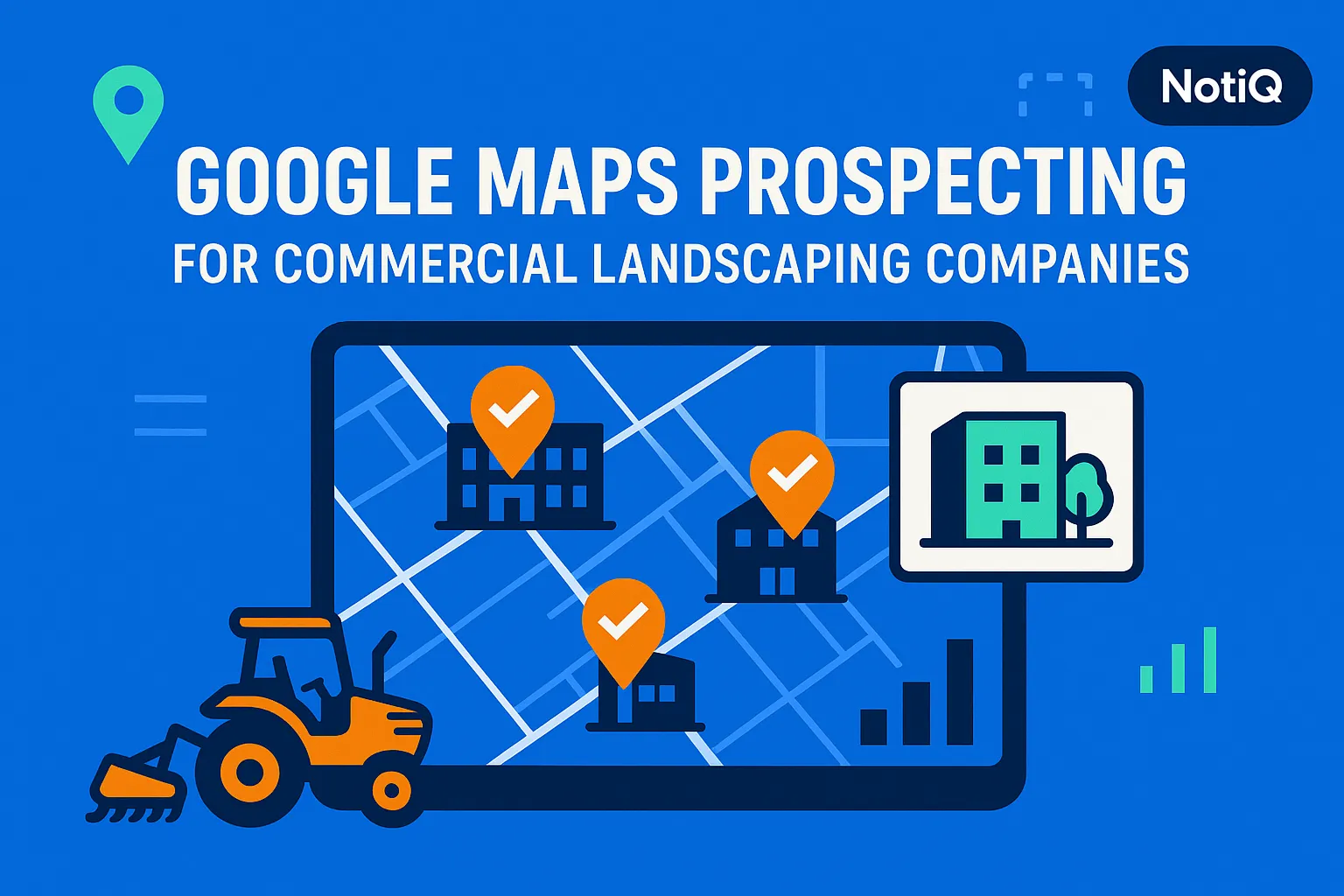
Google Maps Prospecting for Commercial Landscaping Companies
Learn how commercial landscaping companies can use Google Maps to find higher-fit commercial property leads, qualify visible need, and build denser service routes. This guide breaks down a practical workflow for smarter prospecting and better contract opportunities.
1. Introduction
Many commercial landscaping companies do not have a lead problem as much as they have a qualification and territory problem. Sales teams and branch managers can easily find plenty of local business listings, but too many of these records are low-fit, scattered haphazardly across a map, or tied to the wrong buyer.
For commercial landscaping, the best prospects are not simply nearby businesses. They are properties that fit your specific service scope, show visible grounds maintenance needs, align with route density, and connect to the right decision-maker. Google Maps Prospecting for Commercial Landscaping Companies provides a practical prospecting engine for finding, qualifying, and prioritizing these exact commercial property leads for lucrative grounds maintenance contracts.
This is not a generic local lead generation guide. It is an operations-first process built specifically for office parks, hospitality venues, retail centers, industrial sites, and multi-site operators. In this guide, we will cover property discovery, qualification, decision-maker research, territory planning, and localized outreach workflows. By treating prospecting as an extension of operations, platforms like[NotiQ](/)provide the operational layer that helps organize territory research and outreach workflows, ensuring your sales efforts directly support field efficiency and route profitability.
2. Why Google Maps Works for Commercial Landscaping Prospecting
Google Maps is exceptionally useful for commercial landscapers compared to generic lead lists, referral networks, or broad databases. The primary advantage lies in local context. Maps provides a wealth of publicly accessible data that competitors often miss: exterior photos, customer reviews, location clustering, business categories, and visible signs of property condition.
Crucially, this provides a massive operational benefit. Prospecting can be directly aligned to territory design, route density, and crew efficiency, rather than just chasing raw lead volume. While static databases and purchased lists quickly become outdated, Google Maps offers fresh, locally visible, and visually validated data. It solves the most common pain points in commercial sales: inconsistent lead flow, wasted manual review time, weak fit scoring, and poor service-area coverage.
To understand the boundaries of what data is natively available and how properties present themselves, reviewing Google Business Profile guidelines is highly recommended. Unlike generic B2B lead tools that prioritize contact volume over service-area fit and visible need, a NotiQ-style workflow uses Map data compliantly to build highly targeted, operationally sound prospect lists.
What Google Maps Gives You That Generic Lead Sources Often Do Not
On-map context is everything in commercial landscaping marketing. Maps reveals the business category, nearby property clusters, user-uploaded images, traffic patterns, and review signals. These visual cues allow landscapers to quickly spot likely grounds maintenance opportunities without ever leaving the office. You can identify sparse planting beds, inconsistent turf, or complex hardscaping that requires specialized care.
However, it is important to recognize that Google Maps is strongest at top-of-funnel discovery and first-pass qualification. It is not a complete account intelligence tool by itself, but rather the foundational layer for Google Maps lead generation that informs the rest of your property manager prospecting.
Why Commercial Landscapers Need an Operations-First Prospecting Approach
A "good lead" in B2B landscaping sales is not just a business with a phone number. It is a site that matches your service capability, offers strong contract potential, and fits neatly into your routing logic.
An operations-first prospecting approach reduces windshield time, enables tighter crew deployment, and drives better account profitability. This niche advantage separates high-performing grounds maintenance contracts from generic local outreach aimed at residential or general service businesses. When sales and operations are aligned, every new contract makes the entire branch more efficient.
3. How to Find Target Properties by Geography and Property Type
Building a repeatable workflow for sourcing commercial landscaping leads starts with defining your service areas. Begin with geography first: isolate a city, submarket, commercial corridor, ZIP code cluster, or a specific service radius based on your current crews and branch coverage.
Next, layer in the property types that commonly outsource landscaping: office parks, hospitality venues, retail centers, industrial sites, medical campuses, and multi-site operators. By searching in clusters rather than pulling random, one-off properties, you immediately improve route density.
A systematic approach to geographic discovery, similar to the logic found in Google Places API nearby search documentation, ensures you are compliantly and systematically uncovering every viable property in a given radius. For robust territory organization, property research, and workflow support,NotiQ's features can help structure these searches efficiently.
Start With Service Areas, Not Broad Markets
Define a realistic service territory based on branch location, crew availability, travel tolerance, and seasonal capacity. Prospecting a tight 20-minute cluster is almost always more valuable than collecting listings scattered across an entire metropolitan area.
Rank your submarkets by current density, expansion goals, and revenue potential. This disciplined, B2B local prospecting workflow ensures your local outreach yields highly serviceable grounds maintenance prospecting targets.
Search by Property Type to Improve Fit
Focus your efforts on the highest-fit categories. To ensure accuracy in your segmentation, referencing standard U.S. Census property type definitions can help clarify commercial property categories. Office parks, hotels, retail centers, industrial properties, medical offices, HOAs, and multifamily units all have different outreach angles, budget expectations, and grounds standards.
For example, office park landscaping contracts are often driven by tenant retention and curb appeal, whereas hospitality landscaping leads prioritize guest experience and pristine seasonal color. Understanding these nuances makes your commercial property leads far more actionable.
Use Map Signals to Build Local Clusters
Group nearby prospects into routes or mini-territories rather than treating them as single records. Clusters support better crew utilization and allow your local outreach messaging to be highly specific (e.g., "We already service three properties in the Westside Industrial Park"). Create shortlists by business park, retail corridor, hospitality strip, or industrial zone to maximize route density and appeal to multi-site operator prospecting.
4. How to Qualify Leads Using Visible Need, Portfolio Size, and Fit
Scaling outreach without qualification is a recipe for wasted time. You must separate high-potential commercial landscaping leads from low-value map listings by building a qualification framework around visible grounds condition, property complexity, likely contract value, buyer type, and route compatibility.
Understanding how buyers evaluate contractors is key; resources like UF/IFAS landscaping contract guidelines provide excellent insight into the standards commercial buyers expect. Furthermore,state facility landscaping contract guidance illustrates how grounds maintenance is often procured in structured, contract-oriented ways, requiring a highly professional approach to property manager prospecting.
Look for Visible Need in Photos, Reviews, and Listing Context
Review publicly available photos on Maps for signs of deferred maintenance. Look for inconsistent edging, weak curb appeal, overgrowth, sparse planting beds, or neglected entrances.
Use reviews carefully. They are not definitive proof of landscaping issues, but they offer supporting context for service quality concerns, upkeep complaints, or management responsiveness. This method has limits—you cannot infer everything from a listing—but it is a highly effective first step for Google Maps lead generation and commercial landscaping marketing.
Score Properties by Contract Potential and Service Fit
Rank mapped sites by size, complexity, service frequency needs, visibility, and whether they likely need recurring grounds maintenance contracts rather than one-time cleanups. A medium-sized property in a dense route is often more valuable than a larger, isolated account. Factor in equipment requirements, crew specialization, irrigation needs, seasonal color, and enhancement opportunities to ensure strong B2B landscaping sales alignment.
Identify Multi-Site and Portfolio Expansion Signals
Look for regional brands, management groups, or operators that control multiple nearby properties. One mapped property can easily become an entry point into a broader portfolio conversation. Note naming patterns, repeated operators, and location clusters as clues. This is the foundation of effective multi-site operator prospecting and facility manager outreach.
Build a Simple Qualification Checklist
Create a standardized scoring model. Include fields such as property type, visible condition, estimated size, buyer type, likely decision-maker, route fit, portfolio potential, and outreach priority. Use a high/medium/low scoring range or a weighted point system. Always include a "why this account matters" note to help personalize future lead qualification efforts.
5. How to Identify Decision-Makers and Organize Territories
Moving from property discovery to account ownership requires strategic territory planning. You must understand the difference between local site contacts and regional portfolio decision-makers. Organizing prospects by territory, asset type, and account cluster ensures that sales activity maps directly to operations.
Commercial landscaping outreach wins faster when teams know exactly who they are selling to. Many competitor tools stop at basic business records, leaving a gap where landscapers actually need account structure and operational relevance. Tools that offer AI-assisted enrichment and workflow automation, like ScaliQ, are invaluable for scaling decision-maker research compliantly.
Determine Whether the Site Is Locally Managed or Regionally Controlled
Look for signals indicating whether a site is part of a larger portfolio or independently managed. This fundamentally changes your outreach strategy, timing, and the level of messaging detail required. An independent office park requires a different conversation than a national hotel group, retail chain, or industrial portfolio. Accurate facility manager contact research is essential here.
Match the Outreach Angle to the Buyer Type
Messaging must shift depending on the audience. Property managers care about tenant experience and curb appeal; facility managers care about safety and vendor consolidation; hospitality operators care about pristine first impressions. Tailor your B2B landscaping sales pitch to these specific outcomes. A strong local outreach statement might be: "We help facility managers in the North Corridor reduce vendor management burden through consolidated, proactive grounds care."
Organize Prospects Into Territories That Sales and Operations Can Both Use
Build territories around route density, branch coverage, and service mix. The handoff between sales and operations improves dramatically when account clusters are documented clearly. Tag commercial landscaping leads by submarket, priority, buyer type, and route cluster to streamline grounds maintenance prospecting.
6. How to Turn Mapped Prospects Into Repeatable Local Outreach
Research is only valuable if it converts into a practical, repeatable outreach workflow. Your sequence must move seamlessly from mapped property discovery to qualification, enrichment, first-touch messaging, and follow-up.
Personalized local outreach always beats generic cold messaging. Show the prospect that you understand their property type, their local footprint, and their specific service needs. Always ensure your outreach references observable property context rather than making unverified assumptions. To manage this process,[NotiQ](/)serves as the ideal workflow layer for moving from mapped research to organized prospecting and follow-up.
Capture the Right Data Before Outreach
Collect the minimum useful fields: property name, address, type, visible need notes, cluster, estimated fit, decision-maker role, portfolio clues, and outreach angle. Collecting too little data results in generic facility manager outreach; collecting too much slows your team down. Standardize this data gathering so your team can evaluate commercial property leads consistently.
Personalize Messaging Based on Property Type and Observable Context
Reference the asset type, curb appeal expectations, footprint complexity, or multi-site consistency needs in your messaging. Do not just say, "We do landscaping." Speak to business outcomes. For office park landscaping contracts, mention tenant retention. For hospitality landscaping leads, mention guest arrival experience. For industrial sites, mention sightline safety and debris management.
Build a Simple Follow-Up Sequence
Establish a practical cadence: a first touch, a follow-up with added context, a check-in tied to a specific season or service need, and requalification later if the timing is off. Local timing matters immensely around peak growing seasons, contract renewal windows, property transitions, or visible maintenance changes. Use the account notes gathered from Maps to make every follow-up highly relevant to grounds maintenance contracts.
Measure What Makes the Workflow Better Over Time
Track metrics that matter: qualified properties per territory, response rates by asset class, meetings booked, route density gained, and closed revenue by cluster. The best local business prospecting system gets smarter over time as teams track which property types and geographies actually convert. Treat this as a repeatable revenue engine, not a one-time list-building task.
7. Tools and Resources to Support Google Maps Prospecting
Making this process repeatable requires the right infrastructure, especially as you scale. Practical components include map discovery interfaces, qualification templates, CRM or spreadsheet tracking, decision-maker enrichment, and workflow automation.
Manual prospecting is often enough for a single rep working a tight radius. However, software support becomes highly valuable when managing larger territories, multiple reps, or multi-location research. It is critical to differentiate software-assisted workflows from generic scraper tools. Ethical, compliant Google Maps lead generation relies on publicly accessible data aligned with API terms of service. Operational relevance, proper account clustering, and compliant facility manager contact research are the true differentiators for scaling commercial landscaping leads effectively.
8. Conclusion
Google Maps is a high-value source of commercial landscaping leads when teams use it strategically to find the right property types, qualify visible need, identify the right buyer, and organize accounts by route density. The best Google Maps Prospecting for Commercial Landscaping Companies improves both sales performance and field operations simultaneously.
Start small: focus on one territory, one property segment, and one simple scoring framework rather than trying to map an entire market at once. By building a repeatable local prospecting system, you ensure a steady pipeline of highly qualified grounds maintenance prospecting targets. As an operational prospecting platform, NotiQ provides the necessary architecture for organizing commercial property research, territory planning, and outreach execution, turning map data into profitable commercial contracts.
Frequently Asked Questions
- How can commercial landscaping companies use Google Maps to find leads?
- Search within a defined service area, filter by relevant commercial property types, review listing context (photos and reviews), and group prospects into local clusters. Google Maps lead generation is best used for discovery and first-pass qualification, which is then combined with targeted decision-maker research to find high-quality commercial landscaping leads.
- Which commercial property types are best for grounds maintenance prospecting?
- The best segments typically include office parks, hospitality venues, retail centers, industrial properties, and medical campuses. However, the ideal segment depends heavily on your specific service capabilities, desired contract size, and current route density. Targeting office park landscaping contracts and hospitality landscaping leads often yields strong recurring revenue.
- What information should you collect from Google Maps before outreach?
- Capture the property name, address, category, photos, review signals, visible need notes, nearby cluster data, likely buyer type, and any portfolio clues. Collecting these fields ensures stronger qualification and highly relevant facility manager outreach, turning raw data into actionable commercial property leads.
- How do you qualify a commercial landscaping lead from a local listing?
- Score properties based on visible grounds condition, service fit, asset class, route compatibility, and multi-site potential. Avoid treating every listing equally; disciplined property manager prospecting requires focusing only on sites that align with your operational strengths and grounds maintenance prospecting goals.
- Is Google Maps better than buying commercial landscaping lead lists?
- Google Maps offers stronger local context and better visual validation, whereas purchased lists may offer scale but often lack accuracy and operational relevance. The most effective local business prospecting process combines the local discovery of Maps with compliant enrichment, disciplined qualification, and accurate facility manager contact research.
Continue Reading
More articles you might find useful
How to Find Businesses With Weak Google Maps Descriptions
Learn how to find businesses with weak Google Maps descriptions and turn visible GBP gaps into qualified local SEO leads. This guide covers audit criteria, scoring, and outreach angles you can use at scale.
Read the article →
Google Maps Lead Generation for Pest Control Companies
A beginner-friendly playbook for turning Google Maps visibility into more pest control leads. Learn how to improve rankings, build reviews, and convert local searches into booked jobs.
Read the article →
How to Build Lead Lists From Businesses Inside Shopping Centers
Learn how to build accurate prospect lists from businesses inside malls using tenant directories, place data, validation, and deduplication. This guide shows a center-first workflow for cleaner retail outreach.
Read the article →Popular industry lead playbooks
Maps search examples and niche outreach for the verticals teams prospect most.