Technology
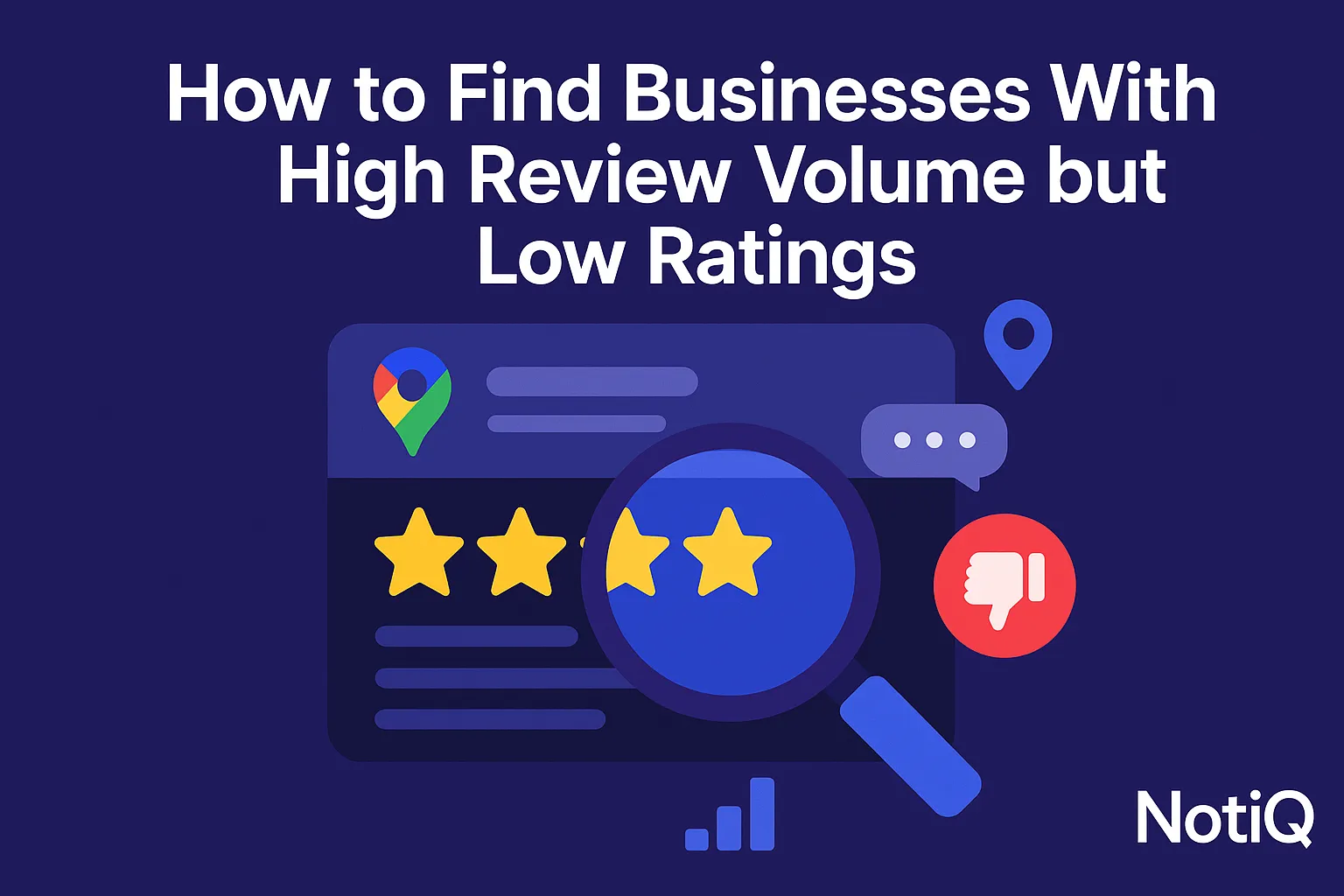
How to Find Businesses With High Review Volume but Low Ratings
Learn how to find visible local businesses with lots of reviews but weak ratings using Google Maps signals, review trends, and owner response gaps. This blueprint helps agencies prioritize stronger reputation management leads and personalize outreach.
1. Introduction
Some local businesses are already highly visible, already getting customer attention, and already collecting lots of reviews—yet their ratings still signal lost trust and conversion leakage. This presents a massive, untapped opportunity for agencies.
Most teams either prospect manually in Google Maps without a clear framework or buy generic lists. Neither approach reliably surfaces businesses with urgent, obvious reputation problems. This is not a general Google Maps lead gen guide; it is a repeatable system for finding high review low rating businesses using publicly available review data, rating thresholds, recency, owner responses, and visibility clues.
Written for agencies and lead gen teams selling reputation management, local SEO, or conversion-focused services, this blueprint provides a clear framework: identify, qualify, score, segment, and turn review insights into high-converting outreach. At NotiQ, our positioning centers around identifying visible businesses with reputation gaps using specific review count and rating combinations, allowing you to pinpoint prospects who actually need your help.
For more local SEO and prospecting frameworks, visit our blog.
2. Why High-Review Low-Rating Businesses Are Valuable Prospects
These specific business profiles are significantly more valuable than generic local business lists or broad B2B databases. The core logic is simple: a high review volume signals real customer flow and market visibility, while a weak rating signals unresolved trust issues.
When pitching businesses needing reputation management, you must reframe the pain from "bad branding" to "lost clicks, calls, and conversions." This is highly commercially relevant for agencies. Contrast these leads with low-review businesses: a company with only a handful of reviews may have a reputation issue, but the opportunity is less visible and often less urgent.
This pattern creates stronger outreach relevance because the problem is public, measurable, and easier to contextualize. Unlike typical generic lead databases that offer no insight into a company's immediate pain points,high-volume review businesses with low ratings offer a clear entry point. The impact of this is well-documented;research on online listings and business performance proves that online reputation directly influences revenue.
What Counts as a “Reputation Gap”?
A reputation gap analysis looks for strong visibility and review activity paired with below-expectation ratings or negative sentiment patterns. The opportunity is not just a low star rating; it is the mismatch between the attention the business receives and the trust it has earned.
The best low-rated local businesses to target sit right in the middle: they are visible enough to matter, yet weak enough to improve. Rather than relying on one universal threshold for every industry, effective review score analysis requires comparing a business's rating against its direct, local competitors to measure the true gap in consumer trust.
Why These Leads Convert Better Than Generic Prospect Lists
Review-based prospecting creates deep contextual relevance before outreach even starts. Visible pain points drastically outperform generic firmographic targeting when selling reputation management leads.
Because these businesses are already receiving review volume, they provide built-in proof of demand. This makes the business case for your services much easier to justify. While most competitors talk about Google review lead generation broadly, they miss the mark on how to identify distressed prospects systematically. Mastering this local SEO lead generation strategy gives you a massive advantage over agencies relying on static, unverified lists.
3. How to Find Them in Google Maps and Google Business Profile
To build a practical, repeatable workflow, you must first master manually finding these prospects before moving to automation. The search process begins with a simple category plus city query. From there, you inspect listings for review counts, star ratings, and visible pack presence.
Use Google Maps and Google Business Profile data as discovery signals rather than final qualification criteria on their own. Document your prospects in a spreadsheet with columns for category, city, rating, review count, recency, owner response behavior, and notes. This manual Google Maps prospecting helps your team learn the patterns of distress before scaling up.
Understanding how Google review scores are calculated will help you analyze these Google Business Profile prospecting signals accurately. Once you master the manual process, you can use[NotiQ](/)to operationalize and scale this review-based Google Maps lead sourcing workflow.
Start With Category + Geography Searches
Begin your Google Maps prospecting with targeted search logic, such as "plumbers in Chicago" or "roofing contractors near me." Geography matters immensely: city size, competitive density, and local review culture affect what qualifies as a strong lead.
Use industry-specific searches to compare reputation patterns across categories. When you find low-rated businesses on Google Maps, collect a first-page sample to establish a baseline before expanding to surrounding areas. This localized approach ensures your local SEO prospecting by reviews remains highly relevant.
Review Count and Rating: The First-Pass Filters
Scan the search results for high review low rating businesses. Avoid rigid, universal thresholds too early in the process. Instead, compare a listing against others in the same SERP and category.
The best prospects combine massive proof-of-demand (high review counts) with obvious rating underperformance. There is a distinct difference between a low rating with no traction (e.g., a 3.2 rating with 4 reviews) and a low rating with strong market visibility (e.g., a 3.8 rating with 450 reviews). Proper review score analysis on high-volume review businesses focuses exclusively on the latter.
Use Local Visibility as a Multiplier
A listing ranking prominently in Maps or local pack results has a much more urgent reputation issue because thousands of searchers are actively seeing their weak rating. Visibility amplifies both the pain for the business and the pitch for your reputation management services.
Note whether the listing consistently appears for core local intent terms. This ties directly into Google’s algorithms; understanding Google’s local ranking factors such as relevance, distance, and prominence will help you explain to prospects why their Google Business Profile prospecting profile is leaking revenue. This makes for highly compelling local SEO lead generation and Google Maps lead sourcing.
4. Qualification Criteria Beyond Star Rating
Star rating alone can be misleading. To improve lead quality, you must layer in secondary signals. Two businesses with the exact same rating may be entirely different prospects depending on review recency, owner behavior, and sentiment concentration.
Moving from surface-level list building to real qualification requires a deeper review score analysis. This is a key differentiator from broader competitor content that stops at reviews as a generic trust metric. To find the best businesses needing reputation management, your reputation gap analysis must go deeper.
Review Recency and Negative Trend Signals
Recent negative reviews create much more immediate sales triggers than old, stale complaints. Look for clusters of recent negative reviews, declining average sentiment, or a visible run of unresolved complaints.
This is evidence that the problem is active right now, not historic. Note whether poor reviews mention repeatable operational issues. These review score analysis insights provide perfect, tailored angles for your reputation management leads.
Owner Response Rate and Response Quality
A lack of owner responses often indicates absolute neglect, while weak, argumentative, or defensive responses reveal internal process problems. Response behavior adds critical nuance: a 3.9-star listing with thoughtful, professional responses is a very different prospect from a 3.9-star listing with total silence.
Owner response gaps create highly personalized outreach angles. This is one of the most overlooked qualifiers in broad Google Business Profile prospecting when targeting businesses needing reputation management.
Sentiment Concentration and Complaint Patterns
Look for repeated themes in the text of the reviews: excessive wait times, poor communication, billing issues, rude staff, or unmet expectations. Repeated complaint patterns strengthen both your qualification and your outreach because they indicate systemic friction rather than random, one-off dissatisfaction.
Recurring issues point directly to trust and conversion leakage. A proper reputation gap analysis on businesses with bad Google reviews allows you to turn these review score analysis patterns into highly segmented outreach messaging.
Why Compliance and Ethics Matter in Reputation Prospecting
The goal of your service must be to help businesses respond to honest customer reviews—not to suppress feedback or manipulate ratings. Never use outreach that implies the removal of legitimate negative reviews or the creation of fake positive reviews.
Ethical Google review management centers around building proper response systems, generating reviews from real customers, and creating operational feedback loops. Always ensure your reputation management leads are handled in accordance with the law. Familiarize yourself with the FTC guidance on honest customer reviews and the recent FTC fake review rule.
5. How to Score and Segment Leads by Industry and Geography
To turn ad hoc prospecting into a prioritization system your agency can actually use, you need a scoring model. Scoring helps teams focus on the highest-opportunity accounts first instead of blindly contacting every low-rated listing. Industry and market context will heavily dictate your thresholds and outreach style for reputation gap analysis,local SEO lead generation, and Google Maps lead sourcing.
Build a Simple Opportunity Score
Outline a practical scoring framework by weighting the following factors:
• Review count
• Star rating gap (compared to local competitors)
• Recent negative review activity
• Owner response rate
• Map visibility
Keep the system easy enough to use in a spreadsheet before adding automation. Scoring should reveal urgency and upside, not pretend to be mathematically perfect. This review score analysis ensures you are only spending time on the most viable reputation management leads during your Google Maps prospecting.
Segment by Industry
Some industries naturally generate more reviews and stronger emotional responses, which changes what "good" and "bad" look like. Teams must compare businesses against category norms rather than forcing a single benchmark across all niches.
When determining which industries generate the best reputation management opportunities, look for categories where reputation strongly affects lead flow, trust, or booking behavior (e.g., medical, home services, legal). Complaint patterns differ by niche, so your local SEO prospecting by reviews on high-volume review businesses must be segmented accordingly.
Segment by Geography and Competitive Density
Metro size, local competition, and SERP crowding dictate the true value of an opportunity. A weak rating in a dense, highly competitive market creates significantly more urgency than the same rating in a rural, uncompetitive area.
City-level segmentation improves campaign routing and allows sales reps to specialize in specific regional pain points. Visibility combined with high competition is a much stronger predictor of opportunity than review count alone for Google Maps lead sourcing,local SEO lead generation, and Google Business Profile prospecting.
Prioritize Visible Businesses First
Visible businesses with reputation gaps are infinitely better prospects than obscure businesses with weak profiles. If a business is already ranking in the local pack, you can credibly pitch the immediate revenue impact of fixing their rating.
Contrast this approach with broad list-building methods that completely ignore public trust signals. Targeting high review low rating businesses ensures your reputation gap analysis is focused strictly on businesses needing reputation management who actually have traffic to lose.
6. How to Turn Review Data Into Relevant Outreach
Review-based prospecting must lead to personalized messaging rooted in observable problems, not generic sales pitches. Review count, rating, recency, complaint themes, and owner response behavior should all inform your opening message.
Keep your tone analytical and opportunity-driven, never judgmental. Sourcing reputation management leads for Google review lead generation only works if you approach businesses needing reputation management with empathy and data. For broader context on how these services fit into conversion optimization, check out Repliq.
Lead With Business Impact, Not Just “Bad Reviews”
Frame your outreach around trust leakage, lower click-through confidence, reduced conversion likelihood, or lost booked appointments. Saying "you have bad reviews" is weak and offensive. Saying "you’re getting strong visibility, but your review profile may be reducing conversions from that visibility" is a compelling, professional observation.
Use visible signals only. Avoid speculative claims you cannot support from the source data when pitching conversion-focused services to your reputation management leads based on your reputation gap analysis.
Use Review Patterns to Personalize the Message
Tailor your outreach based on exactly what the prospect’s reviews reveal:
• A recent negative streak
• A recurring complaint theme (e.g., "I noticed several recent mentions of scheduling delays")
• A low response rate
• A mismatch between high review volume and a weak average rating
Include a brief observation plus a practical next step instead of sending a massive, unsolicited audit in the first touch. This demonstrates relevance and proves you actually looked at their business during your Google Maps prospecting. This review score analysis is the key to engaging businesses with bad Google reviews.
Match the Offer to the Pattern You Found
Different review issues imply different service hooks. Match your offer to the specific problem:
• Response management (for businesses ignoring reviews)
• Review generation systems (for businesses with stale reviews)
• Local SEO support (for businesses losing pack visibility)
• Customer experience feedback loops (for businesses with systemic operational complaints)
Better diagnosis improves your service positioning. This highly targeted approach is far superior to generic outbound workflows that pitch the exact same offer to every local business. This is how you generate premium reputation management agency leads through local SEO lead generation and Google Business Profile prospecting.
Avoid Generic or Adversarial Outreach
Never shame the business for its rating or overpromise dramatic, overnight fixes. Stress respect, evidence, and specificity. Emphasize the message: "Here is the opportunity visible in your public profile," instead of "You have a terrible problem and we can save you." When dealing with reputation management leads and honest customer reviews, ethical Google review management starts with ethical sales outreach.
7. Manual vs Scalable Workflows: Spreadsheets, Enrichment, and Automation
Operationalizing this method requires a clear progression: start with manual Google Maps research, move to spreadsheet qualification, and finally implement enrichment and automation.
Each stage has pros and limitations regarding speed, consistency, and personalization. However, the core logic stays exactly the same whether done manually or through a workflow tool. At NotiQ, our practical authority comes from focusing strictly on visible businesses with reputation gaps, not generic list building. To explore AI-assisted workflow orchestration, visit[NotiQ](/).
Manual Prospecting for Pattern Recognition
Manual review teaches your team how to spot good prospects and refine their thresholds. Use this phase to build category benchmarks and test outreach angles. While manual Google Maps research is slower, it is absolutely vital for validating your playbook for Google Business Profile prospecting and review score analysis.
Spreadsheet Workflows for Basic Qualification
Structure a simple sheet with columns for category, city, rating, review count, negative recency, owner response status, visibility notes, and your opportunity score. This stage standardizes prioritization across reps and campaigns. Adding detailed notes here will later support highly personalized outreach based on your reputation gap analysis,local SEO prospecting by reviews, and Google Maps lead sourcing.
Automation and Enrichment for Scale
Once your qualification logic is proven, automation can drastically speed up sourcing, enrichment, and segmentation. The strategic advantage lies in legally enriching review-based leads rather than starting from generic databases. Broad automation tools often fail because they do not focus specifically on reputation-gap identification. True workflow automation for reputation management leads requires specialized Google Maps prospecting rules.
8. Best Practices and Common Mistakes
To prevent misapplying this method and creating noisy, low-converting lists, you must avoid common prospecting errors. The core thesis remains: combine visibility, review volume, ratings, recency, and response behavior to find the perfect fit. Mastering this ensures your reputation gap analysis yields the best high review low rating businesses for Google review lead generation.
Mistake: Using One Universal Threshold for Every Industry
Category norms vary far too much for a single benchmark to work everywhere. A 4.1 rating might be terrible for a plumber but perfectly average for a fast-food franchise. Always use comparative qualification within the same niche and market to find the right review threshold for reputation management prospecting among high-volume review businesses.
Mistake: Ignoring Visibility
A low-rated business with weak visibility is a low-urgency prospect. If no one is seeing their listing, they aren't feeling the pain of lost clicks. Map presence is a multiplier. Ignoring visibility is the fastest way to ruin your Google Maps prospecting and local SEO lead generation efforts.
Mistake: Pitching Star Rating Alone
Ratings are only the headline. The real sales story is recent sentiment, missed responses, recurring complaints, and conversion risk. Nuanced qualification and messaging based on deep review score analysis is the only way to close businesses needing reputation management.
9. Conclusion
Finding high-converting leads requires a systematic framework: find businesses by category and geography, filter by review volume and rating, qualify with recency and response behavior, score by opportunity, and personalize your outreach using visible review data.
The ultimate differentiator is this: the best reputation management leads are not just low-rated businesses—they are visible businesses with measurable reputation gaps. Start manually to validate your patterns, then build a repeatable spreadsheet or automated workflow.
NotiQ's focus is built entirely on identifying these exact visible businesses with reputation gaps, ensuring you never waste time on dead-end leads. Explore more prospecting systems on our blog, or discover how to automate your workflow at[NotiQ](/).
Frequently Asked Questions
- How do you find businesses with lots of reviews but low ratings?
- Search by category and geography in Google Maps, then compare review counts and average ratings against local competitors. Once you find low-rated businesses on Google Maps, qualify these high review low rating businesses using recency, owner responses, and local pack visibility.
- What is a good review threshold for reputation management prospecting?
- The ideal review threshold for reputation management prospecting depends entirely on the industry and market size. The core principle is to look for high-volume review businesses that have meaningful review volume relative to their direct local competitors.
- Should agencies prioritize recent negative reviews over overall rating?
- Yes.recent negative reviews indicate urgency and active customer dissatisfaction. This makes recent poor feedback a much stronger sales trigger than a stagnant overall rating when conducting your review score analysis.
- Which industries often produce strong reputation management opportunities?
- When determining which industries generate the best reputation management opportunities, look for sectors with high customer volume, emotionally charged experiences, and high public trust sensitivity (e.g., healthcare, home services, automotive). These create the strongest reputation management agency leads.
- Why use review-based prospecting instead of generic lead lists?
- Review-based prospecting provides visible pain points, better qualification, and stronger personalization than broad lists built only on firmographics. It allows you to target reputation management leads through precise reputation gap analysis, making your Google review lead generation vastly more effective.
Continue Reading
More articles you might find useful
Google Maps Prospecting for Commercial Landscaping Companies
Learn how commercial landscaping companies can use Google Maps to find higher-fit commercial property leads, qualify visible need, and build denser service routes. This guide breaks down a practical workflow for smarter prospecting and better contract opportunities.
Read the article →
How to Find Businesses With Weak Google Maps Descriptions
Learn how to find businesses with weak Google Maps descriptions and turn visible GBP gaps into qualified local SEO leads. This guide covers audit criteria, scoring, and outreach angles you can use at scale.
Read the article →
Google Maps Lead Generation for Pest Control Companies
A beginner-friendly playbook for turning Google Maps visibility into more pest control leads. Learn how to improve rankings, build reviews, and convert local searches into booked jobs.
Read the article →Popular industry lead playbooks
Maps search examples and niche outreach for the verticals teams prospect most.