Technology
How to Prioritize Businesses With Verified Google Profiles
A practical framework for ranking local leads beyond the verified badge. Learn how to prioritize Google Business Profiles using fit, freshness, completeness, and activity signals.
1. Introduction
Most local prospecting teams don’t struggle with finding businesses — they struggle with deciding which ones are actually worth contacting first. When staring down a list of thousands of local merchants, contractors, or service providers, sales reps naturally look for a shortcut to identify the best opportunities. For many, that shortcut is targeting verified Google Business profiles.
While verification is a useful signal, it is often overvalued when used in isolation. Treating a verified badge as an automatic green light for outreach can lead to wasted effort on stale, irrelevant, or unresponsive listings. This article will show you how to treat verification as just one input inside a broader, more reliable lead scoring model.
Designed for sales teams, GTM operators, agencies, and marketers who use Google Maps or Google Business Profile data to build local lead lists, this guide provides a practical framework for ranking businesses. We will explore how to prioritize local prospecting using a combination of verification, completeness, reviews, website presence, and activity signals. Unlike most content that explains verification purely for local SEO purposes, this guide translates public business data into concrete sales qualification logic.
At NotiQ, our data-driven prospecting perspective emphasizes interpreting public business signals responsibly. The goal is never to make absolute claims about business quality, but rather to build highly efficient, compliant outreach queues. To explore more local prospecting and qualification workflows, visit our Blog.
2. What Verification Actually Signals
To build a reliable lead prioritization model, you must first establish a precise, trustworthy definition of what "verified" means in the context of a Google Business Profile. According to official Google Business Profile Help documentation, Google Business Profile verification generally indicates that Google has confirmed a business owner or authorized representative can legitimately manage the profile.
It is critical to clarify the distinction between profile control and broader assumptions. Verification confirms ownership and management access; it does not guarantee responsiveness, sales readiness, or overall business quality. When users ask, "What does a verified Google Business Profile indicate about a business?" the most accurate answer is simply that someone has successfully passed Google's verification process—usually via phone, email, video recording, or postcard.
You may also hear the terms "claimed" and "verified" used interchangeably, but they represent different stages. A listing is "claimed" when a user requests management access. It only becomes "verified" once Google authenticates that request. To understand the full scope of data tied to these listings, developers and ops teams often reference Google Business Profile location fields, which detail the precise attributes—like address, phone number, and category—that owners can manage post-verification.
Verification remains a meaningful trust signal, but for verified business listings to be useful in sales, they must be viewed as a foundational data point rather than definitive proof of operational quality.
What verification confirms — and what it doesn’t
Google Maps business verification confirms that an authorized individual has access to the profile, suggesting a baseline level of management and a higher confidence that the listing is tied to a real operator.
However, it is vital to understand what verification doesnotprove. A verified badge does not equate to purchase intent, operational responsiveness, current staffing levels, high revenue, or even strong ongoing profile maintenance. Framing this as a "signal vs. conclusion" helps GTM teams avoid false confidence. Verification is an active business signal that points toward legitimacy, but concluding that all verified Google Business profiles are sales-ready leads is an operational misstep.
Why sales teams care about verification in the first place
Despite its limitations, verification matters operationally. For sales teams, it acts as an early legitimacy signal that can significantly reduce wasted time on clearly weak, abandoned, or spam listings.
When applied to practical use cases like territory planning, SDR queue prioritization, and local list cleanup, verification helps filter out the noise. It provides a baseline of qualified local leads to work from. However, while it is a critical component of local lead prioritization and evaluating Google Maps prospecting signals, relying on verification alone is too thin for a reliable, high-converting prioritization strategy.
3. Why Verification Alone Is Not Enough
A common shortcut in outbound sales is treating verified profiles as automatically high-priority leads. The risk of over-weighting verification becomes obvious when a rep calls a verified business only to find the profile is stale, the contact information is incomplete, or the company is poorly aligned with the target market.
In any robust data strategy, one field is rarely enough to support a strong qualification decision. According to the NIST data quality dimensions, evaluating completeness, accuracy, freshness, and consistency is essential when building predictive models. A profile might be verified but suffer from poor freshness (inactive for years) or low completeness (missing a website).
Sales teams must also account for edge cases: verified but inactive businesses, newly opened businesses that haven't yet built an online presence, suspended or weakly maintained profiles, and listings that fall into low-fit categories. Understanding these nuances is the best way to prioritize SMB leads effectively.
Common false positives from verified listings
Treating verification as the ultimate filter creates false positives. For example, a verified Google Business Profile might feature outdated hours, lack a functional website, have no recent reviews, sit in an irrelevant business category, or offer weak contact coverage.
Verification confirms access at a specific point in time, while other profile completeness signals better reflect current operational activity. Consider a hypothetical contractor who verified their profile in 2019 but hasn't updated their phone number or responded to a review since. Compare that to a local bakery that is verified but has no website and no menu linked. In both cases, the verified vs unverified status is less important than the lack of actionable data. A true local lead scoring framework must look past the badge.
The signals that often matter just as much — or more
To build a complete picture, you must evaluate non-verification indicators. Combinations of signals are vastly more predictive than single attributes. Key indicators include review recency, review volume, website presence, phone availability, business hours, photos, posts, and category fit.
These attributes, outlined in the Google Places public business signals, provide a window into a business's daily operations. For instance, consistent Google Business Profile optimization and high review recency strongly suggest an active, engaged owner. However, it is also important to view reviews with a critical eye; as noted in the FTC guidance on review authenticity, review quality and the risk of manipulation must be factored into your assessment.
By grouping these signals into legitimacy, activity, and fit, you can create a highly effective scoring model.
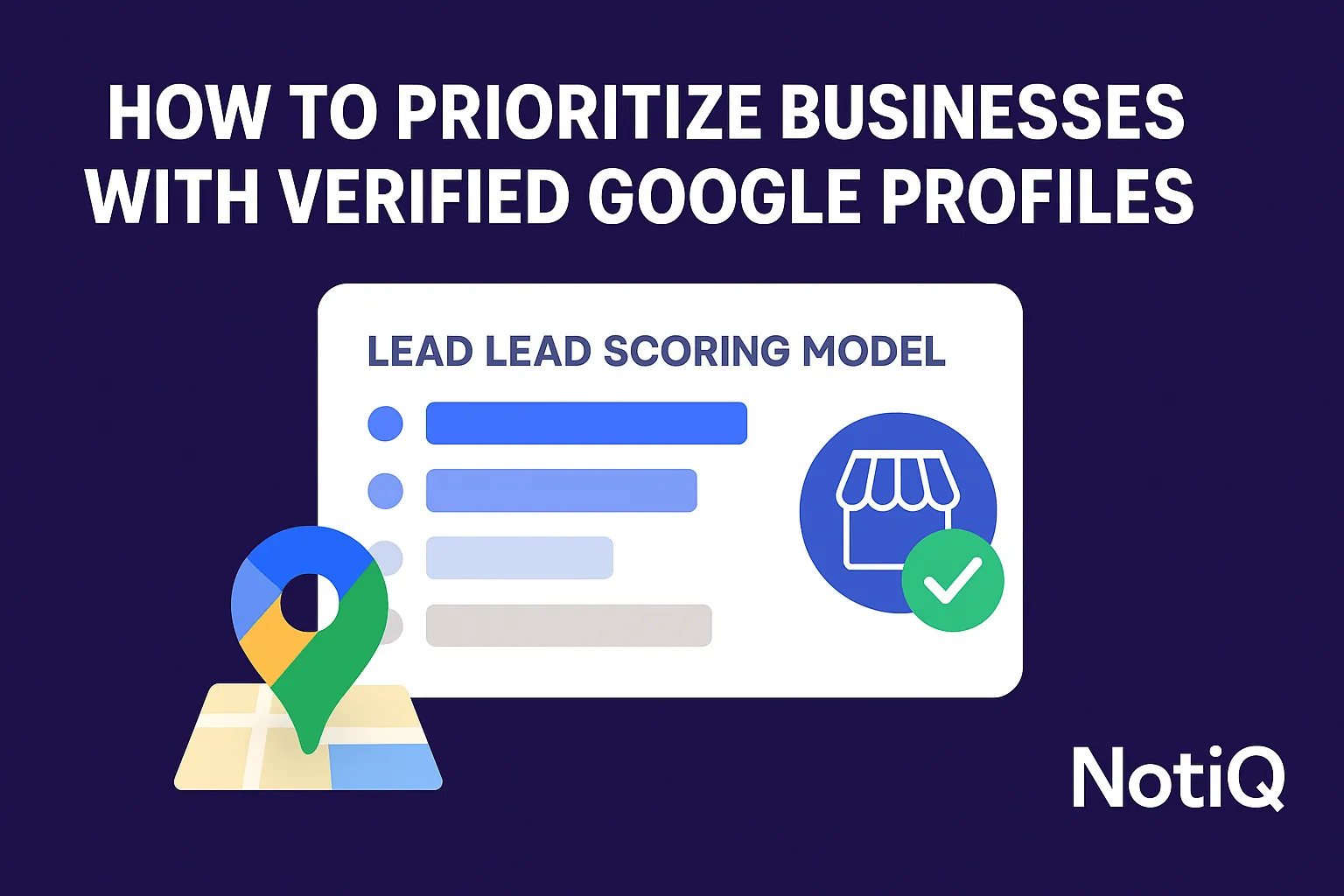
4. The Local Lead Scoring Framework
To consistently identify qualified local leads, teams need a repeatable model that uses verification as one weighted signal rather than the only filter. This local lead scoring framework is designed to be practical and lightweight enough for SDRs, agencies, or ops teams to apply manually, or to automate at scale.
The score is organized into four clear categories: ownership confidence, activity/freshness, profile completeness, and ICP (Ideal Customer Profile) fit. While exact weights will vary by team, geography, and sales motion, maintaining this consistent structure ensures transparent, predictable lead prioritization. To see how teams operationalize weighted local prospect scoring instead of relying on one-off manual checks, visit[Home](/).
Score category 1 — Ownership and legitimacy signals
The first category establishes baseline trust. Business ownership verification is an important factor here, but it should not dominate the score. Supporting legitimacy signals include a consistent business name, a valid phone presence, website availability, and high location confidence.
Using standards like the USGS place-name and location standard can help ops teams standardize geographic data and ensure location confidence. This category helps local prospecting teams avoid clearly weak or suspicious verified business listings without assuming too much about their likelihood to buy.
Score category 2 — Activity and freshness signals
Activity and freshness signals are often better predictors of outreach relevance than verification alone. This category covers indicators of likely current operation: recent reviews, newly uploaded photos, recently updated hours, active Google posts, and consistent owner engagement (such as replying to reviews).
Review recency is a particularly strong active business signal. A verified-but-stale listing with no reviews in three years is generally a colder lead than an unverified-but-active listing that received and replied to five reviews this month.
Score category 3 — Completeness and contactability
Complete profiles are inherently easier to route into an outreach sequence. Profile completeness signals include having a functional website, a valid phone number, listed business hours, a specific primary category, and detailed service descriptions.
From a prospecting perspective, high contact completeness reduces friction for downstream data enrichment and first-touch personalization. A simple Google Business Profile completeness checklist for reps might include:
• Is the website URL present and functioning?
• Is a local or toll-free phone number listed?
• Are operating hours clearly defined?
• Is the business category specific (e.g., "Emergency Plumber" vs. just "Contractor")?
Score category 4 — ICP fit and sales relevance
Even a perfectly optimized, verified profile should rank low if it doesn’t match your team’s target market. ICP and category fit must always trump vanity signals.
Filters for fit include category alignment, service area boundaries, city/territory match, website maturity, and specific offering relevance. If you are selling specialized software for high-end HVAC installers, a verified, highly active profile for a one-person handyman service is still not a qualified local lead. Fit dictates the ultimate value, making it the best way to prioritize SMB leads.
A simple weighted model readers can adapt
To put this into practice, teams should adopt a principle-based sales qualification workflow. A sample framework for Google Maps prospecting might assign weights as follows:
• Legitimacy (including Verification): 20%
• Activity & Freshness: 30%
• Completeness & Contactability: 20%
• ICP Fit: 30%
By assigning a moderate weight to verification and a higher combined weight to freshness, completeness, and fit, local lead prioritization becomes highly accurate, ensuring reps spend their time on businesses that are both real and relevant.
5. How to Rank Verified vs Unverified Listings
One of the most common questions in local lead prioritization is: when should a verified profile outrank an unverified one, and when shouldn't it? The answer lies in side-by-side scenarios rather than abstract theory. By making the decision logic explicit, GTM teams can immediately improve how they qualify local business leads, moving beyond the binary "Google Business Profile verified vs unverified" debate.
When a verified listing should rank higher
A verified listing should absolutely rank higher when it represents the ideal case: a verified Google Business profile paired with complete contact info, recent reviews, active operating hours, strong category fit, and a live website.
In this scenario, verification acts as a multiplier. It strengthens your confidence because the surrounding active business signals are also positive. This creates a "high-priority lead" snapshot—a business that is confirmed to be owner-managed, actively engaging with the public, and perfectly aligned with your ideal customer profile. These are your most qualified local leads.
When an unverified listing may still deserve priority
There are frequent scenarios where an unverified listing can still be a highly promising prospect. If an unverified profile boasts a strong website, recent reviews, excellent category fit, and clear evidence of daily operations, it should take precedence over a verified but dormant listing.
Some businesses simply have weaker profile management discipline or haven't navigated the verification process, yet they are real, reachable, and profitable. SDR rules that automatically discard all unverified profiles actively destroy pipeline by ignoring high-value local leads simply because they lack a badge. In the verified vs unverified debate, active local prospecting must favor actual business activity over administrative profile status.
When both listings should be deprioritized
Certain low-value cases must be deprioritized regardless of verification status. If a profile has no website, no recent activity, a mismatched category, weak location confidence, missing contact info, or stale profile data, it belongs at the bottom of the list.
Verification is not a rescue signal for poor overall fit. A verified listing for a permanently closed business, or one that completely lacks profile completeness signals, will only waste a sales rep's time and skew lead qualification metrics.
A practical ranking matrix for reps
To streamline the prospecting workflow, sales ops teams should implement a skimmable ranking matrix. This provides reps with the best way to prioritize SMB leads at a glance:
• Top Priority: Verified + Active + Complete + Strong Fit
• Medium-High Priority: Unverified + Active + Complete + Strong Fit
• Medium-Low Priority: Verified + Stale/Incomplete + Moderate Fit
• Low Priority (Do Not Pursue): Unverified + Stale + Weak Fit
Applying this local lead scoring framework ensures reps focus their energy where it matters most.
6. Turning Google Maps Data Into Prospecting Action
Moving from qualification theory into execution is where GTM teams generate revenue. Public business profile signals must be transformed into a working prospecting queue, a well-defined territory map, or an automated CRM enrichment flow.
Success in local prospecting requires repeatability: structured list building, consistent scoring, a regular review cadence, and seamless outreach handoff. Once high-priority, qualified local leads are identified from Google Maps prospecting signals, teams need the right tools to execute. For outreach and personalization next steps, explore Home.
Build the list with the right filters first
The first step in local lead prioritization is applying macro filters before you ever look at quality scoring. Start with geography, category fit, and baseline ICP filters.
Avoid generating giant, unstructured lead dumps that create an impossible review burden for reps. Territory planning should come first; filtering by specific zip codes or service areas makes subsequent verification and completeness scoring much more relevant and manageable.
Apply scoring before outreach
Once the initial list is built, apply your scoring model to segment prospects into tiers (e.g., Tier 1, Tier 2, and Monitor/Do Not Pursue). Reps should spend their outbound effort where profile signals suggest both legitimacy and current activity.
Implementing a scoring pass significantly reduces wasted outreach on stale or low-fit businesses. This sales ops workflow ensures that highly qualified local leads are contacted promptly, while lower-tier leads are nurtured or discarded.
Enrich and verify before sending reps live
Before finalizing outreach lists, teams must enrich the data. This means checking website quality, verifying business contact channels, and confirming profile freshness.
Google profile signals are powerful, but they should be combined with internal CRM context or third-party data enrichment when available. Recalling the NIST data quality concepts, operational workflows must prioritize consistency and reliability. Business contact signals must be accurate to avoid bouncing emails or disconnected phone calls.
Refresh scores regularly
Local business data quality is highly dynamic. Hours change, websites go down, new reviews are posted, and operational status can shift overnight. Because of this, treating lead lists as static is a major mistake.
Teams must refresh lead scores on a periodic cadence. This is especially vital for edge cases like new openings, seasonal businesses, multi-location brands, and service-area businesses. Monitoring active business signals over time ensures your reps are always working with the most accurate data.
What strong teams do differently
Mature GTM operations share a common behavior: they use verification as an input, combine it with activity and fit, document their scoring logic, and continuously refine their models based on closed-won outcomes. They rely on a data-driven prospecting approach rather than gut feeling. By systematizing the local lead scoring framework, platforms like NotiQ enable a more disciplined, qualification-focused workflow that scales effortlessly.
7. Tools, Sources, and Evidence to Strengthen the Article
Building a reliable prospecting engine requires anchoring your strategy in authoritative data. Throughout this framework, we rely on foundational sources to define and interpret business signals:
• Google Business Profile Help & API Documentation: Official documentation is the definitive source for understanding what verification means and identifying the available public fields (such as those found in Google Places API).
• Data Quality Standards: Frameworks like the NIST data quality dimensions inform why completeness, freshness, and consistency are non-negotiable when scoring leads.
• Regulatory Guidance: When evaluating review authenticity and the risks of manipulated activity signals, FTC guidance provides the necessary context to avoid over-trusting unverified consumer feedback.
While local SEO publishers offer excellent insights into profile optimization, they should not be treated as the ultimate source of truth for outbound sales qualification.
8. Future Trends in Local Lead Prioritization
The landscape of local data enrichment is rapidly shifting from static, manually pulled lead lists to dynamic scoring models driven by public business signals.
We are seeing a massive trend toward AI-assisted prospecting. This does not mean AI is replacing human judgment; rather, AI is helping teams operationalize multi-signal qualification at scale. By automatically cross-referencing Maps data with CRM enrichment and website scraping (in compliant, publicly accessible formats), AI workflows can instantly calculate lead scoring automation metrics, flagging the absolute best prospects for reps in real-time.
To systematize your local lead qualification and stay ahead of these trends, explore how[Home](/)can transform your outbound engine.
9. Conclusion
Verified Google Business Profiles are undeniably useful, but they work best as one weighted trust signal inside a broader lead prioritization model. Relying on verification alone leaves pipeline vulnerable to stale, poorly-fit, or unresponsive listings.
The most practical framework combines verification with completeness, activity, contactability, and ICP fit. The goal of local prospecting is not to find a perfect, infallible proxy for buying intent, but to reduce wasted outreach and improve prospect quality using consistent, data-backed rules.
It is time to audit your current local prospecting workflow. Replace binary "verified vs unverified" filtering with a multi-signal scoring rubric. By doing so, you will empower your sales team to focus purely on high-probability targets. NotiQ is dedicated to advancing qualification logic, enrichment, and operational efficiency for GTM teams—helping you turn raw local business data into highly prioritized, revenue-generating workflows.
Frequently Asked Questions
- Does a verified Google Business Profile mean a business is active?
- Verification indicates that Google has confirmed management access by an authorized representative, but it does not guarantee current business activity or responsiveness. To confirm if a business is operational, you must evaluate active business signals like review recency, updated hours, website presence, and recent photo uploads alongside Google Business Profile verification.
- Are verified profiles better for prospecting than unverified ones?
- Verified profiles often deserve extra weight in a scoring model because they confirm a baseline of ownership. However, in local lead prioritization, a verified listing should not automatically outrank an unverified listing that exhibits stronger activity, better website completeness, and tighter ICP fit. In the verified vs unverified debate, recent activity and fit always win.
- What profile signals best predict a higher-quality local lead?
- The most reliable predictors of qualified local leads are combinations of profile completeness signals and activity. Look for strict category fit, recent and consistent reviews, a live and functional website, complete contact information, current operating hours, and visible signs of active profile management (such as owner responses to reviews).
- What’s the difference between a claimed and verified Google Business Profile?
- A "claimed" profile means a user has requested to manage the listing. "Verified" means Google has successfully authenticated that request (usually via phone, postcard, or video) and granted full management rights. Business ownership verification is the final step that proves the claimant is authorized by the business.
- How often should local prospect scores be refreshed?
- Local business data quality degrades quickly, so a recurring review cadence is highly recommended. For fast-changing local categories or active outbound territories, you should refresh lead scores monthly or quarterly. Freshness matters because hours, websites, operational status, and reviews change continuously.
No next article
Continue Reading
More articles you might find useful
Google Maps Prospecting for Commercial Waste Management Companies
Learn how commercial waste haulers can use Google Maps to find, qualify, and prioritize better local accounts. This guide shows how to build denser routes and improve outreach with waste-stream and service-area insights.
Read the article →
How to Find Local Businesses With Broken Website Links
Learn how to find local businesses with broken website links using Google Maps, quick validation checks, and proof-based outreach. This guide shows agencies how to turn visible site issues into qualified leads.
Read the article →
Google Maps Lead Generation for Signage Companies
Learn how sign companies can use Google Maps to find local prospects, identify visible signage gaps, and build a repeatable outreach system. This guide shows how to turn visual research into qualified leads without relying on paid ads or generic lists.
Read the article →Popular industry lead playbooks
Maps search examples and niche outreach for the verticals teams prospect most.