Technology
How to Find Businesses That Recently Extended Their Opening Hours
Learn how to spot recent Google Business Profile hours changes, verify which ones signal real growth, and turn them into better local outreach opportunities.
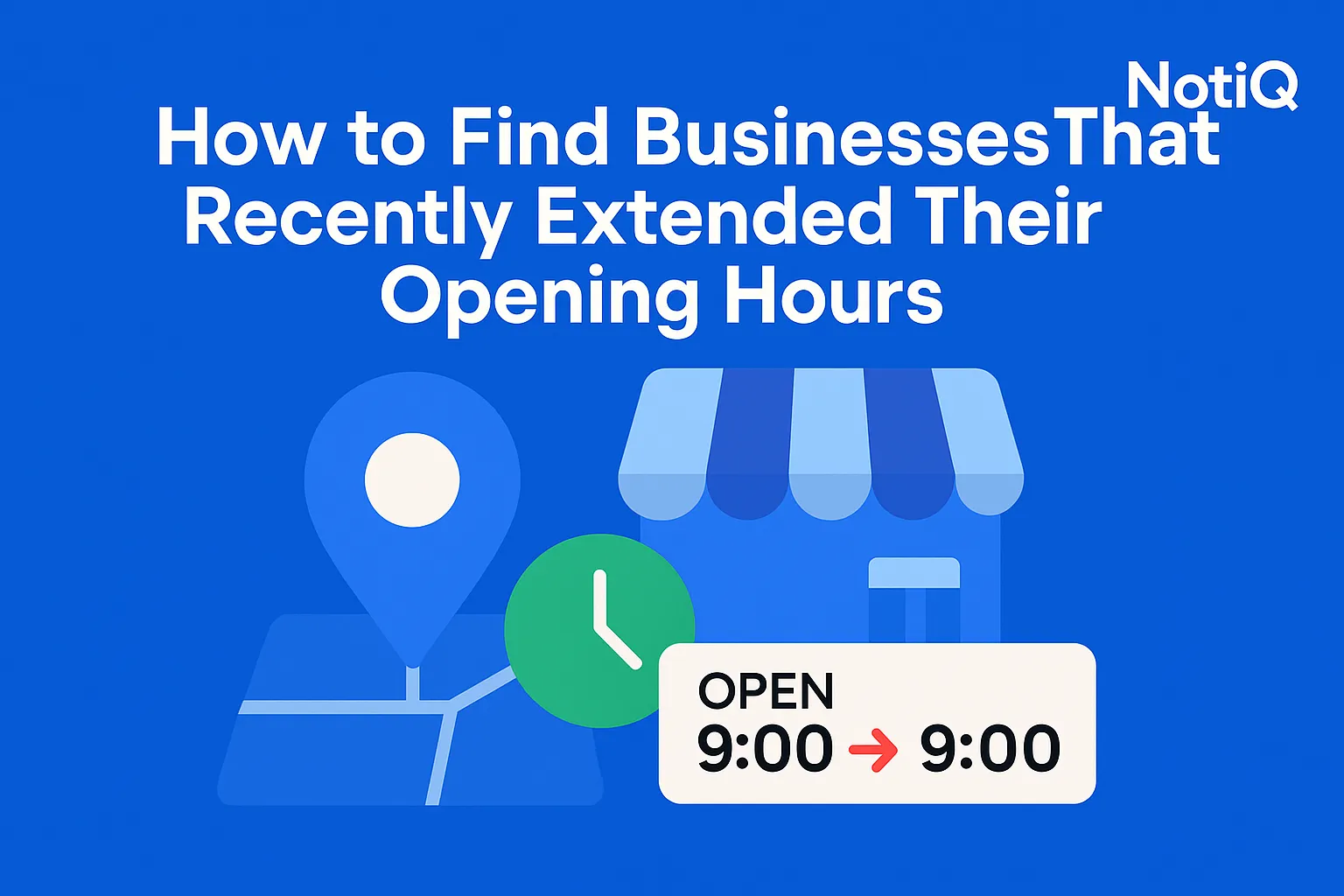
1. Introduction
When a local business extends its opening hours, it is rarely an accident. This operational shift often serves as a direct response to rising demand, added staffing capacity, broader expansion plans, or an aggressive push for more revenue. For sales teams, identifying these extended business hours leads represents a massive opportunity to engage prospects exactly when they are experiencing upward momentum.
However, capturing this data is notoriously difficult. While the signal is publicly visible on Google Maps and Google Business Profiles, it is incredibly noisy, highly manual to track, and frequently misunderstood by outbound teams. Most sales professionals either ignore this data entirely or misinterpret temporary holiday hours as permanent growth.
This article provides a comprehensive framework to solve that problem. You will learn how to detect recent hours changes systematically, filter out temporary or false-positive edits, validate the underlying growth story, and leverage these local growth signals for smarter, highly targeted outreach.
Unlike traditional local SEO strategies focused on managing listings, this is a dedicated sales-intelligence workflow built specifically for SDRs, sales teams, and revenue operators. If your team targets SMBs and local businesses across multiple territories and relies on repeatable, public-data signals, this methodology will transform how you build pipeline.
As a signal-detection platform focused on turning observable public changes into actionable workflows, NotiQ understands that mastering Google Maps outreach requires moving beyond static lists. You can explore more signal-based prospecting tactics here to see how dynamic data translates into higher conversion rates.
2. Why Extended Hours Can Signal Growth
Understanding why longer operating hours matter operationally is the first step in utilizing them as part of a broader prospecting strategy. Hours extensions are not absolute proof of growth on their own, but when paired with other public indicators, they become highly reliable early-stage business growth signals for sales.
Local businesses typically extend their operating hours for a few core reasons: accommodating higher customer demand, leveraging newly hired staff, expanding into previously untapped evening or weekend markets, or testing new revenue windows. Because local SMBs rarely issue press releases about these operational shifts, tracking longer operating hours provides a distinct competitive advantage. It allows sales teams to act on public, observable local business intelligence long before a company formally announces its expansion.
What an Increase in Business Hours May Actually Mean
In simple operational terms, a permanent increase in business hours requires capital, confidence, and capacity. When a retail store or restaurant adds three extra hours to its daily schedule, it often reflects sustained demand growth indicators. The business owner has likely calculated that the revenue generated during those additional hours will outpace the overhead costs of staying open.
Longer hours can also indicate staffing changes, such as the hiring of a new shift manager, or service expansion, like a cafe introducing a new dinner menu. For service-based categories, business expansion signals like opening on Sundays can indicate improved confidence in foot traffic or an overflow of appointment volume. As supported by Census business trends data on hours and demand, operational shifts related to store hours changes frequently correlate with broader economic confidence, though they always require business-context validation before being treated as absolute truth.
Why This Signal Matters More Than Static Firmographics
Traditional prospecting relies heavily on static firmographics—filters like industry category, location, or employee headcount. While static data tells youwhoa business is, dynamic sales prospecting signals like recent hours changes tell youwhat is happening now.
Timing is the ultimate multiplier for outreach relevance. A business undergoing operational expansion is inherently more receptive to solutions that solve immediate growing pains. If you sell tools tied to staffing, employee scheduling, local marketing, analytics, or customer acquisition, pitching a business right after they extend their hours drastically improves your chances of booking a meeting.
This framework of tracking local business prospecting signals fundamentally differs from generic list-building or manual scraping. While local SEO tools focus strictly on profile maintenance and ensuring listing accuracy, this approach is entirely focused on SMB lead generation, lead discovery, and actionable market intelligence.
Which Industries Produce the Strongest Opportunities
Not all industries yield the same quality of extended business hours leads. Consumer-facing sectors—specifically restaurants, gyms, clinics, salons, and retail stores—are among the industries most likely to expand hours during growth periods. Because their revenue is directly tied to foot traffic and appointment availability, operational growth is immediately reflected in their public schedules.
• Restaurants: Adding late-night service often implies a push to capture a new demographic or the launch of a new menu.
• Gyms: Transitioning from standard hours to 24/7 access indicates an investment in new security technology or an expanding member base.
• Clinics: Adding Saturday availability typically signals an overflow of patient demand that standard weekday hours can no longer support.
• Retail: Opening earlier in the morning may reflect new inventory arrivals, seasonal demand, or a strategic move to capture commuter traffic.
Understanding these category contexts ensures you extract the most accurate local growth signals for your outreach campaigns.
3. How to Find Recent Hours Changes
To capitalize on this strategy, you need a practical workflow for spotting businesses that have recently extended their operating hours. The most reliable public sources for this data are Google Maps and Google Business Profiles.
Finding how to find businesses that recently extended their hours requires observing public changes legally and ethically, without relying on non-compliant data extraction methods. Whether you use a manual approach or scalable monitoring, the focus must remain on identifying a valid Google Business Profile hours change to fuel your Google Maps lead generation efforts.
Manual Google Maps Discovery Workflow
For SDRs covering specific, hyper-local territories, a manual discovery workflow is a great starting point for Google Maps outreach. Begin by searching your target category and location (e.g., "dental clinics in Austin, TX"). Open individual business profiles, review their current operating schedules, and look for visual cues indicating a recent update.
Maintain a structured watchlist of target accounts and repeat this review on a weekly basis. When you spot a change, log the business name, category, previous hours, new hours, and any supporting observations in a dedicated tracker. This disciplined approach to business hours update tracking ensures that your Google Maps lead generation efforts are based on verified, observable momentum. As noted in the Google Business Profile hours update guidance, hours are displayed prominently across Google surfaces, making manual verification straightforward for targeted lists.
Using Google Business Profile Details to Spot Meaningful Changes
When analyzing a listing, you must distinguish between permanent schedule changes and short-term edits. Business hours can appear as regular hours, special hours (for holidays), or category-specific hours (like senior-only hours or drive-through hours).
Google Business Profile updates occasionally feature a "recently updated" tag next to the hours section. If a business owner or a reliable user recently modified the schedule, this tag serves as a powerful indicator of a Google Business Profile hours change. However, you must treat recent store hours changes as a trigger for further investigation, not an immediate qualification. Not every update equals growth, which is why understanding the Google Business Profile hours update guidance is critical for correctly interpreting the various hours fields.
Building a Repeatable Weekly Tracking Process
To scale your efforts, teams must transition from ad hoc searches to a repeatable weekly tracking process. Define your target geographies, ideal business categories, and a strict review cadence (e.g., every Tuesday morning).
Your tracking system should log the prior hours, current hours, date observed, likely reason for the change, and a validation status. Always include a "needs validation" stage before passing any sales prospecting signals to the outreach team. By structuring your business hours update tracking this way, you can detect recent opening-hour extensions at scale with far greater accuracy. To move away from manual map scanning and operationalize recurring signal monitoring, teams can leverage platforms like[Home](/)to automate the detection process efficiently.
4. How to Filter False Positives
The true value of this workflow lies in false-positive filtering. Raw data is inherently noisy; filtering is what transforms that noise into usable sales intelligence. If you fail to reduce false positives, your team will waste valuable time pursuing misleading hours changes that do not reflect actual business momentum.
Learning how to reduce false positives in business hours changes requires knowing the difference between a temporary holiday hour changes vs growth signal, and identifying the supporting signals for business hours changes that validate true expansion.
Holiday Hours, Temporary Experiments, and Cleanup Edits
The most common false positives in this workflow are holiday schedules, temporary seasonal experiments, one-off community events, and routine profile maintenance. A retail store staying open late for Black Friday is a temporary holiday hour changes vs growth signal. A single weekend extension is a significantly weaker indicator than a sustained pattern of longer hours across multiple weekdays.
Furthermore, businesses frequently execute cleanup edits to correct inaccurate listings. This can look like a Google Business Profile updates event, but it merely reflects administrative housekeeping, not new demand. When the pattern is unclear, implement a "wait and recheck" rule. Revisit the profile a week later to see if the store hours changes have reverted. As outlined in the Google Business Profile hours update guidance regarding special hours, and how Google sources Business Profile information, listed data is influenced by user suggestions and owner edits, meaning it should never be treated as infallible without secondary verification.
Category-Specific Cases Where Longer Hours Do Not Mean Growth
Category context drastically alters the meaning of an hours extension. A restaurant expanding into late-night service is a classic example of local growth signals. Conversely, a medical clinic adding limited Saturday availability might simply be clearing a pandemic-related backlog—a move born of necessity rather than true business expansion signals.
Some businesses expand their hours defensively. A pharmacy might extend its hours to comply with new local health regulations, or a retailer might test longer hours purely for operational testing rather than reacting to demand growth indicators. Avoid overgeneralizing a single public signal; always contextualize the change within the specific industry's operational realities.
A Simple Decision Tree for Filtering Noise
SDR managers should build a consistent qualification standard to evaluate leads. Use this simple decision tree to determine how to validate extended business hours as a growth signal:
1. Is the change recent? (Has it happened within the last 30 days?)
2. Is the change sustained? (Is it a permanent update to regular hours, or just a temporary special hours edit?)
3. Does it expand customer-facing availability? (Are they opening doors to buyers, or just adding back-office administrative time?)
4. Is there a supporting signal? (Are they hiring, or are reviews increasing?)
If the answer is "no" to most of these questions, you must learn how to reduce false positives in business hours changes by deprioritizing the lead. This rubric ensures your team only pursues high-quality local business prospecting signals.
5. How to Validate and Prioritize Leads
Once you have filtered out the noise, the next critical step is learning how to validate extended business hours as a growth signal. This is the core "turn signal into pipeline" phase of the workflow.
A single profile edit is never enough to justify aggressive outreach. To confirm that an hours extension is meaningful, you must combine it with supporting signals for business hours changes to build a comprehensive case for business growth signals for sales.
Validation Signal 1 — Reviews, Footfall Clues, and Customer Activity
Recent customer review volume is one of the best indicators of local business intelligence. If a business extends its hours, check its recent reviews for mentions of busier operations, longer wait times, or praise for the new, extended service windows.
Customer comments like, "So glad they are finally open on Sundays!" or "The new late-night menu is amazing" directly support the hypothesis of increasing demand. Higher customer activity strengthens the case that the hours change is a genuine demand growth indicators. Keep in mind that review patterns vary heavily by industry, so this should serve as one input among several supporting signals for business hours changes.
Validation Signal 2 — Hiring, Staffing, and Capacity Changes
Longer operational hours fundamentally require labor coverage. Therefore, staffing shifts serve as the strongest supporting signals for outreach prioritization. If a business extends its hours, check their website or local job boards to see if they are actively hiring for roles relevant to those expanded operations (e.g., a restaurant hiring closing shift servers, or a clinic hiring weekend receptionists).
Tying the hours extension to operational readiness proves that the business has the capacity and financial confidence to support its growth. These combined business expansion signals create a highly compelling narrative for sales prospecting signals. As highlighted by BLS data on expanding establishments, labor expansion is a primary macroeconomic indicator of establishment growth, making it a highly reliable demand growth indicators when paired with schedule changes.
Validation Signal 3 — Service Changes, Promotions, and Location Activity
Businesses actively trying to capture more demand rarely stop at just changing their hours. Look for menu updates, new promotional offers, the introduction of new service lines, or fresh location photos uploaded to their Google Maps profile.
Extending hourspluslaunching a new offer is a significantly stronger signal than extending hours alone. These clues allow you to infer the business's likely priorities, providing critical local growth signals that will shape your Google Maps outreach. Finding these business expansion signals allows you to craft a hyper-relevant pitch.
Scoring and Prioritizing the Best Opportunities
To manage this workflow efficiently, implement a simple lead-priority model based on the strength of the hours change, the presence of supporting signals, industry fit, and territory relevance.
• High Confidence: Permanent hours extension + active hiring + new reviews. (Pass immediately to active outreach).
• Medium Confidence: Permanent hours extension + no clear hiring data. (Monitor or send a soft exploratory email).
• Low Confidence: Temporary hours change + no supporting data. (Discard or place in a long-term nurture sequence).
By ranking extended business hours leads this way, teams ensure they only spend time on verified local business prospecting signals. For teams looking to connect these validated signals to scaled outbound execution, platforms like Home can help automate the SMB lead generation and scoring process.
6. How to Tailor Outreach After a Hours Extension
Detecting the signal is only half the battle; bridging the gap between signal detection and message-market fit is what actually generates revenue. Generic outreach underperforms because it ignores the specific operational context behind the change.
The best outreach after a business extends its hours is highly tailored, observational, and aligned with the likely reason for the expansion. Whether executing Google Maps outreach or broader SMB lead generation campaigns, your messaging must reflect the prospect's current reality.
Messaging Angle 1 — Demand Growth and Customer Volume
When supporting signals point to a business handling increased demand, your outreach should focus on optimizing that customer volume. Frame your messaging around improving conversion rates, reducing missed opportunities during peak rushes, increasing repeat visits, or smoothing out front-of-house operations.
Keep the message observational, not assumptive. Instead of saying, "I see you are growing," say, "I noticed you recently expanded your evening hours—often when our clients in the restaurant space do this, they are looking for ways to handle the new dinner rush without overwhelming their current staff." This aligns the best outreach after a business extends its hours directly with demand growth indicators and verified sales prospecting signals.
Messaging Angle 2 — Staffing, Scheduling, and Operational Complexity
Longer hours inherently create strain around staffing, shift scheduling, and operational consistency. If you sell workforce coordination tools, customer communication platforms, or operational analytics software, this is your ideal angle.
Acknowledge their expansion without sounding intrusive. "Noticed the new Saturday hours on your profile. Adding weekend shifts usually adds a layer of complexity to team scheduling. We help local clinics manage that exact transition..." Leveraging local business intelligence this way turns business growth signals for sales into highly empathetic, relevant Google Maps outreach.
Messaging Angle 3 — Expansion Readiness and Revenue Experimentation
In cases where a business is testing new evenings or weekends as part of broader growth plans, they are highly focused on measurement and customer acquisition. Your outreach should tie into local market visibility and ROI tracking.
Mini-Template Example: "Hi [Name], I noticed you recently started opening on Sundays. Many of the local retailers we work with use this as a way to test new weekend revenue. If you're looking to measure how much new foot traffic those Sunday hours are actually driving, our platform can help you track that ROI..."
This messaging perfectly captures business expansion signals and local growth signals to deliver the best outreach after a business extends its hours.
Industry-Specific Outreach Examples
The underlying reason for an hours extension changes by category, and your messaging must pivot accordingly to capture the best extended business hours leads.
• Restaurants: "Noticed the new late-night hours. Are you looking for ways to streamline digital orders during that new closing shift?"
• Gyms: "Saw you transitioned to 24/7 access. How are you managing off-hour member support and secure check-ins?"
• Clinics: "Noticed the new Saturday availability. Are you utilizing automated appointment reminders to ensure those new weekend slots don't turn into no-shows?"
• Salons: "Saw you extended your Thursday evening hours. Are you looking for ways to fill those new evening booking slots with local ads?"
• Retail: "Noticed you're opening earlier. How are you tracking if that extra morning hour is converting to actual sales?"
Tailoring your Google Maps outreach to the industries most likely to expand hours during growth periods ensures your message always lands with impact.
7. Tools, Workflow Design, and Automation
Moving from one-off research to a sustainable, scalable workflow requires the right combination of process and technology. Knowing when manual research is sufficient and when automation becomes absolutely necessary will dictate the success of your campaign.
It is crucial to differentiate intelligent signal monitoring from basic, non-compliant scraping or simple listings-management software. The goal is to track business hours update tracking legally and ethically to detect recent opening-hour extensions at scale.
When Manual Google Maps Research Still Works
Manual review remains highly effective for narrow territories, niche verticals, or highly curated account lists. If an SDR is only targeting 50 high-value dental clinics in a single city, manually checking their profiles weekly is completely viable.
However, Google Maps research is manual and time-consuming. The process breaks down entirely when you require multi-market coverage, strict weekly tracking, and rep-by-rep consistency. Manual Google Maps lead generation often leads to missed opportunities and data decay, making automation necessary for larger business hours update tracking operations.
What Automated Signal Monitoring Should Actually Do
True automated signal monitoring is not about extracting raw hours fields; it is about detecting changes over time, comparing historical patterns, and helping revenue teams validate those changes instantly.
A robust system will combine hours changes with adjacent signals like review velocity, hiring data, and service updates. This contrasts sharply with typical extraction-first tools that dump raw data into a spreadsheet and leave all the interpretation work to the user. When comparing manual Google Maps research vs automated signal monitoring, automation wins by providing contextualized supporting signals for business hours changes.
Platforms like[Home](/)are built specifically for monitoring and acting on public business changes faster than manual workflows, providing actionable local business prospecting signals directly to your CRM. You can explore related workflow examples and use cases to see how automation bridges the gap between data and revenue.
Workflow Recommendations Based on Competitor Gaps
Many alternatives in the market focus strictly on Google Business Profile management, raw data extraction, or broad firmographic enrichment. They fail to interpret an hours extension as a strategic growth signal.
To build a superior workflow, prioritize AI enrichment, advanced verification logic, and compliance-aware monitoring. Instead of relying on manual guesswork or basic Google Maps scrapers, utilize tools that automatically flag high-priority changes and cross-reference them against hiring and review data. This approach solves the manual Google Maps research vs automated signal monitoring dilemma by delivering actionable prioritization rather than just raw data dumps.
8. Future Trends in Local Growth-Signal Prospecting
This workflow is becoming more relevant, not less. As outbound prospecting becomes increasingly competitive, revenue teams are rapidly shifting toward using public local-search signals as primary intent data.
The framework outlined in this article aligns perfectly with the broader shift toward signal-based prospecting, proving that local growth signals and business growth signals for sales are the future of local business intelligence.
Public Local Data as Intent Data
Revenue teams are no longer waiting for businesses to download a whitepaper or fill out a form; they are using visible operational changes as early buying or growth cues.
Local businesses are uniquely suited to this approach because their operational changes—like extending hours or launching a new service—almost always appear publicly on maps and search engines long before they are reflected in traditional B2B databases. By treating these sales prospecting signals as intent data, teams can execute highly relevant SMB lead generation and local business prospecting signals campaigns before competitors even know the business is growing.
Why Multi-Signal Validation Will Matter More
As teams adopt more sophisticated qualification methods, single-signal outreach will become significantly less effective. Reaching out purely because a business changed its hours will soon be viewed as basic.
The future relies on multi-signal validation. Hours changes become exponentially more powerful when combined with review velocity, hiring trends, and service updates. As supported by academic research on opening hours and customer behavior, opening-hour changes relate heavily to meaningful customer behavior shifts, making them a critical piece of the puzzle. Mastering how to validate extended business hours as a growth signal by layering supporting signals for business hours changes creates a far more durable, high-converting workflow than traditional, one-off list building for business growth signals for sales.
9. Conclusion
Extended business hours can be one of the most lucrative local growth signals available to outbound sales teams, but only when detected systematically and validated carefully.
The workflow is straightforward but requires discipline: find the public change, filter out the temporary noise, validate the extension with adjacent signals like hiring and reviews, prioritize the lead based on confidence, and tailor your outreach to the likely operational reason behind the extension. By adopting this methodology, revenue teams can successfully transition from relying on static prospect lists to executing timely, opportunity-based outbound campaigns.
NotiQ is dedicated to detecting and operationalizing these public business signals for revenue teams, ensuring you never miss a critical growth indicator. If you want to monitor these changes at scale without the manual heavy lifting,[learn how NotiQ helps teams monitor local growth signals](/)to capture extended business hours leads efficiently. For teams ready to connect these validated signals to scaled outbound execution,explore ScaliQ to drive your Google Maps outreach forward.
Frequently Asked Questions
- How can you find businesses that recently extended their opening hours?
- To find these changes, monitor Google Maps and Google Business Profiles by specific category and geography. Compare current schedules against prior observations or look for "recently updated" cues provided by Google. Success requires continuous tracking and validation over time rather than a one-time search, ensuring you accurately capture a genuine Google Business Profile hours change and master how to find businesses that recently extended their hours.
- Do longer business hours always signal business growth?
- No, not always. Longer hours frequently reflect holiday periods, temporary seasonal experiments, staffing reshuffles, or simple listing corrections. The signal only becomes actionable when cross-checked with reviews, hiring data, and service changes. Understanding the difference between temporary holiday hour changes vs growth signal is critical to mastering how to validate extended business hours as a growth signal.
- What outreach angle works best after a business extends its hours?
- The best outreach depends entirely on the likely reason behind the change: is it demand growth, added staff, revenue experimentation, or customer-service expansion? Use observational, hypothesis-led messaging rather than hard assumptions. This ensures your Google Maps outreach is empathetic and represents the best outreach after a business extends its hours.
- Which industries are most likely to expand hours during growth periods?
- Consumer-facing sectors like restaurants, gyms, clinics, salons, and retail stores are the most prominent. These businesses publicly display their demand and capacity changes through operating-hour adjustments, making them the ideal targets for generating extended business hours leads and identifying the industries most likely to expand hours during growth periods.
- What are the limits of using Google Maps data for prospecting?
- Public profile information can sometimes be incomplete, outdated, or heavily influenced by user contributions and business-owner edits. Sales teams must rigorously validate changes before initiating outreach and avoid treating raw profile updates as definitive truth. Understanding how Google sources Business Profile information is essential for maintaining high data quality and ensuring accurate local business intelligence.
Continue Reading
More articles you might find useful
Google Maps Lead Generation for Window and Door Installers
Learn how window and door installers can use Google Maps to find, qualify, and prioritize better local prospects. This beginner-friendly guide shows a repeatable workflow for smarter local outreach.
Read the article →
How to Prioritize Businesses With Verified Google Profiles
A practical framework for ranking local leads beyond the verified badge. Learn how to prioritize Google Business Profiles using fit, freshness, completeness, and activity signals.
Read the article →
Google Maps Prospecting for Commercial Waste Management Companies
Learn how commercial waste haulers can use Google Maps to find, qualify, and prioritize better local accounts. This guide shows how to build denser routes and improve outreach with waste-stream and service-area insights.
Read the article →Popular industry lead playbooks
Maps search examples and niche outreach for the verticals teams prospect most.