Technology
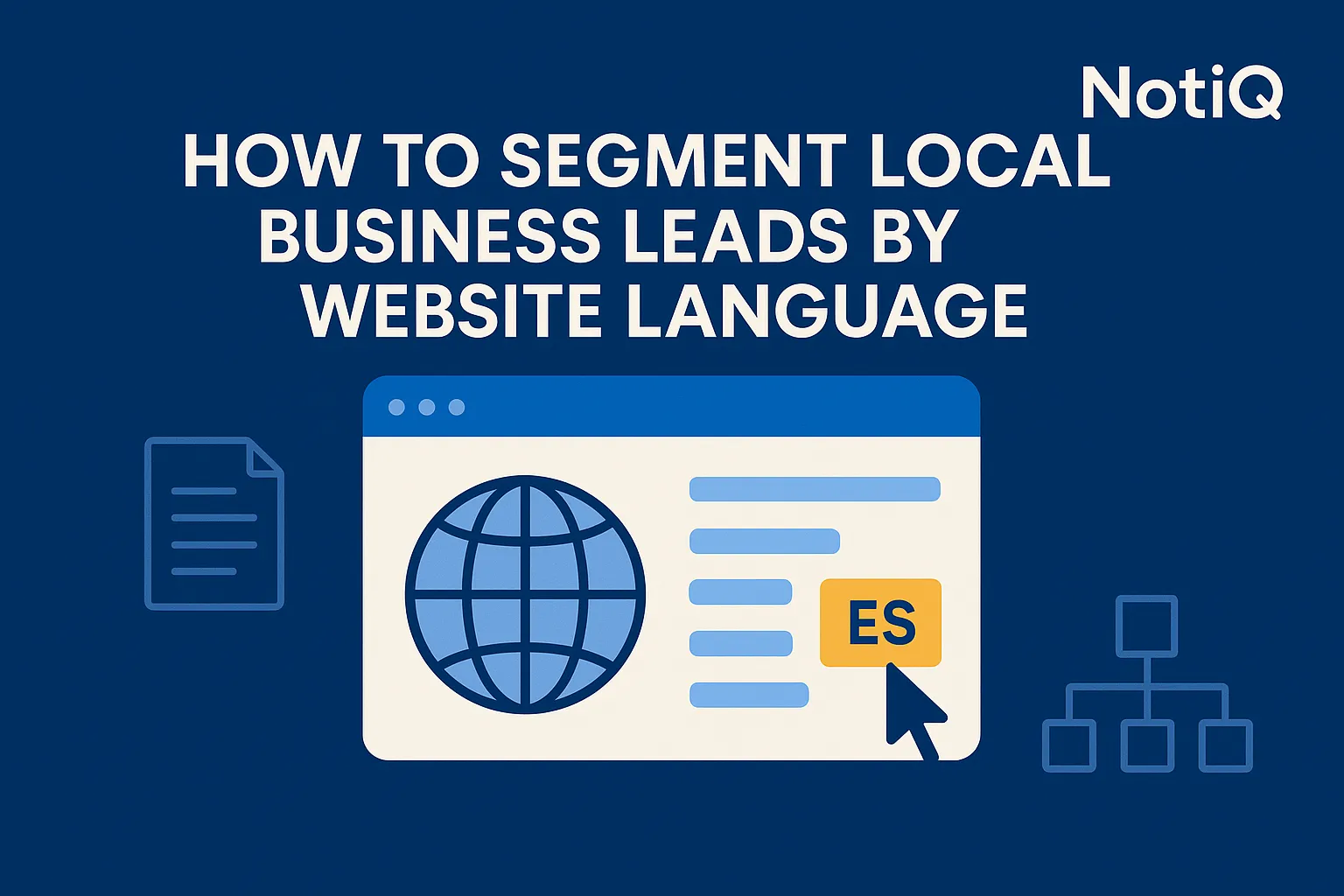
How to Segment Local Business Leads by Website Language
Learn how to detect website language and turn those signals into smarter lead segmentation. This guide shows how to improve multilingual lead generation with better routing, scoring, and outreach relevance.
1. Introduction
Advanced go-to-market teams face a recurring friction point as they scale globally: outreach relevance drops fast when the message language and a prospect's website language do not match. Today, multilingual lead generation and international local prospecting require much more than applying basic country filters or broad geo-targeting rules.
This guide provides a definitive blueprint on how to detect website language, combine it with regional context, and turn that intelligence into a repeatable segmentation workflow. The goal is to bridge technical SEO signals—such as`hreflang`tags, URL structures, and visible page language—with CRM enrichment and outbound execution.
This is not a beginner’s overview of localization. It is an operational playbook designed for marketers, SDRs, and revenue operations teams who need to orchestrate complex campaigns at scale. Accurate website language segmentation ensures your outreach lands with the right tone, in the right language, and with the right regional context.
As a platform built for sophisticated data orchestration,[NotiQ](/)provides the ideal workflow context for turning website signals into actionable multilingual campaign preparation. By aligning language detection with regional relevance, revenue teams can confidently scale their outreach. For deeper insights into operationalizing these strategies, the NotiQ blog offers extensive guidance on related workflow and automation techniques.
2. Why Website Language Matters for Prospecting
Website language is not just an SEO detail; it is a highly practical segmentation layer that directly impacts lead qualification and outreach relevance. When sales and marketing teams experience a language mismatch, the business impact is immediate: lower response quality, weaker personalization, and a massive increase in manual validation work for sales reps.
It is critical to clarify the difference between language segmentation and geo-targeting. A prospect’s country does not always equal their primary operating language, especially in multilingual regions like Switzerland, Canada, or Southeast Asia. Combining language with geography, industry, and website structure improves lead quality far more than geography alone. By leveraging language-based targeting, teams can optimize downstream use cases, including cold outreach, sales qualification, paid campaigns, and localized campaign preparation.
To understand the structural difference between language and region, teams should look to established technical standards, such as Google guidance on multilingual and multi-regional sites. Unlike typical sales databases that segment strictly by country or firmographics while ignoring site-language accuracy, a language-aware workflow ensures true regional relevance.
Why country-based segmentation often fails
Relying solely on country data leads to common misclassification scenarios. Multilingual countries often require segmented approaches, while many English-language sites explicitly target non-English markets. Furthermore, companies frequently hide regional pages under a single global domain.
When teams assume a single official language per country, local business prospecting breaks down. The operational consequence is costly: teams send outreach in the wrong language or route high-value leads to the wrong regional representative, stalling the sales cycle before it even begins. Accurate international sales prospecting by language requires looking at the actual digital footprint, not just the headquarters' mailing address.
Where website language creates a competitive advantage
Site-language awareness gives revenue teams a distinct advantage in prioritization, personalization, and account routing. While most adjacent tools stop at basic enrichment or SEO analysis, a specialized language workflow turns these signals into immediate action.
By integrating language detection into localized outreach segmentation, teams can leverage AI enrichment and automated verification to maintain pristine CRM hygiene. This approach ensures compliance with data standards while enabling highly targeted multilingual lead generation that generic data providers simply cannot match.
3. Signals That Reveal a Site’s Primary Language
Reliable website language detection for lead generation requires a hierarchy of evidence. No single signal is perfect; the most accurate classification comes from combining multiple website clues, moving from the strongest visible signals to weaker inferred ones.
By evaluating homepage copy, HTML declarations,`hreflang`tags, subdirectories, ccTLDs, metadata, and contact-page clues, revenue teams can confidently determine a prospect's primary operating language.
Visible homepage copy and primary navigation
Visible text is often the most practical first signal for website language segmentation. When analyzing a site for local business language targeting, teams should look directly at hero copy, menu labels, calls-to-action (CTAs), forms, and footer content.
However, this signal has limitations. Visible copy can sometimes mislead if the homepage is intentionally language-neutral, relies heavily on images, or uses IP-based auto-localization that obscures the company's default operating language from external crawlers.
HTML`lang`attribute and declared page language
The HTML`lang`attribute is a fundamental technical signal that indicates the default language of a web page. For accurate language-based targeting, this declared language should always be validated against the visible content, particularly on mixed-language pages.
Standardized tags are essential for normalizing data into CRM-friendly values. For technical accuracy, teams should refer to the W3C guide to HTML language declarations and ensure the tags align with the BCP 47 language tag standard.
`hreflang`tags and alternate localized URLs
To understand a site's international SEO architecture,`hreflang`tags are invaluable. These tags reveal language and region variants across alternate URLs, helping teams distinguish a single translated page from a fully developed multilingual site structure.
By analyzing hreflang prospecting signals, teams can identify specific locale targeting—such as an`es`tag for general Spanish versus an`es-MX`tag specifically targeting Mexico. For a definitive understanding of how these tags dictate site structure, refer to the hreflang guidance for localized site versions.
URL patterns, subfolders, subdomains, and ccTLDs
Localized URL structures provide strong clues about language and market coverage. Indicators like`/fr/`or`/de/`subfolders, locale-specific subdomains (`fr.example.com`), or country-code top-level domains (ccTLDs like`.co.uk`or`.de`) highlight a company's investment in specific geo-targeting.
While URL structure alone does not definitively prove the best outreach language, it is a powerful classification input. A French subfolder combined with visible French copy is a much stronger indicator for website localization than a subfolder standing alone.
Contact-page geography, currency, and local business clues
Contact pages often hold the key to regional relevance. Local addresses, service-area descriptions, specific phone number formats, and local currency references serve as vital supporting signals for international local prospecting.
While these local business clues are not primary proof of language, they are instrumental in separating superficial translation-only pages from deeply integrated, market-specific operations.
Browser and adaptive signals to treat carefully
Certain adaptive signals, such as the`Accept-Language`header, can influence localized experiences but should be treated with caution. These hints are useful for dynamic content delivery but should not be the sole segmentation signal for regional language relevance for B2B leads.
Over-relying on adaptive content when no crawlable alternate URLs exist can lead to false positives. For technical context on how this header functions, consult the Accept-Language header reference.
4. How to Segment Multilingual Leads Accurately
Turning raw language signals into a repeatable classification framework is the cornerstone of multilingual lead generation. Advanced teams need strict rules, not just raw signals, to avoid inconsistent classification across their prospecting workflows.
By combining language, region, and business context, teams move beyond simplistic one-field labels. While many SEO tools can identify site structures and sales tools can activate lists, connecting the two into a coherent segmentation logic requires a workflow-driven approach.
Build a classification model for each lead
To operationalize lead segmentation for multilingual campaigns, teams must establish a structured CRM enrichment model. Suggested fields include:
• Primary website language
• Secondary languages available
• Target region / market
• Confidence score
• Multilingual flag (Boolean)
• Outreach language recommendation
These fields are essential for automating lead routing, scoring, and ensuring precise personalization at scale.
Rank signals by reliability
To scale website language detection for lead generation, teams must establish a clear order of operations. Signals should be ranked by reliability: visible copy first, followed by HTML`lang`,`hreflang`prospecting signals, locale folders/subdomains, geographic clues, metadata, and finally, weaker inferred signals.
When multiple signals align, the confidence score increases. Advanced readers should implement a simple, automated scoring approach to operationalize this validation at scale.
Combine language with geography, industry, and business type
A website’s primary language must be interpreted alongside its local market context and business model. The same language can imply vastly different outreach strategies depending on the region and business category.
For example, international local prospecting for a SaaS company in Quebec requires a different localized approach than prospecting for a brick-and-mortar manufacturer in Paris, even though both sites may operate in French. Language is a vital segmentation layer, but it must be paired with regional relevance and industry context.
Decide the best outreach language, not just the detected language
There is a distinct difference between classifying a site's language and selecting the actual outreach language. Effective language-based targeting requires logic patterns: use the homepage language as the default, align with the regional page language for localized branches, or apply bilingual treatment for explicitly multilingual companies.
Localized outreach segmentation must include fallback rules for ambiguous cases to ensure multilingual campaigns maintain a high standard of professionalism.
5. Handling Mixed-Language and Multi-Region Websites
Edge cases create the most manual work and lead misclassification in website language segmentation. Addressing ambiguous domains requires a decision-tree mindset. Mixed-language and multi-region websites should trigger confidence scoring and review logic, rather than forcing a rigid, one-language label onto a complex business.
Mixed-language homepages
When handling homepages with multiple languages visible at once, teams must distinguish between true multilingual business prospecting and partially untranslated pages. If a site features mixed languages haphazardly, it should be assigned a multilingual flag but given a lower confidence score until supporting evidence (like HTML`lang`or`hreflang`) is verified.
Translation-only pages vs market-specific pages
There is a massive operational difference between a simple translation layer (like a dynamic translation widget) and a localized landing page built for a specific region. Market-specific pages feature unique contact details, localized service messaging, regional pricing/currency, and tailored offers. Recognizing this difference is critical for regional relevance and accurate prioritization.
Country-specific English sites and non-English local markets
English content does not automatically mean English-first outreach is the best strategy. In international local prospecting, regional context and local business signals can and should override simplistic assumptions. Assuming "country equals language" is a fast track to poor regional language relevance for B2B leads. If an English-language site targets a predominantly non-English local market, geo-targeting clues should guide the outreach language.
Multiple regional domains under one brand
Enterprise brands often operate separate regional sites or country domains. For accurate website localization and lead segmentation, teams must apply lead-level segmentation by regional domain or location-specific page, rather than making brand-level generalizations. This prevents wrong-language routing across multi-region websites and franchise-like structures.
Machine-translated or low-confidence content
Automated translation widgets or thin, machine-translated pages should be treated with high skepticism. When structural support is weak, teams should assign lower confidence scores. A robust multilingual lead generation workflow relies on verifiable language quality, standing in stark contrast to manual scraper lists that ignore verification and jeopardize lead quality.
6. Turning Language Data Into CRM and Outreach Workflows
The ultimate goal of language segmentation is to translate logic into operational fields, scoring, routing, and multilingual campaign execution. By enriching CRM records with language attributes, SDR and marketing workflows become highly efficient. Language-based targeting improves personalization, lead assignment, and overall campaign preparation.
For highly personalized outreach execution, platforms like Repliq utilize segmented language data to craft hyper-relevant messaging. Upstream,[NotiQ](/)orchestrates the entire process—from detecting website signals to intelligent routing and multilingual campaign prep.
Recommended CRM fields and data model
Structured CRM enrichment reduces manual interpretation across teams. The recommended data model for language-based targeting includes:
• Detected primary language
• Alternate languages
• Target region
• Signal confidence (0-100)
• Multilingual site flag
• Recommended outreach language
• Review required flag
When these fields are standardized, lead segmentation becomes an automated, frictionless process.
Lead scoring and prioritization rules
Effective lead scoring prioritizes prospects where language, region, and offer alignment are strongest. For example, a high-confidence language match paired with the presence of a region-specific page should trigger a high lead score. Conversely, ambiguous domains lacking clear regional relevance should be deprioritized or flagged for manual review to protect the integrity of multilingual lead generation efforts.
Routing leads to the right team or rep
Detected language dramatically improves sales routing and reduces handoff friction. Multilingual segments can be automatically assigned to specialized reps, localized agencies, or specific market owners. This CRM enrichment solves the persistent pain point of international sales prospecting by language, where teams previously lacked standardized prioritization and routing rules.
Personalizing multilingual outreach by segment
Localization is not just translation; it encompasses regionally relevant messaging. Depending on the localized outreach segmentation, teams must adapt their subject line tone, proof points, offer framing, and market references. Multilingual campaigns powered by accurate segmentation outperform generic outbound tools that execute campaigns without solving the upstream language classification problem. Outreach personalization must reflect the prospect's actual digital environment.
Build fallback logic for uncertain cases
Advanced revenue teams running at scale must build fallback logic for uncertain cases. When language detection yields low confidence, workflows should dictate whether to use a default outreach language (typically English for global B2B), test variants, or route the lead for human review. This safeguards lead qualification and ensures multilingual business prospecting remains professional.
7. Tools, Validation, and Workflow Design
Operationalizing language segmentation requires a repeatable workflow rather than a one-off research task. Advanced teams must balance automated website language detection, standards-based validation, and human QA for edge cases. This workflow bridges the gap between raw SEO signals, CRM enrichment tools, and outbound execution systems.
Manual review vs automated language detection
There is a distinct tradeoff in website language segmentation: manual review is slow but highly useful for low-confidence domains, while automation is scalable but requires strict validation logic. Advanced teams should adopt a hybrid workflow. Automated website language detection handles the bulk of the classification, while domains falling below a specific confidence threshold are flagged for manual review.
Validation checklist for higher confidence
To ensure high-confidence language detection and proper international SEO alignment, teams should utilize this validation checklist:
• [ ] Visible primary copy matches expected language
• [ ] HTML `lang` attribute is present and standard-compliant
• [ ] `hreflang` tags confirm localized alternate URLs
• [ ] Localized URL patterns (subfolders/ccTLDs) match target market
• [ ] Regional business clues (address, currency, phone) align with language
• [ ] Multilingual consistency exists across key conversion pages
What to benchmark against competitor approaches
When evaluating workflow-driven prospecting, it is important to understand tool capabilities. SEO platforms are excellent for structural education, and tech-intelligence tools are strong for dataset discovery. However, sales platforms are built for activation. The true value of a platform like NotiQ lies in connecting these layers into a practical, CRM enrichment-focused segmentation workflow, ensuring multilingual lead generation is both accurate and actionable.
8. Future Trends in International Local Prospecting
As global go-to-market strategies mature, AI-based language detection and classification are becoming central to multilingual campaign preparation. The future of international local prospecting lies in combining website crawl data, CRM enrichment, and outreach personalization into a single, automated pipeline. Regional nuance and compliance awareness will only become more critical as teams scale.
More granular segmentation beyond country and language
Teams will increasingly combine language data with buyer intent, market fit, and localized content depth. Simple country filters will continue to lose precision for advanced teams. Successful localized outreach will depend on lead segmentation that understands the nuances of regional relevance, such as distinguishing between a global English site and an English site explicitly tailored for the Nordic market.
Website intelligence as a CRM-native signal
Website language will transition from being viewed as external research metadata to a first-class, CRM-native signal. This shift reinforces the operational necessity of website intelligence in CRM enrichment, ensuring that routing, scoring, and multilingual lead generation are inherently language-aware from the moment a record is created.
9. Conclusion
Website language is one of the most practical yet underused segmentation layers for multilingual lead generation and international local prospecting. By moving beyond basic geographic filters, revenue teams can dramatically increase their outreach relevance.
The definitive framework requires detecting language using multiple structural signals, validating those signals with regional context, handling mixed-language cases with rigorous confidence scoring, and operationalizing the results directly into CRM and outreach workflows. The biggest mistake GTM teams can make is assuming that a country code, a global domain, or a simple translation widget automatically determines the right outreach language.
To execute highly relevant international prospecting, teams must build a language-first enrichment process. Explore how[NotiQ](/)supports language-aware prospecting workflows to ensure your global outreach is always perfectly aligned with your buyer's localized experience.
Frequently Asked Questions
- How can you segment local business leads by website language at scale?
- To segment leads by website language at scale, use automated website language detection supported by multiple technical signals: visible copy, HTML declarations,`hreflang`tags, and URL structure. Before routing leads to sales, apply confidence scoring and regional validation to ensure accuracy.
- What is the difference between website language segmentation and geo-targeting?
- Geo-targeting organizes prospects strictly by their physical location or IP address, whereas website language segmentation focuses on the actual language signals a business uses on its digital properties. Both dimensions should be used together to ensure accurate regional relevance, rather than treating them interchangeably.
- How do you handle websites with multiple language versions?
- Businesses with multiple versions should be marked as multilingual within the CRM. You should create separate fields for the primary language, alternate available languages, and the specific target region. Look to`hreflang`tags, subfolders, and regional domains as the most useful indicators for accurate lead segmentation.
- Should outreach follow the homepage language or the regional page language?
- The correct approach depends on the specific lead record being targeted. Brand-level, corporate outreach may follow the primary homepage language, while localized outreach segmentation should align with the relevant regional page and local market. Always establish fallback rules for ambiguous situations to ensure language-based targeting remains professional.
- What website signals are most reliable for identifying a company’s primary language?
- The most reliable hierarchy of signals begins with visible homepage copy, followed by the HTML`lang`attribute,`hreflang`prospecting signals, localized URL patterns, and local business context (like currency and address). Remember that language detection is most accurate when multiple matching signals produce a high confidence score.
Continue Reading
More articles you might find useful
Google Maps Prospecting for Uniform and Workwear Suppliers
Learn a practical Google Maps workflow for finding and qualifying local uniform and workwear buyers. This guide shows suppliers how to spot recurring demand and prioritize better B2B leads.
Read the article →
How to Find Local Businesses With Very Few Website Pages
Learn how to find local businesses with very few website pages using a repeatable audit framework. This guide shows how to validate page count, spot missing pages, and prioritize the best outreach opportunities.
Read the article →
Google Maps Lead Generation for Window and Door Installers
Learn how window and door installers can use Google Maps to find, qualify, and prioritize better local prospects. This beginner-friendly guide shows a repeatable workflow for smarter local outreach.
Read the article →Popular industry lead playbooks
Maps search examples and niche outreach for the verticals teams prospect most.