Technology
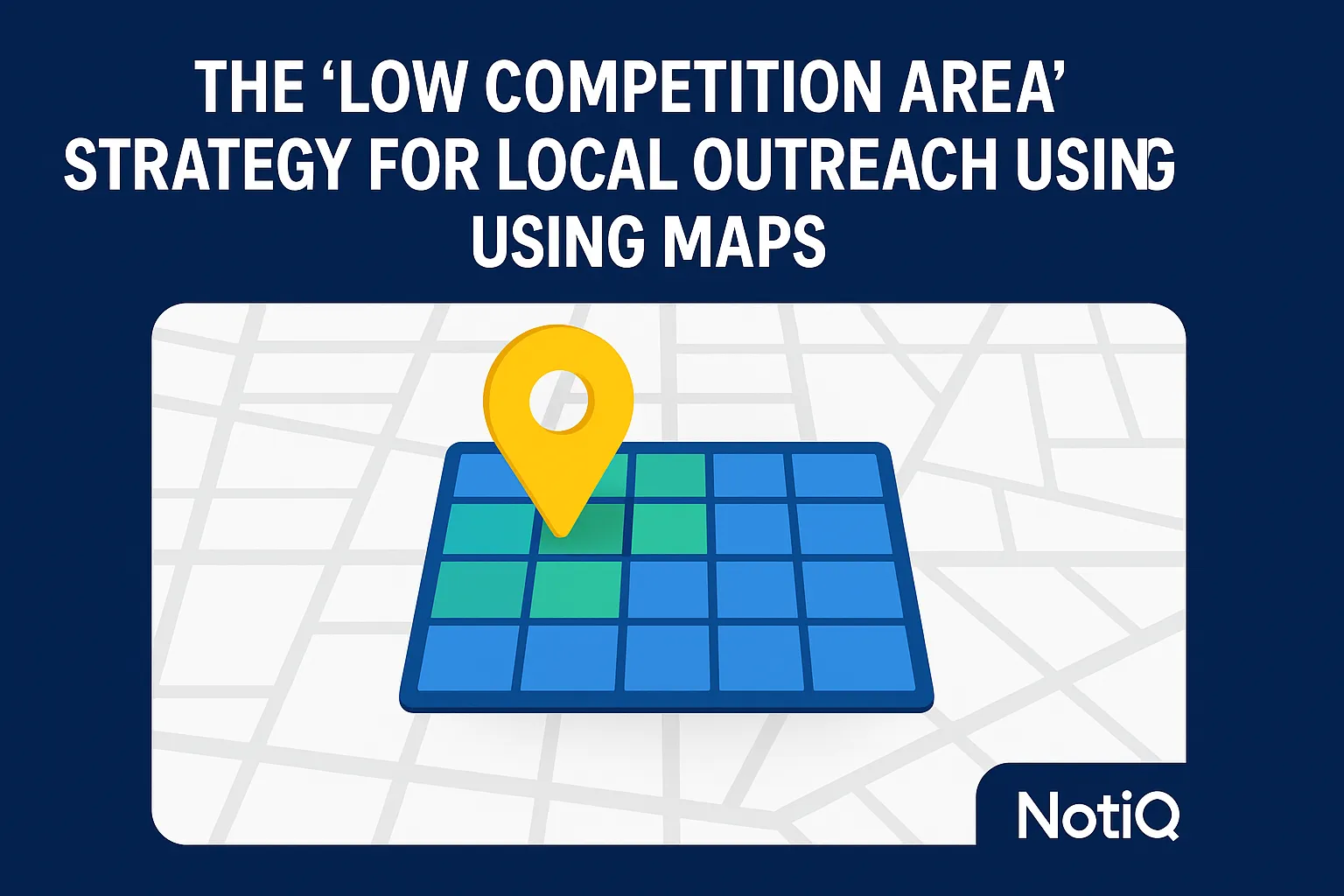
The “Low Competition Area” Strategy for Local Outreach Using Maps
Discover how to use map visibility, review signals, and territory scoring to find underserved local markets. This guide shows how a local SEO audit can turn geographic gaps into smarter outreach.
1. Introduction
Most local outreach fails for one simple reason: sales teams target obvious, crowded markets instead of finding underserved pockets with real, untapped demand. When agencies and lead generation operators rely on broad, list-based prospecting, they fundamentally ignore geographic saturation, review density, and crucial local visibility gaps. The result is wasted effort, low response rates, and messaging that gets lost in a sea of identical pitches.
This article provides a definitive blueprint for a low competition area strategy for local outreach using maps. We will explore how to use map, review, and local SEO signals to identify low competition maps, score territories effectively, and convert that geographic research into high-converting outreach execution. Unlike content that stops at basic keyword research or raw data extraction, this guide connects local market discovery directly to strategic sales action.
For agencies, sales teams, and local lead generation operators managing outreach across cities, ZIP codes, or neighborhoods, mastering geo targeting outreach is the ultimate competitive advantage. Grounded in practical execution rather than theory alone, this methodology mirrors the core philosophy behind[Home](/), a strategic platform and framework designed to use geographic gaps to dominate local outreach. By prioritizing underserved areas through compliant, publicly accessible data, you can transform your prospecting from a guessing game into a precise, repeatable science.
2. Why Broad Local Outreach Misses Underserved Markets
Generic local outreach consistently underperforms because it treats geography as an afterthought. Geography must become a foundational part of your local outreach strategy, not just a setting for ad targeting or a variable in SEO planning. Too often, sales teams choose territories based on familiarity, sheer population volume, or pure guesswork rather than analyzing actual competition and demand signals.
Targeting high-density markets where many businesses already have strong review profiles and entrenched visibility is a recipe for low conversion. "More businesses in an area" does not automatically mean "better outreach potential." Instead, the goal should be to identify underserved local markets—places where local demand exists, but competitor visibility, review strength, or category saturation is comparatively weaker. This territory-based lead generation approach ensures your message reaches businesses that actually need your services.
The hidden cost of targeting obvious markets
A common pattern in regional prospecting is defaulting to major cities, broad metros, or familiar neighborhoods because they seem safer and easier to list-build. However, this safety is an illusion. These obvious areas often produce significantly lower response rates due to market fatigue and stronger incumbent competition.
Contrast these high-volume regions with adjacent, lower-saturation areas. A suburb just outside a major metro may offer vastly superior entry potential because local businesses are less bombarded by vendor pitches. By ignoring geographic outreach targeting and local competitor density, teams incur the hidden costs of wasted effort, burned domains, and frustratingly weak response rates.
Why local SEO signals matter for outreach, not just rankings
Map visibility, review count, and listing saturation act as highly practical proxies for market competition. The overlap between local SEO analysis and outbound prioritization is striking: both disciplines are trying to understand who is visible, who is dominant, and who is vulnerable in a specific market.
While SEO focuses on improving rankings, this local SEO outreach strategy is about using those exact signals to decide where to prospect first. By examining Google’s local ranking factors—specifically relevance, distance, and prominence—you can gauge how entrenched competitors are. This location intelligence for outreach empowers you to make data-backed sales decisions based on map-based prospecting rather than intuition.
What makes geo targeting for outreach different from geo targeting for ads
It is vital to clarify that ad geo targeting focuses purely on delivery, while geo targeting outreach focuses on selecting the best markets and tailoring your messaging. Outbound teams need robust territory planning for outreach, not just audience segmentation settings in an ad manager.
Geographic context improves both prioritization and personalization. When you understand the specific competitive landscape of a neighborhood, your location-based sales prospecting becomes highly relevant. You are no longer just sending a message to a ZIP code; you are addressing the unique market conditions of that specific territory.
3. How to Spot Low Competition Areas Using Map and Review Signals
To execute a successful local outreach strategy, you must learn to identify underserved markets using observable local data points rather than gut feeling. The core signal categories include listing density, review volume, ratings, category overlap, and local visibility patterns.
When searching for low competition maps, always compare nearby geographies rather than evaluating a single city in isolation. Remember that no single metric defines a low competition area; the true signal comes from the combined pattern of these data points, driving smarter map-based lead generation.
Listing density and category saturation
The first step is to assess how many relevant businesses appear for a target service or category in a given city, ZIP code, or neighborhood. Lower listing density often indicates a less crowded market, especially when paired with evidence of commercial demand.
However, business density must be weighed against category saturation. If there are only twenty businesses in an area, but they all offer near-identical services with massive category overlap, the market may still be saturated despite its small size. To spot relative gaps, compare multiple nearby areas. For authoritative context on establishment-density, cross-reference your geographic outreach targeting findings with U.S. Census County Business Patterns data.
Review counts as a proxy for competitive strength
Average review count and review disparities are incredibly revealing metrics. They show exactly how entrenched competitors are in a local market. A market with many listings but a weak overall review depth may actually be easier to enter than a market dominated by a few high-review incumbents.
When conducting review count analysis, look at the review count distribution, not just the average. If one business has 500 reviews and the rest have under 10, that is a different competitive landscape than ten businesses with 50 reviews each. Reviews are a proxy for local competition signals, not a perfect measure, but as highlighted by Google’s local ranking factors, prominence (often driven by reviews) is a critical indicator of market dominance and underserved market analysis.
Visibility gaps, proximity patterns, and local map coverage
Visibility can vary significantly by neighborhood, not just by city limits. A specific business category may be incredibly crowded in the downtown center but weakly served in outer neighborhoods or adjacent towns.
When evaluating low competition maps, consider proximity and service coverage in practical outreach terms. Some providers may rank or appear broadly, while others have incredibly thin coverage outside their core zones. Understanding these proximity patterns allows you to identify regional lead targeting opportunities. Relying on established trade area analysis methodology helps validate geographic service zones before you prioritize your outreach efforts.
Signals that a market is underserved, not simply small
There is a massive difference between low competition and low opportunity. A truly underserved local market will show some sign of commercial activity or service demand alongside its lower competitor intensity.
If an area has zero competitors but also zero population or commercial infrastructure, it is not a territory-based lead generation opportunity; it is a dead zone. A worthwhile low competition area typically has enough population density, commercial activity, or search demand to justify outreach. Location intelligence for outreach requires balancing these demand indicators with the competitive gaps you uncover.
4. A Simple Framework for Scoring and Prioritizing Territories
Turning geographic observations into a repeatable scoring model is the core operational differentiator of this strategy. Rather than relying on an overly complex, black-box algorithm, teams should use a practical territory score built from a few weighted variables. This allows for clear territory planning for outreach and ensures your geographic outreach targeting is consistent across cities, ZIP codes, and neighborhoods.
The four-part low competition territory score
A highly effective market scoring model relies on a simple four-part framework:
1. Demand Signal: Evidence of commercial activity or population density.
2. Listing Density: The total count of competitors in the defined area.
3. Review Strength: The average and distribution of competitor reviews.
4. Category Saturation: The degree of service overlap among existing businesses.
By evaluating these variables, you can create a relative score across markets. For example, a scorecard might rate each variable from 1 to 5, resulting in a total score that dictates priority. This low competition area strategy keeps map-based prospecting objective and scalable.
How to compare two or three nearby markets
To see this in action, imagine comparing a crowded city center with an adjacent underserved area. The city center might have high demand (5), high listing density (5), high review strength (5), and high category saturation (5). It is a highly competitive, low-yield market for outreach.
Conversely, a suburb ten miles away might show moderate demand (3), low listing density (2), weak review strength (2), and fragmented category saturation (2). This adjacent area presents a massive underserved market analysis opportunity. In regional prospecting, the best market is rarely the largest one. By identifying these geographic gaps—a core observation driving NotiQ’s methodology—teams can unlock significantly higher outreach ROI using low competition maps.
When to deprioritize a market
A good scoring framework doesn't just find attractive territories; it eliminates poor-fit ones. You must know when to deprioritize a market. Red flags include very low commercial activity, no clear demand signal, poor service fit, or misleadingly low competition caused by a fundamental lack of opportunity.
If your territory-based lead generation targets an area with low competition but zero local relevance for your service, it will still lead to weak campaign performance. Market prioritization requires ruthless disqualification of dead zones to maintain a high-performing local outreach strategy.
Turning territory scores into campaign sequencing
Once scored, group your markets into priority tiers:Launch Now,Test Next, andMonitor Later. This sequencing helps teams allocate outreach effort efficiently and avoids spreading resources too thin across a massive geographic footprint.
Sequence your outreach by win probability and local fit rather than broad geographic coverage. To scale these territory-based workflows and operationalize this process seamlessly, consider exploring Pricing to see how dedicated outreach prioritization tools can manage your geo targeting outreach and regional lead targeting at scale.
5. How to Localize Outreach Messaging by City or Neighborhood
Market analysis must directly shape your messaging, not just your list selection. Localized messaging is where a low competition area strategy starts to produce real, measurable outreach gains. By connecting signal-based insights to practical copy changes, you move beyond generic templates and step into true hyperlocal personalization. Your local outreach strategy should sound locally aware without ever becoming overly formulaic.
What to change in your messaging based on local signals
Your outreach messaging should actively reflect the visible market conditions you discovered. If you noticed weak competition, underserved service areas, or gaps in local positioning, mention them.
The outreach angle must vary by place. Instead of using a single city-swapped template, your localized outreach messaging should reference specific neighborhood coverage, local demand conditions, or competitive whitespace. City-specific outreach works best when it proves to the prospect that you actually understand their immediate commercial environment, making neighborhood prospecting highly effective.
City-level vs neighborhood-level personalization
Knowing when to use city-level messaging versus granular neighborhood or ZIP-code context is vital. In dense metropolitan areas, tighter geographic outreach targeting is often necessary. Mentioning a specific borough or district proves local relevance.
Conversely, in smaller regional markets, city-level or county-level messaging is usually sufficient. The goal of your local outreach strategy is to balance hyper-relevance with operational efficiency, applying regional segmentation where it makes the most impact.
Messaging mistakes that make local outreach feel generic
The fastest way to ruin a geo targeting outreach campaign is superficial localization—simply inserting`{{City_Name}}`into a generic template. Generic outreach fails because broad claims do not reflect actual local gaps or market conditions.
If you claim to help them "dominate the local market," but they already have 500 reviews and zero close competitors, your message looks foolish. Instead, use insight-backed statements tied directly to what you observed in your map and review analysis to build immediate local relevance.
How to align copy with underserved-market opportunities
Outbound copy should emphasize timing, whitespace, or unaddressed local demand. Tie your localized sales outreach directly to service coverage, market-entry opportunities, or weak incumbent positioning.
For example:"I noticed your competitors in [Neighborhood] have very thin review profiles, leaving a clear gap for a dominant provider in the area."This map-based lead generation insight proves you did your homework. For more advanced positioning angles and best practices on targeting underserved local markets, review the resources at Blog.
6. How to Turn Geographic Gap Analysis Into a Repeatable Workflow
The ultimate goal is not a one-off territory research project, but a recurring, repeatable outreach workflow for market discovery, prioritization, and execution. While many tools help collect data, very few show teams how to operationalize it into actual campaigns. Bridging this gap is the key to mastering geo targeting outreach and map-based prospecting.
Step 1: Define your trade area and serviceable market
First, clearly define the geographic unit of analysis: city, ZIP code, district, or neighborhood. The right market boundary is critical for accurate scoring and messaging. Use actual service radiuses and buyer realities rather than arbitrary administrative boundaries. Proper regional prospecting relies on sound trade area analysis methodology to ensure your serviceable market is defined accurately before evaluation begins.
Step 2: Collect map, review, and local visibility signals
Gather compliant, publicly accessible data: listing counts, review counts, business categories, and visible competitor patterns. Keep your guidance strategy-led. Pure scraper workflows often fail because raw extraction alone is useless without interpretation and prioritization.
By utilizing location intelligence for outreach platforms like NotiQ, teams can rely on workflow-driven approaches that legally and compliantly analyze review signal analysis and map-based prospecting data, avoiding the pitfalls of unguided manual extraction tools.
Step 3: Score territories and build priority tiers
Translate your collected signals into a ranked list of target markets using the territory scoring model discussed earlier. Keep the scoring visible and simple so teams can revisit their assumptions monthly. Assign your markets intoLaunch,Test, andMonitortiers to ensure your geo prospecting and market prioritization remain focused and actionable.
Step 4: Build localized prospect lists and messaging tracks
Feed your selected territories into segmented prospect lists. Ensure each territory receives a tailored message track based on local gaps and competition patterns. This territory-based lead generation approach connects city-specific prospecting directly to higher response quality, proving that localized outreach yields better results than mass volume alone.
Step 5: Measure response quality and refine the model
After launching, meticulously track replies, meetings booked, conversion quality, and territory-level performance. Campaign outcomes must feed back into future territory scoring. Maintain transparent measurement and documented assumptions. Iterative learning and constant territory optimization are what transform standard outreach response rates into dominant regional campaign performance.
7. Tools, Resources, and Validation Inputs
Executing this strategy requires a practical resource layer to validate competition, market size, trade area logic, and outreach execution. Focus on decision-making inputs rather than getting lost in software hype. The right local outreach tools provide location intelligence for outreach that validates your market assumptions.
Map and local visibility inputs
Map listings, category results, and review patterns provide immediate, surface-level competition insights. Frame these Google Maps signals as directional indicators that must be interpreted in context. To understand exactly why these local visibility analysis inputs matter for map-based lead generation, always refer back to Google’s local ranking factors.
Market sizing and density validation
Broader business establishment data helps validate whether an area is truly underserved or simply too small to matter. Establishment counts support territory planning at a macro level, ensuring you don't waste time on non-viable regions. For accurate market sizing and business density metrics, rely on authoritative sources like the U.S. Census County Business Patterns data.
Planning frameworks for sustainable territory selection
Avoid random territory choices by utilizing educational frameworks for trade area analysis and local market benchmarking. Consistent planning always beats ad hoc list building. For a highly practical, repeatable market analysis workflow, leverage resources like the downtown market analysis toolbox to ensure your territory planning for outreach is structurally sound.
8. Future Trends in Geo-Targeted Outreach
Geo-focused outreach is rapidly evolving. The future belongs to teams leveraging AI-assisted territory segmentation, hyperlocal personalization, and tighter integration with local SEO intelligence. Staying ahead of these trends in geo targeting outreach will define the next generation of sales success.
Why location intelligence is becoming part of modern prospecting
Outreach teams are becoming significantly more selective about where they prospect first. The competitive advantage increasingly comes from choosing better markets, not just automating more messages. Location intelligence for outreach allows teams to master regional prospecting and market prioritization, ensuring every email sent has a high probability of landing in a receptive inbox.
The shift from broad lists to geographic opportunity scoring
The industry is moving aggressively away from generic lead lists toward territory-aware models. Geographic opportunity scoring improves efficiency, response quality, and campaign sequencing. By embracing territory scoring and underserved market analysis, geo prospecting becomes a strategic asset rather than a numbers game.
Where NotiQ can differentiate
[Home](/)serves as the critical bridge between geographic research and outreach execution. By identifying geographic gaps, prioritizing markets, and turning those insights into compliant, actionable outreach workflows, NotiQ solves the execution gap that plagues traditional map-based prospecting. With advanced AI enrichment and execution planning, it provides the ultimate geo-focused outreach workflow for modern sales teams.
9. Conclusion
The best local outreach strategy is not broader outreach—it is better market selection. By identifying underserved areas using map and review signals, scoring territories accurately, localizing your messaging, and repeating the process, you can dramatically increase your campaign success. Map-based research only becomes valuable when it actively drives outreach decisions and campaign structure.
Start small. Pick a set of adjacent markets, build a simple territory score, and localize your messaging before scaling up. This low competition area strategy for local outreach using maps is your blueprint for dominating geo targeting outreach. To operationalize this geographic gap analysis into a repeatable, high-converting workflow, explore the solutions at Pricing and transform your local outreach strategy today.
Frequently Asked Questions
- How do you find low competition areas for local outreach?
- To find low competition areas, compare nearby markets using listing density, review counts, category saturation, and visible local competition patterns. Focus on relative comparison across adjacent territories rather than searching for one universal threshold to guide your geographic outreach targeting and uncover low competition maps.
- What signals best reveal an underserved local market?
- An underserved local market is revealed by review disparities, thin listing density, weak category coverage, and visibility gaps across neighborhoods or nearby towns. For effective map-based prospecting, always pair these review signals with concrete evidence of local demand.
- What is the difference between geo targeting for ads and outreach?
- Ad geo targeting controls the distribution and delivery of content to an audience. Conversely, geo targeting outreach controls market selection, prioritization, and message relevance, making it a foundational element of territory planning for outreach and location-based sales prospecting.
- How should teams prioritize cities, ZIP codes, or neighborhoods?
- Teams should prioritize markets using a territory scoring model that combines demand signals, competition density, review strength, and category saturation. Group these markets into priority tiers to optimize regional lead targeting and market prioritization.
- How often should you revisit your territory scoring model?
- You should review your market scoring model monthly or quarterly, depending on your campaign volume and the pace of market change. New business entrants, review growth, and regional campaign performance can shift territory attractiveness quickly, requiring ongoing territory optimization.
Continue Reading
More articles you might find useful
Google Maps Prospecting for Commercial Landscaping Companies
Learn how commercial landscaping companies can use Google Maps to find higher-fit commercial property leads, qualify visible need, and build denser service routes. This guide breaks down a practical workflow for smarter prospecting and better contract opportunities.
Read the article →
How to Find Businesses With Weak Google Maps Descriptions
Learn how to find businesses with weak Google Maps descriptions and turn visible GBP gaps into qualified local SEO leads. This guide covers audit criteria, scoring, and outreach angles you can use at scale.
Read the article →
Google Maps Lead Generation for Pest Control Companies
A beginner-friendly playbook for turning Google Maps visibility into more pest control leads. Learn how to improve rankings, build reviews, and convert local searches into booked jobs.
Read the article →Popular industry lead playbooks
Maps search examples and niche outreach for the verticals teams prospect most.