Technology
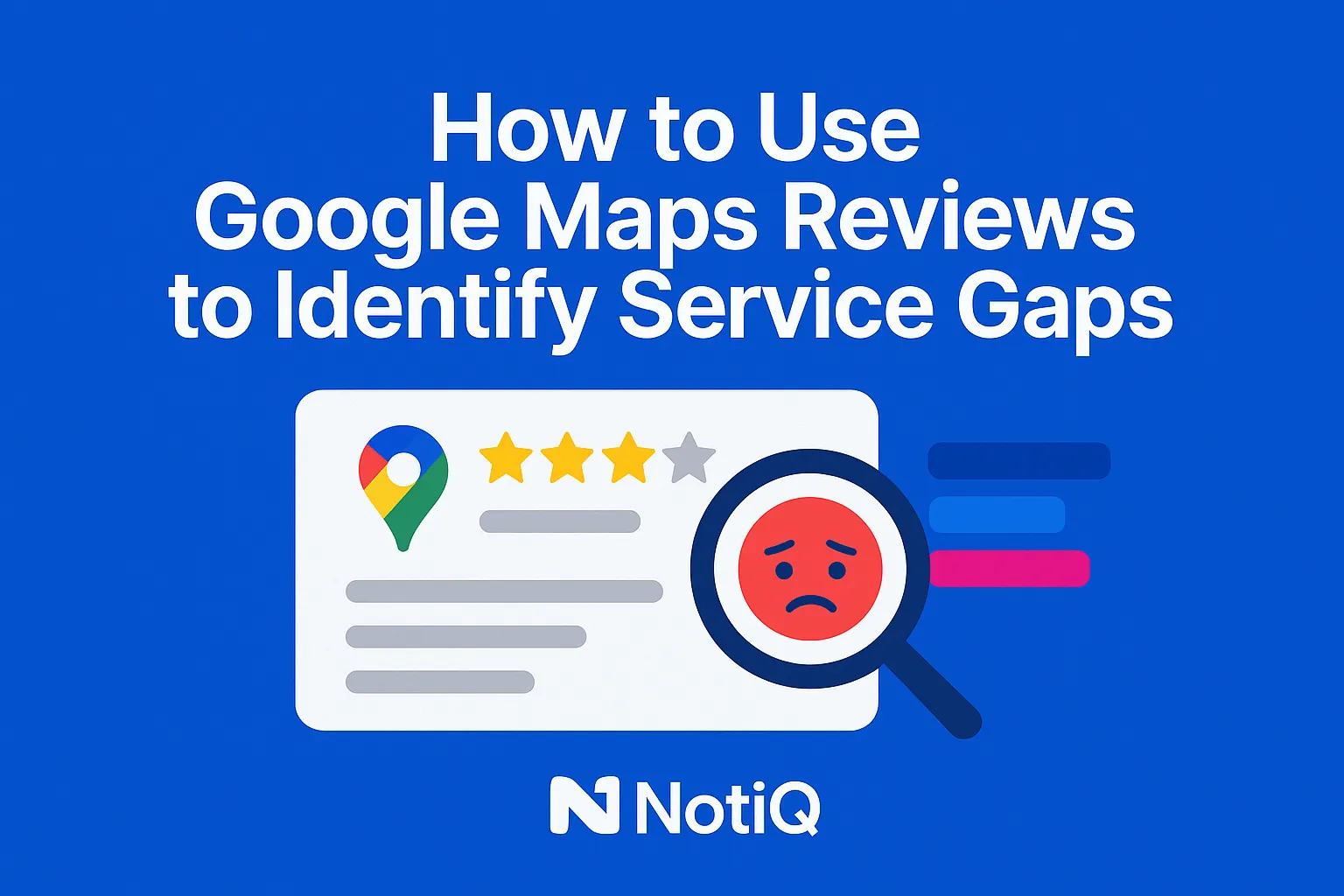
How to Use Google Maps Reviews to Identify Service Gaps (And Sell Solutions)
Learn how to analyze Google Business Profile reviews to uncover recurring service gaps and turn them into tailored sales opportunities. This guide shows how to spot patterns, score accounts, and craft ethical outreach.
1. Introduction
Google Maps and Google Business Profile reviews are much more than mere reputation signals—they are a highly visible, public record of unmet expectations, repeated complaints, and urgent buying triggers. While most businesses understand that reviews matter, the vast majority of sales teams and marketers either skim this feedback manually or relegate it entirely to reputation management software. By doing so, they miss out on one of the most powerful sources of sales intelligence available today.
This guide will show you exactly how to analyze google maps reviews analysis patterns, separate one-off emotional complaints from genuine service gaps, and turn those findings into ethical, highly personalized outreach. For agencies, SaaS marketers, and sales teams targeting local businesses, this creates a repeatable workflow that anchors your pitch in reality rather than guesswork. Using platforms like[NotiQ](/), which specializes in AI-assisted complaint mining and personalized sales angles, teams can transform public review signals into structured prospect research.
By the end of this article, you will know how to collect reviews, cluster complaints, validate patterns, map them to actionable solutions, prioritize high-value accounts, and write outreach that feels deeply relevant rather than invasive.
2. Why Reviews Reveal Service Gaps
Public review text is a goldmine of market intelligence. When customers leave feedback on a Google Business Profile, they often highlight operational friction that the business owner may be too close to see. Repeated review language frequently exposes deep-seated issues such as slow response times, poor communication, missed appointments, hidden fees, or inconsistent service quality.
Contrast this with generic cold outreach. Standard prospecting relies on vague personalization and broad assumptions about a company’s needs. Review-based signals, however, allow sales teams to anchor their messaging in highly visible customer feedback mining. When you reach out to solve a specific, documented pain point, your message cuts through the noise.
It is crucial to understand the difference between review management and review-based prospecting. Most reputation software focuses on monitoring ratings, auto-responding to customers, and boosting local SEO. While valuable, these tools lack prospecting execution, account scoring, and AI enrichment. A true service gap analysis uses reviews not just to manage a brand’s image, but to build a qualified sales pipeline. Furthermore, these insights can simultaneously support a prospect’s local SEO and customer experience strategy, making your eventual pitch infinitely more valuable. Research supports this methodology; a recent peer-reviewed study using Google Maps reviews for sentiment analysis demonstrates how systematically evaluating public feedback reveals clear patterns in service perception.
What Counts as a “Service Gap” in Reviews
A service gap is defined as a repeated mismatch between what customers expect and what they actually experience. Not every negative review qualifies. To separate a true gap from an isolated complaint, you must look for recurrence, severity, and consistency of wording across multiple local business reviews.
High-signal categories that indicate a systemic service gap include:
• Response time: Customers repeatedly stating they waited days for a callback.
• Appointment reliability: Mentions of no-shows or double-booked schedules.
• Staff professionalism: Consistent notes about rude or unhelpful front-desk behavior.
• Communication quality: Failure to explain procedures or follow up post-service.
• Pricing transparency: Multiple complaints about hidden fees or billing surprises.
• Complaint resolution: A track record of ignoring issues once they are raised.
Extracting these negative review patterns local business owners are facing allows you to pinpoint exactly where their operations are failing.
Why This Matters for Agencies, Sales Teams, and SaaS Marketers
For agencies, conducting review mining for sales outreach provides a credible foundation for pitching services. Instead of saying, "We can improve your marketing," an agency can say, "We noticed a pattern of missed appointments in your reviews, and we build automated scheduling systems."
SaaS marketers can map these public complaints directly to their product use cases or workflow automations. If a SaaS tool resolves booking friction, targeting businesses with reviews complaining about booking difficulties guarantees message-market fit. Ultimately, review-based lead generation improves lead qualification by revealing a prospect's urgency and operational pain points long before the first email is ever sent.
3. How to Spot Recurring Complaint Patterns
Finding real negative review patterns requires a systematic, repeatable framework rather than cherry-picking isolated negative comments. The goal is to gather a meaningful sample of reviews, tag complaint themes, group similar language, and measure both frequency and recency.
The best outreach opportunities stem from patterns that are both heavily repeated and highly relevant to the business's bottom line. It is also vital to analyze nearby competitors to understand whether an issue is unique to the prospect or a category-wide challenge. This systematic approach to complaint analysis aligns with established operational standards, such as the NIST guidance on complaint analysis and service improvement, which emphasizes structured evaluation over anecdotal interpretation.
Step 1 — Collect a Useful Review Sample
To accurately perform a customer review sentiment analysis for local businesses, you must look beyond the latest three to five reviews. Gather a sufficient, legally accessible sample of recent Google Business Profile reviews to balance recency with volume.
Reviewing a larger dataset allows you to identify repetition, long-term rating trends, and severity clusters. Patterns hold significantly more weight when the same operational complaint appears across multiple, unrelated reviewers over a span of several months.
Step 2 — Tag Complaints by Theme
Once you have your dataset, categorize the feedback into simple complaint buckets. Common tags includeslow response, no-shows, rude staff, pricing surprises, poor communication, inconsistent quality,andunresolved issues.
Whenever possible, retain the customers’ exact language. Preserving the authenticity of the complaint helps you uncover phrasing that will later make your messaging resonate. While AI summarization can drastically speed up this clustering process, human review remains essential to ensure context is not lost. For deeper insights into building these workflows, explore this educational content around personalized outreach workflows and review-informed messaging.
Step 3 — Separate One-Off Complaints From Real Patterns
To find service gaps from online reviews, you must validate patterns using three critical filters: frequency, severity, and consistency of wording.
One angry review from a bad day does not indicate a true service gap. However, repeated mentions of the exact same failure to resolve complaints reviews over six months is a glaring operational flaw. When validating, ask yourself:
• Is this issue recent?
• Does it appear more than once?
• Does this specific problem directly affect the business's trust, revenue, or conversion rates?
Step 4 — Compare Against Competitors or Local Alternatives
Competitor review analysis reveals whether a complaint is a specific weakness of your target account or a broader industry norm.
If similar local businesses are praised for lightning-fast response times, while your target prospect is repeatedly criticized for delays, that gap becomes a highly effective outreach angle. The strategic value here lies in insight gathering, not aggressive competitor bashing. Modern AI enrichment tools offer distinct advantages in verifying these local SEO tools review analytics, ensuring your competitive benchmarking is accurate and compliant.
4. Complaint-to-Solution Mapping for Outreach
The objective of review analysis outreach is never to "call out" or embarrass a business for its negative reviews. Instead, the goal is to identify operational pain points and seamlessly connect them to a relevant, helpful solution.
By mapping complaints to specific solutions, you transition from a critic to a consultant. This complaint to solution mapping from google reviews is what separates high-converting sales prospecting from generic spam.
Common Complaint Categories and the Best Outreach Angles
Every common complaint maps to a likely operational need. Here is how to position your solutions based on the feedback:
• Slow response times google reviews: Pitch lead routing, unified inbox automation, or automated follow-up systems.
• Missed appointments customer reviews: Pitch scheduling workflows, SMS reminders, or no-show prevention software.
• Poor communication in customer reviews: Pitch messaging automation, chatbots, or customer support workflows.
• Hidden fees: Pitch pricing clarity tools, estimate automation, or pre-service communication templates.
• Unprofessional staff behavior: Pitch staff training, QA systems, or customer experience (CX) workflows.
• Inconsistent service quality: Pitch Standard Operating Procedures (SOPs), performance monitoring, or process standardization consulting.
Always use concise, solution-oriented phrasing rather than accusatory language.
Use Verbatim Customer Language to Strengthen Relevance
Pulling recurring phrases directly from public reviews makes your outreach incredibly resonant—if handled carefully. The key to pain point extraction is paraphrasing the broader pattern rather than quoting a single reviewer verbatim in a way that feels invasive or overly monitored.
Using the customer's wording can drastically improve your subject lines, first lines, and overall positioning statements. For guidance on executing this tactfully, review strategies for personalized first-line creation from public review signals.
Example Transformation — From Complaint Cluster to Outreach Hook
Transforming review mining for sales outreach into a compelling hook requires tact.
• Weak outreach: "Hi [Name], we help local businesses grow and improve their operations. Do you have 15 minutes to chat?"
• Stronger outreach (Direct): "Hi [Name], I was looking through some local med spas and noticed a few recent mentions about booking delays. We actually build automated scheduling workflows that eliminate front-desk bottlenecks. Would you be open to seeing how it works?"
• Stronger outreach (Consultative): "Hi [Name], I specialize in helping home service teams improve response times. I noticed a pattern in recent feedback regarding delayed callbacks, which is super common in this industry right now. We set up automated lead routing that handles this instantly—worth a quick chat?"
The best messages focus entirely on improvement and positive outcomes.
5. How to Prioritize High-Opportunity Accounts
Not every business with a few negative reviews is a good prospect. To avoid wasting time, you must prioritize accounts based on a structured scoring framework. The best prospects are rarely the lowest-rated businesses; rather, they are the ones with visible, repeated gaps that your specific service can actually solve.
Build a Simple Prospect Score
To streamline your review-based lead generation, build a simple prospect score based on the following criteria:
1. Frequency of complaint theme: How often does the specific issue appear?
2. Recency of issue: Are these complaints from the last 90 days?
3. Severity or trust impact: Does this issue actively cost them money or clients?
4. Fit with your offer: Can your product or service directly fix this exact problem?
5. Evidence of care: Does the business respond to reviews or show they care about growth?
This lightweight rubric can be used manually by sales teams or scaled using ai review summarization for local business prospecting.
Which Complaint Types Usually Signal the Best Sales Opportunity
Some complaints map much more directly to B2B solutions than others.
High-opportunity examples: Slow response times, appointment reliability issues, unresolved complaints reviews, and systemic communication breakdowns. These are operational failures that software, automation, or agency services can fix quickly.
Lower-opportunity examples: Highly subjective taste preferences (e.g., "the soup was too salty") or one-off emotional rants with no repeat pattern. These do not present a scalable sales opportunity.
Prioritize by Urgency and Business Type
Urgency differs drastically by vertical. When analyzing local business reviews, context is everything. Missed appointments or no-shows represent a massive loss of revenue for home service contractors (HVAC, plumbing). Conversely, staff professionalism and booking friction may be the most critical metrics for private clinics, dentists, or med spas. Always align your prospect scoring with your Ideal Customer Profile (ICP) and the realities of their specific industry.
6. Ethical Ways to Use Public Reviews in Messaging
The biggest barrier to executing review analysis outreach is trust. Sales teams often worry about sounding creepy, manipulative, or non-compliant. Ethical review outreach relies on accurate, respectful, and solution-oriented messaging that never misrepresents public feedback.
When referencing public data, you must adhere to compliance standards and platform terms. For foundational legal and ethical grounding, teams should review the FTC guidance on consumer review rules as well as the FTC guide to ethical review practices. Additionally, the OECD good practices for online ratings and reviews provides excellent international context on maintaining trust and review reliability.
What to Say — and What Not to Say
When figuring out how to turn negative reviews into outbound messaging, phrasing is everything.
What to say:"I noticed a pattern around response times recently..." or "It looks like booking friction has been a recurring theme..." What not to say:"John Smith said your receptionist was rude on Tuesday..."
Never quote a negative review word-for-word in a confrontational manner. Avoid exaggeration, making private assumptions, or using language that implies surveillance. Frame your outreach entirely around solving a visible operational challenge.
Use Reviews as Context, Not Ammunition
Public reviews should inform the relevance of your pitch, not become a pressure tactic to shame the business owner. Solution-led outreach is inherently more credible than shame-based outreach. Always validate your findings manually before sending messages, especially when relying on customer feedback mining generated by AI summaries.
When Not to Use Review-Based Personalization
Exercise discernment and restraint. Do not use this tactic if the complaint is isolated, outdated (over a year old), ambiguous, or completely unrelated to your service. If there is no clear complaint-to-solution match, forcing personalization will immediately reduce trust and ruin the relationship before it begins.
7. Tools and AI Workflows for Review Analysis at Scale
Operationalizing this process requires leverage. Reading thousands of reviews manually is not scalable. This is where AI review summarization for local business prospecting becomes invaluable. AI excels at summarizing review text, clustering complaint categories, extracting repeated wording, and generating draft outreach angles based on public data.
However, AI should accelerate your analysis, not replace human judgment. For teams looking to scale, platforms like[NotiQ](/)offer sophisticated orchestration, enrichment, and workflow automation to turn raw review data into actionable sales intelligence.
A Simple AI-Assisted Workflow
To implement a scalable google maps reviews analysis system, follow this sequence:
1. Pull public reviews: Gather accessible data from target accounts.
2. Summarize by theme: Use AI to categorize feedback into operational buckets.
3. Tag repeated complaints: Highlight the most frequent and severe issues.
4. Score the account: Apply your prioritization rubric to qualify the lead.
5. Draft outreach angles: Use AI to generate solution-mapped messaging.
6. Human-review before sending: Verify accuracy, tone, and ethical compliance.
Where AI Adds Value — and Where Humans Still Matter
AI is incredibly strong at pattern recognition, clustering large datasets, and drafting initial copy. However, humans must remain in the loop to verify nuance, assess the actual business relevance of a complaint, and ensure the final message is empathetic and ethical. Over-automation leads to tone-deaf messaging; human oversight ensures trustworthiness.
How This Differs From Traditional Review Tools
Traditional reputation management software is built for local SEO reviews. They help business owners monitor ratings, collect new reviews, and respond to angry customers. However, they stop short of converting those insights into outbound prospecting execution. Review-based lead generation tools differentiate themselves through data extraction, account prioritization, and personalized outbound workflows designed specifically for sales teams.
8. Future Trends in Review-Based Prospecting
The landscape of outbound sales is shifting rapidly. As inboxes become increasingly crowded, generic outreach is losing its effectiveness. The market is moving away from passive data monitoring and toward action-oriented, signal-based workflows.
Emerging trends include advanced ai review summarization, signal-based outbound personalization, and automated review clustering by complaint category. Teams that adopt these strategies early will achieve significantly sharper message-market fit.
From Reputation Management to Sales Intelligence
Review data is evolving. It is no longer just a support or marketing dataset; it is a critical pipeline-generation asset. Customer feedback mining allows sales teams to bypass the traditional "guessing game" of cold outreach by approaching prospects with undeniable proof of an operational bottleneck.
The Growing Role of Automation
Automation empowers teams to monitor thousands of local accounts, detect negative review patterns faster, and personalize outreach at an unprecedented scale. As ai-assisted prospect research becomes the standard, the teams that succeed will be those who balance high-volume automation with strict human oversight regarding accuracy and ethical data use.
9. Conclusion
Google Maps and Google Business Profile reviews are a transparent window into recurring service gaps. They make sales outreach undeniably relevant—but only when teams take the time to validate patterns and respond with genuinely useful solutions.
The framework is straightforward: collect a meaningful sample of reviews, tag the complaints, validate the operational gap, map it directly to your offer, score the account for urgency, and write ethical, solution-led outreach. This approach moves far beyond traditional reputation management or local SEO; it transforms public review data into high-converting sales intelligence.
If you are ready to operationalize this workflow and stop guessing at your prospects' pain points, explore how AI-assisted research platforms can help you extract complaint patterns and turn them into personalized, high-converting sales angles.
Frequently Asked Questions
- How can Google Maps reviews reveal service gaps?
- Google maps reviews service gaps emerge when customers repeatedly highlight where their expectations are consistently not being met. A single negative review may be an anomaly, but a recurring theme—like slow callbacks or hidden fees—indicates a structural service gap analysis opportunity.
- How many reviews should you analyze before drawing conclusions?
- You should look for a meaningful sample with enough volume to detect repeated themes, recent trends, and severity. While the exact number varies by business size, analyzing only the last three reviews is insufficient. Focus on finding negative review patterns rather than hitting a rigid numerical quota.
- What types of complaints create the best outreach opportunities?
- The best opportunities come from complaints that map cleanly to solvable operational issues. Examples include slow response times google reviews, missed appointments customer reviews, poor communication in customer reviews, and unclear pricing.
- How do you use public reviews in outreach without sounding invasive?
- Practice ethical review practices by referencing broad operational patterns rather than weaponizing a single, specific review. Stay accurate, respectful, and entirely focused on how your solution fixes the visible bottleneck.
- Can review analysis help with both prospecting and local SEO?
- Yes. The exact same review themes that power review analysis outreach can also be handed to the business owner to inform service improvements, refine their google reviews reputation management strategy, and ultimately boost their local visibility.
Continue Reading
More articles you might find useful
Google Maps Prospecting for Commercial Landscaping Companies
Learn how commercial landscaping companies can use Google Maps to find higher-fit commercial property leads, qualify visible need, and build denser service routes. This guide breaks down a practical workflow for smarter prospecting and better contract opportunities.
Read the article →
How to Find Businesses With Weak Google Maps Descriptions
Learn how to find businesses with weak Google Maps descriptions and turn visible GBP gaps into qualified local SEO leads. This guide covers audit criteria, scoring, and outreach angles you can use at scale.
Read the article →
Google Maps Lead Generation for Pest Control Companies
A beginner-friendly playbook for turning Google Maps visibility into more pest control leads. Learn how to improve rankings, build reviews, and convert local searches into booked jobs.
Read the article →Popular industry lead playbooks
Maps search examples and niche outreach for the verticals teams prospect most.