Technology
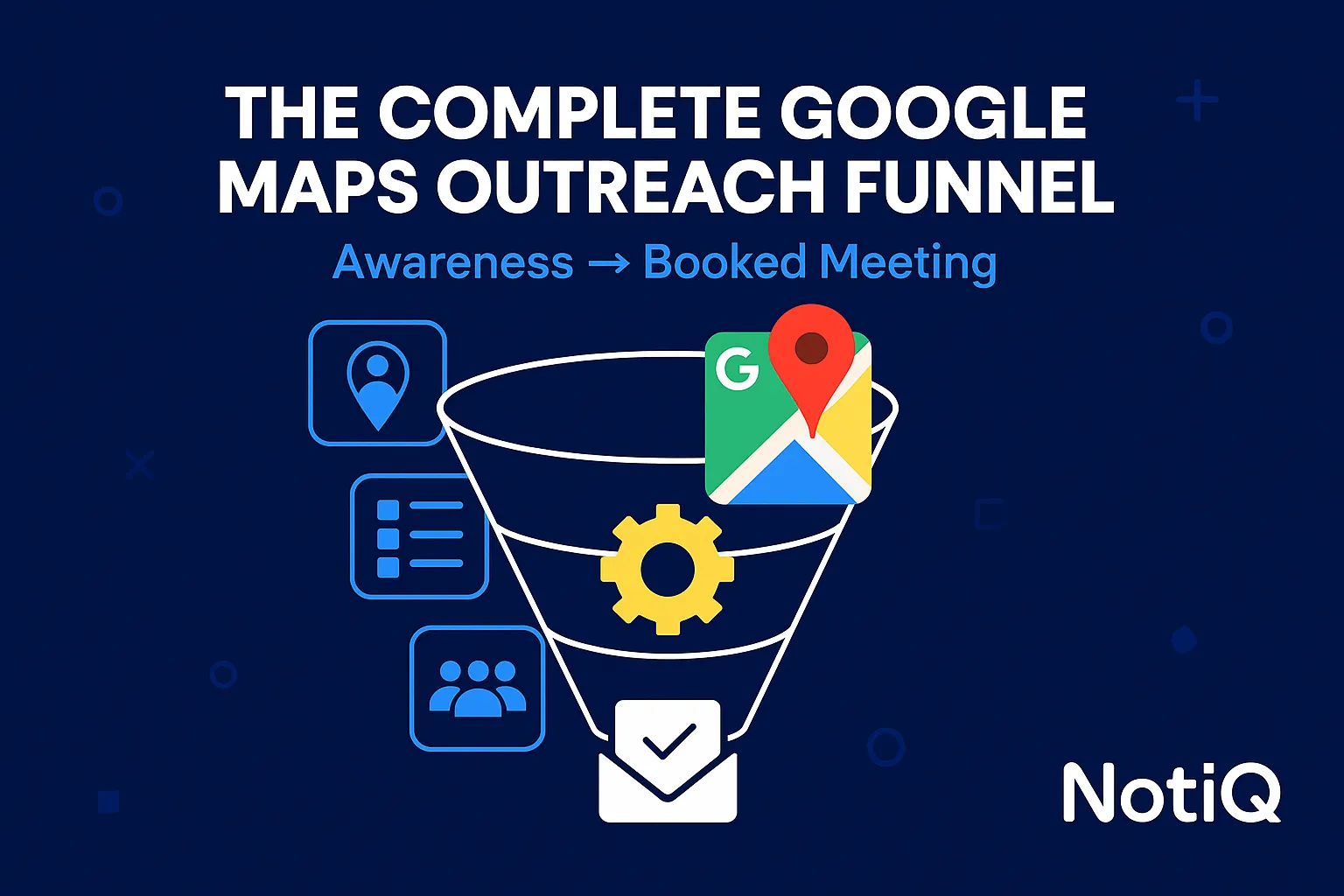
The Complete Google Maps Outreach Funnel (Awareness → Booked Meeting)
A complete end-to-end Google Maps outreach funnel showing how to turn raw Maps data into qualified leads and booked meetings using segmentation, enrichment, and multi‑channel outreach.
1. Introduction
Growing competition and inconsistent deal flow make local SMB acquisition unpredictable for agencies and SaaS teams. Relying on stale B2B lists often results in high bounce rates and low engagement, trapping sales teams in a "feast or famine" cycle.
To break this cycle, you need more than just a list of phone numbers; you need a strategic architecture. This guide reveals a complete end-to-end Google Maps outreach funnel—moving beyond simple data extraction to a sophisticated system of segmentation, enrichment, and booked meetings.
Drawing on NotiQ’s experience building hundreds of outbound funnels, we will deliver a strategic acquisition system complete with workflow maps, messaging frameworks, KPIs, and automation recommendations.
2. Why Google Maps Is the Highest-Intent Prospecting Channel
For local businesses, visibility on Google Maps is not a luxury—it is survival. Unlike enterprise companies that may rely on long sales cycles and brand equity, a local SMB (Small to Medium Business) relies on immediate local discovery to drive revenue. This makes Google Maps the highest-intent prospecting channel available today.
When you prospect via Google Maps, you are looking at businesses that are actively trying to be found. Data from industry leaders like BrightLocal and Moz consistently highlights that profile completeness correlates directly with local search ranking. A business with an unclaimed profile, few reviews, or outdated hours is actively bleeding revenue. This creates an immediate, quantifiable pain point that sales teams can address.
Map-based leads outperform cold, unfiltered B2B lists because the data reflects the business's current operational reality. While a database like ZoomInfo might list a headquarters that moved three years ago, Google Maps reflects what the consumer seesright now.
Competitors often focus solely on "scraping" volume—pulling thousands of leads and blasting them. This is a mistake. The winning strategy focuses on the funnel: using Maps data to identify specific deficits in a business's digital presence and offering a solution.
E-E-A-T Note:For context on the importance of this channel, the SBA guidance on optimizing Google Business Profiles emphasizes that accurate digital listings are critical for small business resilience and growth.
The Psychology of Local SMB Owners
Understanding the target persona is critical for conversion. The typical local SMB owner is often digitally overwhelmed. They are experts in their trade—plumbing, dentistry, legal services—not in digital marketing.
Their primary pain point is pipeline consistency. They know they need to be online, but they rarely have the time to manage it. When they see a drop in calls or foot traffic, they panic.
This psychology makes Maps-based outreach effective. When you point out a specific issue on their Maps profile (e.g., "You have a 4.2 rating while your competitor across the street has a 4.8"), you are not selling a generic service; you are addressing a threat to their livelihood.
Why Maps Data Is Cleaner, More Accurate, and Easier to Segment
Google Maps data is superior for local outreach because it creates precise targeting opportunities based on public signals. You can filter by:
• Review Count & Rating: Identify businesses with reputation management issues.
• Operating Hours: Target businesses open 24/7 or those with incorrect hours.
• Website Presence: Filter for businesses with no website or non-secure (HTTP) sites.
• GMB Signals: Identify "Unclaimed" profiles.
This granular data allows for "lane-based" prospecting. Instead of a generic pitch, you can create a "Reputation Lane" for businesses with under 10 reviews, or a "Web Design Lane" for businesses without a website. This segmentation is the foundation of high-performing maps prospecting automation.
3. The Complete Google Maps Outreach Funnel Framework
A list of leads is not a strategy. To scale acquisition, you must treat Google Maps outreach as a funnel with distinct stages: Awareness, Interest, Consideration, Action, and the Booked Meeting.
This framework moves beyond raw data extraction. It requires a strategic layer to orchestrate the movement of data from a public source into a qualified sales conversation. [NotiQ](/)serves as the strategic funnel engine enabling these stages, ensuring that raw data is transformed into actionable intelligence before a single email is sent.
Stage 1 — Scrape & Extract (Awareness)
The first stage involves the ethical extraction of public data. The goal here is volume and breadth within a specific niche.
Best Practices for Extraction:
• Targeting: Define tight geographic and categorical parameters (e.g., "HVAC contractors in Austin, TX").
• Data Fields: Collect Name, Address, Phone, Website, Review Count, Average Rating, and Claimed Status.
• Compliance: Strictly adhere to terms of service and only extract publicly visible information.
This stage establishes your Total Addressable Market (TAM). Historically, initiatives like Google’s Get Your Business Online program have encouraged businesses to make this data public to improve discovery. Your goal is to aggregate this public data to identify who exists in your target market.
Stage 2 — Enrich & Qualify (Interest)
Raw Maps data lacks personal contact information. Stage 2 is lead enrichment workflow.
Enrichment Steps:
1. Contact Discovery: Use waterfall enrichment tools to find decision-maker emails and mobile numbers associated with the business domain.
2. Digital Forensics: Analyze the website. Is it mobile-friendly? Is the SSL certificate valid? Are there tracking pixels installed (indicating they spend money on ads)?
3. Qualification: Discard leads that don't meet your criteria (e.g., businesses with no website if you sell SEO, or businesses with 500+ reviews if you sell reputation management).
Stage 3 — Segment & Prioritize (Consideration)
Once enriched, leads must be segmented. Do not treat all leads equally.
• Hot Lane: Businesses spending on ads but with low conversion signals (e.g., bad website). They have budget but need help.
• Warm Lane: Businesses with high revenue potential but low visibility (e.g., 4.9 rating but only 5 reviews).
• Cold Lane: Low-intent businesses with no digital footprint (harder to convert).
Prioritize the "Hot" and "Warm" lanes for your most expensive outreach channels (direct calls, personalized video), and use automated lanes for the "Cold" segment.
Stage 4 — Personalize & Craft Offers (Intent)
Generic outreach dies in the inbox. In this stage, you map specific offers to the segments created in Stage 3.
Personalization Frameworks:
• Review-Based: "I noticed you have a 4.9 rating but only 12 reviews. Your competitor [Name] has 150. Here is how we close that gap."
• Location-Based: Reference a specific landmark or neighborhood to prove you aren't a bot.
• Visual Proof: Include a screenshot of their ranking map or website audit. Visuals convert at 2–3x the rate of text-only emails.
For advanced strategies on using assets in your outreach, read this guide on mastering LinkedIn outreach with personalization to stand out in the inbox.
Stage 5 — Outreach, Nurture & Meeting Booking
The final stage is execution. A single touchpoint is rarely enough. You need a multi-channel workflow:
1. Day 1: Cold Email (Personalized Audit).
2. Day 2: LinkedIn Connection Request (Blank or low-friction).
3. Day 4: Phone Call / Voicemail drop.
4. Day 7: Follow-up Email (Case Study/Social Proof).
This sequence builds familiarity and trust, moving the prospect toward the booked meeting.
4. Tools and Automation Workflows for Scaling Maps Prospecting
To execute this funnel at scale, you need a technology stack that handles extraction, enrichment, and orchestration. While many tools exist, most only cover one slice of the pie.
Success requires integrating these tools into a cohesive system. Scaliq is an excellent resource for understanding how AI-driven enrichment and automation can streamline these complex workflows.
Scraping Tools & Data Extraction Workflows
Tools in this category automate the collection of public data from Maps.
• Pros: High speed, ability to target specific coordinates.
• Cons: Rate limits and IP blocks if not managed correctly.
• Workflow: Use cloud-based scrapers that handle IP rotation. Schedule batches to run overnight so data is ready for your sales team in the morning. Always prioritize accuracy over raw speed to ensure data integrity.
Enrichment, Cleaning & Verification Tools
Extraction gives you a business name; enrichment gives you a prospect.
• Trend: The industry is moving toward AI and NLP-based enrichment. These tools don't just find emails; they categorize business sentiment and intent.
• Verification: Always run emails through a verification tool (like NeverBounce or ZeroBounce) before sending. High bounce rates will destroy your domain reputation.
Sending Platforms & Deliverability
For SMB outreach, deliverability is paramount.
• Constraint: Google and Yahoo have tightened spam regulations.
• Strategy: Use "warm-up" tools to keep sending domains healthy.
• Volume: Avoid bulk blasts. Sending 50 highly personalized emails per day yields better results than 500 generic ones.
Workflow Orchestration (Where NotiQ Fits)
Most agencies cobble together a scraper, a verifier, and a sender using Zapier sheets that break constantly.NotiQ positions itself as the orchestrator. It ties the extraction, enrichment, and segmentation logic into a unified outbound funnel map. Instead of managing disparate CSV files, you manage a workflow. This distinction is what separates high-growth agencies from those stuck in manual data entry.
5. Messaging, Personalization, and Follow-Up Strategies for SMB Owners
Messaging for SMB owners must be concise, respectful, and value-driven. They do not have time for corporate jargon.
Personalization That Actually Converts
The goal of personalization is to prove you have done your homework.
• The "Neighbor" Angle: "I was looking for plumbers in [Neighborhood] and noticed your listing didn't show up in the top 3, even though you're just down the street from [Local Landmark]."
• The "Ego" Angle: "Congrats on the 5-star rating. I noticed you haven't responded to the last 3 reviews—Google actually penalizes that. Want a quick fix?"
• The "Competitor" Angle: "I saw [Competitor Name] is running ads on your brand name. Here is a screenshot."
Multi-Channel Follow-Up Timing & Cadence
SMB owners are busy. They often read an email, intend to reply, and get distracted by a customer.
• Follow-Up Philosophy: Be persistent but polite. You are not pestering; you are ensuring they didn't miss value.
• Recommended Sequence:
• Day 1: Email 1 (The Hook/Audit).
• Day 3: Email 2 (Bump + value add).
• Day 5: Call/SMS (If compliant).
• Day 8: Email 3 (The "Break-up" or Pivot to free resource).
Common Messaging Mistakes to Avoid
• Over-Complexity: Offering "Full-Stack Omni-Channel Digital Transformation." Instead, offer "More calls from Google Maps."
• Generic Templates: "Dear Business Owner..." is an immediate delete.
• No Credibility: Failing to mention who you are or linking to your own website/reviews.
6. KPIs, Optimization, and Real-World Examples
You cannot improve what you do not measure. A local business funnel optimization strategy relies on strict KPI monitoring.
Essential KPIs for Maps Funnels
• Lead Validity Rate: What percentage of scraped leads actually have valid contact info? (Target: >60%)
• Reply Rate: Are people responding? (Target: 3–5% for cold traffic).
• Positive Reply Rate: Are the responses "Interested" or "Stop emailing me"?
• Meeting Booking Rate: The ultimate metric. (Target: 1–2% of total leads enrolled).
Funnel Diagnostics: Fixing Leaks at Every Stage
• Leak: High Bounce Rate. Fix: Improve email verification and scraping accuracy.
• Leak: Low Open Rate. Fix: A/B test subject lines; check domain health.
• Leak: Low Reply Rate. Fix: Your offer is weak or your personalization is generic.
• Leak: No Shows. Fix: Implement automated SMS reminders before meetings.
Real-World Examples & Mini Case Studies
Case Study: HVAC Contractor
• Challenge: A local HVAC company had great service but zero visibility in new housing developments.
• Strategy: Scraped Maps data for new developments, identified competitors with weak profiles, and sent video audits showing the "ranking gap."
• Result: 12% reply rate, 15 booked meetings in month one.
Case Study: Med Spa
• Challenge: High competition, relying on expensive PPC.
• Strategy: Targeted local competitors with <4.0 ratings. Offered a "Reputation Rescue" package.
• Result: Acquired 3 new retainers worth $15k/mo recurring.
E-E-A-T Note:The impact of digital infrastructure on local business success is well-documented. An academic study on digital infrastructure and local business creation reinforces that digital visibility is a primary driver of local economic activity, validating the necessity of these services.
7. Conclusion
The "feast or famine" cycle of agency growth is often a symptom of poor prospecting architecture. By shifting from simple scraping to a comprehensive Google Maps outreach funnel, you gain control over your lead flow.
This system—moving from Awareness to Interest, Consideration, and Action—transforms public data into predictable revenue. Tools like NotiQ bridge the gap between raw information and strategic execution, allowing you to build a pipeline that is resilient, scalable, and high-intent.
Don't just extract data. Build a funnel.
Frequently Asked Questions
- How many leads can you realistically get from Google Maps?
- The volume is virtually unlimited depending on your geographic scope and niche, but quality is key. A focused campaign might target 1,000 highly qualified businesses rather than 50,000 random ones.
- What outreach channel works best after scraping?
- Cold email combined with LinkedIn is the most effective B2B combination. For local businesses, a phone call following an email often yields the highest conversion rate.
- How do you avoid spam filters when targeting SMB owners?
- Use verified data, warm up your sending domains, limit daily sending volume per inbox (max 30–50), and avoid spam trigger words in your copy.
- Should I use cold email, SMS, or both?
- Cold email is the standard for initial contact. SMS should generally be reserved for leads who have opted in or as a gentle reminder for booked meetings, due to stricter compliance regulations regarding unsolicited texts.
- What KPIs indicate your funnel is working?
- A "Positive Reply Rate" above 1% and a "Meeting Booked Rate" above 0.5% generally indicate a healthy, profitable funnel in the SMB space.
Continue Reading
More articles you might find useful
How to Find Local Businesses With Missing Email Addresses
Learn how to find and verify missing email addresses for local businesses discovered on Google Maps. This guide covers enrichment, verification, and cleaner lead generation workflows.
Read the article →
How to Find Businesses With Strong Ratings but Almost No Reviews
Learn how to find local businesses with strong ratings but too few reviews. This guide shows how to qualify better review-growth leads using competitor gaps, recency, and activity signals.
Read the article →
Google Maps Prospecting for Commercial Kitchen Equipment Suppliers
A practical blueprint for commercial kitchen equipment suppliers to use Google Maps and Google Business Profiles to find, score, and target better local hospitality leads. Learn how to turn public business signals into CRM-ready outreach opportunities.
Read the article →Popular industry lead playbooks
Maps search examples and niche outreach for the verticals teams prospect most.