Technology
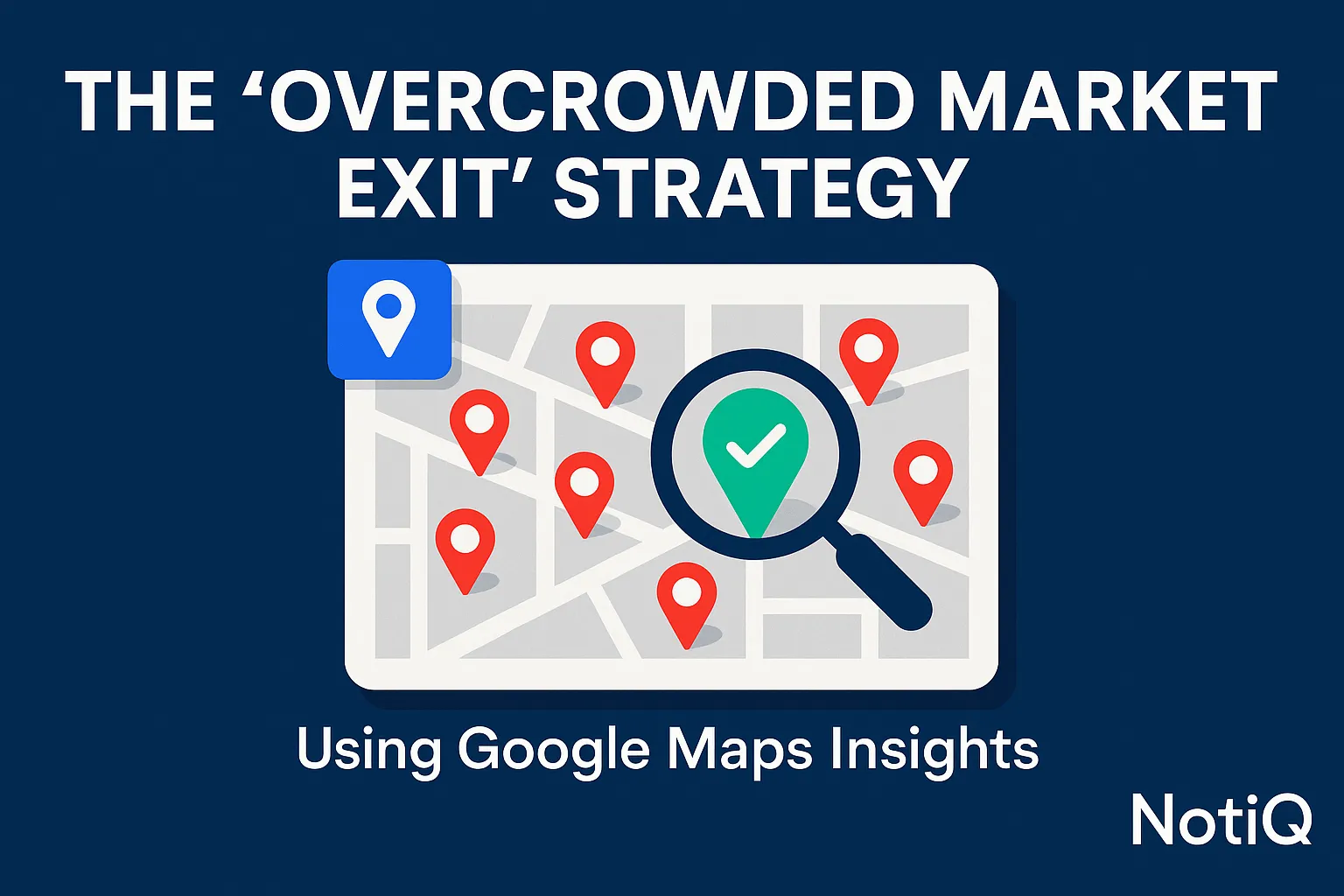
The “Overcrowded Market Exit” Strategy Using Google Maps Insights
Learn how to use Google Maps and Google Business Profile signals to spot saturated local markets and uncover better growth opportunities. This guide shows when to stay, differentiate, expand, or pivot based on real competitive density.
1. Introduction
In many local markets, the smartest move is not better optimization—it is executing a disciplined overcrowded market exit strategy before more budget gets trapped in a red ocean. Advanced operators often misread citywide search demand as a local opportunity. In reality, Google Maps insights reveal the on-the-ground truth of competitive density, review concentration, and incumbent dominance.
This article provides a framework to use Google Maps and Google Business Profile (GBP) signals to make a critical strategic choice: whether to stay, differentiate, expand, or exit. Designed for service businesses, local marketers, and operators already competing in dense markets, this guide offers a faster, more reliable decision model than traditional keyword tools alone. By reframing Maps as a market shift strategy and niche-pivot intelligence layer, you can stop fighting unwinnable battles and start allocating capital where you actually have a structural advantage.
At the forefront of this methodology is[NotiQ](/), a research-driven platform that acts as the strategic workflow layer for saturation research and niche pivot planning, helping you analyze competitive density and local whitespace before recommending your next move.
2. How to Spot Local Market Saturation on Google Maps
Recognizing whether a local niche is truly overcrowded requires a diagnostic framework that goes beyond simple keyword difficulty. Generic SEO tools stop at search volume and rankings, missing the neighborhood-level market reality. Google Maps gives a much more honest view of local market saturation.
In practical terms, saturation means too many similar businesses, a lack of meaningful differentiation, and overwhelming incumbent trust concentration. A crowded market is not just about the raw count of listings; it is about who owns the reviews, geographic proximity, category relevance, and perceived legitimacy. Through ethical, compliant Google Maps competitor research, you can map out these overcrowded niches with precision.
Listing Density and Geographic Clustering
Visible clusters of similar businesses indicate severe competitive compression. Rather than treating a whole metropolitan area as a single market, you must scan map results by neighborhood, suburb, or ZIP-level boundaries.
Tight clustering of near-identical providers often signals limited room for a new or weaker player to gain traction. In practice, high density looks like a dozen identical service listings within a two-mile radius, repeated primary categories, and a map pack that rarely rotates its top players. This geographic compression raises customer acquisition costs dramatically, even when underlying demand exists. Service area market research must account for this density. For official guidance on how local searches surface these clusters, refer to the Google Places Nearby Search documentation, which outlines how nearby place and category searches operate at the neighborhood level.
Review Concentration and Incumbent Trust Advantage
Local market saturation becomes dangerous when trust is concentrated among a few dominant incumbents. High review gaps create a structural disadvantage for newer or smaller operators. There is a vast difference between a market with fifty listings that all have under twenty reviews (fragmented trust) versus a market where three players hold thousands of reviews and dominate all attention (concentrated trust).
When conducting Google Business Profile analysis, look closely at review velocity and listing quality. These are secondary clues to help you spot weak points in an otherwise crowded category. A crowded market with a flat review distribution among local competitors may still be playable; one with extreme review concentration at the top is often a lost cause for new entrants.
Category Overlap, Ads, and Map-Pack Compression
Saturation extends beyond organic listings into structural commoditization. Heavy category overlap suggests a market where everyone is offering the exact same service under the exact same Google Business Profile categories. If every listing looks interchangeable, small profile optimizations will not change your business outcomes.
Furthermore, a heavy presence of Local Services Ads, search ads, and aggressive map pack competition signals a market where visibility is incredibly expensive to buy and nearly impossible to earn organically. This stands in stark contrast to typical local SEO market research advice, which falsely assumes every market is worth entering if you just optimize well enough. For more insights into building compliant, AI-assisted local research workflows to analyze these overlaps, explore NotiQ's blog.
3. The Signals That It’s Time to Exit a Crowded Niche
Moving from observation to decision-making is the hardest part of local strategy. The real question advanced operators must ask is: “Do we keep optimizing, differentiate harder, or leave?”
An overcrowded market exit strategy is not a failure; it is a disciplined capital allocation decision. The cost of staying in a saturated market includes wasted SEO investment, stagnant lead growth, and long-term positioning weakness. The market does not reward stubbornness. When incumbents own trust, proximity, and category fit, a market shift strategy is often the most profitable path forward.
When Optimization No Longer Changes the Outcome
There is a threshold where incremental local SEO effort stops producing meaningful upside. If you are facing entrenched review leaders, near-identical competitors, saturated map packs, and minimal whitespace in your target service areas, you have hit that threshold.
If every move requires outsized effort just to achieve parity with the baseline, the niche is structurally unattractive. The opportunity cost is massive: what else could your business build with that exact same budget? By running a local SEO competitor gap analysis, you can compare this reality against the futility of manual rank chasing in a crowded niche where competitive density analysis proves the market is locked.
Citywide Demand Can Hide Neighborhood-Level Weakness
Strong citywide search volume provides false comfort. Aggregate demand metrics can easily mask a complete lack of practical openings in specific neighborhoods. Advanced operators use Google Maps insights to compare local clusters instead of relying on metro-level averages.
Local growth depends entirely on where customers can actually discover and trust your business—not where generic search volume looks attractive. Keyword tools flatten the reality of the map; local market saturation analysis brings the true neighborhood-level friction into focus, showing you exactly how to find underserved areas for a business.
Exit vs Differentiate vs Expand: A Decision Lens
Before committing resources, you need a strategic decision tree based on evidence from Maps and GBP signals, rather than gut feeling.
• Stay and differentiate: If competitive density is high but incumbents are weak, fragmented, or poorly reviewed.
• Expand: Move into an adjacent niche expansion strategy if certain suburbs or border neighborhoods remain under-defended.
• Exit and pivot: If review concentration, category overlap, and proximity barriers make efficient growth mathematically unlikely, initiate a niche pivot strategy.
To support the logic of evaluating competition and demand before committing resources, consult the official SBA market research and competitive analysis guide.
4. How to Find Whitespace by Neighborhood, Suburb, and Category
Once you decide to pivot, the next step is locating where to go. The best pivots are rarely random—they emerge from adjacent demand paired with significantly weaker competitive pressure. Finding whitespace requires a targeted service area gap analysis focusing on neighborhood-level gaps, suburban edges, and adjacent service categories.
Compare Neighborhoods, Not Just Cities
To isolate hyperlocal opportunity, you must understand that two neighborhoods in the exact same metro area can have completely different competitive realities.
When mapping underserved neighborhoods, compare listing counts, review averages, review leaders, category spread, and visible service coverage. Whitespace almost always exists at the edges: suburbs, border neighborhoods, or emerging commercial zones with weaker incumbents. For example, scanning an established, affluent neighborhood might reveal impenetrable incumbent dominance, while a rapidly developing adjacent suburb might show high demand with zero established Google Maps insights leaders.
Look for Adjacent Categories With Lower Friction
Category adjacency creates a much easier pivot path than a full brand repositioning. Businesses often have operationally adjacent services they can test before rebuilding their entire identity.
If your primary category is saturated, look for category fragmentation. Nearby Google Business Profile categories may offer weaker competition and better entry conditions. Moving from a broad, crowded service into a highly specialized, locally underserved subservice is a classic adjacent niche expansion strategy. Category fit still dictates relevance, so ensure your operational capabilities align with the new category.
Use Weak Competitor Clusters as Entry Points
You do not need a market with zero competition; you need a market where the incumbents are vulnerable. Low-review clusters, inconsistent listing quality, and weak profile completeness indicate high opportunity despite moderate listing density.
This is a far more nuanced approach to competitive density analysis than simplistic "high/low competition" labels. Competitors often miss these entry points because they treat all dense markets as equal. A cluster of ten competitors with poor review velocity and no website links is a highly playable market compared to three competitors with a thousand five-star reviews each.
5. How to Validate a Niche Pivot Before Rebuilding Your Site
A niche pivot strategy must be tested before you invest in irreversible changes like major site architecture overhauls, rebranding, or heavy content production. Lean validation protects your traffic, your budget, and your business continuity.
Run Lightweight Tests Before Full Repositioning
Pre-pivot validation relies on low-risk experiments. Deploy temporary landing pages, offer-specific call tracking, conversion-focused ad experiments, and limited category positioning trials.
The purpose of local demand validation is to confirm actual market response, not merely theoretical traffic. Call-tracking metrics, inquiry quality, and lead intent are vastly stronger signals than search impressions. Validate the service area market research in the real world before you rebuild your entire website around it.
Use GBP and Performance Signals as Early Proof
Google Business Profile performance data provides excellent early proof to strengthen your pivot decisions. Profile interactions, direction requests, calls, and website clicks over time reveal whether a new positioning is actually resonating in a target area.
These performance signals should be used as directional evidence alongside your Google Maps insights. To understand how to access and interpret this data programmatically and compliantly, refer to the Google Business Profile performance metrics API.
Benchmark Maps Findings Against External Demand Data
To ensure strategic rigor, pair your visible Google Maps findings with external demand and business-density benchmarks. Relying solely on anecdotal map scans can lead to overreactions.
Look at ZIP-level business counts, demographic shifts, and economic context to validate your local market saturation analysis. Authoritative external validation sources like the Census Business Builder and the ZIP Code Business Patterns API provide the hard demographic and economic data needed to back up your competitive analysis. For further reading on testing messaging and go-to-market experiments before a full pivot, check out Repliq's blog.
6. A Practical Saturation Scoring Framework for Local Decisions
To turn observation into action, you need a simple, skimmable decision model. This saturation scoring framework helps you objectively decide whether a niche is worth staying in, differentiating within, or exiting.
The Five Inputs to Score
Evaluate your target area using these five core variables:
1. Listing Density: The raw volume of competitors within a strict geographic radius. (High = severe competitive density analysis).
2. Review Concentration: The gap between the top three incumbents and the rest of the market. (High = untouchable trust barriers).
3. Category Overlap: The percentage of competitors using the exact same primary GBP category. (High = heavy commoditization).
4. Geographic Whitespace: The availability of underserved adjacent neighborhoods. (Low = nowhere to expand).
5. Ad/Map-Pack Pressure: The aggressive presence of paid local ads and static map packs. (High = expensive visibility).
How to Interpret the Score
Convert your Google Maps competitor research into strategic action:
• Low Saturation: Enter or expand aggressively. The market is fragmented and playable.
• Moderate Saturation with Weak Incumbents: Differentiate. The market is dense, but the competitors are lazy or poorly reviewed.
• High Saturation with Dominant Incumbents and Low Whitespace: Exit or pivot. Initiate a market shift strategy.
No score replaces operational judgment—margin potential and service fit still matter—but this provides a clear decision aid for resource allocation.
What Competitor Content Usually Misses
Most local SEO competitor gap analysis content focuses entirely on reporting metrics, profile optimization, and rank tracking. It assumes every battle is worth fighting. The real strategic gap is knowing whennotto compete.
By utilizing AI enrichment, verified data, and compliance-oriented analysis, advanced operators can spot a market exit strategy before burning capital. NotiQ studies saturation first, recommending pivots backed by hard evidence rather than blind optimization tactics.
7. Tools, Data Sources, and Workflow Inputs to Strengthen Your Analysis
Advanced readers need reliable inputs to make this framework function. The goal is lightweight, evidence-based decision support, utilizing legal, publicly accessible information workflows in full compliance with platform terms of service.
Core Inputs to Gather
Your minimum viable dataset should include:
• Neighborhood listing counts
• Review leader benchmarks
• Category usage patterns
• Service area spread
• Visible ad pressure
• GBP performance trends
Keep the analysis practical. Whether using simple spreadsheets, manual screenshots, or automated, API-compliant Google Business Profile analysis tools, consistency across areas matters more than dashboard complexity when mapping competitive density.
Where Authoritative Validation Fits
Authoritative sources strengthen the credibility of your market research. Use Google Developer documentation to understand visibility mechanics, U.S. Census Bureau tools for local business counts, and SBA frameworks for market validation logic. Tying your local market saturation observations to these verified external datasets ensures your strategic pivots are grounded in reality, not assumptions.
8. Future Trends in Hyperlocal Market Shift Strategy
Local market analysis is rapidly evolving away from broad SEO reporting and moving toward hyperlocal opportunity scoring and AI-assisted research. Neighborhood-level decision-making, adjacent category intelligence, and lean validation are becoming the new standard.
From Ranking Data to Market Intelligence
Businesses increasingly require local SEO market research signals to inform actual market selection, not just visibility tweaks. Google Maps insights, GBP performance data, and external economic benchmarks are merging to form a comprehensive market intelligence layer. Decisions are no longer about "how to rank," but "where to play."
Why Contrarian Operators Will Win More Often
Disciplined exits and evidence-based pivots will consistently outperform brute-force competition in saturated categories. Contrarian growth strategy dictates that avoiding bad markets is often the fastest path to scaling a business. By leaving overcrowded niches to competitors who are willing to bleed margins for map-pack real estate, you preserve capital to dominate profitable, underserved whitespaces.
9. Conclusion
Google Maps is far more than a visibility tool—it is a diagnostic engine for local market saturation. By making incumbent strength, review concentration, and neighborhood-level whitespace visible, it allows you to make calculated decisions about your future.
Assess the density, analyze category overlap, and evaluate geographic gaps. Then, choose your path: stay, differentiate, expand, or execute an overcrowded market exit strategy. The smartest growth strategy is often abandoning a red ocean where incumbents already control trust and proximity. Build your saturation score before you invest in another site rebuild, ad campaign, or SEO sprint.
To explore a research-driven approach to local opportunity analysis and discover how to evaluate competitive density before committing to a pivot, visit[NotiQ](/).
Frequently Asked Questions
- How can Google Maps reveal overcrowded local niches?
- Google Maps makes saturation highly visible by highlighting listing density, geographic clustering, review leaders, category repetition, and map-pack compression within specific neighborhoods.
- How many competitors in a map pack indicate saturation?
- There is no universal number. Saturation depends heavily on review concentration, category overlap, ad pressure, and whether the incumbents are fragmented or dominant.
- What signals suggest it is time to exit an overcrowded niche?
- Key signals include entrenched review gaps that are mathematically impossible to close quickly, poor differentiation, zero geographic whitespace, and rising acquisition costs relative to your expected upside.
- How do Google Business Profiles help evaluate local competition?
- GBP listings reveal primary categories, review velocity, profile quality, and performance patterns. This data helps you accurately estimate trust concentration and the defensibility of a local market.
- How do you find underserved local opportunities before a pivot?
- The most effective approach is a service area gap analysis: comparing neighborhoods, suburbs, and adjacent categories, and then validating those gaps with GBP performance signals and external market data.
Continue Reading
More articles you might find useful
How to Find Businesses With High Review Volume but Low Ratings
Learn how to find visible local businesses with lots of reviews but weak ratings using Google Maps signals, review trends, and owner response gaps. This blueprint helps agencies prioritize stronger reputation management leads and personalize outreach.
Read the article →
Google Maps Prospecting for Commercial Landscaping Companies
Learn how commercial landscaping companies can use Google Maps to find higher-fit commercial property leads, qualify visible need, and build denser service routes. This guide breaks down a practical workflow for smarter prospecting and better contract opportunities.
Read the article →
How to Find Businesses With Weak Google Maps Descriptions
Learn how to find businesses with weak Google Maps descriptions and turn visible GBP gaps into qualified local SEO leads. This guide covers audit criteria, scoring, and outreach angles you can use at scale.
Read the article →Popular industry lead playbooks
Maps search examples and niche outreach for the verticals teams prospect most.