Technology
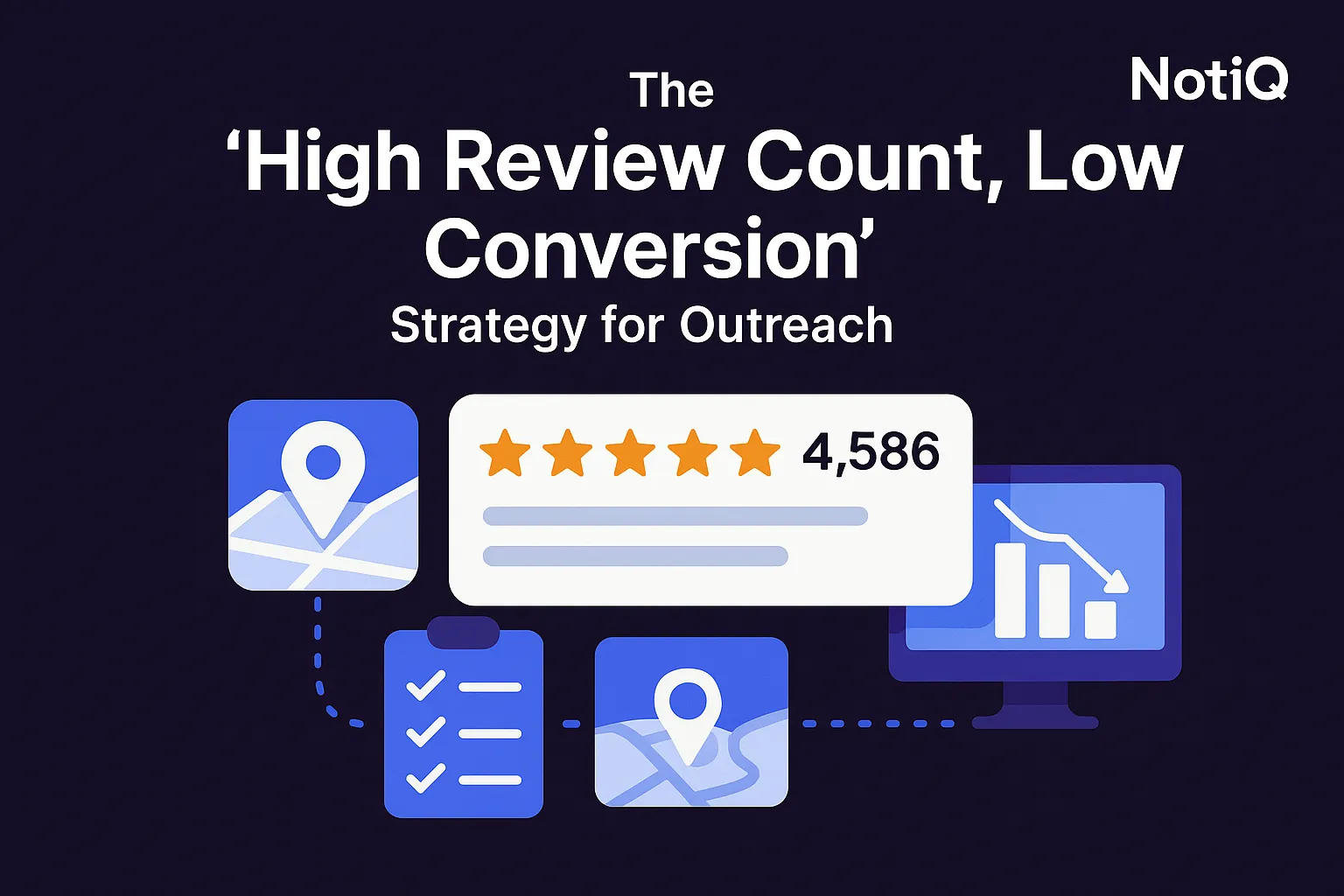
The “High Review Count, Low Conversion” Strategy for Outreach
Discover how to use Google Maps and Google Business Profile signals to find businesses with strong demand but hidden conversion leaks. This framework helps agencies and sales teams prioritize smarter, more personalized outreach.
1. Introduction
It is the central paradox of local search: a business can boast hundreds or even thousands of Google reviews, dominate local visibility, and still fail to turn that demand into booked calls, form fills, or appointments. For many local businesses, high visibility masks a severe revenue leakage problem.
To run a smarter outbound strategy, review count is better treated as a demand signal than a conversion signal. This article will show agencies, outbound teams, SaaS sales professionals, and local growth consultants how to use Google Maps signals, Google Business Profile (GBP) data, and lightweight website diagnostics to identify businesses with obvious demand but hidden operational friction.
Instead of chasing low-visibility businesses that require building an audience from scratch, the most lucrative prospecting strategy targets high-visibility businesses that are under-monetizing the attention they already have. At NotiQ, our focus is on detecting these exact inefficiencies in popular businesses, turning public signals into analytical, compliant workflows that power high-converting outreach. By mastering this high reviews low conversion outreach framework, you can build a repeatable maps lead qualification engine that actually resonates with prospects.
2. Why High Reviews Can Still Mean Low Conversion
There is a fundamental difference between visibility metrics and revenue metrics. While a massive review count proves that a business has earned consumer trust and local prominence, it does not guarantee operational efficiency.
Many local businesses obsess over optimizing for prominence, star ratings, and social proof, yet completely neglect response speed, booking friction, CTA clarity, and mobile user experience. According to Google’s local ranking guidance, prominence and relevance dictate visibility in the local pack, but visibility alone does not book appointments. A business can rank number one and still leak leads at the listing level, on their website, or during the follow-up stage.
For outreach professionals, relying solely on high review count low conversion metrics creates false positives when prioritizing prospects. Unlike generic local SEO content that stops at ranking and reputation, this framework focuses entirely on commercial efficiency, helping you pinpoint local business inefficiencies.
Reviews Signal Demand, Not Necessarily Execution
Review volume is undeniable evidence that a business has market attention, a solid transaction history, and steady customer flow. For prospecting, this Google reviews analysis is highly valuable because you are not trying to create demand from scratch. You are simply identifying where existing demand is being wasted.
A strong review count paired with weak conversion systems creates a far more compelling outreach angle than pitching a business with zero visible traction. You are approaching an underperforming high-visibility business with a solution to capture revenue they are already generating but failing to close.
Where the Conversion Gap Usually Appears
Public trust can easily coexist with private operational inefficiency. Conversion bottlenecks typically manifest as weak CTA structures, missing booking links, painfully slow websites, buried phone numbers, poor mobile UX, unclear service pages, and sluggish lead handling.
When prospecting using map signals, these gaps highlight exactly where the website conversion rate for local businesses falls flat. Identifying these leakage points sets the stage for using Maps and GBP signals as your first layer of diagnosis.
Why This Is a Better Outreach Strategy Than Generic Pitching
Analytical outreach vastly outperforms generic "we can help your marketing" messaging. The most effective outreach targeting strategy starts with visible proof of missed revenue from unanswered leads, not abstract promises of future growth.
Generic pitches fail because they do not resonate with businesses that are already getting attention. By pointing out a specific, fixable leak in a high-traffic system, you position yourself as a strategic partner rather than another vendor pushing local lead generation tactics. To operationalize this, you need a system layer for turning public business signals into repeatable prospecting workflows, which you can explore at[Home](/).
3. Maps and GBP Signals That Reveal Lead Leakage
To build a defensible hypothesis for outreach, you need a practical framework for identifying businesses where high review volume does not match their conversion infrastructure. This GBP optimization for service businesses audit combines listing quality, engagement behavior, and conversion path clarity.
By looking beyond the star rating and utilizing strictly public, compliant Google Maps signals, you can pinpoint exact areas of friction.
Review Recency, Velocity, and Response Behavior
A high total review count is meaningless if the last review was left three years ago. Review velocity and recency suggest ongoing, active demand. In contrast, owner response behavior signals operational attentiveness.
A business with high review velocity but a near-zero owner reply rate often suffers from broader customer communication issues. Drawing on authoritative Google reviews analysis frameworks from industry leaders like BrightLocal and Whitespark, a lack of responsiveness is a primary indicator of neglected customer experience and potential lead leakage.
Missing or Weak Action Paths Inside the Profile
A profile must make it frictionless to take the next step, whether that is booking, calling, ordering, or requesting a quote. You can audit a profile to see if these action-oriented links are absent, broken, or poorly configured.
A business can earn massive attention but lose conversions entirely if it fails to implement Google Business Profile action links. A glaring mismatch between high trust signals and a missing booking CTA is one of the strongest maps lead qualification indicators available.
Weak Attributes, Messaging, and Qualification Signals
Incomplete attributes and vague listing information create immediate friction for high-intent searchers. Poor qualification cues lead to consumer confusion, unnecessary phone calls, and abandoned conversions.
Auditing Google Business Profile attributes allows you to see if a business is communicating its service specifics, differentiators, amenities, and trust details clearly. When reputation signals vs customer experience do not align, local business inefficiencies become obvious outreach targets.
Listing-to-Website Inconsistency
The website experience must match the trust level implied by the GBP listing. Broken message match is a massive conversion bottleneck. Look for scenarios where a highly polished profile links to a weak website, or where thousands of reviews lead to thin service pages with no clear path to action.
Listing-to-site consistency is critical; when the website fails to uphold the listing's promise, the website conversion rate for local businesses plummets. This gap is precisely where your prospecting opportunity lies.
Website Friction That Confirms the Maps Hypothesis
To validate your low-conversion hypothesis, conduct a lightweight audit of the destination site. Look for booking friction, poor mobile usability, hidden click-to-call buttons, slow page speed perception, and complex form structures.
This is not a comprehensive CRO audit—it is merely gathering evidence. Finding a business with "1,200 reviews but no visible booking CTA" or "top Maps visibility with a buried contact path" confirms the lead leakage hypothesis and provides the exact ammunition needed for outreach.
4. How to Score and Qualify Underperforming Prospects
Turning your audit into a repeatable maps lead qualification model helps teams prioritize exactly who to contact. By using a simple prospect scoring rubric that combines demand indicators with conversion weakness indicators, you reduce false positives and focus only on underperforming high-visibility businesses.
Step 1 — Score Demand Strength
First, answer the question: “Is there enough evidence of real demand to make this business worth analyzing?” Evaluate the review count signal, review recency, review velocity, and local pack rankings. Category competitiveness matters here; a "high" review count in a niche B2B service will look very different from a high count for a downtown restaurant.
Step 2 — Score Conversion Friction
Next, evaluate the missed revenue potential. Score factors like missing booking links, weak CTA placement, poor mobile experience, low owner response rate, listing-to-site mismatch, and unclear service messaging. Group these conversion bottlenecks into profile friction, site friction, and communication friction. High friction in the booking flow or lead response time suggests significant revenue leakage.
Step 3 — Score Outreach Readiness
Opportunity size means nothing if you cannot craft a credible message. Determine if the evidence is strong enough to support personalized outreach. Can you point to a specific public issue, estimate a likely downside, and explain the fix in a single sentence? Analytical outreach requires this level of precision to succeed.
Example Qualification Matrix
To avoid false positives and systematize your local SEO audit checklist, use a basic qualification model:
• High demand + high friction = Priority prospect (The ideal target).
• High demand + low friction = Likely false positive (They are already converting well).
• Low demand + high friction = Weak target (Requires building demand from scratch).
• Low demand + low friction = Irrelevant (Not a fit for this specific play).
Score prospects on a simple 1–5 or Low/Medium/High scale based strictly on observable public data.
Industry Variance and Category Sensitivity
Review-to-conversion mismatch looks different across industries. The booking friction for a home services plumber is evaluated differently than reservation friction for a hospitality brand or intake friction for a healthcare clinic. Ensure your review count thresholds and friction cues are evaluated against local business categories and specific category benchmarks, rather than universal assumptions.
5. Turning Audit Findings Into Personalized Outreach
The goal of this framework is to convert public signals into high reviews low conversion outreach that feels specific, credible, and commercially relevant. Businesses with strong reviews already know they are reputable; your personalized outreach must focus on the missed revenue model without using aggressive teardown language.
The Best Outreach Angle: “You Have Demand, But It’s Leaking”
Frame your message around undeniable market demand paired with one or two specific conversion issues. Use calm, analytical language. An effective outreach messaging structure follows this flow:
1. You clearly have demand (cite their review count/velocity).
2. Here is the likely leak (cite the missing CTA or conversion leakage).
3. Here is what fixing it could unlock (frame the missed revenue from unanswered leads).
Personalization Inputs From Public Signals
Use exact examples drawn from your public audit signals. If a prospect has a high review count but a missing booking CTA, mention it. If they have recent reviews but a low owner response rate, highlight the communication gap. If they have a trusted reputation but an unclear service-page path, point out the friction. For advanced strategies on turning review text personalization and Google Maps signals into compelling copy, review these Personalized Lines.
Estimating Missed Revenue Without Overclaiming
Maintain trust by using directional language. Phrases like “likely leaking opportunities,” “probably suppressing conversion,” or “creating avoidable friction” present your prospecting hypothesis as an evidence-backed observation. Avoid hard ROI promises or exaggerated revenue claims. The conversion rate gap should be framed as a logical assumption based on public friction points.
Example Outreach Structures for Different Teams
This qualification logic adapts perfectly across different go-to-market motions:
• Agency prospecting: Sell local SEO + CRO by highlighting listing-to-site inconsistency.
• SaaS sales outreach: Sell speed-to-lead, booking, or chat automation tools by highlighting response latency and missing GBP action links.
• Local growth consulting: Offer audit and optimization services based on comprehensive friction scoring.
For deeper insights into adapting outbound strategies for various teams, explore the Blog.
6. Avoiding False Positives With Benchmark Checks
To build a trustworthy pipeline, you must avoid false positives. Relying on review count alone without validating conversion friction will lead to pitching businesses that are already operating efficiently.
Signs the Business May Already Be Converting Well
Lower the priority of a prospect if you observe healthy booking flows. Positive signals include visible booking or ordering links, a fast mobile conversion path, strong CTA clarity, consistent owner responses, and clear local trust elements. High reviews plus a smooth conversion path means the business is not a fit for this specific strategy.
Benchmark Against Category and Competitors
Compare your target to direct local competitors. A business's CTA structure or website usability might look weak in isolation, but perfectly normal when compared to service business comparison norms. Competitor benchmarking sharpens your qualification and provides context that manual scraper tools completely miss.
Watch for Review Authenticity and Signal Distortion
Inflated or manipulated review profiles will distort your demand hypothesis. Look for suspicious review patterns, low review diversity, or extreme sentiment mismatches. Performing Google reviews analysis for authenticity ensures you do not waste time on bad-fit prospects. Always align with FTC guidance on review authenticity when evaluating potentially deceptive review patterns.
Use Plain-Language Clarity as a Conversion Filter
Unclear business descriptions, jargon-heavy messaging, and confusing offers suppress conversion even when local trust exists. Customer messaging friction directly impacts the bottom line. Evaluate the prospect's CTA clarity against plain-language communication principles to determine if their messaging is helping or hurting their conversion rate.
7. Tools, Workflow Ideas, and Repeatability
To scale this strategy, advanced teams must operationalize the framework without relying on manual, one-off searches. Combining public Maps/GBP data with structured website review logic allows for highly effective, AI-assisted local prospecting.
A Lightweight Audit Workflow
Implement a repeatable GBP audit framework to ensure consistency:
1. Identify high-review businesses in a specific category.
2. Validate review recency and responsiveness.
3. Inspect GBP action links and attributes.
4. Check website CTA and mobile friction.
5. Score and prioritize using the matrix.
6. Craft a precise outreach hypothesis.
This structured prospect prioritization keeps agency and sales teams focused and efficient.
Where Automation Helps Most
Automation for prospecting acts as a force multiplier when applied correctly. Use automation for AI enrichment, signal extraction, pattern detection, and initial scoring. However, never completely remove human verification, especially when formulating conversion claims. For seamless workflow orchestration and turning public signals into qualified outreach opportunities, leverage platforms like[Home](/).
How This Approach Differs From Basic Lead List Building
This methodology is vastly superior to buying static databases or using manual scraper tools. Analytical prospecting relies on validation, category context, deep personalization, and missed-revenue logic. While basic lead lists stop at visibility and contact data, this qualified outreach approach ensures you only contact businesses with a verified operational need.
8. Future Trends & Expert Predictions
As local search competition intensifies, the methodologies behind AI-assisted local prospecting will continue to evolve.
Conversion Optimization Will Matter More Than Visibility Alone
As baseline local SEO becomes highly commoditized, conversion optimization will become the primary competitive edge. The gap between visibility vs conversion will widen, making Google Business Profile conversion optimization a mandatory focus for local businesses wanting to survive increased local search competition.
Public Signals Will Power Hyper-Personalized Outreach
Hyper-personalized outreach will increasingly rely on nuanced data points. Review sentiment, response latency, and listing-to-site mismatch will be extracted at scale to formulate highly specific pitches. Better signal interpretation—not just a higher volume of data—will drive the highest response rates.
First-Party Conversion Tracking Will Raise the Bar
Local businesses are shifting their focus from vanity metrics to booked outcomes. First-party conversion tracking and local business conversion metrics will become the standard. Outreach teams that speak the language of missed revenue opportunities and closed-won business will stand out significantly over those still selling basic ranking reports.
9. Conclusion
A high review count is a powerful demand qualifier, but it is not proof of efficient conversion. By identifying visible demand, auditing Maps and GBP signals, validating website friction, and scoring opportunities, you can personalize your outreach around undeniable missed revenue.
The best prospects are never the businesses with zero traction; they are the businesses already proving traction publicly while leaking value operationally. Stop relying on instinct or generic lead lists. Build a repeatable audit workflow that targets high reviews low conversion outreach, leverages Google Maps signals, and solves real local business inefficiencies. At NotiQ, our perspective remains grounded in this exact reality: the highest ROI comes from identifying inefficiencies in already-popular businesses and translating those patterns into practical, revenue-generating outreach systems.
Frequently Asked Questions
- Why do some businesses with many Google reviews still convert poorly?
- While reviews indicate strong social proof and market demand, they do not guarantee operational efficiency. High review count low conversion scenarios occur because businesses often neglect their booking flows, website UX, lead response speed, and CTA clarity, causing interested prospects to abandon the process.
- What Google Maps signals are most useful beyond star rating and review count?
- Beyond basic ratings, the most critical Google Maps signals include review recency, review velocity, owner reply rate, the presence of action links (like booking or ordering), profile completeness, detailed attributes, and listing-to-site consistency.
- How can agencies use Google Business Profile data for prospecting?
- Agencies can use GBP signals to execute a highly targeted outreach targeting strategy. By analyzing public data, agencies can identify existing demand, diagnose conversion friction, prioritize accounts based on revenue leakage, and personalize their pitches with undeniable public evidence.
- How do you avoid false positives when using review count as a lead signal?
- To avoid false positives, never rely on review count alone. Combine it with benchmark checks, website diagnostics, conversion path analysis, and local category comparisons to ensure you are only targeting businesses with legitimate maps lead qualification friction.
- What evidence is most persuasive in outreach to high-review local businesses?
- The most persuasive evidence relies on specific, observable conversion leakage. Highlighting missing booking links, a weak mobile experience, low response behavior, or a trust-to-CTA mismatch provides clear missed revenue indicators that make personalized outreach incredibly compelling.
Continue Reading
More articles you might find useful
How to Find Businesses With High Review Volume but Low Ratings
Learn how to find visible local businesses with lots of reviews but weak ratings using Google Maps signals, review trends, and owner response gaps. This blueprint helps agencies prioritize stronger reputation management leads and personalize outreach.
Read the article →
Google Maps Prospecting for Commercial Landscaping Companies
Learn how commercial landscaping companies can use Google Maps to find higher-fit commercial property leads, qualify visible need, and build denser service routes. This guide breaks down a practical workflow for smarter prospecting and better contract opportunities.
Read the article →
How to Find Businesses With Weak Google Maps Descriptions
Learn how to find businesses with weak Google Maps descriptions and turn visible GBP gaps into qualified local SEO leads. This guide covers audit criteria, scoring, and outreach angles you can use at scale.
Read the article →Popular industry lead playbooks
Maps search examples and niche outreach for the verticals teams prospect most.