Technology
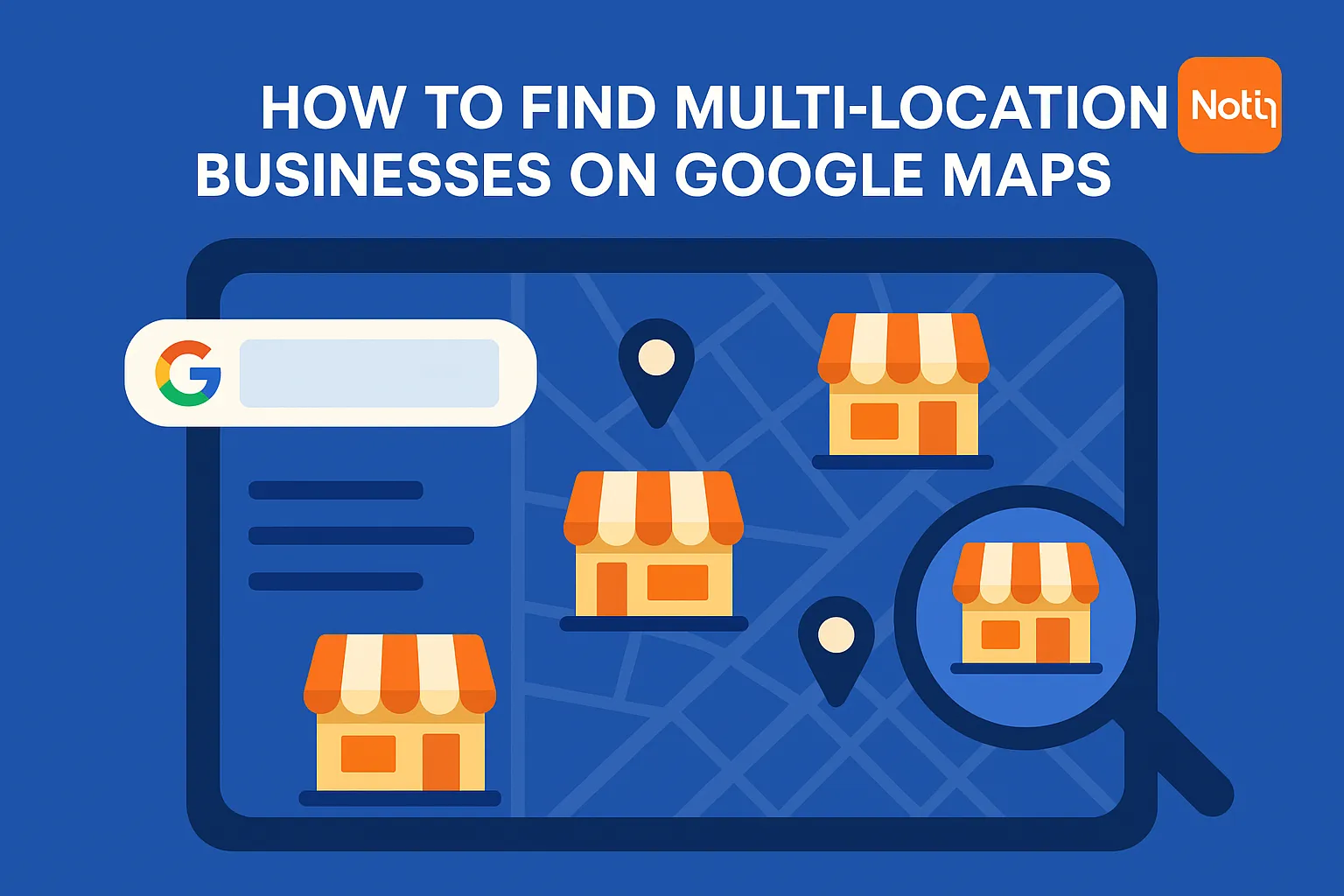
How to Find Multi-Location Businesses on Google Maps
Learn how to identify chains, franchises, and regional operators on Google Maps using repeatable validation signals. This guide shows how to turn scattered listings into clean, account-level leads.
1. Introduction
For advanced prospecting teams, Google Maps is a double-edged sword. It is an unparalleled engine for local discovery, yet it is notoriously poor at providing account-level clarity. When one corporate brand appears as dozens or hundreds of fragmented, individual listings, sales and research teams are left to piece together the puzzle manually.
Solving this puzzle is highly lucrative. Multi-location business leads often represent significantly larger deal sizes, broader service contracts, and stronger territory potential than single-location, one-off businesses. Securing a contract with a regional operator or a multi-unit franchisee can yield ten times the revenue of a standard local deal, making these accounts the ultimate prize for B2B sales.
This guide delivers a repeatable methodology for finding, validating, deduplicating, and rolling up separate Google Maps listings into one usable, account-level company record. This is not a generic scraping tutorial or basic lead generation advice. Instead, it is a rigorous methodology for entity identification and data consolidation. If you are learning how to find multi-location businesses on Google Maps, the goal is not just to collect rows of data, but to structure that data into actionable intelligence.
Designed for agencies, SaaS sales teams, and RevOps or data operations professionals, this guide focuses on consistent workflows over ad hoc list building. Building reliable google maps leads requires a process-driven approach. As a methodology-driven platform behind repeatable business-location discovery workflows,[NotiQ](/)establishes the standard for turning fragmented local data into structured, high-value account records.
2. Why Multi-Location Businesses Are Hard to Identify on Google Maps
Extracting raw location data is easy, but translating that data into a coherent sales strategy is operationally difficult. The raw results from Maps often create severe lead quality issues if they are not properly processed.
Google Maps shows locations, not always the full company
There is a fundamental difference between a physical location (an establishment) and a parent company record (an enterprise). Google Maps is built for consumers looking for the nearest coffee shop or plumber; it is optimized for local discovery, not account rollups for B2B prospecting.
When a sales or research team queries a market, they may see 20 listings with similar names. Without deeper analysis, it is impossible to immediately know whether those listings belong to one unified enterprise, five separate multi-unit franchisees, or 20 unrelated independent operators who happen to share a generic name. To understand this distinction in business listings research, it helps to look at official U.S. Census definitions of enterprise and establishment. An establishment is a single physical location, whereas the enterprise is the parent company. Relying solely on raw Google Business Profile data without understanding this hierarchy leads to disorganized outreach. Multi-site company identification requires looking beyond the individual pin on the map.
Why manual franchise prospecting breaks down
Attempting to identify multi-location business leads manually—searching category-by-category and city-by-city—quickly becomes slow, inconsistent, and virtually impossible to reproduce at scale.
Common breakdowns occur constantly during manual local SEO prospecting. Naming variations (e.g., "Main Street Auto" vs. "Main Street Auto Repair"), duplicate profiles, missing ownership context, and results that shift based on the searcher's exact geographic coordinates all corrupt the data set. These issues tie directly to CRM clutter, poor territory routing, and drastically lower outreach efficiency. Many existing franchise prospecting workflows stop at raw data extraction, skipping the critical validation steps required to make the data useful.
The hidden cost of fragmented listings
Fragmented listings carry a high operational cost. When a single company is imported into a CRM as 15 separate, unlinked records, it causes duplicate outreach, embarrassing sales collisions, undercounted account value, and poor territory planning.
Account-based sales teams need one consolidated record with rolled-up locations to execute an effective strategy. Lead quality improves exponentially when teams validate parent-child relationshipsbeforeimporting data into their systems. This methodology sharply contrasts with generic scraper-first approaches that prioritize sheer volume over accuracy. In modern chain business discovery and franchise lead generation, superior location intelligence—achieved through rigorous validation and consolidation—will always outperform a massive but messy spreadsheet.
3. Map Signals That Reveal Chains, Franchises, and Regional Operators
To consolidate records, teams must first know what visible signals indicate that multiple listings belong to the same parent company.
Naming conventions and repeated brand patterns
Repeated naming structures often reveal multi-location businesses, even when listings include neighborhood, city, or store-number modifiers (e.g., "Apex Plumbing - Northside" and "Apex Plumbing #42").
When conducting franchise prospecting, look for standardized prefixes or suffixes, brand-plus-location naming frameworks, and slight Doing Business As (DBA) variations. However, beware of false positives. "Springfield Dental" and "Springfield Dental Care" might be completely unrelated practices in the same city. Because similar names do not always reflect shared ownership, teams should document all observed naming variants before deciding whether to merge records. For foundational context on how legitimate chains represent themselves, refer to the Google Business Profile guidelines for representing a business. Accurate multi-site company identification relies on spotting these patterns reliably.
Shared website domains and contact signals
The website domain is arguably the strongest visible indicator that independent listings roll up to one parent company. During business listings research, always compare root domains rather than full URLs. Note when individual location pages sit under one central root domain (e.g.,`brand.com/locations/dallas`).
Phone analysis also provides valuable location intelligence. Repeated call center numbers or toll-free numbers across multiple profiles strongly suggest a unified operation. Conversely, unique local phone numbers do not disqualify a group of listings from being a chain, as many franchises use local lines. Contact fields should be used as corroborating signals alongside Google Business Profile data, not as the sole validation method.
Category consistency across geographies
Repeated primary categories across multiple cities or regions strongly indicate a chain, franchise, or regional operator. If 15 businesses share a similar name, the same root domain, and the exact same primary category, the likelihood of shared ownership is exceedingly high.
This category overlap becomes highly persuasive when paired with consistent branding. However, category drift can happen across locations—one branch might be listed as a "HVAC Contractor" while another is an "Air Conditioning Repair Service." Teams should track both primary and adjacent categories in their local business directory prospecting rather than requiring exact uniformity. The more signals that align, the stronger the case for consolidating those google maps leads.
Geographic clustering and regional footprint clues
Mapping where listings cluster helps identify regional chains. Look for metro spread, expansion along major highway corridors, or multi-state adjacency.
Geography helps separate true regional operators from one-off independents who happen to share a similar name. For example, if you find five "Summit Landscaping" locations clustered within a 50-mile radius, they are likely a chain. If you find one in Oregon and one in Florida with no shared domain, they are independents. Documenting geographic clustering allows teams to note whether locations concentrate in a serviceable territory relevant to their sales outreach, tying directly into territory design and the prioritization of multi-location business leads.
How to distinguish chains, franchises, and lookalikes
In prospecting, the practical difference between corporate chains, franchise systems, and independent operators dictates the outreach strategy. Corporate chains have centralized decision-making. Franchise brands share naming and branding, but differ in ownership structure, meaning you may need to sell to the local multi-unit franchisee rather than corporate headquarters.
Look for red flags that indicate lookalikes or false positives: inconsistent domains, wildly different categories, unrelated reviews, or no evidence of a common parent brand on the website. Utilize a "signal stacking" rule—never rely on one field alone to determine ownership. For deeper context on the legal and structural differences between franchisor systems and local franchise ownership, consult the FTC franchise disclosure and compliance guide. Finding franchise businesses on Google Maps requires understanding these nuances.
4. How to Validate and Consolidate Listings Into One Company Record
Once you know how to spot the signals, you must turn that discovery into a repeatable validation workflow that produces clean, account-level records.
Step 1: Build a discovery set by category and geography
Start with targeted searches by vertical, city, region, or service area rather than broad, unmanageable national queries. If you want to know how to find multi-location businesses on Google Maps, start by defining a tight geographic and categorical boundary.
Collect an initial set of candidate listings before making any judgments on ownership. Advanced teams meticulously document the query, market, and category used so their business listings research is strictly reproducible. Consistency in gathering google maps leads matters far more than trying to chase every possible listing on the first pass.
Step 2: Cluster listings by shared business signals
Next, group your candidate listings using the signals discussed earlier: name similarity, root domain, category pattern, and geography.
Implement a confidence model for this entity resolution process: label groups as high-confidence matches, possible matches, and false positives. Add specific notes for edge cases like DBA names, service-area businesses (SABs) without physical addresses, or distinct departments inside larger businesses (e.g., a pharmacy inside a grocery store). Validation must be done at this cluster level before any data touches your CRM. Interestingly,Google’s bulk verification requirements for multi-location profiles serves as evidence that Google itself recognizes and manages multi-location account structures at scale, validating the need for this location intelligence approach.
Step 3: Validate parent-child relationship before rollup
Confirming that separate listings belong under one company record requires evaluating the most critical fields: brand name, domain, category, location spread, and contact consistency.
Establish practical decision rules. For example: "Merge locations into a parent account only when at least three independent signals (e.g., name, domain, category) align perfectly." When dealing with franchise lead generation, remember that franchises may require two linked fields in the CRM: the parent brand and the local operator, especially when local ownership dictates purchasing power. Using a simple validation checklist ensures that every piece of Google Business Profile data is scrutinized uniformly.
Step 4: Create the account-level record
Roll up the validated, separate locations into a single company record. This master record should feature a total location count, region coverage summary, primary category summary, and the supporting evidence used to make the match.
These output fields make the record immensely useful for outbound sales and territory planning. This step is the bridge between raw map discovery and sophisticated account-based prospecting. Imagine the "before and after": importing 40 fragmented, confusing listings versus importing one clean, authoritative account entry that says "Apex Plumbing (40 Locations - Texas Region)." Platforms that prioritize this level of multi-site company identification and location intelligence, such as NotiQ, are built specifically to handle this consolidation.
Common validation mistakes to avoid
When researching google maps leads, avoid these common pitfalls:
• Over-merging: Combining unrelated independent businesses just because they share a common name like "First Choice Roofing."
• Under-merging: Keeping listings separate because one field (like a phone number or a slightly varied category) differs across locations.
• Getting confused by duplicates: Duplicate map pins, specific department listings, and location-specific landing pages can easily confuse researchers.
Always document your merge logic so different researchers apply the same rules to deduplicate listings effectively.
5. How to Deduplicate, Enrich, and Prioritize Leads
Validation creates the account, but deduplication, enrichment, and prioritization make the account actionable for sales teams.
Deduplicate records before outreach or CRM import
Deduplication must happen at both the listing level (before rollup) and the account level (before CRM import). Common duplicate types include exact duplicates, naming variants, duplicate map pins for the same building, and duplicate web destinations.
Keep a strict audit trail for why records were merged or suppressed. This deduplication workflow directly results in cleaner reporting and fewer outreach collisions where two sales reps call the same company. For advanced best practices around record linkage and data quality, the NIST guidance on entity resolution and deduplication provides an excellent framework for handling multi-location business leads and complex business listings research.
Enrich for context, not just more fields
Data enrichment should clarify account quality, territory fit, and probable parent-child relationships. It should not be an excuse to indiscriminately add useless data fields.
Enrich your records around root domain consistency, category confirmation, and region coverage. Emphasize operational usefulness: location data enrichment for sales should directly support lead routing, email personalization, and audience segmentation. This strategic approach to location intelligence stands in sharp contrast to tools that focus solely on raw extraction volume without providing context.
Prioritize by location count, region clustering, and service relevance
Once consolidated, teams must rank leads based on the number of locations, concentration in target territories, and overall fit with their Ideal Customer Profile (ICP).
Not every chain is equally valuable. A highly concentrated, five-location regional operator in your core market will often outrank a loosely matched, 50-location national brand that only has one location in your territory. Use prioritization tiers: high-priority regional chains, strategic franchises, and lower-priority one-offs. Tying this territory-based targeting to your actual outreach capacity ensures your franchise prospecting and multi-location lead generation efforts yield the highest possible ROI.
Create a practical lead scoring framework
Turn your map research into a repeatable prospecting asset by implementing a simple lead score. Factor in location count, category fit, territory overlap, website consistency, and validation confidence.
Apply negative scoring for red flags: unclear ownership, inconsistent branding, or low-quality duplicate data. A dynamic scoring model transforms static spreadsheets into an agile account-level lead generation engine. For teams looking to scale this logic, integrating these rules into AI-assisted prospecting and prioritization workflows (such as those offered by ScaliQ) ensures that regional chain analysis and google maps leads are always ranked by actual revenue potential.
6. When to Move From Manual Maps Research to Repeatable Workflows
Manual research is an excellent way to learn the signals, but it is not a long-term strategy for high-growth teams.
Signs manual research is no longer enough
You will know it is time to upgrade from manual research when you face multi-market coverage demands, recurring list-building needs, strict CRM sync requirements, or when analysts spend more time validating listings than reps spend selling.
When inconsistency across different researchers creates downstream routing and sales problems, manual methods have failed. If your team repeatedly rebuilds the same search and validation logic every month, you need a process, not just another data export. Ground your decision in operational pain. Finding reliable Google Maps scraping alternatives is about building repeatable workflows for multi-location lead generation.
What a repeatable workflow should include
A truly repeatable workflow orchestrates multiple distinct stages: discovery, clustering, validation, deduplication, enrichment, prioritization, and export into usable account records.
The real advantage of this system is not simply speed; it is consistency and quality control. By scaling the exact methodology outlined in this guide, the workflow remains compliant and process-driven. It relies on AI workflow orchestration and entity resolution to achieve superior location intelligence, reinforcing the value of platforms like NotiQ in designing workflows that seamlessly identify and consolidate business locations.
How to stay accurate and responsible as workflows scale
As you scale, you must use visible listing signals carefully and verify strong claims before initiating outreach. Ground your data interpretation in official rules regarding business representation and multi-location presence.
Teams must focus on validation, clarity, and record hygiene when building prospecting systems from Maps data. Ensure your workflows align with the Google Business Profile guidelines for representing a business and respect Google’s bulk verification requirements for multi-location profiles. Adhering to these standards ensures your compliant enrichment processes yield high-quality Google Business Profile data and trustworthy business listings research.
Differentiate from scraper-first workflows
It is critical to differentiate this methodology from typical manual scraper tools or no-code extractors. Raw data extraction is not the same as parent-account identification, deduplication, or prioritization.
The highest-value workflow is account-quality focused, not row-volume focused. Collecting 10,000 unverified google maps leads is easy; distilling them into 400 validated, multi-location accounts is valuable. This methodology-first approach to franchise prospecting and account-level prospecting is what makes the data operationally useful for sales and RevOps teams.
7. Conclusion
Google Maps is undeniably a powerful discovery source, but highly valuable multi-location business leads only emerge after rigorous validation, consolidation, and prioritization. Raw data is just noise until it is structured.
By applying a repeatable framework—searching by category and geography, detecting repeated brand signals, validating clusters, deduplicating records, enriching for context, and rolling individual locations into one parent company record—teams can completely transform their outbound strategy. The business outcomes are clear: cleaner CRM data, superior territory planning, and highly effective outreach to lucrative chains, franchises, and regional operators.
If you are serious about how to find multi-location businesses on Google Maps, it is time to stop relying on ad hoc manual franchise prospecting. Operationalize your workflow to turn fragmented location data into structured account intelligence. Explore[NotiQ](/)to build repeatable multi-location business discovery and consolidation workflows today.
Frequently Asked Questions
- How can I tell if a business on Google Maps has multiple locations?
- The strongest indicators that a business has multiple locations are repeated naming patterns, shared root domains on their websites, category consistency across profiles, and a logical geographic spread across multiple listings. Because one signal alone is rarely enough, you should rely on "signal stacking"—building confidence by verifying that several visible signals align perfectly. This is the foundation of accurate multi-site company identification.
- What is the best way to identify franchise locations from Google Maps results?
- The best way to identify franchise locations is to compare brand naming, website URL structure, category alignment, and regional clustering. Keep in mind that while franchise systems share a unified brand identity, the actual ownership can vary by local operator. Your validation process should separate the parent brand from the local owner when relevant for outreach. For legal context on how these entities operate, refer to the FTC franchise disclosure and compliance guide.
- What fields matter most when consolidating Google Maps listings into one company record?
- When consolidating Google Business Profile data into a single entity resolution record, prioritize the brand name, root domain, primary category, location geography, phone patterns, and your own validation confidence notes. These specific fields provide actionable location intelligence and are vastly more useful for sales routing than simply exporting every available, unfiltered listing field.
- How do I remove duplicates when researching Google Maps leads?
- To effectively deduplicate listings, you must look for both exact duplicates and likely duplicates caused by naming variants, duplicate map pins for the same building, or overlapping website and contact details. Document your merge rules clearly so that the process remains consistent across all team members involved in business listings research and handling google maps leads.
- When should I move from manual Google Maps research to an automated workflow?
- You should transition to an automated workflow when your team operates across multiple territories, repeatedly builds new prospect lists, or requires consistent, error-free account rollups for CRM synchronization and outreach. When exploring Google Maps scraping alternatives, ensure you choose repeatable workflows that preserve validation quality and multi-location lead generation accuracy, rather than tools that only offer collection speed.
Continue Reading
More articles you might find useful
How to Prioritize Businesses With Verified Google Profiles
A practical framework for ranking local leads beyond the verified badge. Learn how to prioritize Google Business Profiles using fit, freshness, completeness, and activity signals.
Read the article →
Google Maps Prospecting for Commercial Waste Management Companies
Learn how commercial waste haulers can use Google Maps to find, qualify, and prioritize better local accounts. This guide shows how to build denser routes and improve outreach with waste-stream and service-area insights.
Read the article →
How to Find Local Businesses With Broken Website Links
Learn how to find local businesses with broken website links using Google Maps, quick validation checks, and proof-based outreach. This guide shows agencies how to turn visible site issues into qualified leads.
Read the article →Popular industry lead playbooks
Maps search examples and niche outreach for the verticals teams prospect most.