Technology
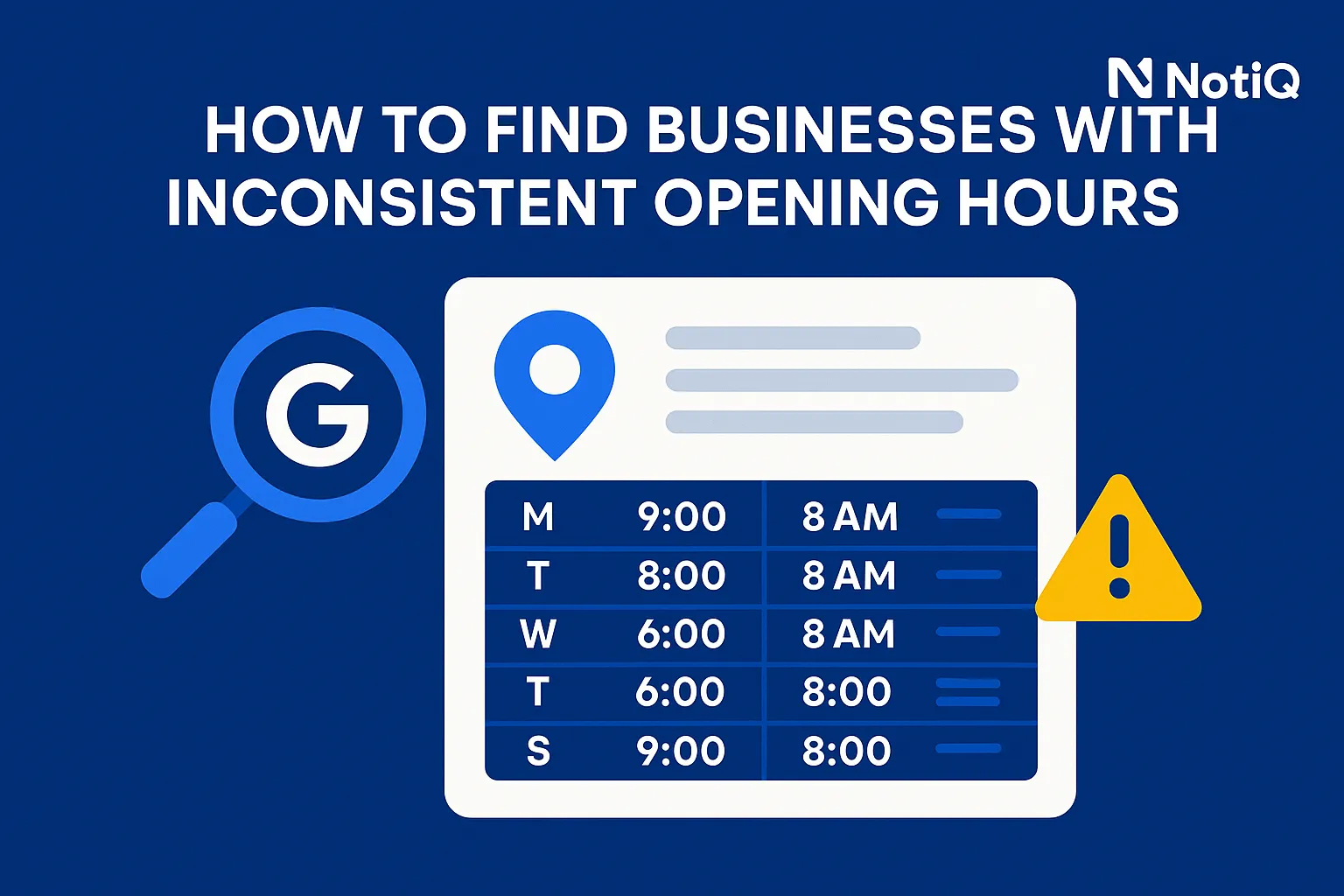
How to Find Businesses With Inconsistent Opening Hours
Learn how to spot inconsistent business hours across Google Business Profiles, websites, and directories using a repeatable audit workflow. This guide shows how to turn hours mismatches into qualified local SEO opportunities.
1. Introduction
Inaccurate business hours often look like a minor listing issue, but they frequently signal a much larger profile maintenance or local SEO problem. For many businesses, opening hours are fragmented across Google Business Profiles, store locator pages, and a vast ecosystem of third-party directories. Because maintaining this data manually is slow and error-prone, inconsistencies inevitably emerge, leading to customer frustration and diminished local search visibility.
This article will demonstrate a repeatable, compliant way to understand how to find businesses with inconsistent opening hours, verify the correct data, and turn those findings into qualified local SEO or data maintenance opportunities. Instead of merely explaining how to fix incorrect hours after the damage is done, this guide outlines how inconsistent business hours can act as a high-signal prospecting trigger.
Designed for local SEO agencies, consultants, SaaS teams, and multi-location operators, this blueprint provides a scalable method for detection and prioritization. Built on practical audit workflows rather than generic theory, this approach is rooted in a data-quality-first perspective. If you are looking to streamline local prospecting and ensure accurate public data,[NotiQ](/)offers a robust data-quality and prospecting workflow solution to identify these valuable discrepancies at scale.
2. Why Inconsistent Opening Hours Matter
Wrong hours are not just cosmetic errors; they represent significant customer experience, trust, and local visibility issues. The immediate business impact of inaccurate hours is deeply felt by consumers. Customers arrive at physical locations only to find the doors locked, or they attempt to call outside of actual operating times. This friction quickly transforms into frustration, often resulting in negative reviews, diminished brand trust, and lost revenue.
From a local SEO and profile quality perspective, inaccurate hours are a glaring indicator of neglected Google Business Profile maintenance. Mismatches in operating times rarely occur in isolation; they frequently coexist with other business listing inaccuracies, such as outdated contact information or unmanaged reviews. Weak data quality fundamentally undermines customer confidence in local search results. Google relies on consistent data to rank local businesses, and understanding how Google updates Business Profile information highlights why maintaining accurate hours is a core requirement for a healthy local presence.
For agencies and consultants, these visible discrepancies create a concrete, highly effective conversation starter. Businesses with wrong hours are significantly more likely to need broader citation cleanup or comprehensive profile support. While most generic local SEO guides focus solely on fixing hours after the fact, this workflow focuses on detection, qualification, and the raw outreach value of identifying a Google Business data quality problem before the business owner even realizes it exists.
Why inaccurate hours are a strong prospecting signal
Opening hours mismatches are incredibly easy to verify and even easier to explain to prospects. Unlike abstract local SEO concepts like link authority or algorithm updates, an opening hours mismatch is a visible, customer-facing problem that is financially relevant to the business owner.
When you point out that a business says it is open on Google but closed on its website, you are offering immediate value. Furthermore, these hours issues often correlate with neglected updates in other profile fields. This makes hours discrepancies a highly useful top-of-funnel filter, allowing local SEO prospecting signals to guide you toward businesses that genuinely need professional help with their Google Business Profile hours.
The downstream impact on trust, reviews, and conversions
The practical outcomes of bad hours data are tangible: wasted trips, missed appointments, confused callers, and public complaints. When customers experience this operational friction, they frequently turn to public forums to voice their displeasure.
Review sentiment can severely amplify the damage when customers mention being closed unexpectedly. A one-star review stating, "Google said they were open, but I drove 20 minutes and they were closed," damages conversions long after the store hours discrepancies are fixed. Tying these business listing inaccuracies back to real operational friction and lost customer trust proves to prospects that this is a business problem, not just a ranking factor.
3. Where Hours Discrepancies Usually Appear
To effectively audit a business, you must first map the most common sources of mismatch so you know where to compare data. The primary comparison set involves three main pillars: the Google Business Profile (and Google Maps), the official business website or store locator page, and major third-party directories and citation sources.
Discrepancies happen for several reasons. Updates are often made in one place but forgotten in another. Holiday or special hours might be added inconsistently. Temporary closures or staffing changes may not be reflected across all platforms. Additionally, multiple data sources, including user suggestions and third-party apps, feed profile updates. Recognizing how Google updates Business Profile information helps clarify why a Google Business Profile might suddenly display hours that differ from the official website. Some of these location data management discrepancies are more meaningful than others, which is vital for prioritizing outreach.
Google Business Profile vs website hours
The business's official website often acts as the most practical source-of-truth candidate, especially on dedicated location pages. When conducting a website hours audit, you must review both the visually displayed hours and the underlying structured data.
Comparing Google Business Profile hours against LocalBusiness structured data for opening hours is a highly effective way to spot technical discrepancies. On-site mismatches are especially useful for prospecting because they are undeniable and easy to screenshot for outreach, proving that the business's own assets are contradicting each other.
Directory and citation platform inconsistencies
Hours often drift across the broader directory ecosystem even when the primary GBP has been updated. Stale data can persist in third-party listings for months or years, especially for businesses that have changed their schedules recently.
Conducting a citation audit for opening hours reveals how deeply the inconsistency runs. When multiple directories conflict in different ways—such as Yelp showing one set of hours, Bing showing another, and Facebook showing a third—it becomes a significantly stronger signal that the business lacks a centralized citation consistency strategy. This makes it incredibly easy to find inaccurate business listings that require professional remediation.
Categories most likely to show hours mismatches
Certain business categories are highly vulnerable to store hours discrepancies and offer high-opportunity segments for prospecting. Restaurants, retail stores, healthcare facilities, franchises, service-area businesses, and seasonal businesses frequently struggle with business hours mismatch in local SEO.
These categories face frequent schedule changes, manage many locations, navigate complex holiday hours, deal with practitioner-level scheduling complexity, or undergo temporary operational changes. Because their hours are inherently volatile, their multi-location listing data quality often degrades rapidly without professional oversight.
4. A Repeatable Hours Audit Workflow
To detect inconsistent opening hours at scale, you need a step-by-step system that is legal, compliant, and relies on publicly accessible information. This repeatable audit sequence is designed to be highly tactical, moving beyond broad optimization advice to provide a clear, operationalized framework.
By systematically choosing a business set, collecting data, comparing sources, flagging mismatches, and validating the likely source of truth, agencies and consultants can build a powerful engine for local SEO audit generation. For more deep-dive educational content on building repeatable audit systems and local data workflows, explore the NotiQ blog.
When structuring your data collection, it is helpful to reference standard API structures, such as the Business Profile regular and special hours fields, to understand exactly how Google categorizes this information.
Step 1 — Define the business set and audit scope
Before auditing, segment your targets to ensure efficiency and high qualification rates. Define your scope by looking at single-location versus multi-location businesses, category sensitivity to hours, recent review activity, and local market relevance.
Defining this scope matters because it dictates the value of the resulting local prospecting signals. Agencies should focus first on verticals where bad hours create obvious customer friction—like a restaurant during dinner rush or an urgent care clinic on a weekend. Targeting multi-location listing data quality issues often yields higher-value retainers.
Step 2 — Capture Google Business Profile hours
Next, document exactly what is visible in Google Maps and the Google Business Profile. You must review the regular hours, special hours, and any temporary closure indicators where relevant.
Keep in mind that profile information can change from multiple sources, which creates unexpected drift. Documenting the current state of the Google Business Profile hours is critical because, as noted by Google's documentation on how Google updates Business Profile information, the listed hours may differ from what the business owner actually thinks is currently live. Finding a Google Business Profile hours incorrect status is the foundational trigger for the opening hours mismatch audit.
Step 3 — Cross-check the website and location pages
Once you have the GBP data, cross-check it against the business's official digital presence. Review the visible page content, contact pages, and dedicated store locator pages for the official hours.
As an extra validation layer during your website hours audit, check for LocalBusiness structured data for opening hours. Discrepancies between the GBP and the official site are especially persuasive for prospecting because they highlight internal business listing inaccuracies that the owner has direct control over.
Step 4 — Compare third-party directories and citations
The goal here is not to manually check every obscure directory, but to identify whether the inconsistency is isolated or systemic. Look for clear patterns: is there just one outdated source, are multiple sources showing the same old hours, or are different sources showing wildly different values?
Repeated inconsistency across directories is a stronger sign of broader location data issues. A targeted citation audit for opening hours will quickly reveal if the brand is suffering from poor citation consistency, helping you find inaccurate business listings that need a comprehensive cleanup campaign.
Step 5 — Classify the mismatch type
Not all mismatches require the same approach. Group your findings into practical categories: regular-hours mismatch, holiday/special-hours mismatch, temporary closure inconsistency, location-page missing hours, or directory-only drift.
Classification helps determine the urgency of the issue and shapes your outreach messaging. A regular-hours mismatch on a primary location page is a high-urgency store hours discrepancies issue, whereas a minor directory-only drift might be a lower-priority location data management task.
Step 6 — Validate a likely source of truth
Not every mismatch is a true lead unless there is a plausible source of truth. Compare the official website location page against current signage (if visible via recent user photos) or recent customer-facing social media updates.
Exercise caution around assumptions, especially regarding recent holidays or temporary disruptions. Ensuring consistency across official channels is a fundamental rule of business data quality; as the SBA advises on keeping directory listings and website details consistent, public business details must remain aligned to maintain trust. Establishing this source of truth location data prevents you from pitching a business hours mismatch local SEO solution based on a false positive.
5. How to Prioritize and Qualify Prospects
Turning raw discrepancy findings into a ranked list of outreach or remediation opportunities requires a practical qualification framework. Not all hours mismatches are equally valuable. By prioritizing leads based on severity, visibility, and category sensitivity, agencies can focus their sales conversations on the highest-impact opportunities.
Modern workflows leverage AI enrichment, compliant verification, and compliance-focused monitoring to scale this process—closing the gaps often left by manual competitor analysis.
High-priority vs low-priority discrepancies
To effectively manage local prospecting, you must know what moves a lead higher on your list. High-priority discrepancies include wrong hours on Google versus the official website, mismatches for high-traffic or review-heavy locations, errors in customer-facing businesses where timing matters daily, and recurring holiday or special-hours errors.
Conversely, lower-priority issues include minor directory-only inconsistencies or single outdated citations with no visible GBP conflict. Focusing on severe store hours discrepancies ensures your local SEO audit efforts yield highly responsive prospects.
Signals that suggest a broader local SEO problem
Hours mismatches rarely exist in a vacuum. They often appear alongside incomplete profiles, inconsistent NAP (Name, Address, Phone) details, weak location-page quality, and outdated website information.
Because poor location data management usually points to a systemic lack of Google Business data quality oversight, hours issues serve as the perfect entry point into a much larger, comprehensive local SEO audit and subsequent retainer.
A simple lead-scoring framework agencies can use
Agencies can operationalize this by building a practical lead-scoring model. Factors should include the number of mismatched locations, the seriousness of the mismatch (e.g., closed when they should be open), the business category, review count and customer exposure, and evidence of outdated data across multiple channels.
Make this framework easy to convert into a spreadsheet, checklist, or software product workflow. For teams looking to scale this process into personalized outreach or follow-up workflows based on these local prospecting signals and multi-location listing data quality scores, tools like Repliq can help operationalize prospect qualification.
How to present findings in outreach
When reaching out, lead with the visible issue rather than a generic SEO pitch. Concise local SEO prospecting outreach should clearly state where the mismatch was found, why it matters to their customers (mentioning lost revenue or bad reviews), and whether it likely reflects a broader business listing inaccuracies issue.
Maintain a helpful, evidence-based tone. Pointing out inconsistent business hours should position you as a knowledgeable consultant offering a solution, rather than relying on fear-based selling.
6. Holiday, Special, and Multi-Location Challenges
Many false positives and true, high-value opportunities stem from special operational scenarios. Maintaining accurate hours across many locations with numerous date-specific exceptions is incredibly complex. Understanding these edge cases differentiates your audits from simplistic, automated checks that fail to grasp real-world operational nuances.
For technical context on how these exceptions are managed via API, refer to Google's documentation on Google Business Profile locations and special hours.
Holiday and special-hours drift
Holiday periods create temporary, highly visible mismatches. Businesses frequently update their hours on one channel—such as putting a banner on their website—but forget to update their Google Business Profile.
This holiday hours drift is both a massive operational risk for the business and a strong prospecting signal for agencies. Finding a Google Business Profile hours incorrect status during a major holiday proves that the business lacks a proactive special hours strategy.
Seasonal businesses and temporary closures
Seasonal changes create significant ambiguity in listings. When auditing seasonal business hours, it is vital to distinguish between a true inaccuracy, a legitimate temporary closure, and incomplete public communication.
Verify the status by checking social media or recent reviews without overclaiming. An opening hours mismatch here might just be a lag in seasonal updates, but it still represents an opportunity to offer better listing management services.
Franchises, healthcare, and practitioner-level complexity
Large brands, franchises, and specialized categories like healthcare often face severe location-level variations. Practitioner listings (e.g., individual doctors) and department-level schedules (e.g., a pharmacy inside a grocery store) act as major sources of confusion.
While franchise listing management and healthcare location data complexities produce more false positives, they also represent highly lucrative multi-location listing data quality opportunities for agencies equipped to solve them.
False positives to avoid
To maintain trust and avoid sounding overly salesy, you must recognize cases that should not automatically be treated as neglect. Examples include recent holiday timing lags, sudden emergency closures, website updates lagging slightly behind confirmed profile changes, or appointment-only and service-area exceptions.
Acknowledging these nuances proves you understand source of truth location data and reinforces your authority in Google Business data quality, rather than just blasting automated business listing inaccuracies reports.
7. Tools, Monitoring, and Ongoing Processes for Data Quality
Moving from one-time audits to sustainable monitoring and operational improvement is the final step in mastering local data quality. Recurring checks matter deeply because hours can change frequently, and profile data is constantly updated from multiple user and algorithmic sources.
Automation and anomaly detection are the logical next steps after manual validation. Turning detected maintenance issues into action-ready prospecting or monitoring workflows is essential for scale. To implement a monitoring-first workflow with robust anomaly detection and scalable prospect discovery, integrating a platform like[NotiQ](/)ensures you never miss a critical data shift.
What to monitor continuously
Recurring checks should be established for regular hours, holiday and special hours, website-versus-GBP consistency, and recurring directory drift.
The highest-value hours monitoring targets are businesses with frequent operational changes. As detailed in the Business Profile regular and special hours fields documentation, ongoing monitoring is especially important for profiles affected by constant algorithmic or user-suggested updates to location data management.
When manual audits break down
Spreadsheets and ad hoc checks quickly become inefficient when scaled across dozens or hundreds of locations. Manual checking does not scale; it introduces missed updates, inconsistent validation, and weak prioritization.
As multi-location listing data quality demands increase, the sheer volume of data points necessitates automated detection and enrichment to maintain high Google Business data quality standards.
Turning anomaly detection into a workflow
Detected mismatches should automatically feed into prospect lists, account health reviews, support tickets, and local SEO maintenance queues.
A successful anomaly detection system relies on a closed-loop process: detect the error, verify it against the source of truth, prioritize it based on business impact, act on it via outreach or remediation, and recheck to ensure compliance. This transforms business listing inaccuracies from static errors into dynamic local prospecting assets.
8. Conclusion
Inconsistent opening hours are far more than a simple cleanup issue—they are a practical, high-signal way to identify neglected profiles and highly qualified local SEO opportunities. By implementing a repeatable workflow, you can systematically compare Google Business Profiles, websites, and directories, validate a likely source of truth, classify the discrepancy, and prioritize outreach based on visibility and business impact.
While most industry content stops at explaining how to fix incorrect hours, agencies and data-quality teams can leverage these mismatches to uncover broader profile maintenance needs and generate qualified leads. By shifting your focus from reactive fixes to proactive detection, you transform a common listing error into a powerful business development tool.
Operationalize your hours-audit process today to stop leaving local SEO opportunities on the table. To explore a monitoring-first workflow that turns inconsistent business hours and Google Business data quality issues into actionable local prospecting goldmines, discover the practical, data-quality-first approach at NotiQ.
Frequently Asked Questions
- How do you find businesses with inconsistent opening hours?
- The fastest compliant method to learn how to find businesses with inconsistent opening hours is to compare the Google Business Profile hours with the official website and a few major directory listings, then accurately classify the mismatch to determine the true source of truth.
- Why do inconsistent business hours matter for local SEO?
- Why do inconsistent business hours matter for local SEO? Because hours accuracy is directly linked to user trust, customer experience, and visible profile maintenance quality. Furthermore, Google Business data quality issues like wrong hours almost always indicate broader, systemic local data problems that suppress search visibility.
- What causes mismatched opening hours across business listings?
- Common causes of store hours discrepancies include a business updating one channel but neglecting others, missing holiday or special hours updates, multi-location management complexity, and unauthorized updates overriding location data management platforms from multiple third-party data sources.
- Which businesses are most likely to have inconsistent hours?
- Businesses most prone to an opening hours mismatch include restaurants, retail stores, healthcare facilities, franchises, seasonal businesses, and any high-change local operators struggling with multi-location listing data quality.
- How often should business hours be audited?
- Hours audit frequency should depend on the business's change rate, seasonality, and location count. However, more frequent reviews are highly recommended around holidays, special events, and major operational changes to ensure Google Business Profile hours remain accurate.
Continue Reading
More articles you might find useful
Google Maps Lead Generation for Commercial Flooring Companies
Discover a practical Google Maps prospecting workflow for commercial flooring companies. Learn how to find, qualify, and organize better local B2B opportunities.
Read the article →
How to Build Lead Lists From Businesses in Tourist Areas
Learn how to build better hotel and hospitality lead lists by focusing on tourist zones, visitor intent, and seasonality. This guide shows a repeatable workflow for finding higher-fit prospects in destination markets.
Read the article →
Google Maps Prospecting for Uniform and Workwear Suppliers
Learn a practical Google Maps workflow for finding and qualifying local uniform and workwear buyers. This guide shows suppliers how to spot recurring demand and prioritize better B2B leads.
Read the article →Popular industry lead playbooks
Maps search examples and niche outreach for the verticals teams prospect most.