Technology
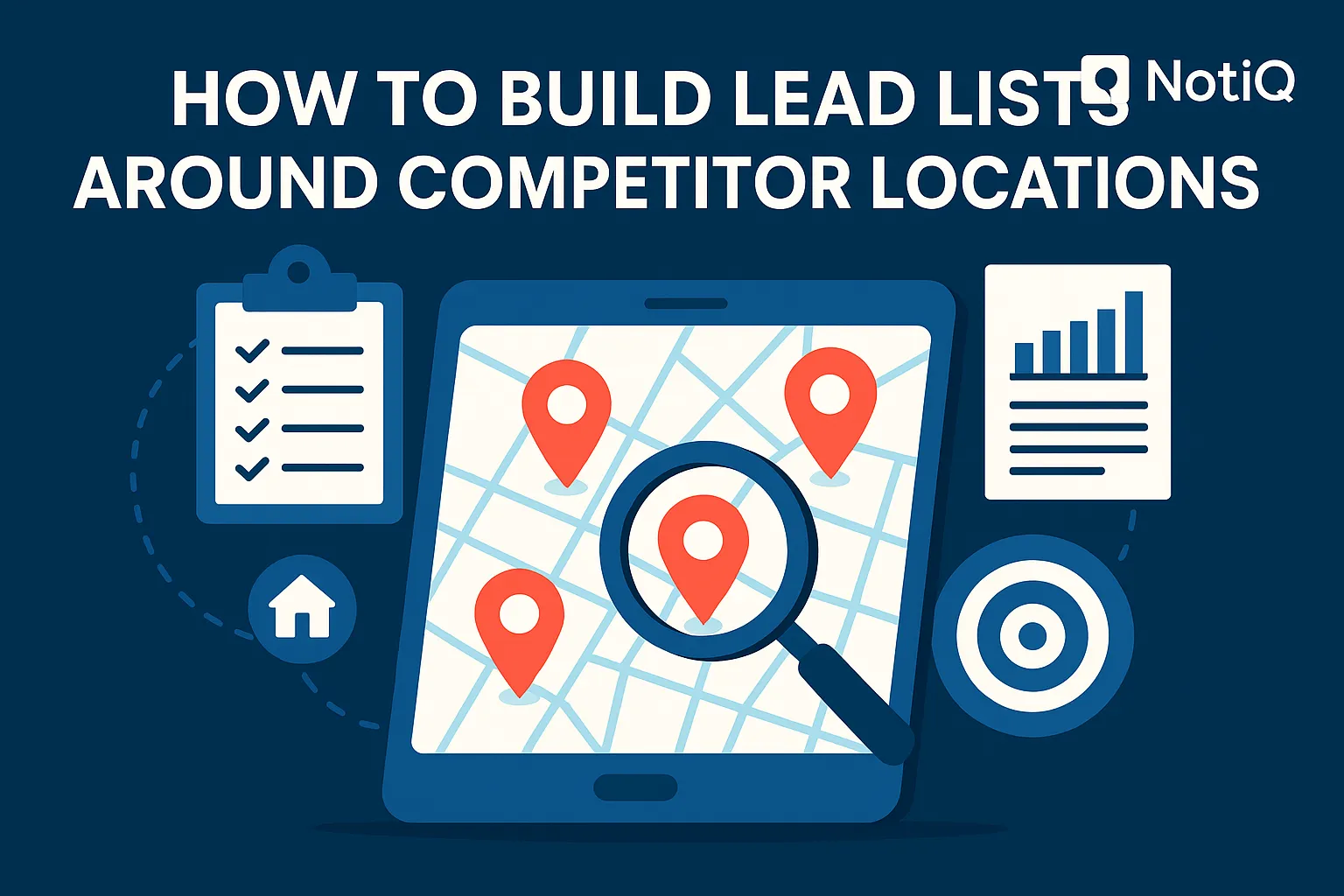
How to Build Lead Lists Around Competitor Locations
Learn how to turn competitor footprints into qualified geographic lead lists. This guide covers validation, ICP filtering, scoring, and localized outreach.
1. Introduction
For advanced sales and RevOps teams, mapping out a competitor’s physical footprint is a logical first step in territory planning. However, proximity alone does not create a good lead list. Without rigorous validation and firmographic filtering, local prospecting quickly deteriorates into bloated, low-conversion outreach targeting unqualified accounts.
Competitor locations are high-signal market indicators. They reveal where demand exists, where supply chains are established, and where buyers are already educated on your category. Yet, most revenue teams treat market mapping, data enrichment, and outreach execution as disconnected tasks. They pull a raw list of nearby businesses and hand it to sales reps, resulting in wasted effort and burned territories.
This article provides an end-to-end, methodology-first blueprint for turning competitor footprints into qualified, prioritized, and outreach-ready account lists. Designed for teams already utilizing modern CRMs and prospecting databases, this guide moves past beginner definitions. We will explore a complete workflow: capturing competitor locations, validating the data, defining proximity logic, applying ICP filters, scoring accounts, and activating localized outreach.
Mastering competitor location prospecting, geographic lead lists, and local market targeting requires a strategic, data-oriented approach. By leveraging a methodology-led framework, teams can map markets accurately and prioritize prospects based on actionable intelligence rather than arbitrary geography.
2. What Competitor Location Targeting Is and When to Use It
Competitor location targeting is the strategic process of using a competitor’s physical business presence as a geographic signal for discovering and prioritizing nearby accounts. Unlike generic geo-targeting, which simply draws a circle around a city and pulls every business inside it, this methodology relies on competitive density as an indicator of market viability.
It is crucial to distinguish this approach from other location-based strategies. Simple nearby business searches yield unstructured data with no competitive context. Standard territory prospecting relies on static boundaries like ZIP codes or state lines, regardless of market dynamics. Competitor-based local market targeting, however, anchors your search around proven hubs of industry activity.
This approach is highly effective for:
• Field sales coverage: Routing reps efficiently between high-probability accounts.
• Regionally concentrated TAM: Maximizing penetration in specific industrial or commercial hubs.
• Local service delivery: Ensuring prospects fall within profitable service or distribution radii.
• Market-entry analysis: Identifying where competitors have already validated local demand.
• Dense metro account clustering: Grouping prospects to prevent scattered, inefficient outreach.
Conversely, this methodology is less useful for purely national digital sales motions without geographic constraints, or in markets where physical location has no bearing on purchasing behavior.
Many teams attempt this using manual map scraping or basic list-building tools, which often lack the necessary compliance and data verification layers. The critical gap in most existing operations is the failure to connect footprint validation directly to outreach activation. To bridge this gap,[Home](/)serves as the orchestration system for connecting market mapping, enrichment, and workflow execution, championing a location-based competitive prospecting methodology over disjointed, tool-first tactics.
Why competitor footprints are a useful market signal
A competitor’s physical presence is rarely accidental. An active location indicates proven local demand, route viability, market maturity, or vertical concentration. By anchoring your search around these footprints, competitor location prospecting helps surface likely buyer clusters rather than random geographic lists.
However, footprint data must be treated as a signal, not absolute proof of fit. A nearby business might be in the right location, but it still requires firmographic qualification. When used correctly, these signals drastically improve rep efficiency, optimize territory design, and enhance outreach relevance by focusing efforts where the market is already primed.
The most common mistakes teams make
When executing local market targeting, teams frequently stumble over execution gaps. The most common mistakes include:
• Relying on outdated or unverified competitor addresses.
• Choosing arbitrary radii (e.g., a flat 50-mile circle) that ignore local geography and drive times.
• Pulling every nearby company into a CRM regardless of ICP fit.
• Over-targeting dense urban markets with weak-fit accounts, creating noise rather than pipeline.
Local relevance without account quality inevitably creates wasted sales effort. Building high-converting geographic lead lists requires solving these pain points systematically.
3. How to Validate Competitor Locations and Define Proximity Rules
Before pulling a single prospect into your CRM, you must verify that the competitor locations are real, current, and strategically relevant. Poor location data breaks the entire workflow: wrong addresses lead to wrong distances, incorrect clusters, and misaligned sales priorities.
A strict validation checklist is non-negotiable. Teams must verify whether a site is currently active, determine its operational function (e.g., branch, headquarters, warehouse, or retail storefront), confirm address standardization, and eliminate duplicates. Furthermore, "location" must be defined carefully. A registered corporate entity is not always the physical site of operation. For accurate market mapping, teams should rely on official establishment methodology to distinguish between establishment-level operating sites and parent-company headquarters.
Once validated, proximity logic must be selected based on your specific selling model—whether that is a straight radius, drive-time calculations, postal code clustering, or formal territory boundaries. Throughout this process, all competitor location analysis must rely strictly on privacy-safe, publicly accessible business data.
Step 1 — Validate competitor addresses before list building
A practical validation process ensures that your foundation is solid. First, normalize addresses using established frameworks. Referencing U.S. Census geocoding guidance ensures that physical locations are accurately mapped to standardized geographic coordinates.
Next, geocode these locations and identify duplicate sites. Not all competitor footprints hold equal weight. A flagship sales office or major distribution center is a stronger market signal than a small, satellite service depot. Tag each competitor location by type and assign a confidence level. For example, a recently verified regional headquarters represents a "high-confidence" signal, while a P.O. box or unverified secondary address should be flagged as "low-confidence" and excluded from location-based prospecting.
Step 2 — Choose the right proximity model
Selecting the correct proximity model dictates the shape of your geographic lead lists.
• Radius-based logic: Best for quick, high-level screening in uniform geographies. It is easy to calculate but ignores physical barriers like rivers or highways.
• Drive-time logic: Essential for field sales realism. A prospect might be five miles away but take an hour to reach in dense traffic. Drive-time ensures route viability.
• Territory boundaries: Ideal for operational ownership, ensuring geo-targeted sales prospecting aligns with existing rep compensation and CRM routing rules.
Rather than picking one arbitrary cut-off, teams should test different models based on local infrastructure and sales velocity requirements.
Step 3 — Use threshold tiers instead of a single cutoff
Instead of a binary "in or out" radius, group prospects into threshold bands. For example:
• Tier 1: 0–5 miles (Immediate zone / high priority for field visits)
• Tier 2: 5–15 miles (Core market / standard outbound sequencing)
• Tier 3: 15–30 miles (Secondary expansion zone / digital-first outreach)
Tiering improves prioritization and prevents an all-or-nothing list. Dense urban centers and sprawling rural markets require entirely different threshold logic. A 10-mile radius in Manhattan represents a massive, complex market, whereas a 10-mile radius in rural Texas might yield only a handful of accounts.
4. How to Build Geo-Targeted Lead Lists With Firmographic Filters
Competitor proximity narrows the search universe, but ICP and firmographic filters determine actual qualification. To avoid low-fit local lists, geographic logic must be layered with deep account-level criteria.
A repeatable workflow follows these steps: start with validated competitor footprints, pull nearby businesses within the defined proximity tiers, apply strict industry filters, narrow by company size or segmentation, and finally, add buying-signal data where available. Geography is just one dimension inside a much broader qualification model. Competitor-based lead generation fails when teams stop at the map and neglect filtering depth.
For teams looking to operationalize this,Home provides the necessary workflow features to automate enrichment, filtering, and repeatable prospecting operations.
Start with ICP before pulling nearby accounts
Assuming that "every business near a competitor" is a viable prospect is the fastest way to ruin a geographic lead list. Before querying nearby accounts, clearly define your ICP using rigid firmographic filters.
Utilize official NAICS industry classification to standardize industry segments and cut out obvious low-fit accounts immediately. Define parameters such as employee headcount bands, location types (commercial vs. residential), revenue proxies, and serviceability requirements. Advanced revenue teams separate total addressable market (TAM) discovery from immediate outreach lists, ensuring reps only see accounts that match the strict ICP profile.
Layer geographic logic with firmographic and buying-signal data
Precision in location intelligence for sales comes from combining proximity with fit dimensions. Once the geographic boundary is set and the industry is filtered, layer in account potential and local market relevance.
Data enrichment validates whether nearby accounts are active, growing, or strategically aligned with your solution. Conceptually, an account scoring input list should look like this:
• Proximity to competitor (Tier 1, 2, or 3)
• Industry match (Exact NAICS match vs. adjacent)
• Company size (Within ideal employee band)
• Buying signals (Recent funding, tech stack additions, or hiring trends)
This layered approach transforms basic map prospecting into highly targeted, geo-targeted lead lists.
Decide what fields belong in the final local lead list
The final output must be actionable for sales reps. A well-structured local account mapping export should include:
• Account name and standardized address
• Distance or drive-time to the competitor location
• Industry classification and company size
• Territory owner and priority tier
• Relevant market context notes ("Why this account made the list")
Operational fields matter just as much as contact data. Providing context ensures a smooth handoff between RevOps and the executing sales team, preventing reps from having to guess why an account was assigned to them.
5. How to Score and Prioritize Accounts in Dense Local Markets
Dense markets create a unique challenge: too many nearby accounts. When a single competitor location yields hundreds of nearby businesses, distance sorting is no longer sufficient. Teams need a rigorous scoring model that balances fit, proximity, saturation, and opportunity.
Prioritizing accounts in dense local markets requires a framework that prevents reps from being overwhelmed by false abundance. By analyzing local market sizing and establishment density using County Business Patterns data, teams can determine whether a territory is worth deeper pursuit or if it is already over-saturated.
Build a scoring model that balances fit and geography
A weighted scoring model ensures that high-fit accounts are prioritized appropriately. Categories should include firmographic fit, proximity band, market potential, and signal strength.
Crucially, an account that is very close to a competitor but falls slightly outside the core ICP should never outrank a perfect-fit account that is slightly farther away. A sample scorecard might allocate 40% weight to ICP fit, 30% to buying signals, 20% to proximity tier, and 10% to market potential. This ensures that proximity-based lead lists remain grounded in actual revenue potential rather than just geographic convenience.
Avoid over-targeting dense markets with low-fit accounts
Dense local markets often create list inflation. When local competition density is high, it heavily impacts opportunity and prioritization, a dynamic supported by OECD competition and market dynamism guidance.
To avoid overwhelming sales teams, RevOps should implement account caps, priority bands, or rep-specific routing rules. Evaluate the opportunity-per-mile or opportunity-per-cluster to decide if a dense market warrants a dedicated field sprint or just a standard digital cadence. Quality must always act as a bottleneck against geographic volume.
Use cluster logic, not just one-account-at-a-time ranking
Instead of ranking accounts in a vacuum, group nearby accounts into micro-markets, ZIP clusters, or route-efficient pods. Cluster prioritization dramatically improves field sales coverage, allowing reps to maximize meeting efficiency and reduce windshield time.
Market mapping at the cluster level also helps sequence outreach rationally. If a rep secures a meeting in a specific ZIP code, they can immediately activate outreach to the rest of the cluster, leveraging local presence to drive additional pipeline.
6. How to Turn Local Market Insights Into Relevant Outreach
Location-based lists must translate into conversion-oriented outreach. The fatal flaw of competitor-based lead generation is mentioning proximity in a way that feels invasive, creepy, or overly obvious (e.g., "I saw you are located near Competitor X").
Instead, leverage local market context. Use insights about known industry concentration, regional demand conditions, service coverage patterns, or operational convenience. Connect your account scoring outputs directly to message relevance and sequence priority. This is where strategic research transitions into tangible pipeline activity. For executing this localized outreach efficiently and managing personalization at scale,Home provides the necessary workflow integration. Always maintain a privacy-safe framing, relying entirely on public business context rather than implying behavioral surveillance.
Messaging angles that feel relevant without sounding invasive
Effective localized outreach establishes relevance professionally. Safe, highly effective messaging angles include:
• Local service availability: "We recently expanded our implementation team in the [City/Region] area..."
• Regional specialization: "We are working with several manufacturing hubs along the I-95 corridor..."
• Market-specific operational insight: "Supply chain constraints in the [Local] market have been impacting local distributors..."
Never state or imply that you are tracking their proximity to a competitor. Use the geographic insight to inform your timing and value proposition, keeping the outreach focused on solving business pain points relevant to their specific region.
Match outreach priority to score tiers
Operationalize your prioritization by matching outreach intensity to your score tiers.
• Tier 1 (High Fit, Close Proximity): Heavy personalization, multi-threading, direct phone outreach, and potential in-person field visits. Assigned to senior AEs.
• Tier 2 (Good Fit, Core Market): Standard outbound sequences, automated email steps mixed with targeted SDR calling.
• Tier 3 (Lower Fit or Expansion Zone): Automated, digital-first nurturing campaigns.
By connecting scoring bands to execution channels, you ensure that geo-targeted sales prospecting is an operational reality, not just an analytical exercise.
Use local proof points and market context
Strengthen your messaging by incorporating regional customer patterns or industry concentration data. A strong localized framework follows a simple structure: Local Context + Fit Insight + Business Outcome.
For example, referencing how similar businesses in their specific county are navigating regulatory changes adds immediate credibility. However, local relevance should only support the core business case—it cannot replace a strong, outcome-driven value proposition.
7. Tools, Workflow Design, and Operationalization
To move from theory to execution, advanced teams must operationalize this methodology across their mapping, CRM, enrichment, and outreach systems. Fragmented, manual workflows that require downloading CSVs, mapping them in third-party consumer tools, and manually uploading them back to a CRM are prone to error and data decay.
A structured, repeatable workflow orchestration is required to maintain data integrity and sales velocity.[Home](/)acts as the orchestration layer for these repeatable, data-oriented prospecting workflows, ensuring that strategic methodology translates into operational sales efficiency.
What a repeatable workflow should look like
Standardization is vital for RevOps teams managing multiple territories. A repeatable competitor location prospecting workflow follows these sequential steps:
1. Capture: Identify competitor locations using verified public data.
2. Validate: Standardize addresses and classify site types.
3. Define: Set proximity thresholds (radius or drive-time).
4. Pull: Extract nearby accounts within those boundaries.
5. Filter: Apply strict ICP and NAICS industry filters.
6. Score: Rank accounts based on fit, proximity, and buying signals.
7. Cluster: Group accounts into route-efficient pods.
8. Assign & Activate: Route to the appropriate rep and launch localized outreach.
For automated verification and seamless operational handoffs between these steps, integrating Home ensures the process remains scalable.
Governance, refresh cadence, and data hygiene
Stale location data creates stale outreach priorities. Competitor footprints change—new branches open, old warehouses close, and target accounts relocate.
Establish a strict governance and refresh cadence. Competitor location data and local account lists should be reviewed quarterly. Implement automated duplicate suppression, inactive-site cleanup, and territory ownership alignment checks. Proper data hygiene ensures your geographic lead lists remain accurate and your sales team maintains trust in the system.
8. Future Trends in Competitor Location Prospecting
The landscape of location intelligence for sales is evolving rapidly. Emerging trends are shifting the focus from static maps to dynamic decision systems. AI-assisted market mapping and clustering are enabling RevOps teams to process massive spatial datasets instantly. Enrichment layers are becoming more sophisticated, blending real-time firmographics with spatial context.
Furthermore, route optimization is becoming deeply tied to prospecting logic, allowing field teams to generate lists based on actual travel efficiency rather than just proximity. Underpinning all of this is a strict adherence to privacy-safe competitive intelligence, ensuring compliance while maximizing market visibility. The future of territory design lies in end-to-end workflow orchestration as a core strategic advantage.
Why methodology will outperform tool-led tactics
The market is currently crowded with point solutions—basic scrapers, standalone mapping plugins, and isolated enrichment tools. However, very few systems connect these disparate functions into a cohesive, strategic workflow.
Methodology will always outperform isolated tactics. Vendor-led content often focuses too narrowly on generating a list, ignoring the crucial steps of validation, scoring, and safe outreach activation. By adopting an end-to-end, workflow-driven prospecting framework, revenue teams can elevate their strategy from basic competitor-based lead generation to highly orchestrated market capture.
9. Conclusion
Competitor locations are incredibly valuable market signals, but their value is only realized when the data is validated, filtered, scored, and activated through a repeatable workflow. Raw proximity is not enough.
To build high-converting geographic lead lists, teams must follow a strict sequence: validate footprint data, choose the right proximity rules, layer in ICP and firmographics, score by fit and geography, and convert local insights into relevant, non-invasive outreach. The most successful local market targeting systems do not chase every nearby business; they identify the highest-fit opportunities within a competitor’s geographic footprint.
Stop relying on ad hoc list-building exercises and start treating local market mapping as a structured revenue operation. Explore how[Home](/)can help you operationalize this prospecting methodology, bringing strategic, data-oriented efficiency to your sales workflows.
Frequently Asked Questions
- How do you build lead lists around competitor locations?
- Building these lists requires a structured process: identify and validate competitor sites, define proximity logic (like drive-time or radius), pull nearby accounts, filter those accounts by strict ICP criteria, score and prioritize them based on fit, and finally, activate targeted outreach. Validation and qualification are just as critical as map proximity.
- What is competitor location prospecting in B2B sales?
- It is a strategic prospecting methodology that uses a competitor’s physical business presence as a geographic signal to identify, filter, and prioritize nearby target accounts. It differs from generic local lead generation by using competitive density as proof of market viability, rather than relying on arbitrary territory lines.
- How close should a prospect be to a competitor location to qualify?
- There is no universal threshold. The correct distance depends on your specific sales motion, physical route realities, and local market density. Instead of a single cutoff, teams should use threshold bands or drive-time tiers (e.g., 0-5 miles, 5-15 miles) to prioritize accounts effectively.
- What data sources are best for validating competitor locations?
- The best sources rely on public, compliant business registries and mapping data. Validation requires address normalization, geocoding, and establishment-level interpretation. Authoritative frameworks, such as U.S. Census geocoding guidance and official establishment methodology, should ground your data verification efforts.
- How do you prioritize accounts within a competitor’s geographic footprint?
- Prioritization should be driven by a weighted scoring model that combines ICP fit, proximity bands, local market potential, and signal-based readiness. Additionally, teams should utilize cluster-level thinking—grouping nearby accounts into micro-markets—to improve field efficiency rather than just relying on single-account ranking.
Continue Reading
More articles you might find useful
How to Prioritize Businesses With Verified Google Profiles
A practical framework for ranking local leads beyond the verified badge. Learn how to prioritize Google Business Profiles using fit, freshness, completeness, and activity signals.
Read the article →
Google Maps Prospecting for Commercial Waste Management Companies
Learn how commercial waste haulers can use Google Maps to find, qualify, and prioritize better local accounts. This guide shows how to build denser routes and improve outreach with waste-stream and service-area insights.
Read the article →
How to Find Local Businesses With Broken Website Links
Learn how to find local businesses with broken website links using Google Maps, quick validation checks, and proof-based outreach. This guide shows agencies how to turn visible site issues into qualified leads.
Read the article →Popular industry lead playbooks
Maps search examples and niche outreach for the verticals teams prospect most.