Technology
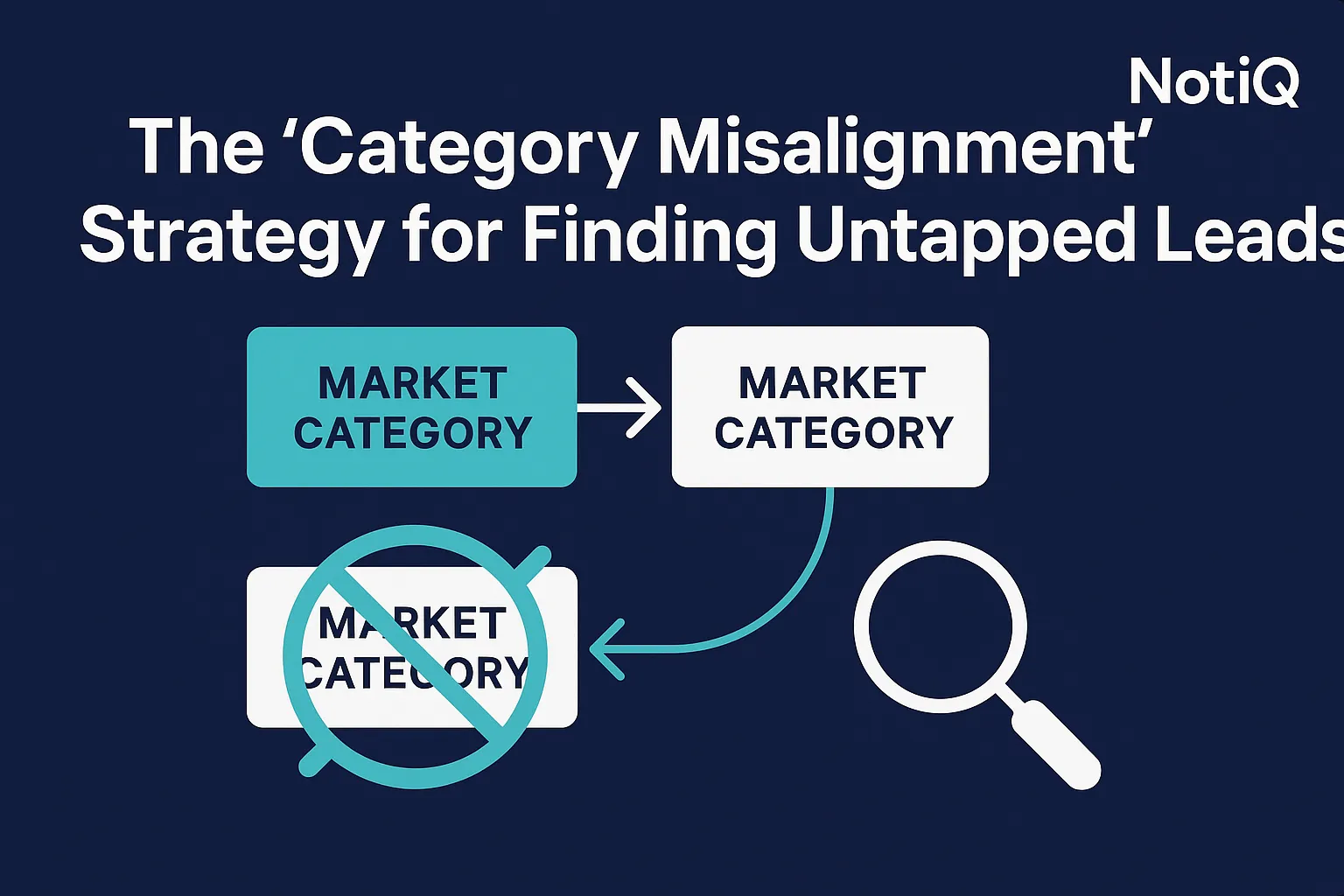
The “Category Misalignment” Strategy for Finding Untapped Leads
Learn how to use market category mapping to spot category misalignment, uncover adjacent demand, and find niche lead opportunities your competitors miss.
1. Introduction
Many B2B brands operate under a fundamental misconception: they believe they have a traffic problem, when in reality, they have a category problem. When your market searches for a solution, a specific workflow, or an alternative, but uses terminology entirely different from your brand’s self-declared category, you become invisible. You are either discovered through the wrong lens—resulting in unqualified traffic and high bounce rates—or you are not discovered at all. This disconnect between buyer language and vendor language is a critical failure point for growth.
This article is a tactical guide for advanced marketing and SEO teams on implementing a category misalignment strategy. It details how to diagnose category misalignment through observable search engine results page (SERP) overlap, alternative-page patterns, and workflow-first search behavior. By utilizing category mismatch maps, you can identify where your brand truly fits in the minds of consumers, rather than just on your internal pitch decks.
The payoff of this strategy is substantial: better discoverability, stronger niche positioning, highly relevant content clusters, and the acquisition of high-quality untapped leads. We will cover the complete process, from diagnosis and mapping to prioritization, content execution, and safe repositioning.
As a strategic authority on detecting wrong category positioning,[NotiQ](/)translates complex positioning decisions into actionable SEO execution and organic growth systems. By leveraging NotiQ as the strategic layer for identifying demand-capture gaps, teams can operationalize insights and turn overlooked search patterns into measurable revenue.
2. What Category Misalignment Looks Like in Search
Category misalignment is not merely a theoretical branding issue; it is a measurable demand-capture problem. It occurs when a brand categorizes itself in a way that fundamentally clashes with how the market searches for the problem it solves. For advanced teams, this wrong category positioning suppresses discoverability, distorts competitor benchmarking, and severely weakens conversion pathways. Rather than relying solely on internal brand workshops, category errors can be directly observed and quantified in SERPs.
Define the concept through search behavior, not just branding theory
There is often a massive chasm between internal positioning language and external search-market behavior. While a vendor might categorize their product as an "enterprise synergy orchestration platform," buyers are simply searching for "how to automate client onboarding." Buyers search by workflow, outcome, role, or alternative rather than adhering to rigid, vendor-defined software categories.
Because buyer language differs from vendor language, advanced SaaS marketers and SEOs require diagnostic signals rooted in actual search data, not abstract positioning advice. Market category mapping must reflect reality. It is important to distinguish a category misalignment strategy from pure category creation; the former is about realigning with existing demand, while the latter requires building entirely new demand. As users become more intent-driven, aligning with their specific discovery paths is paramount. This shift is supported by Google research on changing search behavior, which highlights how modern search is becoming increasingly dynamic and discovery-oriented.
Signals that your brand may be positioned in the wrong category
Diagnosing category confusion in search requires looking at practical, observable signs. The most glaring signal is exceptionally low relevance between your ranking queries and your actual revenue-driving use cases. If your site generates traffic but no pipeline, your category framing is likely attracting the wrong intent.
Another major signal is when adjacent tools, industry publishers, or "alternative to" pages dominate the SERPs your Ideal Customer Profile (ICP) actually uses. If you want to know how to detect wrong category positioning from SERP patterns, look for poor click-through rates (CTR) on your assumed category terms, coupled with disproportionately higher engagement on unexpected, granular use-case pages. Furthermore, your declared competitors in sales decks are often entirely different from your real search competitors. When your competitive positioning analysis reveals that you overlap with alternative competitors outside your assumed market, it is a clear indicator that your brand is miscategorized in the eyes of the search engine and the user.
Why category misalignment becomes a lead-generation problem
When you fail to align your category with search reality, you inevitably miss high-intent leads that are actively searching within adjacent or substitute categories. Brands miss leads in adjacent categories because their content architecture mirrors a flawed, overly narrow market definition. If your website is structured around a category no one searches for, your lead capture will be equally constrained.
Category misalignment is fundamentally a missed demand capture issue. A highly effective demand-capture model must be built around role-specific and workflow-based intent rather than static product labels. Finding these niche opportunities requires a strategic workflow that goes beyond manual, research-heavy approaches that often yield outdated insights. By connecting positioning concepts to measurable search signals, teams can pivot their architecture to capture the exact intent of their most lucrative buyers.
3. How to Build a Category Mismatch Map
To correct positioning errors, teams need a repeatable framework they can apply immediately. The category mismatch map is a visual and analytical model that compares a brand's current positioning against actual buyer discovery behavior. This framework maps out direct, adjacent, and substitute categories, ensuring you are not only looking at declared peers.
Start with the right inputs
Building an accurate map requires gathering the right data. The key inputs to collect include your current category labels, top-ranking pages, Google Search Console (GSC) query patterns, “alternative” queries, raw customer language from sales calls, and competitor overlap metrics.
Advanced readers understand that because buyer language differs from vendor language, you must collect terminology derived from use cases, pain points, and jobs to be done segmentation, rather than relying on product taxonomy alone. A structured input table is essential here. Create a matrix that tracks the internal product label against the actual search intent clusters your buyers are using. This data collection phase ensures that your subsequent mapping is grounded in empirical search data rather than internal assumptions.
Map direct, adjacent, and substitute categories
Once your inputs are gathered, categorize the search landscape into three distinct buckets:
• Direct: Your declared market peers and head-to-head competitors.
• Adjacent: Neighboring categories serving similar workflows or overlapping user roles.
• Substitute: Non-obvious alternatives solving the exact same outcome (e.g., searching for a "freelance writer" vs. an "AI content generator").
Category boundaries become distinctly visible when the same buyer problem appears across multiple SERP types. Use a simple matrix to plot these out: track the category label, target audience, specific use case, search patterns, and the dominant page type ranking for those terms. Often, the most lucrative competitive whitespace and adjacent market opportunities are found in the substitute and adjacent buckets, where alternative competitors are capturing your ideal buyers. Establishing these boundaries with rigor is critical, a concept heavily reinforced by the OECD market definition and competition toolkit, which emphasizes the importance of understanding substitutability in market analysis.
Score each opportunity by relevance, intent, and size
Not every adjacent niche deserves your marketing budget. Teams need a standardized way to evaluate these areas. How do you validate whether a niche opportunity is large enough to pursue? You must score each opportunity by its overlap with ICP pain points, the quality of the search intent, content ranking difficulty, and overall business fit.
Implement a simple prioritization model based on four pillars: relevance to the core product, empirical evidence of demand (search volume and trend), SERP fragmentation (are authoritative sites dominating, or is it a mix of forums and weak blogs?), and the ease of narrative fit. By scoring these factors, you can effectively uncover untapped leads and prioritize adjacent market opportunities. Establish clear decision rules: if intent and relevance are high but volume is low, build a targeted use-case page; if the category is massive and fragmented, build a comprehensive content cluster; if the narrative fit is poor, simply monitor the niche without immediate investment.
4. Finding Adjacent Categories and Untapped Demand
With your category mismatch map built and scored, the next step is applying it to uncover actual traffic and lead opportunities. Hidden demand rarely sits in the center of highly competitive head terms; it almost always appears at the edges of categories.
Use SERP overlap to find your real competitors in search
To truly understand your market positioning, you must compare the ranking entities across your head terms, use-case terms, and alternative queries. SERP overlap analysis reveals who is consistently capturing the attention of your buyers. When the same domains appear repeatedly across related but non-identical SERPs, it is a massive signal of category adjacency.
You must ask yourself: who are your real competitors in search versus sales? The competitors your sales team fights in deals are often completely different from the publishers, adjacent SaaS tools, and review aggregators outranking you on Google. A narrow competitive positioning analysis that only looks at direct software rivals will blind you to the broader search landscape. By analyzing SERP overlap across the entire mismatch map, you identify exactly whose traffic you need to intercept.
Mine alternative-page patterns and workflow-first searches
Broad category terms are often vanity metrics. Instead, "alternative to," "vs," "best tools for [workflow]," and role-based searches reveal category mismatch much faster. These query archetypes expose substitute competitors and highlight cross-category decision journeys.
For example, a project management tool might find that buyers aren't searching for "project management software," but rather engaging in workflow-based search behavior like "best tools for workflow-based category discovery" or "how to track remote design teams." By mining alternative to competitor pages for adjacent categories, you can intercept buyers precisely when they are dissatisfied with their current solution and open to a substitute. Identifying these specific query archetypes is a major competitive advantage, as most competing content strategies stop at basic positioning frameworks and fail to target the bottom-of-funnel comparison intent.
Validate niche opportunities before building content
Before committing resources to content production, you must test whether an adjacent category is strategically worth pursuing. Validation requires assessing the relevance to your product, the resonance with buyer language, and your realistic ability to win attention in the SERP.
Look for leading indicators: repeated query patterns, consistent SERP overlap with weaker domains, and clear content gaps where user intent is not being fully satisfied. In many cases, role-specific intent and pain-point specificity will drastically outweigh raw search volume. Advanced teams know how to identify niche opportunities in crowded markets by prioritizing the quality of intent and the potential for account expansion over broad vanity metrics. Users naturally follow paths with the strongest relevance to their immediate needs, a principle thoroughly documented in research on information foraging and information scent. Validating this "scent" ensures you capture competitive whitespace effectively.
5. Turning Insights Into Content and Internal Linking
Strategy is completely useless until it is reflected in your website's pages, internal links, and topic relationships. You must translate the insights from your category mismatch map into actionable content briefs, clusters, and navigational signals that reinforce your newly refined category narrative. This is how you execute true demand capture.
Build content around pain points, alternatives, and workflows
To capture adjacent demand, your content formats must align with the specific stages of buyer discovery. Relying on a single, broad category page is a failing strategy when your content strategy targets wrong keywords. Instead, deploy educational category pages, alternative pages, use-case-driven category discovery pages, comparison pages, and role-specific guides.
Each format maps to a different set of category assumptions. Alternative pages intercept users looking to leave a competitor; use-case pages capture workflow-specific searches; and educational guides bridge the gap between a buyer's problem and your unique category definition. For examples of how to connect strategic thought leadership with educational clusters, explore the NotiQ blog. Furthermore, when executing workflow-led educational assets, structuring them as comprehensive resources—similar to the Repliq guides—ensures you meet the depth of information buyers require.
Use internal linking to reinforce your revised market narrative
Publishing isolated articles without architectural reinforcement is a common failure point. Internal linking is the mechanism that connects educational category-discovery content to adjacent solution pages and deeper, commercial-intent assets. This network of links helps both users and search engines understand your market category mapping.
Anchor text must be descriptive, crawlable, and strictly aligned with buyer language. Link strategically between problem-definition content, comparison content, and commercial pages to solidify the semantic relationships of your new positioning. Adhering to Google’s internal linking best practices ensures that these contextual signals are properly parsed by search engine crawlers, fundamentally reinforcing your revised market narrative and improving overall site authority.
Create clusters for direct, adjacent, and substitute demand
To capture both current-market demand and future repositioning demand without causing abrupt narrative shifts, implement a structured cluster model based on your mismatch map.
A robust architecture should include:
• Core category cluster: Targeting the direct, declared market terms.
• Adjacent workflow cluster: Targeting the specific jobs-to-be-done and adjacent market opportunities.
• Alternatives/comparison cluster: Leveraging comparison keywords to intercept competitor traffic.
• Thought-leadership cluster: Focusing on category strategy examples and high-level market education.
This balanced approach ensures you cover both informational and commercial intent—not every page needs a hard sell. By structuring clusters this way, you also create distinct advantages for AI enrichment and strategic orchestration, effectively closing the gaps identified during your competitor analysis.
6. How to Reposition Without Confusing the Market
The most common objection to a category misalignment strategy is the fear that repositioning will create market confusion, dilute brand equity, or weaken trust. However, effective repositioning is additive and evidence-based. It is not about a sudden, reckless abandonment of your existing market context; it is about refining your market positioning to match reality.
Distinguish category creation from category repositioning
It is vital to understand the difference between category creation vs category repositioning. Category creation requires inventing an entirely new market frame, educating the market on a problem they didn't know they had, and building demand from scratch. It is highly resource-intensive. Most B2B teams do not need a category creation framework; they need demand recapture.
Repositioning, on the other hand, involves refining your place within an existing or adjacent category based on undeniable evidence from buyer language and search behavior. By comparing the strategic implications, it becomes clear that repositioning is a safer, faster path to revenue because it leverages existing search volume and established market positioning, rather than fighting against it.
Use message architecture that expands rather than replaces meaning
To reposition messaging safely, you must preserve familiar category anchors while seamlessly introducing adjacent frames. If buyer language differs from vendor language, bridge the gap in your subheadings, page copy, and supporting content.
Reduce category confusion in search by tying new category claims directly to concrete use cases and measurable outcomes. For example, instead of abandoning "CRM" entirely, expand it to "CRM built for outbound agency workflows." This before-and-after evolution ensures that existing customers still recognize the core value, while new, highly targeted prospects see their specific vocabulary reflected on the page. A phased rollout logic across your navigation and content hierarchy prevents jarring user experiences.
Add trust, compliance, and proof to any repositioning claim
Any new category framing must be strictly truthful. You cannot materially mislead users about what your product actually does simply to capture search volume. Trustworthiness is non-negotiable.
Back every repositioning statement with concrete examples, verifiable product capabilities, and transparent explanations of fit. A safe category repositioning checklist includes: clarifying the exact scope of the product, avoiding inflated or absolute claims, and aligning all marketing copy with actual user outcomes. Maintaining authoritative, truthful framing not only protects your brand but significantly improves your Experience, Expertise, Authoritativeness, and Trustworthiness (E-E-A-T) signals. For baseline compliance on claim clarity and avoiding deceptive market framing, teams should always adhere to FTC truth-in-advertising guidance.
7. Conclusion
Category misalignment is far more than a branding issue—it is a highly measurable search visibility and demand-capture problem. When your internal language ignores the reality of external search behavior, you forfeit high-intent traffic to competitors and substitutes.
By executing a category misalignment strategy, you can systematically detect these errors in the SERPs. Building a category mismatch map allows you to identify adjacent demand, score niche opportunities, and translate those insights into a robust content and internal linking architecture. Ultimately, advanced teams must use search behavior as the foundational evidence for all market-positioning decisions.
Audit your current category assumptions, map the adjacent demand, and begin operationalizing these findings today. As a leader in connecting positioning challenges with execution,[NotiQ](/)provides the strategic orchestration required to turn raw category insights into automated, high-converting growth workflows.
Frequently Asked Questions
- What is category misalignment in marketing strategy?
- Category misalignment in marketing strategy is a fundamental mismatch between how a brand positions itself and how buyers actually search, compare, and understand solutions. This wrong category positioning often manifests in adjacent or substitute searches long before internal teams recognize the disconnect, resulting in lost visibility and wasted marketing spend.
- How can category mismatch maps uncover untapped leads?
- Category mismatch maps systematically reveal adjacent categories, substitute competitors, and high-intent workflows that a narrow, traditional market definition completely misses. By mapping these blind spots, brands can pivot their content targeting to intercept untapped leads who are actively searching for solutions using alternative vocabulary.
- How do you identify niche opportunities in crowded markets?
- To identify niche opportunities in crowded markets, you must analyze SERP fragmentation, pain-point specificity, workflow queries, and alternative-page patterns. Smaller, highly specific intent pockets—often found in the competitive whitespace of adjacent categories—frequently outperform broad, crowded head terms in terms of conversion and pipeline generation.
- What signals show a brand is positioned in the wrong category?
- Key diagnostic signals include weak resonance and low conversion on assumed category pages, unexpected substitute competitors dominating your target SERPs, disproportionately strong engagement on granular use-case content, and glaring mismatches between sales call transcripts and website copy. These factors clearly indicate category confusion in search.
- What is the difference between category creation and category repositioning?
- Category creation vs category repositioning comes down to market maturity. A category creation framework introduces an entirely new market frame and requires educating buyers from scratch. Category repositioning adjusts how a company is understood within or across existing categories, leveraging current search-market evidence and existing demand to capture revenue faster.
Continue Reading
More articles you might find useful
Google Maps Prospecting for Commercial Waste Management Companies
Learn how commercial waste haulers can use Google Maps to find, qualify, and prioritize better local accounts. This guide shows how to build denser routes and improve outreach with waste-stream and service-area insights.
Read the article →
How to Find Local Businesses With Broken Website Links
Learn how to find local businesses with broken website links using Google Maps, quick validation checks, and proof-based outreach. This guide shows agencies how to turn visible site issues into qualified leads.
Read the article →
Google Maps Lead Generation for Signage Companies
Learn how sign companies can use Google Maps to find local prospects, identify visible signage gaps, and build a repeatable outreach system. This guide shows how to turn visual research into qualified leads without relying on paid ads or generic lists.
Read the article →Popular industry lead playbooks
Maps search examples and niche outreach for the verticals teams prospect most.