Technology
How to Use Google Maps “Owner Responses” to Identify Engaged vs Passive Businesses
Learn how to analyze Google Maps owner responses to classify businesses as engaged, reactive, or passive. This framework helps SEO, sales, and research teams turn public review behavior into actionable insight.
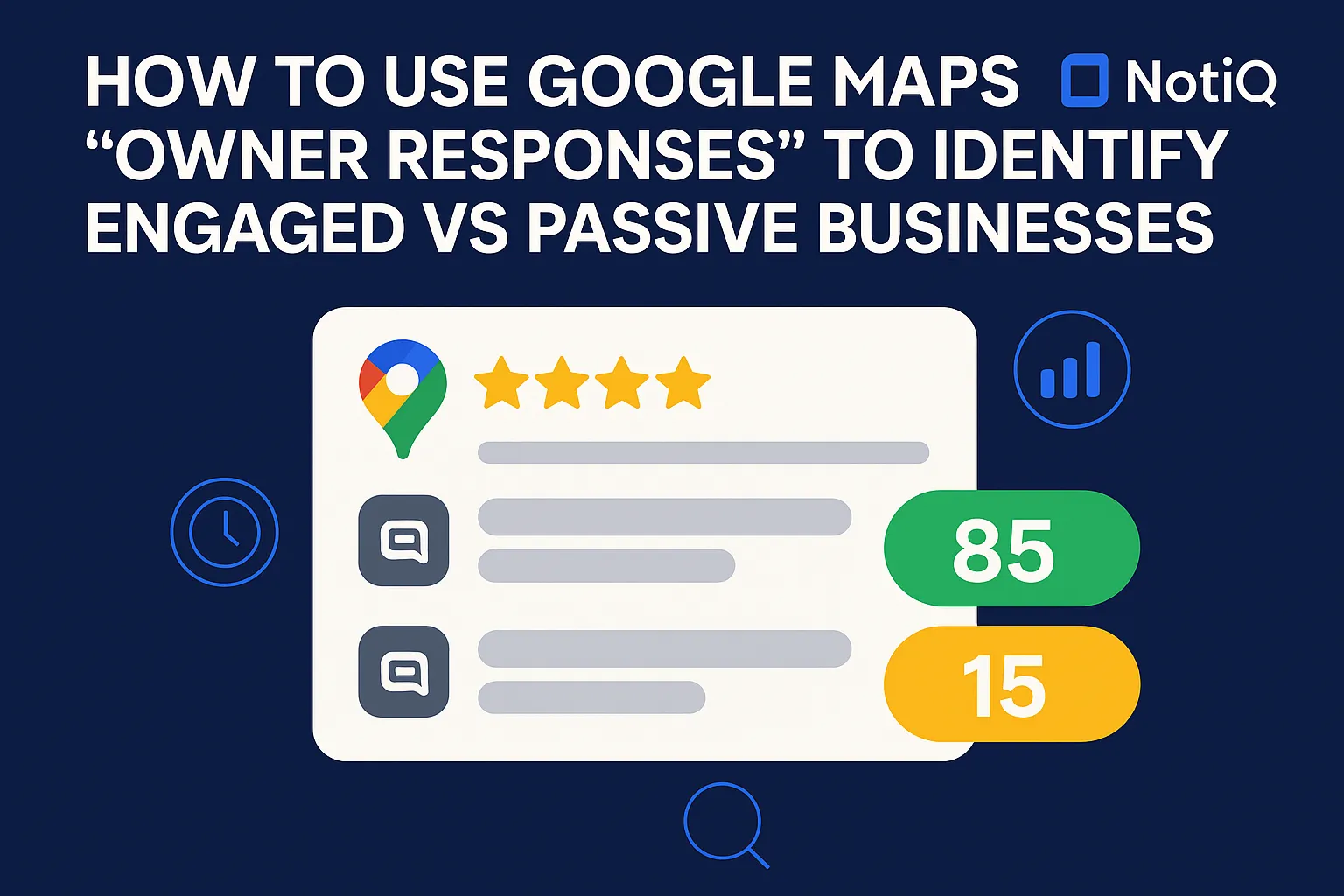
1. Introduction
At first glance, many businesses look virtually identical on Google Maps. They share similar star ratings, operating hours, and service categories. However, looking just below the surface at their owner response behavior reveals drastically different levels of operational engagement.
While star ratings alone are incomplete, public owner replies act as highly visible engagement signals. For intermediate SEO practitioners, sales teams, growth researchers, and market analysts, these responses are a goldmine. They provide a public, observable metric for local SEO potential, prospecting, lead qualification, and competitor research.
This article provides a repeatable scoring framework to classify businesses as engaged,reactive, or passive based on response rate, recency, consistency, and personalization. While owner responses maps activity is a directional signal—not definitive proof of business quality or immediate sales readiness—it offers a critical layer of intelligence.
By utilizing a workflow layer like[NotiQ](/)for turning public review activity into usable business signals, teams can transform unstructured google maps owner responses into structured, actionable intelligence.
2. Why Owner Responses Matter on Google Maps
Standard reputation-management advice dictates that businesses should reply to reviews to "look good." But from an intelligence and analytics perspective, owner responses matter because they are an observable indicator of profile management, operational discipline, and customer attentiveness.
Google explicitly gives businesses the tools to reply publicly to feedback, as outlined in their Google Business Profile review response guidance. Because of this, business owner replies to reviews serve as a proxy for how actively a business is managed. Consistent replies suggest a business that values customer engagement and trust-building behavior. In contrast, passive profiles that collect reviews but show little to no visible owner involvement often indicate a hands-off approach.
Unlike generic guides that simply encourage replying, this framework treats google business profile owner responses as a data point. The value lies in analyzing these google maps engagement signals to infer operational maturity.
What owner replies can reveal that ratings alone cannot
Ratings show customer sentiment; replies show owner behavior. A 4.5-star rating tells you customers generally like the business, but it reveals nothing about the management’s current operational state.
Review reply behavior highlights responsiveness, professionalism, the recency of profile activity, and a willingness to engage in public discourse. Two businesses with identical 4.5-star ratings and similar review counts can have vastly different engagement levels. One might have a high google reviews response rate with thoughtful replies posted within 24 hours, signaling a highly active owner. The other might have zero replies, indicating passive management. These are distinct customer engagement signals that ratings simply cannot capture.
Why this signal matters for SEO, sales, and market research
Analyzing engaged vs passive businesses unlocks practical value across multiple disciplines:
• Local SEO: Active local SEO review management is heavily associated with stronger profile upkeep and consumer trust.
• Sales and Prospecting: Responsive businesses are often better outreach targets. They are actively monitoring their digital presence, making them easier to qualify and more likely to see your communication.
• Market Research: Competitive intelligence relies on benchmarking. Owner replies help analysts compare the operational maturity of competitors within the same geographic area or industry category.
3. A Framework for Scoring Engagement
To effectively utilize google maps owner responses, you need a methodology to score them. This inference framework evaluates public behavior to classify businesses into a three-category model:engaged,reactive, and passive.
Because no single metric tells the whole story, readers must score multiple signals together—specifically response rate, recency, consistency, and personalization.
Methodology Note: This scoring rubric is an inference framework based strictly on legally accessible, public behavior. It is a directional indicator of digital engagement, not a definitive measure of a company's financial health, offline service quality, or business viability. Businesses with very low review volumes should be handled carefully to avoid unfair classification.
Signal 1 — Response rate
The google reviews response rate is your baseline indicator. To calculate this, estimate what share of total (or recent) reviews receive an owner reply.
Generally, higher response rates indicate more active profile management. However, this metric must be read in context. A business that replies to 100% of its reviews with a generic copy-paste message may be less engaged than a business that replies to only 30% of its reviews, but does so with highly detailed, individualized google business profile responses. Look at the response rate as the foundation of owner responses maps behavior, but never the sole determining factor.
Signal 2 — Recency of replies
Timing is critical. Recent responses are significantly stronger google maps engagement signals than historical bursts from years ago.
When evaluating review reply behavior, look for signs of current, ongoing activity. A profile that responded to 50 reviews in 2022 but hasn't replied to a single one in the last 12 months exhibits stale behavior. This often indicates declining attention, a change in management, or an abandoned digital strategy. Current customer engagement signals require recent action.
Signal 3 — Consistency over time
Consistency helps separate sustained engagement from isolated, one-off efforts. Businesses that reply steadily across multiple months or review cycles signal robust operational consistency.
Conversely, a single burst of google business profile owner responses—often triggered by a wave of bad reviews or a temporary marketing push—does not indicate ongoing engagement. To accurately identify engaged vs passive businesses, compare recent review interactions with older ones to establish a true pattern of response consistency.
Signal 4 — Personalization and specificity
This signal separates authentic engagement from superficial activity. Highly personalized replies that reference the specific customer experience indicate genuine attentiveness.
While templated language is not inherently bad—especially for high-volume businesses—excessive repetition weakens the quality of the inference. Tone, specificity, and relevance in business owner replies to reviews are strong customer engagement signals. A thoughtful response to a nuanced complaint carries much more weight than a generic "Thanks for your feedback" pasted onto every review.
How to classify businesses as engaged, reactive, or passive
By synthesizing these four signals, you can confidently classify businesses into one of three categories:
• Engaged: These businesses exhibit consistent, recent, and personalized replies across both positive and negative reviews. They treat google maps owner responses as a core part of their customer experience.
• Reactive: These businesses primarily reply when negative reviews appear, or they only show activity during short, isolated bursts. Their owner responses maps behavior is defensive rather than proactive.
• Passive: These businesses show little to no visible response behavior, despite having a sufficient volume of reviews to assess. They are collecting feedback but not engaging with it.
4. How to Spot False Positives and Weak Signals
While public owner-response behavior is a highly useful metric, it is imperfect. Relying blindly on raw data counts can lead to overinterpreting noisy or misleading signals.
When classifying businesses for outreach or research, cautious interpretation is required. Templated replies, crisis-only responding, outsourced agency management, or manipulated review ecosystems can severely distort google maps engagement signals. To maintain methodological rigor, always align your analysis with compliance standards, such as the Google review policy on deceptive and restricted content and the FTC guidance on reviews and testimonials.
Templated responses that look active but say little
High review reply behavior volume is not enough if the substance is lacking. Repetitive, automated responses like "Thank you for your feedback" can artificially inflate perceived engagement without demonstrating real operational attentiveness.
When evaluating google business profile responses, look for specificity. While some templating is normal for efficiency, overuse drastically reduces the strength of the signal. If every reply on an owner responses maps profile is identical, it is a weak signal.
Negative-only replies and reactive behavior
Some businesses only break their silence when criticism appears. This pattern distinguishes proactive customer engagement from defensive reputation management.
If business owner replies to reviews only exist to argue with 1-star ratings or mitigate public damage, this indicates a defensive habit rather than ongoing engagement. In your scoring framework, weight these negative-only response patterns as reactive, not fully engaged, regardless of the overall google reviews response rate.
Low-review businesses and thin data
Profiles with very few reviews present a challenge for fairness and methodological accuracy. If a business only has three reviews, a single reply skews the data immensely.
When dealing with low review volume, avoid forcing a category. Instead, use a minimum review threshold (e.g., at least 10 reviews in the past year) or apply a “needs more data” label. For these profiles, combine the limited customer engagement signals with other google maps engagement signals—such as the recency of profile updates or photo uploads—to form a complete picture.
Agency-managed profiles, one-time bursts, and suspicious ecosystems
Outsourced reputation management can create highly polished but less revealing response patterns. An agency-managed profile may look perfect on paper but lacks the authentic, operational signals of an owner-operated profile.
Furthermore, a sudden, one-time burst of replies often reflects a cleanup effort rather than normal engagement. Analysts must also be wary of manipulative patterns or fake review ecosystems, keeping in mind the FTC principles for handling online reviews. Suspicious review ecosystems are a primary reason to remain cautious and verify engagement signals against other data points.
5. Using Response Behavior for Prospecting and Benchmarking
The ultimate goal of this framework is to operationalize these insights into real-world workflows. Moving beyond generic SEO advice, owner-response analysis directly improves lead prioritization, segmentation, competitor benchmarking, and outreach messaging.
Unlike manual scraper tools or generic data vendors that simply dump raw review counts, evaluating customer engagement signals provides enriched, verified, and repeatable scoring. This helps you analyze google reviews for lead generation and clearly separate engaged vs passive businesses for commercial advantage.
How engaged businesses can be prioritized for outreach
Businesses demonstrating active owner involvement are inherently more likely to notice, evaluate, and act on B2B outreach. They are already paying attention to their digital channels.
Use engagement categories to segment your lists. Highly engaged businesses should be prioritized as top-tier targets, while passive businesses may require a different, longer-term nurture approach. This engagement scoring should complement, not replace, your existing lead qualification criteria. Tools that provide enriched google maps owner responses and engagement signals, such as NotiQ features, can seamlessly support this list building and prioritization workflow.
How reactive businesses change your messaging strategy
Your outreach strategy should adapt based on whether you are targeting engaged vs passive businesses—or in this case, reactive ones.
Reactive businesses, which typically only respond to negative feedback, often respond best to messaging centered around reputation defense, customer experience recovery, or missed opportunities. Their review reply behavior shows they care about damage control. By using public response behavior to tailor your hypotheses, your sales and growth teams can craft highly relevant, context-driven outreach rather than relying on generic assumptions.
How passive businesses can inform market mapping and competitive research
The value of this framework extends far beyond direct outreach. Passive profiles are incredibly useful for broader market mapping.
A high concentration of passive businesses in a specific area may reveal underserved competitors, operational gaps, or generally weak customer-engagement maturity in a local market. This google maps business engagement data supports deep territory analysis and competitive benchmarking. By comparing competitor google review replies side-by-side across locations and verticals, analysts can identify precisely where market leaders are pulling ahead.
6. How to Analyze Owner Replies at Scale
Translating this framework into a repeatable workflow for larger datasets requires moving from qualitative observation to a structured scoring process.
To analyze google business profile responses effectively, you must capture specific data fields: review count, reply count, reply recency, consistency, tone/personalization, and negative-review handling. Automation is highly useful for extracting this data at scale—provided it strictly adheres to legal, publicly accessible information workflows and API compliance—while human review remains necessary for interpreting edge cases and nuanced review reply behavior.
For teams looking to operationalize this,[NotiQ](/)serves as the practical workflow for extracting, scoring, and acting on these signals at scale. For additional context on adjacent workflow education, the RepliQ blog offers supporting reading.
The minimum data points to collect
To keep the framework simple enough for manual audits, spreadsheet workflows, or compliant data extraction, use a streamlined data schema.
Capture the total review volume, the number of owner replies (google review response rate), the time window of those replies, the date of the most recent activity, and a few examples of reply quality. Always include a notes field to flag edge cases, such as highly templated responses or likely agency management. This ensures your google maps owner responses data remains clean and actionable, providing reliable customer engagement signals.
A simple scoring workflow for teams
To make the method fully operational, assign weighted scores to your core metrics.
For example, you might score response rate (1-5), recency (1-5), consistency (1-5), and personalization (1-5). Based on the total score, classify each business into your categories: engaged, reactive, passive, or insufficient data. Encourage your team to briefly documentwhya score was assigned. This improves consistency across team members and ensures that the engaged vs passive businesses framework and owner responses maps scoring framework remain objective.
When to combine owner responses with other profile signals
To improve accuracy and reduce overreliance on a single metric, owner replies must be paired with other visible profile indicators.
Combine owner response data with overall review volume, the frequency of Google Business Profile updates, and the recency of photo uploads. These combined google maps engagement signals produce much stronger interpretations than owner responses alone. This holistic approach ensures your evaluation of customer engagement signals and google maps business engagement remains directional, practical, and highly accurate.
7. Future Trends in Review-Response Analysis
The landscape of local digital intelligence is shifting. There is a rapidly growing interest in using public review-management behavior as a proxy for overall operational maturity and sales readiness.
As AI-assisted review analysis becomes more sophisticated, it is becoming easier to categorize and enrich owner responses across thousands of businesses simultaneously. The industry is moving away from simply counting replies toward deeply interpreting reply quality, recency, and context. The real opportunity lies not just in tracking SEO visibility, but in converting unstructured, public google maps engagement signals and customer engagement signals into actionable go-to-market insight. This is the core of modern intelligence-oriented workflows.
8. Conclusion
Google Maps owner responses are a highly valuable, publicly accessible signal for identifying whether a business is actively managed. By leveraging this data, you can clearly categorize businesses as engaged, reactive, or passive.
Remember that the framework relies on synergy: response rate, recency, consistency, and personalization are vastly more useful together than they are alone. Always proceed with caution, keeping an eye out for false positives, low-review profiles, and manipulated or templated activity that can weaken the signal.
The most practical next step is to test this rubric on a small set of local businesses in your target market. Once validated, scale the process into your prospecting, competitive benchmarking, or local SEO workflows. To seamlessly turn public owner-response behavior into structured, actionable business intelligence, explore how[NotiQ](/)can power your research and workflows.
(Brand Note: NotiQ approaches review response analysis as a practical B2B research and intelligence workflow problem, ensuring teams have the structured data they need to make informed go-to-market decisions.)
Frequently Asked Questions
- How can you tell if a business is engaged on Google Maps?
- You can tell if a business is engaged by analyzing a combination of their response rate, the recency of their replies, their consistency over time, and the personalization of their messages. True google maps engagement signals rely on this mix of behaviors rather than a single metric.
- Do owner responses on Google reviews indicate better customer service?
- Business owner replies to reviews indicate digital attentiveness and a willingness to communicate publicly, which are strong customer engagement signals. However, they are directional inferences and not definitive proof of offline customer service quality.
- What is a good response rate for Google Business Profile reviews?
- There is no universal benchmark for a "good" google reviews response rate. A strong google business profile responses strategy depends heavily on review volume, the recency of the replies, and operational consistency, rather than just hitting a specific percentage.
- Can review response behavior reveal lead quality or sales readiness?
- Yes. Review reply behavior serves as a highly useful directional signal for lead qualification and prioritization. When combined with other market and engagement signals, responsive businesses often prove to be more digitally mature and ready for outreach.
- How do you analyze owner replies on Google Maps at scale?
- To analyze owner replies on Google Maps at scale, you must establish a compliant workflow to collect reply data, score core signals (rate, recency, consistency, personalization), classify businesses using a scoring framework, and manually review edge cases. This turns raw owner responses maps data into actionable intelligence.
Continue Reading
More articles you might find useful
Google Maps Lead Generation for Window and Door Installers
Learn how window and door installers can use Google Maps to find, qualify, and prioritize better local prospects. This beginner-friendly guide shows a repeatable workflow for smarter local outreach.
Read the article →
How to Prioritize Businesses With Verified Google Profiles
A practical framework for ranking local leads beyond the verified badge. Learn how to prioritize Google Business Profiles using fit, freshness, completeness, and activity signals.
Read the article →
Google Maps Prospecting for Commercial Waste Management Companies
Learn how commercial waste haulers can use Google Maps to find, qualify, and prioritize better local accounts. This guide shows how to build denser routes and improve outreach with waste-stream and service-area insights.
Read the article →Popular industry lead playbooks
Maps search examples and niche outreach for the verticals teams prospect most.