Technology
The “Review Sentiment Imbalance” Strategy for Outreach Opportunities
Learn how to turn competitor review themes into ethical outreach opportunities. This guide shows how to validate pain signals and build sharper, problem-aware sales messaging.
1. Introduction
Most outbound outreach fails because it is generic. Go-to-market (GTM) teams routinely rely on weak firmographic signals—company size, funding rounds, or industry tags—instead of tapping into real customer frustration patterns. When you reach out to a prospect based purely on their tech stack without understandinghowthat tech stack is failing them, your message blends into the noise.
Public review data is more abundant than ever, offering a direct window into what users love and hate about their current solutions. Yet, most teams still lack a repeatable way to convert this qualitative data into trustworthy, actionable outreach opportunities. Reading reviews manually is not scalable, and building campaigns around one-off complaints is a recipe for tone-deaf messaging.
This guide details a better approach: the review sentiment imbalance strategy. We will explore how to identify recurring negative signals in competitor reviews, map them by theme, validate their authenticity, and use them ethically in personalization. This is not a basic explainer on sentiment analysis; it is a practical, advanced GTM workflow designed to help teams operationalize public review intelligence. By focusing on rigorous methodology, data validation, and messaging guardrails, you can build campaigns rooted in genuine market reality.
As a platform dedicated to turning public review signals into usable GTM research,[NotiQ](/)provides the workflow layer necessary to execute this strategy at scale. By leveraging sentiment imbalance maps, you can stop guessing at your prospect’s pain points and start engaging them with problem-aware precision.
2. What Review Sentiment Imbalance Means
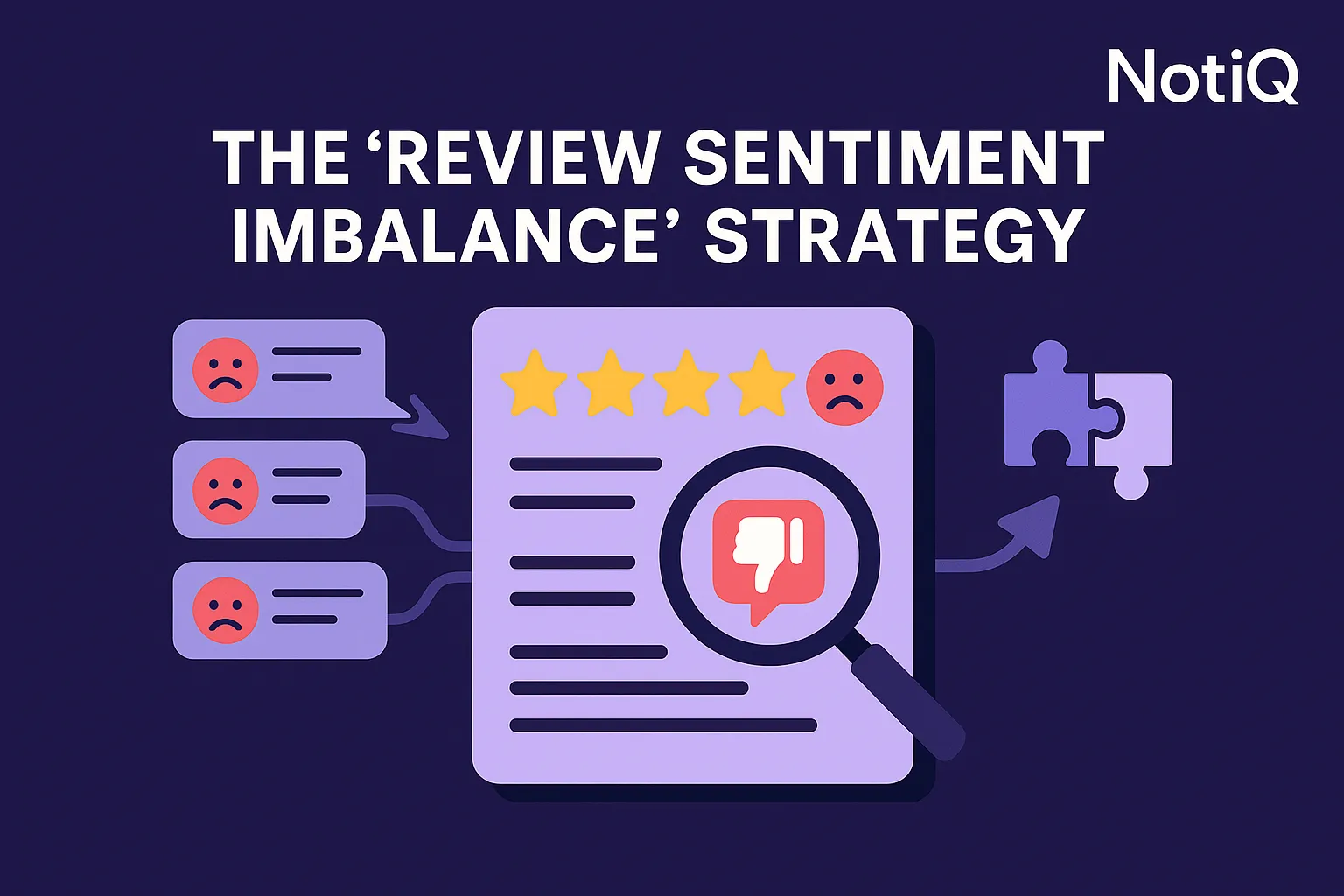
Review sentiment imbalance refers to the measurable gap between positive and negative sentiment across specific themes, features, process stages, or business outcomes. It moves beyond the simplistic metric of overall star ratings.
The most useful signal for a sales or marketing team is rarely, "This competitor has bad reviews." Instead, a powerful review sentiment imbalance strategy reveals that "this competitor shows repeated negative concentration in specific categories like onboarding, support responsiveness, pricing transparency, or system reliability." By analyzing ratio-based theme data rather than relying on anecdotal review reading, GTM teams can build a highly targeted outreach strategy. Recurring imbalances reveal precise pain clusters, genuine switching triggers, and immediate problem-aware messaging opportunities.
Sentiment Imbalance vs Standard Sentiment Analysis
According to baseline definitions from leaders in experience management like Qualtrics or MonkeyLearn, standard sentiment analysis categorizes text into broad positive, neutral, or negative classifications. It tells you if a user is generally happy or unhappy.
Sentiment imbalance mapping goes significantly deeper. It compares how to compare positive vs negative review ratios by theme to pinpoint exactly where the customer experience breaks down. Advanced GTM professionals understand that overall sentiment can easily hide serious dissatisfaction in one critical workflow area. For example, a competitor might boast high overall satisfaction and a 4.5-star rating, but possess consistently negative sentiment specifically regarding their onboarding process. Uncovering that specific imbalance is the key to unlocking a competitive advantage.
Why Negative Theme Clusters Matter More Than Isolated Complaints
One-off complaints are weak signals. A single frustrated user might be an outlier. However, repeated negative themes across dozens or hundreds of reviewers indicate structural weaknesses within a competitor's product or service.
High-signal categories derived from customer pain point mining typically include onboarding friction, support responsiveness, product reliability, hidden costs, and ease of use. These recurring complaints become exponentially more valuable when they align with your target persona, market segment, or specific use case. Targeting competitor review gaps allows teams to transition from pitching generic value propositions to delivering pain-aware relevance that resonates with the prospect's daily reality.
Where This Strategy Fits in a Modern GTM Stack
Review sentiment imbalance is a highly complementary signal that sits alongside intent data, competitor analysis, and account-level research. While intent data shows that an account is researching a topic, it lacks the qualitative context ofwhy. Review-based signals provide that missing "why."
Unlike broad competitor dashboards or generic data extraction tools that simply dump unstructured text, a proper software review intelligence strategy relies on AI enrichment, strict verification, theme clustering, and ethical messaging guidance. It bridges the gap between raw data and actionable outreach opportunities, ensuring that your personalization is grounded in verified market intelligence rather than superficial assumptions.
3. How to Build Sentiment Imbalance Maps
Building sentiment imbalance maps requires a structured, repeatable workflow: collect reviews, sample intelligently, code themes, compare positive versus negative ratios, and visualize where dissatisfaction concentrates. This must be treated as a rigorous operating procedure to ensure transparency in how reviews are selected, coded, and interpreted.
Step 1 — Collect Reviews From Relevant Competitors and Categories
Start by selecting the competitors, products, or software categories most relevant to your target outreach motion. Focus on reputable, publicly accessible review platforms such as G2 reviews, Capterra reviews, and TrustRadius reviews.
Sample across a large enough volume of reviews to detect recurring patterns; relying on a handful of extreme opinions will skew your data. Recency is also a critical factor, as newer reviews more accurately reflect the current reality of the product.Methodology Note: Public reviews should be treated as directional inputs for your review mining for lead generation, not as perfect, infallible ground truth.
Step 2 — Create a Review Taxonomy by Theme
Before diving into the analysis, define your coding buckets. A consistent review taxonomy reduces subjectivity and makes cross-competitor comparisons possible. Common themes include onboarding, support, pricing, reliability, ease of use, and feature expectations.
Your taxonomy should include both product-level themes (e.g., "reporting features") and process-stage themes (e.g., "implementation"). Whenever available, tag the reviewer's context, including their job role, company size, or stage of product adoption. This granular feature-level sentiment analysis is what enables precise customer pain point mining.
Step 3 — Compare Positive vs Negative Ratios by Theme
Once your reviews are categorized, calculate the theme-level imbalance. You need to know how to compare positive vs negative review ratios by theme to see how often each topic appears in a positive light versus a negative one.
The strongest insights emerge from themes with a high frequency of negative mentions and a weak positive offset. Visualize these findings using a sentiment imbalance map—this could be a data table, a heatmap, or a custom scoring model. The goal is not mathematical complexity, but decision-useful pattern recognition that highlights actionable negative signals.
Step 4 — Add Context With Segment, Role, and Use Case Filters
Not all complaints carry the same weight. To make your data actionable, filter your sentiment imbalance maps by ICP (Ideal Customer Profile) relevance, specific use cases, and buyer roles.
A severe support complaint from an enterprise administrator may be a highly lucrative signal for an upmarket campaign, whereas a pricing complaint from a small business might be irrelevant to your enterprise sales team. Applying these filters sharpens your prospect personalization and transforms raw review sentiment analysis for sales into highly targeted outreach opportunities.
Step 5 — Turn the Map Into a Prioritization Asset
Finally, rank your identified pain clusters by frequency, recency, business relevance, and the likelihood of triggering switching intent. Create a simple prioritization framework that your team can apply systematically across different categories and target accounts.
Connect this map directly to GTM execution. Use it to generate problem-aware content ideas, build targeted account lists, formulate messaging hypotheses, and design campaign themes. Because manual prospect research does not scale, operationalizing this workflow through a dedicated platform like[NotiQ](/)allows teams to automate clustering, enrichment, and prioritization efficiently.
4. How to Separate Noise From Real Switching Signals
Because public review data is inherently noisy, biased, and occasionally manipulated, validation is essential. Advanced GTM teams must apply rigorous standards to separate one-off complaints from structural weaknesses before launching campaigns.
Review Volume, Recency, and Repetition Thresholds
Recurring complaints across a large dataset are far more meaningful than isolated grievances. Establish conceptual thresholds for your review sentiment imbalance strategy: you need sufficient review volume, recent data, and repeated mentions of the issue over time.
A complaint about software crashing that appears repeatedly across multiple quarters is a much stronger negative signal than a short-lived grievance about a temporary server outage. Use practical decision rules to gauge the persistence of a problem rather than pretending absolute precision exists in qualitative data.
Cross-Source Confirmation
A pain point gains significant credibility when it appears consistently across multiple platforms. If users are complaining about a competitor's customer service on G2, Capterra, and TrustRadius, the signal is strong.
Validate these competitor review gaps against adjacent public signals, such as support forums, changelog histories, community threads, or public documentation. Cross-source confirmation reduces the risk of overgeneralizing a competitor's sentiment based on a single platform's algorithm. For deeper context on why this is necessary, consider the academic research on online review manipulation, which highlights the importance of multi-channel verification.
Bias, Extremes, and the Problem of Voluntary Reviews
Public review data is noisy and difficult to operationalize because voluntary reviews often overrepresent the extremes—very positive or very negative experiences.
If teams do not normalize for this context, selection bias can distort apparent pain clusters. Do not assume every negative cluster indicates broad, market-wide dissatisfaction. Instead, use these brand reputation signals as a hypothesis generator first, rather than an unquestioned source of truth. Understanding the research on bias in online reviews will help your team interpret review-based signals with the necessary skepticism.
AI-Assisted Clustering With Human Review
AI-assisted review clustering can drastically accelerate theme extraction and the categorization of negative review clustering, but it should never be trusted blindly.
Human review remains critical for edge cases, interpreting sarcasm, decoding mixed sentiment, and clarifying ambiguous complaints. Maintain explainability in your workflow: your team should always be able to demonstrate exactly why a specific theme was labeled as a meaningful signal. Differentiate your review sentiment analysis by stressing verification, confidence scoring, and adherence to guidelines like the NIST AI risk management framework to ensure trustworthy, bias-aware workflows.
5. How to Turn Pain Clusters Into Ethical Outreach
The bridge from analysis to action must be built on trust and compliance. Outreach should reference category-level pain awareness, not weaponize an individual company’s negative reviews against them. Emphasize problem-aware positioning, educational value, and solution fit over exploitative prospect personalization.
Translate Pain Clusters Into Messaging Angles
Each recurring complaint cluster can be translated into a specific messaging theme, content angle, or discovery question.
• Support Delays: Translate into a responsiveness and partnership angle.
• Onboarding Friction: Translate into a seamless implementation and time-to-value angle.
• Hidden Pricing: Translate into a transparency and predictable ROI angle.
Speak to common market frustrations rather than claiming insider knowledge about a prospect's exact situation. Use direct customer language patterns mined from negative review signals prospecting, but never quote sensitive, identifiable, or overly specific snippets.
What Ethical Personalization Sounds Like
Ethical personalization references known category problems and likely priorities.
• Avoid this: "We saw you left a bad review about Vendor X's terrible onboarding."
• Say this: "Many RevOps leaders we speak with mention that standardizing data during implementation is a major bottleneck with legacy platforms. How is your team handling..."
This approach to personalized outreach lines is helpful, problem-aware, respectful, and non-invasive. When teams struggle to personalize outreach without invasive signals, this method builds instant credibility instead of triggering defensiveness.
Build a Simple Outreach Framework From Verified Signals
Structure your outreach around verified review mining for lead generation. A highly effective framework includes:
1. Pain Hypothesis: State the validated category frustration.
2. Role Relevance: Connect the pain to their specific daily workflow.
3. Proof Point: Briefly mention how your solution structurally solves this exact issue.
4. Low-Pressure CTA: Ask a soft discovery question to gauge resonance.
These verified signals should also inform broader GTM use cases beyond cold outbound, including problem-aware content for nurture campaigns, highly targeted landing pages, sales enablement battlecards, and competitor comparison pages.
Guardrails, Compliance, and Trust
When utilizing brand reputation signals, strict guardrails are non-negotiable. Do not misrepresent review evidence, do not target individuals with creepy specificity, and do not overstate a competitor's weakness.
Review mining is only an ethical outreach tactic when teams use publicly accessible data responsibly and transparently. Always practice fair interpretation, balanced sampling, and non-deceptive messaging. To ensure your workflows maintain brand trustworthiness and legal compliance, align your strategy with FTC guidance on honest consumer reviews and FTC review collection and moderation guidance.
6. Which Review Sources and Validation Steps to Use
Different review platforms provide different kinds of signal depth and structure. Source selection should match your specific use case, whether that is broad trend detection, structured pros and cons analysis, or implementation-detail mining.
G2 for Category-Level Comparison and Theme Frequency
G2 reviews are highly useful for category-level comparisons and spotting recurring customer pain points at scale. Because of its high volume, G2 is excellent for mining consistent complaints and identifying broad market language. However, advanced teams must still validate these findings rather than treating platform-generated summaries as final truth before utilizing them in competitor review analysis outreach.
Capterra for Structured Pros and Cons
Capterra reviews often feature explicit, structured pros and cons, making it easier to compare patterns across vendors. Focus on recurring "cons" that map directly to implementation friction, pricing perception, or usability concerns. Because complaints on this platform are usually distinctly separated from praise, it is an excellent source for refining your review taxonomy and isolating negative signals.
TrustRadius for Long-Form Friction Signals
TrustRadius reviews generally skew toward longer-form, highly detailed feedback. This makes it the premier source for extracting nuance around implementation hurdles, ongoing support quality, and expectation gaps. These deeper, narrative-driven complaints are invaluable for customer pain point mining and dramatically improve the quality and empathy of your final messaging.
A Validation Checklist Before Any Outreach or Content Use
Before integrating any review sentiment imbalance strategy into your software review intelligence strategy, run the insights through this compact validation checklist:
• Is the complaint recurring? (Does it appear across multiple accounts?)
• Is it recent? (Does it reflect the competitor's current product version?)
• Does it appear across multiple sources? (Is it on G2, Capterra, and TrustRadius?)
• Is it relevant to your ICP or target role? (Does the person complaining match your buyer?)
• Can it be supported without overclaiming? (Can you speak to the pain ethically?)
This rigorous checklist is what separates a world-class GTM workflow from generic sentiment content.
7. Future Trends in Review Intelligence for GTM Teams
Review intelligence is rapidly evolving from a one-off tactic into a foundational GTM operating model. The convergence of AI-assisted review clustering, external intent signals, and competitive intelligence workflows is changing how teams go to market. The future is not about hoarding more data; it is about achieving better interpretation and delivering trustworthy personalization.
From Review Monitoring to Signal-Based Personalization
The industry is shifting from passive reputation dashboards to active GTM workflows driven by the external customer voice. Signal-based personalization allows review intelligence to simultaneously support SEO, outbound sales, product marketing, and sales research. By identifying niche pain clusters, marketing teams can capture long-tail search traffic, while sales teams can leverage the exact same data to generate highly relevant outreach opportunities.
Why Workflow Design Will Matter More Than Raw Data Access
As data becomes commoditized, competitive advantage will stem from taxonomy design, validation rules, and disciplined execution—not just the ability to collect reviews. A structured software review intelligence strategy far outperforms manual prospect research that does not scale or generic monitoring tools that lack context. The winners in this space will differentiate themselves through strict verification, compliance, and the practical actionability of their sentiment imbalance maps.
8. Conclusion
A review sentiment imbalance strategy is highly valuable because it transforms scattered, noisy public feedback into structured, validated pain signals that GTM teams can use responsibly. By executing a rigorous workflow—collecting reviews, coding themes, comparing positive versus negative ratios, confirming cross-source patterns, and translating only verified clusters into problem-aware messaging—you can dramatically improve your outbound relevance.
The most successful GTM teams do not exploit negative reviews. Instead, they use public customer language to deeply understand market dissatisfaction, allowing them to speak more helpfully and credibly to their prospects. Competitor review analysis outreach should always prioritize empathy, education, and solution alignment.
To stop guessing at your prospect's pain points and start operationalizing review intelligence through a systematic, compliant workflow, explore how[NotiQ](/)can serve as your operational layer for signal-based research and targeted GTM execution.
Frequently Asked Questions
- What is a review sentiment imbalance strategy?
- A review sentiment imbalance strategy is a methodical approach for comparing positive versus negative sentiment across specific review themes. It is used to find recurring dissatisfaction patterns—or sentiment imbalance maps—that reveal highly targeted outreach or content opportunities.
- How can negative review signals uncover outreach opportunities?
- When validated properly, negative review signals prospecting reveals repeated complaints that point to unmet market needs and strong switching triggers. This allows sales and marketing teams to craft outreach opportunities based on highly relevant, problem-aware personalization angles rather than generic firmographics.
- How do you build sentiment imbalance maps from public reviews?
- To build sentiment imbalance maps, you must collect public reviews, code them into a structured taxonomy of themes, compare the positive and negative ratios for each theme, segment the data by ICP relevance, and prioritize the high-confidence pain clusters for your review mining for lead generation.
- Which review sources are best for identifying competitor pain points?
- The best sources depend on the use case, but generally, G2 reviews are excellent for category-level trends, Capterra is ideal for structured pros and cons, and TrustRadius reviews provide deep, long-form friction signals. Strong, valid signals usually appear consistently across multiple sources.
- How do you avoid sounding exploitative when using review-derived insights in outreach?
- Ethical outreach focuses on category-level pain awareness and respectful language. Teams struggle to personalize outreach without invasive signals, but you can avoid sounding exploitative by discussing common industry frustrations rather than making direct, invasive references to a prospect’s current vendor problems. Utilize prospect personalization to position yourself as a helpful consultant solving a known market issue.
Continue Reading
More articles you might find useful
Google Maps Prospecting for Commercial Waste Management Companies
Learn how commercial waste haulers can use Google Maps to find, qualify, and prioritize better local accounts. This guide shows how to build denser routes and improve outreach with waste-stream and service-area insights.
Read the article →
How to Find Local Businesses With Broken Website Links
Learn how to find local businesses with broken website links using Google Maps, quick validation checks, and proof-based outreach. This guide shows agencies how to turn visible site issues into qualified leads.
Read the article →
Google Maps Lead Generation for Signage Companies
Learn how sign companies can use Google Maps to find local prospects, identify visible signage gaps, and build a repeatable outreach system. This guide shows how to turn visual research into qualified leads without relying on paid ads or generic lists.
Read the article →Popular industry lead playbooks
Maps search examples and niche outreach for the verticals teams prospect most.