Technology
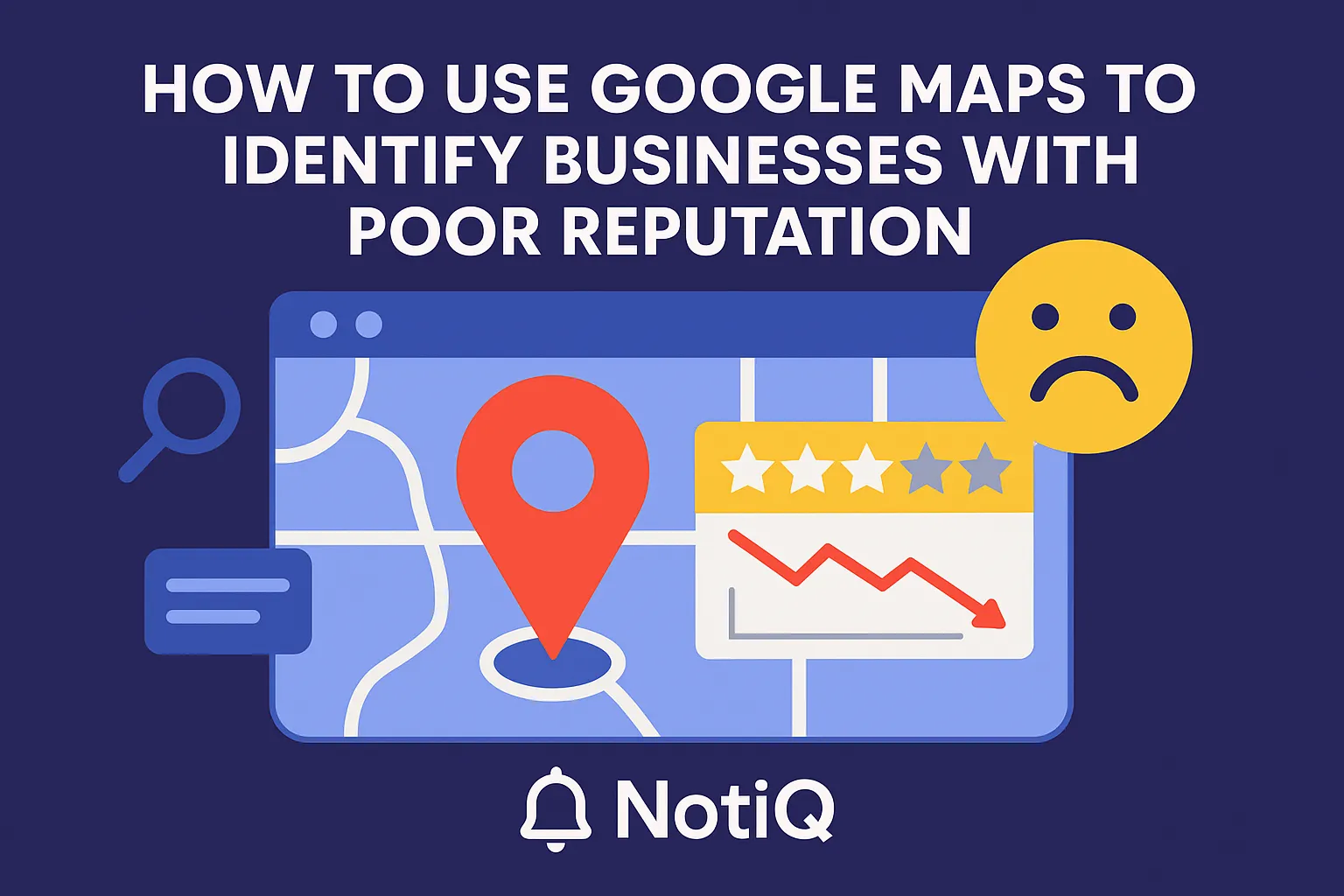
How to Use Google Maps to Identify Businesses With Poor Reputation Trends
Learn how to use Google Maps review trends to spot businesses with declining reputations before static ratings reveal the problem. This framework helps agencies find higher-value outreach opportunities using rating drops, complaint patterns, and visibility signals.
1. Introduction
For advanced marketers and agencies, the traditional approach to reputation-based prospecting is fundamentally flawed. The core problem is simple: a business with a static 3.9-star rating is not always a better prospect than a 4.4-star business, especially if that 4.4-star profile is actively declining.
Static ratings hide momentum. When you rely solely on average star scores, you miss the negative growth signals—falling review scores, worsening sentiment, and complaint clustering—that reveal much stronger audit and outreach opportunities. Learning how to use Google Maps to identify businesses with poor reputation trends allows you to pinpoint companies experiencing active operational or public relations friction.
This article provides a practical, repeatable framework for using Google Maps business reputation analysis and Google Business Profile (GBP) signals to detect sustained reputation decline. Built for professionals familiar with local SEO, this methodology focuses on analysis, qualification, and operationalization. By leveraging platforms like[Home](/), which specializes in tracking business reputation changes over time and monitoring negative momentum, you can transform raw reputation trends maps into a highly qualified pipeline.
2. Why Reputation Trend Matters More Than Static Ratings
To find high-value outreach targets, you must reframe your mental model from "bad rating equals opportunity" to "negative trajectory equals a higher-value signal." Snapshot ratings fail to capture directionality. A business with historically strong reviews can rapidly become an ideal lead if its recent trust signals are actively deteriorating.
Recent review behavior alters user perception much faster than aggregate averages. A company boasting a 4.5-star all-time average might look healthy, but if its last 20 reviews are predominantly 1-star complaints, consumer trust is already eroding. Academic research on how consumers learn from review trends demonstrates that the trajectory and recent momentum of reviews heavily influence buyer decisions, often outweighing the lifetime summary score.
Furthermore, reputation decline directly impacts commercial relevance.Google’s local ranking factors explicitly state that review count and review score factor into local search ranking. Visible businesses experiencing worsening trust indicators face immediate conversion risks, creating a time-sensitive intervention opportunity that long-term, low-rated businesses simply do not offer. Unlike generic reputation management content focused on basic remediation, this framework teaches you how to identify these negative growth signals before the business loses its map pack visibility entirely.
Static Ratings vs. Reputation Momentum
A low static rating simply indicates historical underperformance, whereas an actively worsening profile signals a current, unresolved crisis. When evaluating Google Business Profile review trends, momentum metrics—such as falling review scores, rising complaint frequency, and negative recency-weighted sentiment—matter significantly more than all-time average stars.
Consider a simple scenario comparing two businesses. Business A has a 3.8-star average that has remained flat for three years. Business B has a 4.6-star average, but over the last 60 days, it has received fifteen 1-star reviews citing poor customer service. While Business A has the lower score, Business B is experiencing acute negative review patterns. Business B is the superior prospect because the pain is recent, urgent, and actively damaging a previously strong reputation trends map.
Why Declining Reputation Is a High-Intent Prospecting Signal
Businesses holding visible map positions but exhibiting worsening trust signals are highly commercially relevant. They are currently winning traffic but failing to convert it due to recent reputation damage. This dynamic creates high-intent opportunities for agencies, consultants, and SaaS teams offering local SEO reputation monitoring, audits, or recovery workflows.
The trigger for your outreach should be "negative momentum," not just "bad reviews." When you identify declining business ratings Google users are actively reading, you are finding businesses that have something to lose. They have achieved local visibility but are struggling to maintain the operational standards required to keep it, making them prime candidates for professional intervention.
3. How to Analyze Google Maps and GBP Decline Signals
To execute this strategy, you need a step-by-step signal set to inspect inside Google Maps and adjacent GBP data. This requires moving beyond casual observation into a concrete, systematic methodology. By tracking Google Business Profile performance metrics, you can evaluate time-based signals that indicate true deterioration.
However, it is important to note that Google Maps alone cannot prove a business is failing; these metrics serve as strong indicators requiring validation. Here is how to conduct a thorough Google Maps business reputation analysis.
Start With Category, Geography, and Visibility
Begin your Google Maps review trend analysis by searching for specific service categories within a defined local area (e.g., "HVAC contractors in Austin, TX"). To make your intervention commercially meaningful, prioritize businesses that still appear visible enough in local search to generate leads.
Compare businesses with strong review volume or high map prominence against their recent trend direction. A highly visible business in the top three map pack positions experiencing a sudden local SEO reputation monitoring alert is a far better target than a declining business buried on page four of the results.
Track Rating Trajectory, Not Just Current Stars
To accurately assess declining Google ratings, compare recent reviews against the business's historical averages. Look at the data through specific time windows—such as the last 30, 60, or 90 days—versus the prior year.
You are looking for meaningful drops in falling review scores rather than one-off fluctuations. If a business historically averaged 4.5 stars but has averaged 3.2 stars over the last quarter, that downward trajectory is a clear review trend analysis signal indicating structural issues.
Use Review Recency and Velocity as Leading Indicators
Review recency and business review velocity act as critical leading indicators. Increasing negative review velocity can signal severe operational deterioration long before the all-time average rating falls sharply.
A sudden cluster of negative reviews within a two-week period deserves intense scrutiny. Because recent reviews are weighted heavily by consumers, a spike in negative growth signals creates immediate conversion friction. Understanding recency weighting allows you to spot businesses that are bleeding trust in real-time.
Analyze Complaint Clustering and Negative Review Patterns
Raw negativity is less actionable than specific, repeated complaint themes. Analyze the text of the reviews to identify negative review patterns such as service delays, pricing disputes, rude staff behavior, or inconsistent product quality.
Repeated complaint categories signify operational breakdowns rather than random customer dissatisfaction. When conducting review sentiment analysis for local SEO, highlighting these specific Google review patterns provides you with the exact pain points needed to craft highly relevant, evidence-based outreach.
Check Owner Response Behavior for Added Context
Owner response behavior provides crucial context, helping you distinguish recoverable issues from unmanaged decline. Evaluate response quality, speed, and consistency. According to Google review management guidance, engaging with reviews builds trust, and negative reviews alone do not automatically indicate poor business practices.
However, if you notice a complete lack of responses, highly defensive replies, or an abrupt cessation of previously consistent responses, the decline hypothesis strengthens. Poor reputation management combined with negative Google Business Profile review trends usually indicates a business lacking operational maturity or current bandwidth.
4. How to Separate Temporary Dips From Sustained Decline
One of the biggest challenges in analyzing Google Maps data is avoiding false positives. Advanced analysis must distinguish a short-lived incident—like a single bad weekend or a temporary staffing shortage—from structural reputation deterioration.
Not every negative spike is an outreach-worthy signal. By applying a validation mindset based on time windows, complaint consistency, and market context, you can ensure your targets are experiencing true decline. Always keep Google review management guidance in mind: negative reviews require nuanced interpretation. This section moves past basic review management to teach you how to separate mere volatility from sustained trend decline.
Compare Multiple Time Windows
To confirm a trend, compare short-term, medium-term, and longer-term review behavior. A one-month dip in falling review scores might just be noise. However, repeated deterioration across several periods provides strong evidence of a systemic problem.
Frame your analysis as "recent versus historical baseline." If the business review velocity shows increased negativity over a 90-day period compared to the previous 12 months, the recency data is revealing a sustained downward shift.
Look for Consistent Complaint Themes
Sustained decline rarely consists of random negative sentiment; it is almost always anchored by consistent complaint themes. Complaint clustering supports your confidence in the trend.
If you are conducting review sentiment analysis for local SEO and notice three separate reviews mentioning "unresponsive customer service" in the last month, you have found a negative review pattern. Repeated complaints tied directly to service quality or fulfillment signal a much higher urgency for the business owner.
Validate Against Visibility and Market Context
A decline matters exponentially more when the business maintains enough search visibility and review volume to actively affect buyer behavior. Validate your findings against category-level expectations within the same local market.
Avoid relying on hard universal thresholds. Instead, use directional analysis. If a local plumber has 500 reviews but is suddenly experiencing negative Google Business Profile review trends, that carries more commercial weight than a competitor with 10 reviews experiencing the same local SEO reputation monitoring signals.
Watch for Manipulated or Misleading Review Patterns
Always watch for anomalies that may not reflect genuine customer experiences. Abrupt review bursts, suspicious polarity shifts (e.g., twenty 1-star reviews in a single day followed by twenty 5-star reviews), or obvious spam require extreme caution.
These manipulated online customer reviews can generate false negative growth signals. Refer to FTC guidance on online customer reviews to maintain review integrity and ensure compliance before scoring a business or initiating outreach based on questionable data.
5. How to Score and Prioritize Businesses for Outreach
Once you have analyzed the data, you must turn those findings into a practical qualification framework. A decline-severity scorecard allows agencies and operators to prioritize their efforts effectively, focusing on opportunities rather than false precision.
By building a scoring model around rating trajectory, recency, complaints, and visibility, you can pinpoint exactly how do you use Google Business Profile data to find reputation opportunities. Integrating this data into your CRM, as detailed on the Blog, supports vastly superior outbound and audit workflows.
The 5-Part Decline Severity Scorecard
To standardize your Google Maps business reputation analysis, break your model into five clear components:
1. Rating Decline: Measures the drop in average stars over a specific recent period compared to the historical baseline.
2. Review Velocity Shift: Tracks the acceleration of negative growth signals and recent 1-star or 2-star reviews.
3. Complaint Repetition: Identifies whether the negative feedback clusters around specific, repeated operational themes.
4. Response Behavior: Evaluates whether the owner is ignoring, fighting, or professionally handling the feedback.
5. Visibility / Commercial Value: Assesses the business's current map pack ranking and overall review volume.
This framework should be utilized directionally and adjusted based on your specific target niche or vertical.
Suggested Qualification Thresholds
Define internal working rules for your scoring to categorize prospects into "monitor," "audit," and "outreach-ready" buckets. Do not invent universal benchmarks; instead, set practical thresholds.
For example, an "outreach-ready" prospect might require a recent rating drop of at least 0.4 stars over 90 days, plus a repeated complaint theme, plus strong map visibility. Businesses showing falling review scores without a clear review trend analysis pattern might simply fall into the "monitor" bucket for future observation of declining Google ratings.
Prioritize by Visibility, Not Just Severity
The most lucrative targets for Google Maps lead generation are businesses combining reputation decline with high local search visibility. Visibility raises the opportunity value significantly, even if the decline is only moderate.
A business ranking #2 in the local map pack that is starting to bleed reviews is a high-ROI prospect for an agency because the business owner knows they are losing active leads. Prioritizing by visibility ensures your local SEO reputation monitoring translates directly into commercial value.
Build Outreach Angles From Review Evidence
Use the identified decline signals to craft compelling audits, monitoring offers, or reputation recovery proposals. Recurring complaint themes serve as the perfect foundation for personalized outreach.
Evidence-based messaging—such as referencing a specific negative review pattern regarding appointment delays—is infinitely stronger than a generic "we can help your reviews" pitch. For examples on how to craft these messages, explore how to use Personalized Lines based on specific complaint themes, turning lead qualification into high-converting conversations about reputation management.
6. How to Operationalize Findings With Monitoring and Prospecting
Moving from one-off, manual profile checks to a repeatable workflow is the hallmark of an advanced agency. By monitoring categories, geographies, and target lists systematically, you can automate the detection of automated local lead scoring opportunities.
This operational efficiency ensures analytical consistency. Leveraging platforms like[Home](/)provides the necessary monitoring and workflow orchestration, allowing you to track reputation changes over time and identify what tools help identify businesses with worsening online reputation.
Create a Repeatable Monitoring Workflow
Define your target markets, business categories, and review checkpoints to establish a recurring cadence for your local business negative review monitoring. Instead of relying on ad hoc audits, set up longitudinal tracking.
Review trajectory monitoring over continuous 30, 60, and 90-day cycles drastically reduces false positives and ensures you catch Google Business Profile review trends exactly as they begin to inflect downward.
Add AI-Assisted Sentiment and Complaint Tagging
To scale your analysis across hundreds of profiles, utilize AI-assisted sentiment analysis and complaint categorization. Automation excels at pattern detection, quickly flagging negative review patterns across large datasets.
However, maintain a balanced, data-driven approach: while AI handles the heavy lifting of review sentiment analysis for local SEO, human review remains essential for understanding nuance, context, and final qualification.
Turn Signals Into Audits, Alerts, and Prospect Lists
Decline indicators should seamlessly feed your broader business workflows. Route these reputation opportunities into agency lead lists, internal competitive watchlists, or automated lead scoring triggers.
For instance, a SaaS team might use a sudden drop in review velocity to trigger an automated email alert offering a reputation audit. Always ensure that these Google Maps lead generation signals are paired with commercial relevance before initiating contact.
Compliance, Accuracy, and Trust Considerations
Responsible interpretation of public reputation signals is non-negotiable. Ensure accuracy, fair characterization, and avoid overclaiming based on limited data. Review data should support your outreach hypotheses; it should not be weaponized as definitive judgments about a business's character.
Ethical automation requires strict adherence to trustworthiness standards. Always align your practices with FTC guidance on online customer reviews and Google review management guidance to ensure your prospecting remains compliant and professional.
7. Future Trends in Maps-Based Reputation Analysis
The landscape of local search analysis is rapidly evolving. Trend detection is moving away from manual review reading toward structured, monitorable signals. The integration of AI-assisted sentiment analysis for Google reviews, recency-weighted scoring algorithms, and automated local lead scoring is shaping highly advanced agency workflows.
Rather than guessing at review trajectory monitoring, future-focused teams are relying on data-driven tracking layers. Systems designed to monitor these exact reputation changes over time ensure that agencies can spot negative momentum the moment it registers on the map.
8. Conclusion
The best Google Maps reputation opportunities are rarely the businesses with the lowest all-time star ratings; they are the commercially visible businesses showing clear, actionable negative momentum.
By applying this framework, you can systematically evaluate rating trajectory, recency-weighted negatives, complaint clustering, response behavior, and local visibility before prioritizing your outreach. The ultimate goal is not merely to spot weak profiles, but to identify commercially relevant businesses experiencing sustained decline signals.
Stop relying on one-off manual checks. Build a repeatable monitoring workflow to track these reputation trends maps and negative growth signals at scale. With the analytical rigor provided by dedicated tracking solutions, your Google Maps review trend analysis will become one of your most predictable and high-converting acquisition channels.
Frequently Asked Questions
- How can you spot businesses with declining ratings on Google Maps?
- To spot businesses with declining Google ratings, compare their recent review scores against their historical performance. Look for a recency-weighted rating decline and check whether the negative review velocity is actively increasing over recent 30 to 90-day windows.
- What review patterns signal a poor reputation trend?
- Key negative review patterns include repeated complaint themes (like poor service or pricing issues), an increasing share of negative reviews relative to positive ones, deteriorating owner response behavior, and sustained rating drops across multiple time windows.
- How far back should you analyze reviews to confirm a negative trend?
- When evaluating review recency, compare multiple time periods—such as the last 30, 60, and 90 days against the previous year. You should look for consistent deterioration across these windows rather than relying on a single recent spike to confirm a trend.
- Can review velocity and star-rating decline reveal struggling local businesses?
- Yes, business review velocity and star-rating decline are strong leading indicators of operational struggles. However, they are most reliable when paired with complaint clustering and high local visibility, and they should always be validated manually before initiating outreach.
- What tools help identify businesses with worsening online reputation?
- Advanced teams typically combine Google Maps and GBP review analysis with dedicated monitoring workflows. Tools that offer review sentiment analysis for local SEO, automated sentiment tagging, and local business negative review monitoring help scale the detection and operationalize the outreach process.
Continue Reading
More articles you might find useful

How to Find Local Businesses With Very Few Website Pages
Learn how to find local businesses with very few website pages using a repeatable audit framework. This guide shows how to validate page count, spot missing pages, and prioritize the best outreach opportunities.
Read the article →
Google Maps Lead Generation for Window and Door Installers
Learn how window and door installers can use Google Maps to find, qualify, and prioritize better local prospects. This beginner-friendly guide shows a repeatable workflow for smarter local outreach.
Read the article →
How to Prioritize Businesses With Verified Google Profiles
A practical framework for ranking local leads beyond the verified badge. Learn how to prioritize Google Business Profiles using fit, freshness, completeness, and activity signals.
Read the article →Popular industry lead playbooks
Maps search examples and niche outreach for the verticals teams prospect most.