Technology
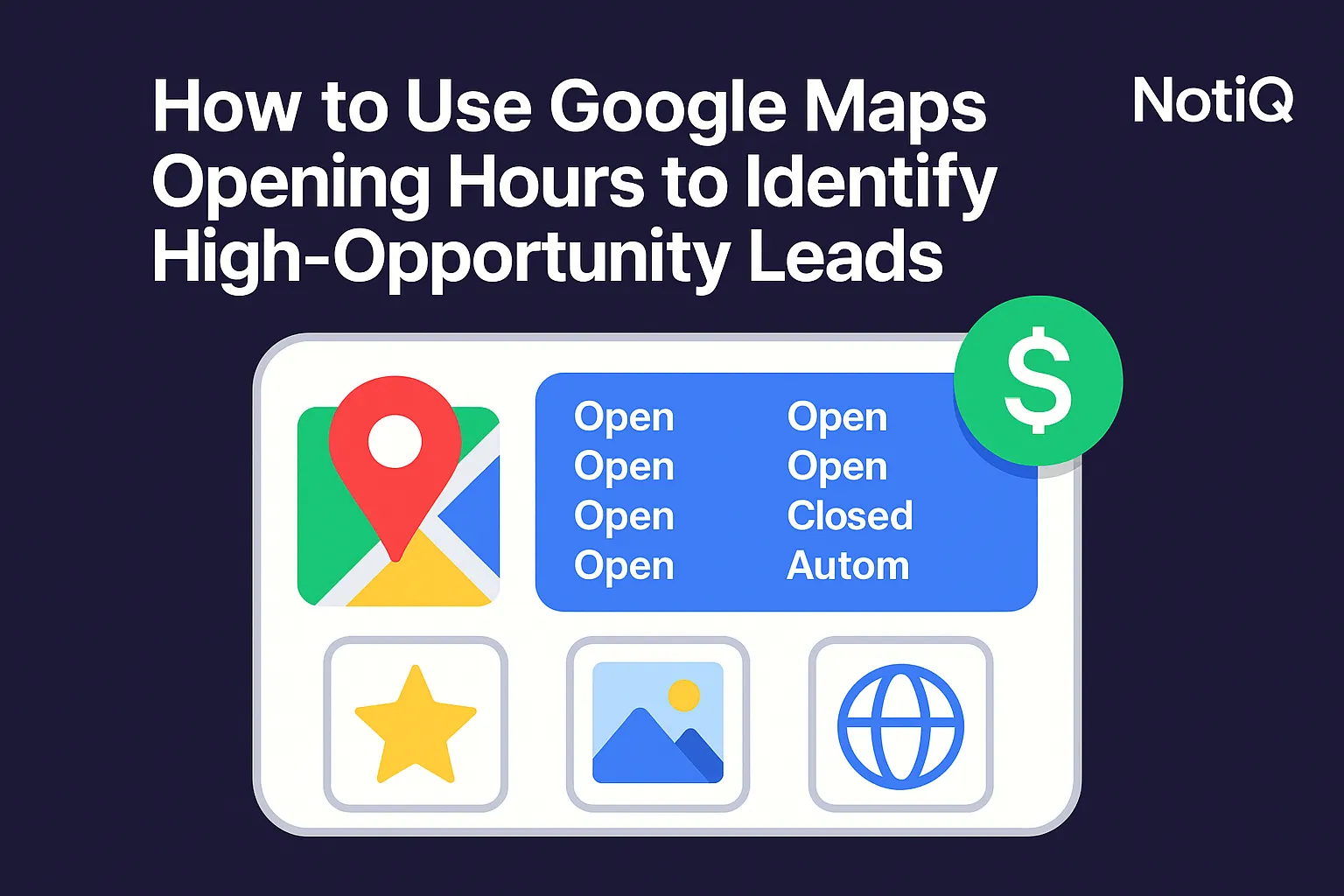
How to Use Google Maps Opening Hours to Identify High-Opportunity Leads
Learn how to use Google Maps opening hours as an activity signal to spot active local businesses. This framework shows how to combine hours with reviews, profile quality, and website freshness to prioritize better leads.
1. Introduction
Most local lead lists tell you who exists, not who is actively operating, reachable, and worth prioritizing right now. For sales development representatives (SDRs), agencies, and local growth teams, sifting through static directories often results in wasted outreach to dormant accounts. However, leveraging Google Maps opening hours leads can act as a highly effective, lightweight business activity signal—but only when used as part of a broader qualification model rather than a standalone shortcut.
This article provides a practical framework for SDRs and sales teams who already utilize Google Maps or Google Business Profile data but need a repeatable way to separate active, high-opportunity leads from stale listings. We will explore why opening hours matter, how to combine them with adjacent operational signals, and outline a tactical workflow to prioritize your outreach. We will also cover the false positives to avoid and how to scale this signal-based local prospecting process compliantly.
At NotiQ, our practical experience using operational signals like hours to identify active businesses proves that this approach is about gathering actionable operational intelligence, not generic directory scraping. By focusing on compliant, publicly accessible information workflows, you can build a pipeline that converts.
2. Why Opening Hours Matter for Lead Quality
Opening hours serve as a highly useful, albeit incomplete, signal of business activity, operational maturity, and likelihood of responsiveness. Relying on business hours data is fundamentally more useful than looking at a raw business listing because it suggests the business is actively presenting operational information to its customers.
There is a vast difference between simply being "present in a directory" and maintaining an "actively maintained local presence." When a company adheres to Google Business Profile business hours guidance, it reflects operational patterns such as staffing consistency, extended service windows, and customer-facing readiness. For sales teams, this translates directly to faster filtering of stale, low-response, or low-priority local accounts, aiding in active business identification.
What Opening Hours Can Actually Tell You
It is crucial to define google maps opening hours as a public operational signal, not a direct buying-intent signal. Complete, visible hours generally indicate that a business is customer-facing, currently active, and paying at least some attention to its Google Business Profile.
Furthermore, longer or highly structured hours can sometimes suggest staffing consistency, demand coverage, or a higher level of operational maturity. However, nuance is required. These lead qualification signals help you prioritize your research and outreach efforts; they do not replace the need for thorough qualification. They are simply one of many business activity signals that indicate a company is actively operating.
Why This Matters More Than Generic Local Lead Lists
Static lead databases often contain outdated information, whereas Google Maps-based signals reflect how a business presents itself publicly in real time. Operational signals reduce wasted outreach by giving SDRs and agencies a tangible reason to rank one local business above another during local business prospecting.
This workflow stands in stark contrast to manual, extraction-heavy approaches that pull raw data without context. The goal of local lead generation should never be to simply export more leads, but to prioritizebetterleads for sales prospecting with maps. By utilizing a platform like[NotiQ](/), teams gain a workflow layer for turning public business signals into prioritized prospecting inputs, ensuring outreach is focused on the most viable accounts.
When Hours Are Most Valuable as a Signal
Opening hours are most valuable in specific use cases: local outbound campaigns, territory planning, vertical-specific prospecting, and agency account targeting. These hours are especially useful early in the qualification process when SDRs are deciding where to spend their manual effort.
Certain industries show clearer signal value because customer access and staffing patterns matter more—for example, retail, hospitality, and clinical services. If you want to know how to find active businesses on google maps, starting with hours is highly effective. However, to truly isolate high-opportunity leads, qualifying local leads with public data becomes far stronger when hours are paired with adjacent operational signals.
3. How to Combine Hours with Other Activity Signals
The real advantage of this methodology comes from combining opening hours with other public indicators instead of relying on a single variable. A simple signal-based lead scoring mindset looks like this: hours + reviews + photos + profile completeness + website freshness.
This multi-signal approach drastically reduces false positives and creates better outreach prioritization logic. Unlike generic google maps data for sales leads, combining lead qualification signals ensures you are targeting businesses with genuine operational momentum. Evaluating these business activity signals through the lens of a government data quality framework supports the logic of assessing completeness, accuracy, and timeliness in your lead-scoring model. Additionally, looking at Google popular times and visit data can provide further Google-native activity indicators.
Pair Hours with Reviews and Review Recency
Visible hours combined with recent reviews often indicate ongoing customer activity and high profile engagement. There is a massive difference between a business with posted hours but no recent signals, and one with fresh reviews that suggest robust, current operations.
Review recency acts as a validation layer, not a perfect proxy for demand. SDRs can use these business activity signals to prioritize outreach timing and relevance. When a business is actively receiving and responding to reviews, it becomes one of your high-opportunity leads, making local business prospecting much more efficient.
Pair Hours with Photos and Profile Completeness
Recent photos, filled-out profile fields, accurate categories, and complete business details strengthen your confidence in the data quality. A fully maintained profile, complete with accurate google business profile hours, often reflects a business that cares deeply about discoverability and customer acquisition.
While incomplete profiles may still belong to valid businesses, they usually require more manual verification. Tying business hours data to profile completeness directly addresses the need for faster qualification. Qualifying local leads with public data in this manner ensures you spend time selling, not verifying.
Pair Hours with Website Freshness
A live, updated website validates that Google Maps hours are not the only current signal. Teams should check for recent copyright updates, current promotional offers, newly published pages, functioning contact forms, or modern service information.
Website freshness is especially useful when local review volume is low, serving as a critical pillar of active business identification. Furthermore, current website messaging helps SDRs craft better, highly personalized first touches, elevating the overall success rate of your local lead generation efforts.
Build a Simple Signal Scoring Model
To operationalize this, build a basic scoring method. Start with hours present, then add points for recent reviews, current photos, profile completeness, and a live website. The goal here is prioritization, not a mathematically perfect model. Any scoring model should account for data quality dimensions such as timeliness and completeness.
Using this lead scoring system, teams can segment business activity signals into score bands: 5-6 points equals "outreach now," 3-4 points equals "research first," and 0-2 points means "deprioritize."
4. A Practical Google Maps Prospecting Workflow
This section provides a repeatable process you can use immediately, from sourcing businesses to qualification and outreach preparation. This tactical workflow provides enough detail to be actionable without overcomplicating the process. We will explore when manual research is sufficient and when ethical automation becomes useful. Unlike basic list-building tutorials, this workflow focuses heavily on prioritization and enrichment using google business profile hours prospecting and sales prospecting with maps to uncover google maps opening hours leads.
Step 1 — Source Relevant Local Businesses in Google Maps
Start with category, location, and niche-based searches aligned strictly to your target market. Focus on relevance before scale; wrong-category volume is still low-quality pipeline.
Segment your searches by geography, service type, and business model where possible. Remember that this is the initial collection stage, not the final qualification stage. Gathering google maps data for sales leads requires a strategic approach to local business prospecting to ensure your local lead generation efforts yield a high-potential starting pool.
Step 2 — Capture Opening Hours and Initial Operational Signals
Capture the core details: regular hours, unusual schedules, visible consistency, and whether the profile appears actively maintained. For teams operationalizing this process at scale, utilizing machine-readable possibilities based on the Places API opening hours reference(such as structured fields like opening hours, openNow, weekdayDescriptions) ensures compliant data integration.
Even simple manual capture of business hours data and google maps opening hours can help create a strong first-pass shortlist, driving effective active business identification.
Step 3 — Enrich with Adjacent Signals
Add recent reviews, photo freshness, profile completeness, and website activity to each prospect. This enrichment layer is where a raw lead list transforms into a prioritized account list.
For example, two plumbing businesses may look identical on a map. However, once signal enrichment is applied, the one with fresh reviews, updated photos, and a modern website will rank significantly higher than the one with a static profile from 2021. Utilizing business activity signals and lead qualification signals is the key to qualifying local leads with public data.
Step 4 — Score and Segment Your Leads
Assign priority tiers based on signal strength and your confidence in the data. Practical segmentation buckets include “high-confidence active,” “needs manual validation,” and “low-confidence/stale.”
Connect this segmentation directly to your rep workflow: high-scoring leads get immediate, personalized outreach; mid-scoring leads are assigned for further research; and low-scoring leads are excluded. This lead scoring methodology ensures your team is only spending time on high-opportunity leads backed by strong business activity signals.
Step 5 — Turn Signals into Better Outreach
Operational signals improve message relevance, not just targeting. Use outreach angles tied to business activity: mention current customer demand, visible service hours, local coverage areas, or their profile maturity.
Public data should inform thoughtful personalization rather than generic templated messaging. For insights on how enriched local signals can feed stronger personalized outreach, explore adjacent personalization workflows at RepliQ. Effective sales prospecting with maps requires turning high-opportunity leads into conversations through highly relevant local business prospecting.
Step 6 — Know When to Move from Manual Research to Automation
Manual workflows are fine for narrow territories or high-value niches, but they become slow and unscalable at volume. Eventually, teams need workflow orchestration, enrichment logic, and repeatable scoring.
This is vastly different from extraction-heavy approaches that stop at raw list generation. When you are ready to scale from manual research to orchestrated signal-based workflows, leveraging platforms like NotiQ allows you to automate the compliant collection of google maps data for sales leads, ensuring active business identification without sacrificing the quality of your business activity signals.
5. Where Opening Hours Create False Positives
To build a reliable pipeline, you must understand the limitations of opening hours and how to avoid overconfidence. Many competing strategies stay too high-level and fail to address edge cases. Opening hours are a useful clue, but they are not absolute proof of opportunity or active demand. Understanding what do business opening hours reveal about lead quality requires acknowledging false positives and recognizing that business activity signals are nuanced.
Outdated or Inaccurate Hours
Some businesses simply fail to update regular, holiday, or seasonal hours. Relying on hours alone can cause reps to prioritize businesses that are much less active than they appear on the surface.
Always validate google business profile hours with reviews, website updates, or direct contact signals to avoid false positives. Business hours data must be cross-referenced to ensure you are not wasting time on a dormant account.
Seasonal Businesses, Break Hours, and Special Cases
Edge cases like seasonal operations, split shifts, appointment-only services, and businesses with special hours can easily distort simplistic scoring models if not handled carefully.
Always consider the industry context before assigning significance to unusual hours patterns. A tax accountant will have different google maps opening hours in April compared to September. Factoring in these lead qualification signals prevents your google business profile hours data from skewing your prioritization.
Service-Area Businesses and Profile Eligibility Nuances
Not every business type presents hours in the same way. Service-area or less customer-facing operations may hide their hours or address entirely. According to Google’s business representation guidelines, there are specific cases where hours may be absent, misleading, or not applicable.
Some valid prospects may look weak in a Maps-based model even when they are strong commercial opportunities. Remember that the absence of hours is not always a disqualifier in local business prospecting; qualifying local leads with public data requires flexibility in active business identification.
Active Profile Does Not Equal Strong Buying Intent
There is a critical distinction between operational activity and purchase readiness. A business can have complete hours, glowing reviews, and fresh photos, yet still be a poor fit for your specific offer.
Always reinforce the need for Ideal Customer Profile (ICP) fit, vertical relevance, and service-match filtersafteroperational scoring. High-opportunity leads are born from a combination of strong lead qualification signals, robust business activity signals, and strict ICP alignment.
6. How Teams Can Scale Signal-Based Local Prospecting
Operationalizing this methodology across reps, markets, and campaigns requires a focus on repeatability, scoring consistency, and team workflows. NotiQ’s credible role is as a tactical workflow layer for identifying active businesses using operational signals such as opening hours, differentiating it from traditional local SEO tools and generic prospecting databases by emphasizing actionability for sales qualification. If you are wondering how can sales teams find active local businesses faster, signal-based prospecting is the answer for scalable local lead generation google maps.
Standardize the Qualification Criteria
Implement a shared checklist or rubric across all SDRs and agencies. Common definitions for terms like “active,” “needs validation,” and “outreach-ready” are essential.
Standardization reduces rep-by-rep inconsistency, improves handoff quality, and ensures that everyone interprets lead qualification signals and business activity signals the exact same way during local business prospecting.
Use a Repeatable Signal Framework by Industry
Signal interpretation varies wildly by niche. Restaurants, medical clinics, retail stores, home services, and appointment-driven businesses behave differently.
For example, a restaurant with no weekend hours is a red flag, but a B2B consulting firm with no weekend hours is perfectly normal. Applying a repeatable framework to business hours data ensures you are accurately identifying high-opportunity leads during google business profile hours prospecting based on industry-specific realities.
Blend Manual Judgment with Automation
The best systems use ethical automation for data collection and scoring, while relying on human judgment to validate fit and craft outreach. This contrasts sharply with tools that prioritize extraction volume over decision quality.
Leveraging AI enrichment, verification, and compliance ensures you are gathering accurate business activity signals while maintaining legal publicly accessible information workflows. This blend is the future of sales prospecting with maps.
Position This Method Against Traditional Alternatives
Signal-based qualification is vastly superior to generic lead databases, local SEO visibility tools, and scraping-first workflows. Traditional tools may help you find a business name or a contact, but they often fail to tell teams which businesses look operationally active and outreach-worthy right now.
By focusing on workflow outcomes rather than raw data extraction, local lead generation becomes highly targeted. Using google maps data for sales leads in a signal-based model ensures you are acting on current business activity signals.
What a Scaled Workflow Looks Like in Practice
In an optimized end-state, a team will source businesses compliantly, enrich public signals automatically, score leads consistently, segment by priority, and trigger tailored outreach.
For example, an SDR logs in, views a dashboard of accounts enriched with hours, reviews, and website data, instantly filters for scores of 5+, and begins personalized outreach. The outcome is not just more data, but superior territory focus, active business identification, and less wasted outreach on high-opportunity leads via targeted sales prospecting with maps.
7. Conclusion
Google Maps opening hours are incredibly valuable because they act as a lightweight operational signal, but their real power is unlocked only when combined with reviews, photos, profile completeness, and website freshness. By treating hours as actionable operational intelligence rather than static profile metadata, sales teams can achieve faster qualification, better prioritization, and highly relevant local outreach.
We encourage readers to start with a simple scoring model, test it on a single territory or niche, and refine the process based on response quality. NotiQ has extensive tactical experience using operational signals to identify active businesses, proving that compliance and strategy yield the best results. To explore how to turn map-based business signals into repeatable, scalable prospecting workflows, visit[NotiQ](/)and start prioritizing your google maps opening hours leads using advanced business activity signals to uncover truly high-opportunity leads.
Frequently Asked Questions
- How can Google Maps opening hours help identify sales leads?
- Opening hours help indicate whether a business appears operational, customer-facing, and actively maintained on Google. While they are a great initial filter to gauge operational maturity, they are best used as a starting point rather than a standalone qualification method. Understanding how can Google Maps opening hours help identify sales leads allows teams to use google maps opening hours leads as foundational business activity signals.
- Are opening hours enough to qualify a local lead?
- No. While helpful, combining hours with reviews, photos, profile completeness, and website freshness creates much stronger confidence. Relying solely on hours can lead to false positives. Lead qualification signals must be layered to accurately identify high-opportunity leads based on holistic business activity signals.
- What other public signals should teams combine with hours?
- Teams should look at recent reviews, review recency, profile completeness, updated photos, website freshness, and other visible Google-native activity indicators. Each of these elements helps validate the timeliness and active engagement of the business. Qualifying local leads with public data requires looking beyond just google business profile hours to encompass all available business hours data.
- Which industries benefit most from using opening hours as a prospecting signal?
- Businesses with clear, customer-facing schedules—such as retail, hospitality, clinical services, and storefront-based operations—often produce the strongest signal value. However, it is vital to apply industry-specific interpretation rather than universal assumptions when conducting local business prospecting to find high-opportunity leads using business hours data.
- What are the limitations of using Google Business Profile hours for prospecting?
- Limitations include outdated hours, seasonal variations, service-area business nuances, duplicate listings, and a generally weak correlation with actual buying intent. Hours indicate operational activity, not a guaranteed fit for your product or service. Be aware of these false positives when evaluating google business profile hours to ensure your business activity signals are pointing you in the right direction.
Continue Reading
More articles you might find useful
Google Maps Prospecting for Commercial Landscaping Companies
Learn how commercial landscaping companies can use Google Maps to find higher-fit commercial property leads, qualify visible need, and build denser service routes. This guide breaks down a practical workflow for smarter prospecting and better contract opportunities.
Read the article →
How to Find Businesses With Weak Google Maps Descriptions
Learn how to find businesses with weak Google Maps descriptions and turn visible GBP gaps into qualified local SEO leads. This guide covers audit criteria, scoring, and outreach angles you can use at scale.
Read the article →
Google Maps Lead Generation for Pest Control Companies
A beginner-friendly playbook for turning Google Maps visibility into more pest control leads. Learn how to improve rankings, build reviews, and convert local searches into booked jobs.
Read the article →Popular industry lead playbooks
Maps search examples and niche outreach for the verticals teams prospect most.