Technology
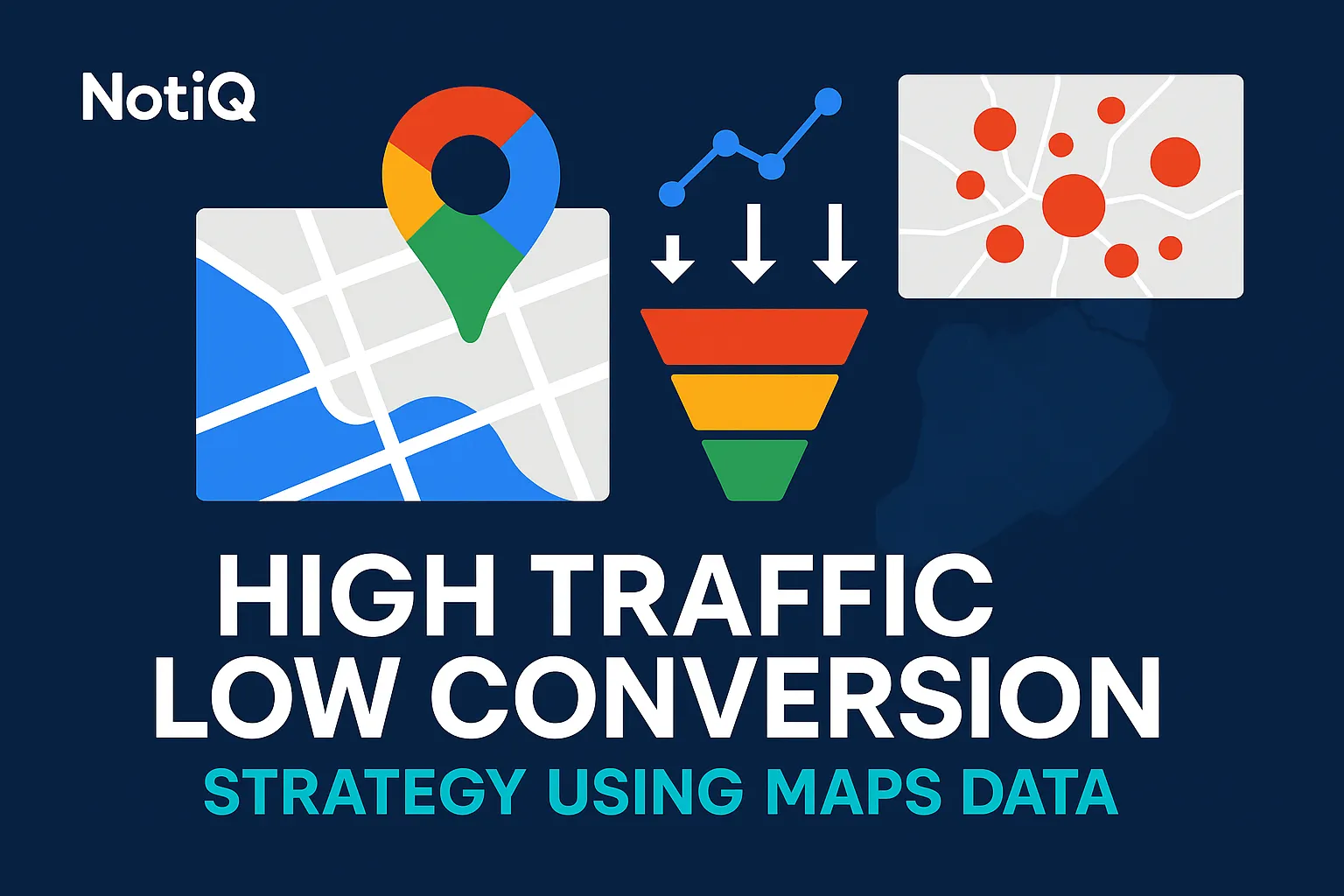
The “High Traffic Low Conversion” Strategy Using Maps Data
Learn how to map traffic against conversions to find hidden inefficiencies across locations. This framework helps teams diagnose funnel gaps, competitor pressure, and low-converting markets faster.
1. Introduction
Advanced multi-location teams frequently face a frustrating paradox: some markets appear perfectly healthy on traffic, visibility, or footfall dashboards, yet sales, leads, or store visits stubbornly underperform. When top-line metrics look green but the bottom-line results flash red, the root cause is rarely a lack of demand. Instead, it is a failure of conversion efficiency.
To solve this, operators must look at performance through the lens of geography. Blended reporting often hides location-level inefficiency signals that only become visible when traffic and conversion are mapped together. High traffic does not automatically mean high performance.
This article outlines a strategy-first framework for multi-location marketers, growth teams, and operators who already have the data but need a better diagnostic model. Instead of relying on isolated foot traffic reporting, you will learn how to distinguish awareness problems from conversion problems using traffic vs conversion maps, trade area context, and competitor density. By leveraging NotiQ’s methodology for surfacing geographic mismatches, your team can build a repeatable high traffic low conversion strategy that prioritizes compliant, publicly accessible data to drive real-world outcomes.
2. Why Traffic and Conversion Diverge by Location
High traffic is merely an indicator of potential, not a guarantee of performance. In local and multi-location environments, aggregate dashboards mislead teams by averaging high-performing and underperforming markets together. A region generating 10,000 monthly visits with a 1% conversion rate looks identical in total volume to a region generating 2,000 visits with a 5% conversion rate, yet their operational realities are entirely different.
To fix this, teams must understand the difference between demand generation and demand capture. A market can boast exceptional visibility or visit volume while completely failing at intent alignment, in-location experience, or competitive differentiation. The primary categories of this divergence include poor traffic quality, trade area mismatch, competitor pressure, cannibalization, and operational friction. The objective of location intelligence marketing is not just measuring foot traffic vs sales conversion, but identifying exactly where conversion leakage occurs geographically.
The Limits of Traffic-Only Reporting
Top-line traffic growth easily creates false confidence when conversion outcomes lag behind. Common store performance analytics setups over-prioritize impressions, clicks, or raw map visits without providing enough market-level context.
A high-traffic market may actually be highly inefficient if acquisition costs are bloated, staffing loads are unmanageable, or local competition reduces profitable outcomes. Unlike typical foot traffic analytics content that stops at visits and directional trends, traffic vs conversion maps force teams to askwhytraffic isn't monetizing. When you only measure the top of the funnel, you optimize for volume rather than value.
The Four Most Common Causes of High-Traffic, Low-Conversion Markets
The same traffic pattern can have vastly different root causes depending on the geography. These local market inefficiency signals typically fall into four practical buckets:
1. Awareness Mismatch: Dense map visibility but weak sales, indicating that people see the location but do not engage.
2. Local Intent Mismatch: Strong demand pockets but low capture, where traffic is high but the audience is looking for a different service or price point.
3. Competitive Pressure: Overlapping catchments or competitor clustering that forces customers to comparison-shop, reducing your overall share.
4. Operational Execution: Locations with massive footfall but long wait times, poor inventory, or understaffing that physically prevents demand capture.
Diagnosis must always precede optimization. Recognizing these inefficiency signals on a map is the first step in successful geospatial conversion optimization.
3. The Map-Based Metrics That Reveal Inefficiency
Maps data becomes highly actionable when paired with conversion outcomes, not when viewed in isolation. To properly diagnose whether a market is underperforming, teams need a practical KPI layer that evaluates site performance benchmarking.
A comprehensive scorecard combines visibility, visits, conversion actions, trade area quality, and competitive context. As supported by this geospatial retail sales prediction study, integrating spatial data with performance metrics is critical for accurate location evaluation. This framework relies on compliant, privacy-safe geospatial analysis rather than tool-specific features.
Visibility-to-Visit vs Visit-to-Conversion Metrics
To conduct a proper maps data conversion analysis, you must clearly define the funnel stages: map visibility (search demand) → visits (foot traffic) → leads/sales/bookings.
Two ratios matter most:
• Visibility-to-Visit Rate: (Total Location Visits / Total Map Impressions). Weakness here suggests an awareness, discovery, or local SEO problem.
• Visit-to-Conversion Rate: (Total Sales or Leads / Total Location Visits). Weakness here suggests on-site friction, pricing misalignment, or intense local competition.
Separating traffic generation from traffic monetization allows teams to see exactly where the foot traffic vs sales conversion funnel breaks down.
Trade Area and Catchment Metrics
Catchment analysis helps identify whether the right audience is coming from the right geographic zones. High traffic from low-intent or weak-fit catchments may inflate volume without improving outcomes.
By analyzing trade area overlap, travel time, distance decay, and inflow/outflow patterns, teams can spot inefficient markets. For example, a location situated on a major commuter highway might draw broad attention, but if the core customer base sits in a residential zone three miles away, the catchment area conversion rate will remain low. Understanding these origin-destination patterns and market flows—similar to methodologies used in U.S. Census commuting flows—is vital for accurate trade area analysis.
Competitor Density and Saturation Signals
Nearby competitor concentration can suppress conversion even when traffic appears strong. There is a distinct difference between healthy demand density (where complementary businesses drive collective footfall) and market saturation.
Evaluating competitor location analysis requires looking at proximity, category clustering, and customer choice overload as geographic leakage signals. You must compare market performance against the competitive context instead of absolute traffic alone. Extensive local retail concentration data confirms that market saturation directly impacts individual store performance, making competitor density a crucial metric.
Location Efficiency Metrics Beyond Raw Traffic
Advanced teams evaluate profitability and operational burden, not just top-line footfall. Location efficiency requires measuring conversion per visit, revenue per visit, and lead quality by location.
The "best market" is the one with the strongest efficient conversion profile, not necessarily the most traffic. A lightweight formula for site performance benchmarking might look like this:
• Location Efficiency Score = (Visit-to-Conversion Rate × Average Order Value) / (Competitor Density Index + Operational Friction Score).
This ensures store performance analytics highlight true profitability.
4. How to Diagnose Trade Area, Competition, and Local Intent Issues
Moving from metrics to interpretation is how teams understandwhya market is underperforming. Maps overlays reveal spatial patterns that a standard CRO dashboard cannot. Diagnosis must combine spatial context, funnel data, and local intent signals to serve as the bridge between analysis and action in location intelligence marketing.
Diagnosing Trade Area Mismatch
A weak trade area often presents as strong top-of-funnel attention originating from outside the ideal catchment, poor accessibility, or low-fit population centers. Travel friction, destination accessibility, and land-use patterns heavily influence conversion efficiency.
Not every high-traffic corridor is a high-conversion trade area. For instance, a coffee shop with strong exposure on a fast-moving transit route may suffer from low purchase intent because the traffic flows are transient rather than destination-driven. Evaluating these accessibility and land-use factors aligns with EPA smart location metrics, proving that physical geography dictates location efficiency just as much as marketing does.
Diagnosing Competitor Pressure and Cannibalization
Overlapping service areas, nearby substitutes, or same-brand location overlap can severely erode conversion. When diagnosing competitor density, you must distinguish true market demand weakness from share loss caused by dense competition.
Competitor clustering is a massive trade area overlap signal indicating that pricing, offer, and differentiation matter far more than traffic growth. Manual competitor location analysis often leaves interpretation to the user, but a strategy-first diagnosis immediately highlights when a market is too saturated to convert efficiently.
Diagnosing Local Intent Mismatch
Traffic quality depends entirely on intent, not just presence or maps visibility. Local search behavior, category interest, and audience needs differ dramatically across markets.
A location might be discoverable for the wrong queries, attract casual curiosity rather than buying intent, or feature messaging that fundamentally does not match local demand. When geospatial customer behavior analysis reveals strong traffic but poor intent, the solution lies in local landing pages, Google Business Profile (GBP) optimization, and localized offers.
Diagnosing Operational Friction
Sometimes, the market demand is perfectly healthy, but the local experience depresses results. Staffing shortages, limited hours, long wait times, poor merchandising, and service execution can create massive conversion leakage.
Maps analysis should guide not only media and SEO decisions but operational decisions as well. If a high traffic low conversion strategy reveals that a specific store has excellent demand but terrible reviews regarding wait times, the bottleneck is operational friction. Store performance analytics become exponentially more powerful when paired with operational KPIs.
5. A Decision Framework for Fixing Low-Conversion Markets
Diagnosis is only useful if it leads to intervention. This decision matrix classifies low-conversion markets into specific issue types, mapping each to a practical response. Not every low-conversion market requires the same fix. Using a platform like[NotiQ](/)can help teams orchestrate this diagnostic workflow across locations, turning inefficiency signals into actionable maps data conversion analysis.
If the Problem Is Awareness, Improve Discovery
Signals: Low visibility relative to market opportunity, weak discovery despite strong nearby demand, or poor map/category presence. Actions: If the funnel is breaking at the top, focus on demand generation. Improve local listings, ensure category relevance, publish local content, and enhance overall map discoverability. This is strictly a local SEO play, distinct from optimizing a location that already gets strong attention but fails to close.
If the Problem Is Intent or Messaging, Localize the Offer
Signals: High traffic exists, but intent alignment is weak, resulting in low visit-to-conversion rates. Actions: Geography changes what converts, not just where traffic comes from. Adjust landing page copy, offer framing, category emphasis, or local proof to better match local demand. Offer localization and market-specific messaging consistently outperform one-size-fits-all campaigns in underperforming regions, driving superior geospatial conversion optimization.
If the Problem Is Competition, Defend or Reprioritize
Signals: High traffic, high competitor density, shrinking market share, and local market inefficiency signals pointing to saturation. Actions: Decide whether to defend the market with stronger positioning or deprioritize it. Defending requires tighter differentiation, category repositioning, or hyperlocal offers. Deprioritizing means reallocating budget to markets with higher location efficiency. Some high-traffic markets are simply structurally inefficient due to saturation.
If the Problem Is Operations, Fix the Conversion Environment
Signals: Good traffic, good intent, weak close rates, poor dwell-to-sale outcomes, or localized customer complaints regarding service. Actions: Growth teams must collaborate with operations. Implement staffing changes, optimize store hours, reduce queues, adjust inventory, or mandate service retraining. Do not treat operational friction as a marketing problem; fix the physical conversion optimization environment first.
6. How to Benchmark and Prioritize Locations for Action
Reacting to isolated anecdotes is a recipe for wasted budget. Teams must benchmark each location against peer cohorts, geography, and competitive context to rank opportunities effectively. The goal of market prioritization is to identify where small improvements can generate disproportionate gains.
Build Peer Cohorts Instead of Comparing Every Location Equally
Urban, suburban, destination, and commuter-heavy markets should never be judged by the same baseline. Cohort benchmarking produces fairer comparisons by adjusting for trade area characteristics, density, and competition. Group locations by similar catchment analysis profiles before ranking them. Store conversion benchmarking relies on relative benchmarks within these peer groups rather than absolute, company-wide leaderboards.
Create a Geo-Efficiency Scorecard
A practical geo-efficiency scorecard surfaces "high opportunity, fixable" markets versus "structurally weak" markets. Create a scorecard with columns for visibility, visits, conversion rate, competitor density, catchment quality, and operational risk.
Use a simple red-yellow-green framework for executive readability. Maps data should drive action prioritization, not just diagnosis. Teams looking to operationalize this geo-efficiency scoring can leverage NotiQ’s workflow capabilities to seamlessly highlight inefficiency signals across their portfolio.
Turn Insights Into Ongoing Testing
This framework must become a recurring operating cadence, not a one-time audit. Test one variable at a time by market: messaging, offer, staffing, hours, or budget allocation.
Benchmarking before and after interventions validates whether the root-cause diagnosis was correct. The loop is simple: analyze → classify → intervene → re-measure. Operationalizing this localized testing iteration—similar to broader experimentation methodologies discussed on the Repliq blog—ensures continuous geospatial conversion optimization.
7. Future Trends in Traffic vs Conversion Analysis
The location intelligence marketing category is rapidly shifting from raw traffic reporting toward comprehensive efficiency scoring by geography. Advanced teams are moving away from static dashboards and toward interpretable action frameworks.
Expect to see a growing reliance on AI-assisted trade area diagnostics, which will automate market clustering and blend mobility, Point of Interest (POI), and demographic analysis into unified, compliant decision systems. NotiQ’s methodology aligns perfectly with this shift, ensuring teams can execute geospatial conversion optimization with analytical clarity and repeatable precision.
8. Conclusion
High traffic is not the end goal; efficient conversion by geography is. When teams map visibility, visits, conversion outcomes, trade area quality, and competitor density together, they can separate awareness problems from conversion problems with incredible accuracy.
Stop treating underperformance as a generic CRO issue. Start diagnosing it market by market using traffic vs conversion maps to uncover hidden inefficiency signals. By implementing a high traffic low conversion strategy based on compliant geospatial data, you can stop guessing and start optimizing.
Ready to turn fragmented location signals into operational decisions? Explore[NotiQ](/)to operationalize this framework and build a repeatable workflow for your multi-location brand.
Frequently Asked Questions
- What does high traffic but low conversion indicate in maps data?
- It usually signals a mismatch between visibility or visits and the ability to capture intent locally. This high traffic low conversion strategy issue is commonly caused by poor trade area fit, competitor density, operational friction, or attracting the wrong audience mix, which becomes evident during maps data conversion analysis.
- Which map-based metrics best identify inefficiency signals?
- The most critical metrics include the visibility-to-visit rate, the visit-to-conversion rate, catchment quality, competitor density, and cohort-based benchmarks. No single metric is enough; true site performance benchmarking power comes from layering these inefficiency signals together.
- How do you separate awareness problems from conversion problems across regions?
- You separate them using funnel logic. Weak visibility on traffic vs conversion maps suggests an awareness issue. Conversely, strong visibility and high visits combined with weak sales outcomes suggest conversion leakage. Analyzing local intent and operational factors helps clarify the exact breakdown.
- What role does competitor proximity play in low conversion?
- Nearby alternatives can severely suppress close rates, especially in dense or saturated markets. This is why competitor location analysis is vital; benchmarking must include competitive context to understand if market saturation is stealing your conversions despite high traffic volume.
- When should a brand optimize messaging, pricing, staffing, or location strategy?
- Intervention must follow the diagnosis. Optimize messaging for intent mismatch, adjust pricing for competitive pressure, fix staffing for operational friction, and rethink location strategy for structurally weak trade areas. Use a market prioritization matrix to guide store performance analytics rather than defaulting to generic traffic acquisition.
Continue Reading
More articles you might find useful
Google Maps Prospecting for Commercial Waste Management Companies
Learn how commercial waste haulers can use Google Maps to find, qualify, and prioritize better local accounts. This guide shows how to build denser routes and improve outreach with waste-stream and service-area insights.
Read the article →
How to Find Local Businesses With Broken Website Links
Learn how to find local businesses with broken website links using Google Maps, quick validation checks, and proof-based outreach. This guide shows agencies how to turn visible site issues into qualified leads.
Read the article →
Google Maps Lead Generation for Signage Companies
Learn how sign companies can use Google Maps to find local prospects, identify visible signage gaps, and build a repeatable outreach system. This guide shows how to turn visual research into qualified leads without relying on paid ads or generic lists.
Read the article →Popular industry lead playbooks
Maps search examples and niche outreach for the verticals teams prospect most.