Technology
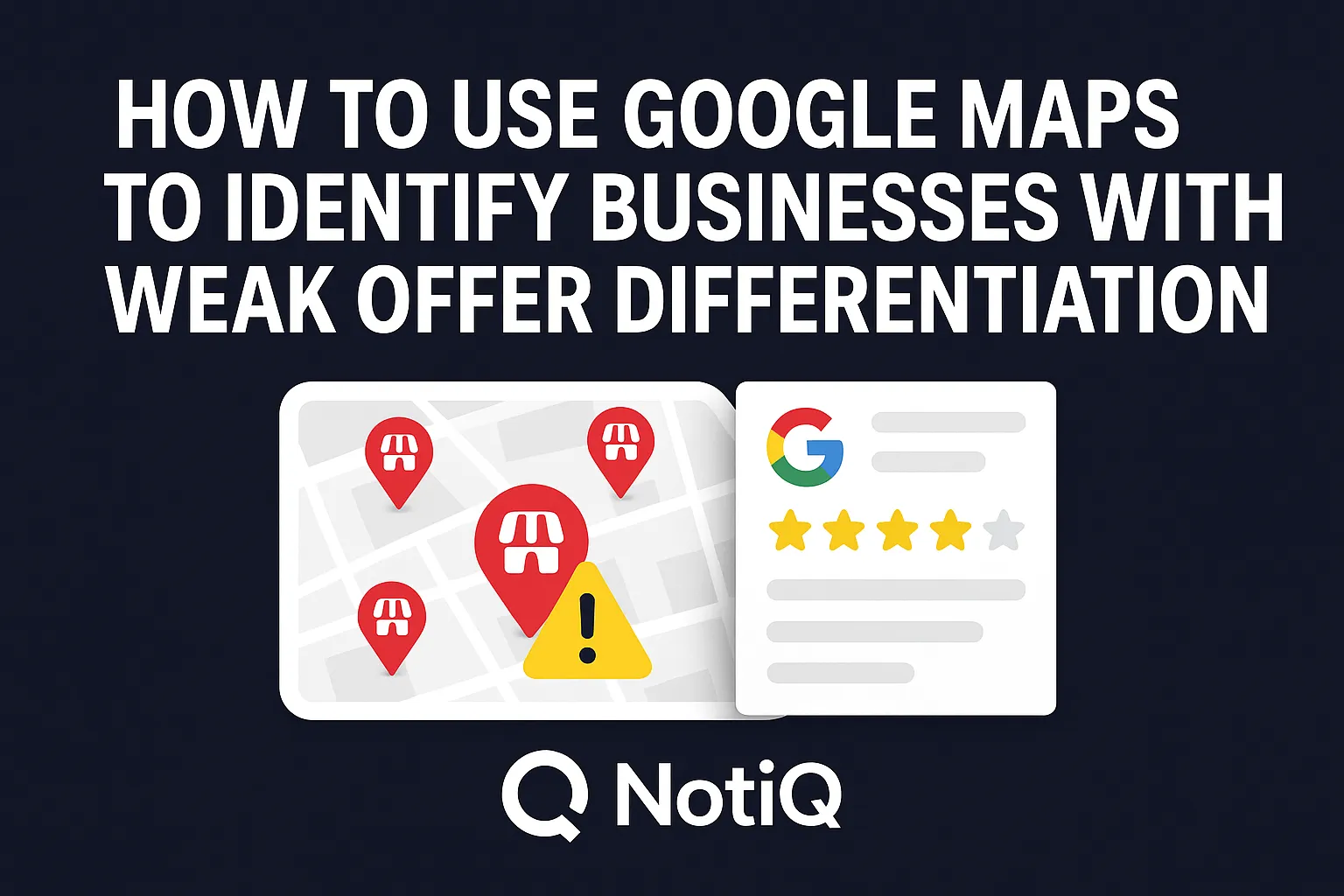
How to Use Google Maps to Identify Businesses With Weak Offer Differentiation
Learn how to use a Google Business Profile audit to find businesses with weak positioning on Google Maps. This guide shows how to spot generic offers, analyze reviews, and turn insights into targeted outreach.
1. Introduction
Many local businesses look nearly identical on Google Maps at first glance. They share the same category, make the same vague promises, and present a nearly identical star-rating-driven appearance. For marketers, agencies, founders, and beginner prospectors, that sameness creates an incredible opportunity. If a business has weak positioning, generic messaging, or unclear specialization, you can spot it using public listing signals before you ever reach out.
This article will show you a beginner-friendly framework for learning how to use Google Maps to identify businesses with weak offer differentiation. You will learn how to compare competitors, diagnose commoditized offers, and turn those insights into lead lists and outreach angles.
To be clear, this is not another local SEO ranking guide. Instead of focusing on how to manipulate algorithms, we will focus on diagnosing weak positioning and converting those findings into action. You will discover exactly what to audit, how to read reviews for positioning gaps, how to compare local competitors, and how to organize your workflow.
By analyzing authoritative Google Business Profile guidance alongside local SEO fundamentals, you can build a highly effective, compliant prospecting system. Tools like[NotiQ](/)can serve as your ideal workflow companion, helping you seamlessly organize your public Maps research, notes, and next-step outreach workflows.
2. Why Weak Differentiation Shows Up on Google Maps
Google Maps is an incredibly useful market-intelligence layer for spotting commoditized local offers. In simple terms, weak offer differentiation means a business looks interchangeable because it does not communicate a clear specialty, outcome, trust signal, or compelling reason to choose it over the competition.
When users search for a local service, they compare multiple listings in a matter of seconds. Because this comparison happens so quickly, visible profile signals are critical. Interestingly, a business can rank reasonably well on Maps and still suffer from weak positioning if its offer looks generic. According to Google’s local ranking factors, relevance, distance, and prominence shape visibility. However, visibility is not the same as differentiation. A business might be prominent and close to the searcher, but still fail to give the buyer a reason to convert.
Standard local SEO content typically focuses on improving rankings. Our core lens for Google Maps prospecting focuses instead on relevance, trust, clarity, and specialization to evaluate business positioning and conduct local competitor analysis.
What “weak positioning” looks like in a local market
Weak positioning usually manifests as a business trying to do everything for everyone. Common signs of a generic offer include vague descriptions, a lack of niche focus, no meaningful proof of past success, and no standout service attributes.
It is important to clarify the difference between poor execution and poor differentiation. A business can deliver excellent service and have decent reviews, but still fail to explain what makes it different in its market differentiation. For example, a local dentist might say they offer "quality dental care," an HVAC provider might promise "reliable service," or a law firm might claim they have "experienced attorneys." These are basic expectations, not unique selling propositions (USP analysis).
Why Google Maps is a fast starting point for beginners
Google Maps offers a low-cost, publicly accessible way to compare businesses by area and category. You do not need expensive market intelligence tools to begin local market research or competitor mapping.
By simply reviewing a Google Business Profile, public elements like categories, photos, reviews, and attributes quickly reveal how clearly a business presents its value. This makes it an ideal starting point for beginners looking to spot messaging gaps.
The difference between local SEO analysis and offer analysis
While local SEO research asks, “Why is this business visible?” offer analysis asks, “Why should a buyer choose this business?”
Combining both viewpoints creates a distinct advantage. Generic competitors often stop at lead generation and fail to teach you how to diagnose a commoditized offer. By conducting a thorough offer audit, you can identify service differentiation gaps and clearly see where a business is failing to stand out to potential buyers.
3. What to Audit in a Google Business Profile
To streamline your offer audit, you need a repeatable checklist for reviewing visible listing cues that signal weak differentiation. This practical framework allows beginners to evaluate local business positioning examples in under 15 minutes per prospect.
When auditing a Google Business Profile, focus entirely on visible elements: the category, business name, description, services, photos, attributes, review count, review quality, and overall profile completeness. Following Google Business Profile representation guidelines can help you understand exactly how businesses are expected to present their names, categories, and services, making it easier to spot when they fall short.
Categories and service labels
Identical primary categories across many nearby businesses often signal a crowded, commoditized market. When conducting competitor mapping, look for overly broad categories, a lack of visible specialization, and weak service labeling.
For example, if ten plumbers in a five-mile radius all use the exact same primary category and list "general plumbing" without highlighting specializations like "tankless water heater installation" or "emergency commercial plumbing," they lack service differentiation. Compare 5–10 similar businesses on their Google Business Profile before drawing conclusions.
Business descriptions and on-profile messaging
Generic phrases like “quality service,” “best prices,” or “trusted professionals” rarely create real offer differentiation. Stronger businesses clearly communicate a specialty, a specific customer type, a desired outcome, or a unique service focus.
When you want to know how to identify weak value proposition, look at the description. A vague description reads: "We are a local landscaping company providing great service to our town." A specific, well-positioned description reads: "We specialize in drought-resistant landscape design and installation for commercial properties." Note whether the listing explicitly explains who it serves best and why. This is the cornerstone of effective business positioning.
Photos, branding, and trust cues
Missing, outdated, or generic photos reduce perceived credibility and cause listings to blend together. Photos should reveal whether a business showcases proof, their process, their team, quality of work, specialization, or the customer experience.
Weak differentiation is obvious when visuals say nothing specific about the offer. A listing with only a blurry photo of a storefront or generic stock images lacks the trust cues necessary for effective business positioning, making it an ideal target for Google Maps prospecting and local SEO research.
Attributes, completeness, and specificity
Profile completeness and attributes help users understand important differentiators at a glance. Missing service details, unclear hours, sparse information, or absent operational signals severely weaken positioning.
According to guidelines on Google Business Profile attributes, these features highlight specific details to customers. Use missing attributes as clues for missed messaging opportunities during your offer audit and local market research, rather than just viewing them as ranking hacks.
A simple scoring system for beginners
To keep your local competitor analysis organized, use a lightweight scoring model. Score prospects from 1 to 5 based on:
• Clarity of the offer
• Specialization
• Proof of results
• Trust signals
• Profile completeness
The goal of this USP analysis and review analysis is consistency, not perfect precision. Score multiple listings side by side to quickly identify the weakest-positioned prospects.
4. How to Mine Reviews for Positioning Gaps
Customer language exposes unmet needs, repeated complaints, and missing value propositions. Reviews often reveal the market’s real buying criteria far better than the business's own profile description.
When mining reviews, emphasize pattern recognition rather than cherry-picking one dramatic complaint. It is also important to conduct this review analysis ethically. As noted in the FTC guidance on review authenticity, reviews should be interpreted responsibly, keeping in mind that manipulated reviews can distort conclusions. We are engaging in ethical public-data analysis, looking for genuine positioning gaps.
What review patterns suggest a generic offer
Repeated comments like “fine,” “decent,” “got the job done,” or “similar to others” strongly suggest low emotional differentiation and weak positioning.
Recurring complaints around communication, speed, reliability, transparency, or mismatched expectations often point to weak offer framing. Both positive and negative reviews provide useful data for evaluating offer differentiation and overall review analysis.
How to extract unmet demand from customer wording
Look for repeated desires in the review mining for customer pain points. Do customers constantly wish for faster response times, clearer pricing, better specialization, more trust, easier scheduling, or stronger communication?
These unmet needs often become the foundation for a stronger positioning angle. Record customer language verbatim in your notes; these exact phrases are invaluable for market differentiation, USP analysis, and crafting future messaging.
Separating weak offer differentiation from poor operations
Some reviews indicate execution problems rather than positioning problems. Poor operations result in service failure (e.g., "The technician broke my sink"). Weak differentiation means there is an unclear reason to choose the business in the first place (e.g., "They fixed the sink, but so could anyone else").
Both scenarios present opportunities for an offer audit and local competitor analysis, but your business positioning and outreach angle will differ depending on the root cause.
A beginner review-mining workflow
To streamline your local market research and Google Maps prospecting, follow this simple review analysis workflow:
1. Read the most recent 20-30 reviews.
2. Tag repeated themes.
3. Note what buyers value most in this specific market.
4. Summarize likely positioning gaps.
Organize your findings into three buckets: trust signals, differentiation signals, and unmet needs.
5. How to Compare Competitors by Area and Category
Weak differentiation becomes glaringly obvious when multiple businesses in the same geography and category are viewed side by side. Evaluating clusters of businesses rather than isolated listings is a core principle of local competitor analysis.
The SBA competitive analysis guide supports the idea that structured comparison is a legitimate, foundational business research method. While standard SEO tools focus on benchmarking traffic, this framework focuses on visible offer weakness signals for practical competitor mapping and Google Maps competitor analysis.
How many competitors to review before drawing conclusions
Always review a meaningful sample. Look at the top 5–10 relevant listings in one category and area. Patterns matter far more than any single profile. Avoid overgeneralizing your local market research or competitor mapping based on just one weak listing.
Comparing businesses in the same category
When evaluating businesses in the same category, compare their category consistency, service emphasis, proof, photo quality, and review themes.
If many businesses use nearly identical language, that category is heavily commoditized. Create a simple comparison matrix to track service differentiation, Google Business Profile completeness, and overall business positioning.
Comparing businesses across nearby areas
Differentiation can vary wildly by neighborhood, city, or service radius. Adjacent markets may reveal whitespace opportunities or highlight stronger specialization.
During your Google Maps prospecting and local market research, compare not just who appears in the map pack, but how each area’s market leaders handle their market differentiation.
Signs a market is highly commoditized
Clear signals of a commoditized market include:
• Identical primary categories
• Same generic descriptions
• Low proof of work
• Repetitive or missing photos
• Little to no specialization
• Repeated customer complaints across multiple competing profiles
These commoditized clusters are incredibly strong targets for agencies, consultants, or SaaS teams offering positioning help. Identifying this weak positioning is the ultimate goal of competitor mapping and offer differentiation analysis.
6. How to Turn Findings Into Outreach and Lead Lists
The goal of this research is not just to observe weak differentiation, but to prioritize which businesses to contact and why. Bridging research to action transforms public listing insights into powerful lead list building and Google Maps prospecting inputs.
Unlike generic AI-content scraping or manual, unverified workflows, this method provides deep enrichment and high actionability for your personalized outreach.
Prioritizing which businesses to contact
Rank your prospects based on their weak positioning, review pain points, incomplete profiles, and the overall competitiveness of their market.
Use a simple tiering system: high-priority, medium-priority, and low-priority. Connect your lead qualification to the likelihood of an improvement opportunity. A business with a terrible offer audit but high visibility is a prime target because the foundation is there, but the conversion messaging is missing.
Turning audit notes into personalization angles
Observed gaps become highly relevant outreach hooks. If you noticed an unclear specialization, a generic description, missing trust signals, or repeated complaint themes, use them.
For example, a strong outreach angle might be: “You’re highly visible in your area, but your listing doesn’t clearly communicate your specialty in commercial landscaping, which is causing you to blend in with residential providers.” Using verbatim review language makes your business positioning and personalized outreach incredibly specific and credible. Learn more about crafting these hooks with RepliQ's personalized lines, or explore advanced strategies on the RepliQ blog.
Building a lightweight workflow with NotiQ
To prevent your research from becoming scattered, use[NotiQ](/)to capture profile observations, summarize patterns, group prospects by problem type, and assign next steps.
NotiQ acts as the operational layer that helps transform raw Google Maps prospecting data into usable lead list building actions. It is highly practical for agencies, founders, and beginner prospectors who need workflow automation without the bloat.
What a complete prospect record should include
A properly structured prospect record supports your sales discovery prep and local competitor analysis. Include the following fields:
• Business name
• Category and Area
• Differentiation score
• Review themes and exact customer phrases
• Missing signals
• Outreach angle
• Priority level
Capturing this data during your review mining and USP analysis ensures your outreach is always relevant and targeted.
7. Best Practices, Limitations, and Common Mistakes
While Google Maps signals are highly useful, they do not paint a complete picture of a business. Treat visible listing cues as hypotheses, not final verdicts. Always rely on official Google guidance and FTC review standards when making claims from public data to ensure compliant competitive analysis and local market research.
Don’t confuse weak listing quality with weak business quality
Some genuinely fantastic businesses simply underinvest in their Google Business Profile. This method identifies visible weak positioning and offer audit gaps, not the total value or operational quality of the company. Keep this distinction clear when evaluating business positioning.
Avoid overrelying on star ratings alone
Star ratings without review context can be highly misleading. A 4.8-star business with only two reviews is very different from a 4.2-star business with 500 detailed reviews. Emphasize depth, specificity, recency, and recurring themes in your review analysis and local SEO research rather than just looking at the aggregate number during Google Maps prospecting.
Use multiple signals before making outreach assumptions
Combine categories, descriptions, photos, attributes, and reviews before deciding on your final outreach angle. Better signal combination improves your offer differentiation, refines your competitor mapping, and eliminates generic messaging from your review mining efforts.
8. Conclusion
Google Maps is far more than just a local directory—it is a practical, beginner-friendly tool for spotting weak offer differentiation in local markets. By auditing the profile, mining reviews, comparing category clusters, and converting those insights into prioritized outreach, you can build a highly targeted prospect list.
The goal of learning how to use Google Maps to identify businesses with weak offer differentiation is not only to see who ranks, but to understand who looks interchangeable and why. By focusing on public, visible data, you can ethically identify gaps in Google Maps prospecting and offer differentiation.
Ready to operationalize your Maps research into a repeatable prospecting workflow? Use[NotiQ](/)to turn your research into organized outreach and lead qualification today.
Frequently Asked Questions
- Can a business rank well on Google Maps and still have weak positioning?
- Yes. Visibility and differentiation are not the same. Rankings are heavily influenced by relevance, distance, and prominence. However, business positioning depends entirely on how clearly the business communicates why it is different to the buyer. A business can rank number one on a Google Business Profile but still suffer from weak positioning.
- What are the biggest signs of weak offer differentiation in a Google Business Profile?
- The most common signs of a failed offer audit include: • Overly broad primary categories • Generic, buzzword-heavy descriptions • Weak, missing, or stock photos • Unclear or missing service lists • Thin or absent profile attributes • Repetitive review themes citing a lack of offer differentiation
- How many competitors should I compare on Google Maps?
- You should review at least 5–10 similar businesses in the same area and category before drawing any conclusions. In local competitor analysis and competitor mapping, patterns across multiple listings matter far more than isolated examples found in your local market research.
- Can reviews really reveal positioning gaps?
- Yes, absolutely. When multiple reviews repeat the exact same desires, complaints, or expectations, they expose a positioning gap. Review analysis and review mining for customer pain points can clearly reveal unmet needs and missing trust signals that the business is failing to address.
- How is this different from a local SEO audit?
- A local SEO research audit focuses on visibility, rankings, and technical optimization. This method focuses on offer differentiation—diagnosing generic offers and turning that diagnosis into highly targeted Google Maps prospecting or messaging opportunities.
Continue Reading
More articles you might find useful
How to Prioritize Businesses With Verified Google Profiles
A practical framework for ranking local leads beyond the verified badge. Learn how to prioritize Google Business Profiles using fit, freshness, completeness, and activity signals.
Read the article →
Google Maps Prospecting for Commercial Waste Management Companies
Learn how commercial waste haulers can use Google Maps to find, qualify, and prioritize better local accounts. This guide shows how to build denser routes and improve outreach with waste-stream and service-area insights.
Read the article →
How to Find Local Businesses With Broken Website Links
Learn how to find local businesses with broken website links using Google Maps, quick validation checks, and proof-based outreach. This guide shows agencies how to turn visible site issues into qualified leads.
Read the article →Popular industry lead playbooks
Maps search examples and niche outreach for the verticals teams prospect most.