Technology
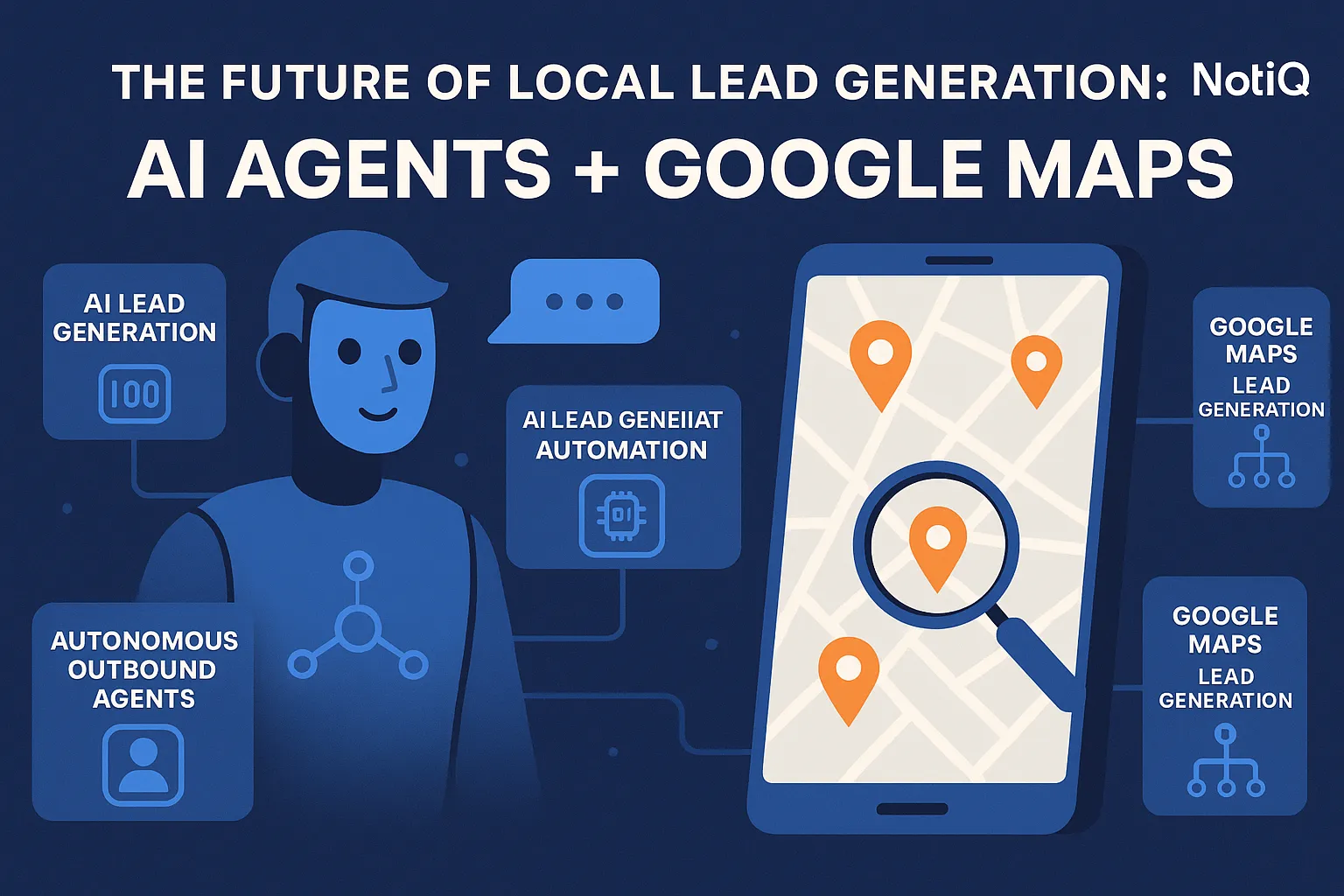
The Future of Local Lead Generation: AI Agents + Google Maps
Learn how autonomous AI agents are revolutionizing Google Maps lead generation with real-time data extraction, enrichment, and self-healing outbound intelligence loops.
1. Introduction
For years, local lead generation has been a battle of attrition. Sales teams and agencies have relied on manual Google Maps prospecting—scouring neighborhoods, copying phone numbers into spreadsheets, and praying the data is accurate. It is a slow, error-prone, and soul-crushing process that fails to keep pace with the dynamic nature of local businesses.
As the demand for real-time market intelligence grows, the old methods of static lists and manual entry are collapsing. We are witnessing a paradigm shift toward AI-powered local lead gen—a transition from human-dependent workflows to fully autonomous, multi-agent systems capable of navigating the physical world digitally.
This article provides a deep technical and practical breakdown of how autonomous agents are redefining outbound operations. Drawing from NotiQ’s experience in designing multi-agent AI architectures for high-volume outbound systems, we will explore how these intelligent loops extract, verify, and activate Google Maps lead generation AI strategies without human intervention.
2. Why Manual Local Prospecting Is Breaking Down
The traditional approach to building local business lists is fundamentally flawed. Manual prospecting on Google Maps is linear and resource-intensive. A human researcher zooms into an area, clicks on pins, verifies the website, and copies data. This process is unscalable. Even with basic scraping tools, the result is often a static snapshot that becomes obsolete the moment it is saved.
Manual local lead gen problems extend beyond simple fatigue. They introduce massive data hygiene issues. Duplicate entries, closed businesses, and incorrect contact details plague manual datasets, leading to wasted spend on outbound campaigns.
As we transition from manual tasks to automated intelligence, platforms like[NotiQ](/)are leading the charge, replacing brittle scraping scripts with resilient, autonomous systems. This shift aligns with broader industry standards for trustworthy automation, such as the OECD AI Principles, which emphasize robustness, security, and safety in AI deployment.
The Hidden Cost of Manual Google Maps Prospecting
The operational burden of manual prospecting is often underestimated. Agencies frequently burn dozens of hours per week on low-value data entry. The "hidden cost" includes not just the hourly wage of the researcher, but the opportunity cost of the sales team engaging with bad data.
When a sales development representative (SDR) dials a wrong number or emails a generic`info@`address that hasn't been checked in months, morale drops and CAC (Customer Acquisition Cost) spikes. Furthermore, manual methods lack repeatability. A human researcher might skip a geographic pocket or miss a specific category keyword, resulting in inconsistent coverage.Google Maps lead generation AI solves this by ensuring comprehensive, algorithmic coverage of target territories.
Why Semi-Automated Tools Still Fall Short
Many teams attempt to solve this with semi-automated "workflow tools" like Zapier, Make, or Clay. While these tools are powerful, they are not autonomous. They require a trigger—a human must feed them a list or initiate a sequence. They are reactive, not proactive.
Google Maps scraping automation via these platforms often breaks when Google changes a CSS selector or when a proxy fails. True workflow automation vs autonomy is the difference between a tool that waits for instructions and an agent that perceives, plans, and executes. Autonomous agents do not need a starting CSV; they need a goal (e.g., "Find all HVAC companies in Texas") and the autonomy to execute the necessary steps to achieve it.
4. Inside a Multi‑Agent System Built for Local Lead Generation
To achieve scale and accuracy, we move beyond single-bot scripts to multi agent systems for local lead generation. This architecture mimics a human research team, where different "agents" hold specialized roles and collaborate to achieve a shared objective.
Agent Roles & Coordination
A robust multi-agent architecture typically consists of several specialized nodes:
• The Dispatcher: Acts as the project manager, breaking down a large territory (e.g., "California") into manageable grid sectors and assigning them to Navigator agents.
• The Navigator: Explores the map interface, handling zoom levels and identifying business pins.
• The Extractor: Parses the specific details (Name, Address, Phone, Reviews) from the identified pins.
• The Enrichment Agent: Takes the raw data and searches the wider web for emails, social handles, and decision-maker names.
• The QA Agent: validatesthe final output, checking for formatting errors or duplicates.
Recent studies on autonomous agent optimization highlight that collaborative agent frameworks significantly reduce hallucinations and improve task completion rates compared to single-agent setups Optimization of Autonomous Agents. This agent coordination ensures that if one agent hits a roadblock (like a CAPTCHA), the Dispatcher can re-route resources without stopping the entire operation.
Eliminating Errors with Cross-Agent Verification
In manual workflows, fatigue leads to errors. In autonomous outbound agents, redundancy is a feature. A "Conflict Resolution" protocol allows agents to vote on data accuracy. If one agent finds a business marked "Permanently Closed" but another finds a recent review from yesterday, the system flags the entity for a deeper check rather than discarding it.
This ai verification process drastically improves lead data quality. We have seen instances where multi-agent systems corrected phone numbers by cross-referencing the Google Maps listing with the text found in the footer of the company's official website, resolving discrepancies that would have caused a bounce.
Contrast vs Competitor Workflows (Without Naming)
Most competitor tools on the market are "wrappers" around basic APIs. They lack persistent intelligence. They pull data once and forget it. If the business changes its hours or adds a new service tomorrow, the competitor's dataset is stale.
In contrast, a true multi-agent system offers adaptive loops. It doesn't just fetch data; it maintains a state of knowledge. This represents the future of outbound prospecting, where the system is not a tool you use, but a workforce you employ.
5. The Future of Outbound: Real-Time, Self-Healing Intelligence Loops
The ultimate evolution of google maps lead generation ai is the shift from "batches" to "streams." Instead of buying a list of 10,000 leads once a quarter, companies will subscribe to a real-time outbound intelligence stream that updates continuously.
Continuous Discovery & Refresh Cycles
New businesses open every day. Old ones rebrand.Hyperlocal business intelligence requires ai continuous monitoring. An autonomous system can be tasked to "watch" a specific city. The moment a new "Coffee Shop" pin appears in downtown Seattle, the agent detects it, enriches it, and pushes it to the sales team.
This allows agencies to be thefirstto contact a new business, rather than the fiftieth.
Adaptive Qualification Models
Not every lead is a good lead.AI lead qualification models integrated into these agents can analyze the "digital footprint" of a business to determine fit.
For example, an agent can analyze the photos uploaded to a Google Maps listing. Does the restaurant have high-end decor? If yes, it might be a fit for premium POS software. This adaptive segmentation ai evolves over time. If the sales team marks "low-end diners" as "Unqualified," the agents update their criteria to prioritize higher-value visual signals in future searches.
Autonomous Outreach Orchestration
Once the data is extracted and qualified, the loop must close with action.Autonomous outbound agents can trigger ai outreach automation sequences directly.
This is where orchestration layers like Scaliq become critical. By connecting the intelligence gathering (Maps agents) with the execution layer (Outreach agents), you create a self-correcting loop. If an email bounces, the system learns, updates the record, and attempts an alternative channel, ensuring total alignment between data and delivery.
6. Tools, Resources, and Practical Implementation
Implementing ai agent implementation strategies requires a mix of infrastructure and orchestration. Whether you are building from code or using low-code platforms, the principles of multi-agent setup remain the same.
Key Tools for Autonomous Local Lead Generation
For teams looking to build or buy google maps ai tools, the landscape is dividing into two categories:
1. Infrastructure Providers: Tools that provide the raw browser automation environments (e.g., Puppeteer, Playwright) enhanced for AI control.
2. Orchestration Platforms: Solutions like NotiQ that manage the complex logic, state, and cooperation between agents.
The orchestration layer is vital. Without it, you are simply running scripts. With it, you are managing a digital workforce.
Compliance & Safety Considerations
With great power comes great responsibility.AI outbound tools must operate within legal and ethical boundaries. This includes respecting`robots.txt`where applicable, adhering to rate limits to avoid burdening servers, and complying with data privacy laws (GDPR, CCPA).
Ethical scraping involves transparency and "good bot" behavior. We must align with global standards for AI safety. The OECD AI Principles provide a framework for responsible stewardship of trustworthy AI. Furthermore, systematic analyses of AI policies, such as those published by Springer, emphasize the necessity of accountability in automated data collection to prevent privacy erosion.
7. Conclusion
The era of manual prospecting is ending. The inefficiencies of human data entry are being replaced by the precision and scale of ai agents lead generation. We are moving from static lists to dynamic, self-healing intelligence loops that understand the physical world through Google Maps.
This transition is not just about speed; it is about accuracy, coverage, and the ability to operate in real-time.NotiQ stands at the forefront of this shift, providing the architectural backbone for the next generation of future of outbound systems.
For organizations ready to abandon the spreadsheet and embrace the autonomous future, the technology is here. It is time to let the agents do the work.
Frequently Asked Questions
- Will Google block AI-based scraping?
- Google employs anti-bot measures. However, ethical AI agents mimic human behavior (rate limiting, pause times) and focus on public data extraction. Adhering to responsible guidelines, such as the OECD AI Principles, is crucial for long-term viability.
Continue Reading
More articles you might find useful
Google Maps Lead Generation for Window and Door Installers
Learn how window and door installers can use Google Maps to find, qualify, and prioritize better local prospects. This beginner-friendly guide shows a repeatable workflow for smarter local outreach.
Read the article →
How to Prioritize Businesses With Verified Google Profiles
A practical framework for ranking local leads beyond the verified badge. Learn how to prioritize Google Business Profiles using fit, freshness, completeness, and activity signals.
Read the article →
Google Maps Prospecting for Commercial Waste Management Companies
Learn how commercial waste haulers can use Google Maps to find, qualify, and prioritize better local accounts. This guide shows how to build denser routes and improve outreach with waste-stream and service-area insights.
Read the article →Popular industry lead playbooks
Maps search examples and niche outreach for the verticals teams prospect most.