Technology
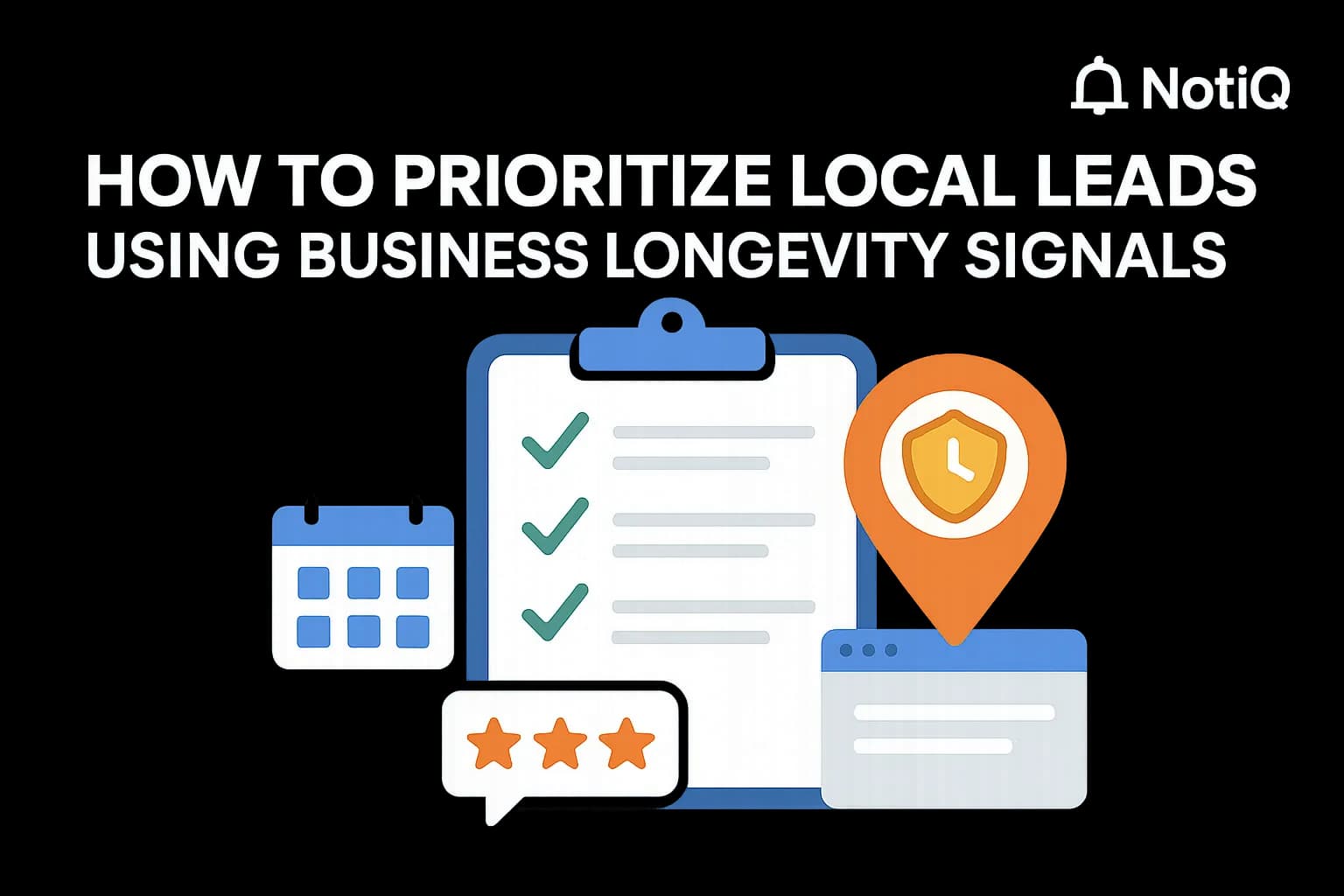
How to Prioritize Local Leads Using Business Longevity Signals
Learn how to use business age, domain history, review activity, and listing consistency to prioritize stable local leads. This practical framework helps sales teams rank accounts more accurately and reduce wasted outreach.
1. Introduction
Local prospecting breaks down when every business on a list looks equally qualified on the surface, but only a fraction are actually stable, active, and worth a sales rep's time. Small-to-medium business (SMB) and local-business outreach frequently suffers from sparse firmographic data, outdated records, and weak qualification logic. When internal data fails to paint an accurate picture, sales teams waste valuable hours chasing dormant accounts.
To solve this, outbound teams can leverage public longevity signals to rank accounts more intelligently. By analyzing founding dates, domain age, review history, and listing consistency, revenue teams can build a practical model that uses these elements as trust proxies for prospect prioritization. Rather than relying on generic SEO theory or basic lead scoring, this framework bridges local trust signals with rigorous outbound sales qualification.
As an analytical authority on local lead qualification, NotiQ champions a transparent, evidence-based methodology to evaluate accounts. In this article, you will learn how to build a weighted scoring rubric, implement false-positive checks, and operationalize a business age lead scoring model at scale. For more foundational reading on qualification-focused prospecting, explore our resources at Blog.
2. Why Local Lead Scoring Needs Longevity Signals
Generic fit-and-engagement models often fall short when applied to SMB and local outreach. The primary pain points are universal among local sales teams: too many local leads with unclear fit, limited firmographic depth, and massive amounts of wasted outreach on inactive or low-stability businesses.
Standard lead scoring frameworks rely heavily on deep internal data, intent signals, and robust tech-stack tracking—luxuries rarely available in the local SMB space. In local-business reality, public trust and operating-history signals are much easier to verify than deep company financials. Established local businesses consistently signal stronger operational stability, clearer budgets, and a significantly lower risk of inactivity. According to BLS establishment age and survival data, survival rates correlate strongly with establishment age, making tenure a highly meaningful maturity signal.
Better B2B lead prioritization directly translates to pipeline efficiency. When reps prioritize effectively, they experience less wasted effort and higher first-touch conversion potential. Unlike firmographic-only or engagement-only scoring—which often misses the nuances of local market presence—this approach integrates lead scoring, reviews, and local SEO trust signals into a single, cohesive local lead scoring model. To see how public business signals can be transformed into operational scoring workflows, visit[Home](/).
Where Traditional SMB Lead Qualification Breaks Down
Local and SMB accounts fundamentally lack the rich enrichment fields typically associated with mid-market or enterprise records. When purchasing or scraping lead lists, teams often inherit stale, duplicate, or low-confidence businesses. Because of this limited firmographic depth for SMB accounts, traditional lead qualification breaks down. Local sales teams require observable, public indicators of stability to guide their sales prospecting efforts when internal CRM data is weak or outdated.
Why Longevity Signals Add Incremental Value
Business longevity signals are observable indicators of a company's operating history and consistency over time. These trust signals for outbound prospecting do not replace essential data like geography, vertical, service mix, or engagement data; rather, they complement them. Multi-signal scoring is inherently more reliable than relying on any single data point. By measuring business credibility signals collectively, sales teams can accurately gauge the operational maturity of a local account.
3. The Core Business Maturity Signals to Track
To accurately identify established local businesses, teams must track a specific set of maturity signals. No single signal should determine priority on its own. Instead, they must be analyzed together to form a comprehensive business age lead scoring model.
Founding Date and Legal Business Age
A company founding date is one of the clearest indicators of business maturity when reliable data is available. Older businesses generally reflect survival, operating consistency, and greater market familiarity. However, local business tenure thresholds vary significantly by vertical. A five-year-old roofing company may be considered highly established, while a five-year-old local software consultancy might still be in a growth phase. As supported by BLS establishment age and survival data, age and survival are deeply intertwined, making tenure a foundational element of qualification logic.
Domain Age as a Web Presence Signal
Domain age serves as a proxy for how long a business has maintained a digital identity. In domain age lead qualification, an older domain suggests legitimacy and consistency. However, domain age alone is not strong enough to prove operational maturity. Edge cases exist, such as parked domains, recently acquired domains, brand pivots, and old websites with weak active operations. To responsibly validate registration history and business credibility signals, sales teams can utilize tools like the ICANN domain registration lookup.
Review Count, Review Recency, and Review History
When evaluating review history business credibility, the timeline of reviews is far more useful than the raw review count alone. Cumulative reviews, review recency, and review velocity indicate ongoing customer activity and operational consistency. A business with 500 reviews from five years ago but zero recent activity is less stable than a business with 50 reviews generated consistently over the last six months. Understanding how Google uses business profile and review data, along with insights from the Princeton longitudinal review dataset, demonstrates how sustained review patterns are vital for accurate local lead scoring.
Listing Consistency Across Local Profiles
Listing consistency refers to the stable representation of a business's Name, Address, Phone number (NAP), and category across local directories. Inconsistent local business listings often signal weak operations, recent management transitions, or unreliable data. Consistent representation builds discoverability and lowers verification friction for sales teams. As detailed in the Google Business Profile representation guidelines, consistent business credibility signals matter deeply. This is precisely where SEO trust logic becomes a highly useful mechanism for sales qualification.
Supporting Context Signals That Improve Interpretation
Geography, industry, and location count help contextualize the main longevity indicators. For example, a multi-location home services brand requires different B2B lead scoring for SMBs than a solo legal practice or a newly opened specialty clinic. Context should influence the weighting of your local lead scoring model, ensuring that prospect prioritization remains logical and industry-appropriate.
4. How to Build a Weighted Scoring Rubric
To move from theory to execution, sales teams need an actionable scoring model. A weighted rubric provides a structured framework to assign points, combine signals, and create transparent priority tiers, ensuring reps understand exactly why a lead ranks highly.
Start With a Simple 100-Point Model
A highly effective business age lead scoring model starts with a 100-point scale. Allocate points across the core signals: age/founding date, domain age, review history, and listing consistency. By establishing relative weighting rather than a fixed, inflexible truth, teams can adjust the model based on performance. These lead scoring frameworks should be simple enough to test manually in a spreadsheet before automating the local lead scoring process in a CRM.
Suggested Weighting Logic for Core Signals
Founding date prospecting and review history business credibility deserve heavier emphasis than domain age lead qualification alone.
• Strong Evidence (e.g., 10+ years in business, consistent weekly reviews): 25-30 points.
• Moderate Evidence (e.g., 3-5 years in business, monthly reviews): 10-20 points.
• Weak Evidence (e.g., newly registered domain, sparse reviews): 0-5 points.
Multiple medium-strength signals combined will easily outweigh one strong standalone signal. Based on the total score, accounts can be routed into a tier system:High Priority(80-100),Medium Priority(50-79),Low Priority(25-49), and Monitor(0-24).
Add Negative Scoring and Confidence Checks
Negative scoring protects the model from over-prioritizing weak fits when data is inconsistent. If a business has a 15-year-old domain but zero recent reviews, or wildly inconsistent listings across directories, points should be deducted. Subtracting points for misleading business credibility signals ensures that prospect prioritization remains accurate and reps do not waste time on dormant accounts.
Combine Longevity With Existing Fit Signals
Longevity signals must complement—not compete with—category, service area, ICP fit, and engagement data. A best-practice workflow order is:Fit First → Maturity Second → Engagement Third. This creates a more robust B2B lead prioritization model than generic data enrichment alone. Public-signal enrichment offers transparent, verifiable data, bridging the gaps often left by traditional data providers. For scalable enrichment and workflow support in ranking local businesses,Home provides robust infrastructure for lead qualification.
Example Rubric Walkthrough
Consider two hypothetical businesses to see how to score local business leads:
1. Account A (Established Local Business): Founded in 2012 (25 pts), domain registered in 2012 (15 pts), steady review velocity with 5 reviews this month (30 pts), perfect listing consistency (20 pts). Total: 90/100 (High Priority).
2. Account B (Mixed Signals): Founded in 2005 (25 pts), domain registered in 2005 (15 pts), but no reviews in the last three years (-10 pts for negative scoring), and inconsistent addresses online (0 pts). Total: 30/100 (Low Priority / Needs Validation).
These trust signals for outbound prospecting make prioritization objective and mathematical.
5. How to Avoid False Positives and Missing Newer Winners
Maturity signals are useful proxies, not absolute guarantees of buying readiness. To maintain a credible lead qualification system, operators must understand where business longevity signals can fail and how to correct for those vulnerabilities during prospect prioritization.
Common False Positives in Longevity-Based Scoring
Domain age lead qualification can easily produce false positives. Old domains are frequently attached to dormant businesses or recently acquired brands that have pivoted entirely. Legacy listings may contain outdated information, and businesses with hundreds of old reviews but no current activity can artificially inflate scores. Without cross-checking these business credibility signals, review history business credibility can be misleading. Always implement practical validation steps before finalizing outreach prioritization.
How to Spot High-Potential Newer Businesses
Newer businesses should not be automatically deprioritized. Established local businesses are valuable, but a one-year-old company with rapid location growth, high listing consistency, and aggressive review recency is a prime target. Create an "emerging priority" or "watchlist" tier for these newer accounts. B2B lead scoring for SMBs must remain flexible enough to capture accounts exhibiting high momentum and excellent ICP fit.
Use Industry-Specific Thresholds Instead of Universal Rules
What constitutes an "established" business varies wildly. A ten-year local business tenure is standard for a legal practice, but a three-year-old digital agency might be considered highly mature. To accurately determine what longevity signals indicate an established local business, operators must benchmark within the specific category and geography. Contextual thresholds improve local lead scoring accuracy without overcomplicating the model.
Validate Public Signals Before Final Prioritization
Before pushing high-priority accounts to sales reps, conduct a final verification pass. Cross-check business profile details, recent review activity, domain records, and visible operating signs on the company's website. Following the Google Business Profile representation guidelines and utilizing the ICANN domain registration lookup ensures that your business credibility signals are legally compliant and publicly accessible. This verification step is the difference between a merely helpful score and a truly trustworthy lead qualification framework for sales prospecting.
6. How Sales Teams Can Operationalize the Model at Scale
Moving from theory to repeatable team workflows requires structured operations. Ops teams must batch-enrich, score, segment, and route accounts transparently so that reps trust the data.
Build the Workflow in Stages
Do not overcomplicate the initial rollout. Build the workflow in a practical sequence:Source Leads → Enrich Public Trust Signals → Score Accounts → Tier Them → Route to Reps. Simple spreadsheet-based validation is the best starting point for local lead scoring before integrating complex automation. Because review recency and listing consistency change, ensure your data enrichment process includes periodic score refreshes to maintain accurate lead qualification.
Create Actionable Priority Tiers for Reps
Score bands must translate into immediate actions. The goal of prospect prioritization is to reduce cognitive load, not give reps another abstract dashboard.
• High Priority: Immediate omnichannel outreach, highly personalized messaging.
• Medium Priority: Standard automated cadence, moderate personalization.
• Low Priority/Monitor: Nurture campaigns, periodic check-ins.
Linking B2B lead prioritization directly to channel strategy and cadence intensity ensures efficient sales prospecting.
Make the Model CRM- and Spreadsheet-Friendly
When building lead scoring frameworks, store each signal in a separate CRM field rather than only storing the final score. Visibility into component signals (e.g., "Domain Age," "Review Velocity") aids in auditability and model iteration. Include confidence flags in your data enrichment process where data quality is uncertain, ensuring the business age lead scoring remains transparent to the end-user.
Differentiate This Approach From Standard Sales Intelligence Workflows
Standard sales intelligence platforms focus heavily on firmographics and engagement. This model adds a critical layer of public-web trust and maturity that is exceptionally useful for local accounts. By utilizing citation consistency, review freshness, and domain history, teams can vastly improve list quality where traditional SMB data is sparse. These business longevity signals act as superior trust signals for outbound prospecting. As an orchestration layer for analytical local lead qualification workflows,[Home](/)helps teams integrate these unique signals seamlessly.
Where to Test and Refine the Scoring Model
Never roll out a new business age lead scoring model globally on day one. Pilot the model on a single geography, a specific vertical, or one outbound team. Measure the improvements in reply rates, connect rates, meetings booked, and pipeline quality by score tier. Prospect prioritization requires continuous refinement; treat your initial lead qualification weights as a baseline to be optimized based on actual conversion outcomes.
7. Future Trends in Local Lead Qualification
The GTM landscape is experiencing a growing shift toward alternative business intelligence signals for SMB and local prospecting. Teams are increasingly combining business longevity signals with territory logic, fit, and engagement data to create holistic profiles. Moving forward, AI-assisted prospecting workflows will help surface, parse, and maintain these public-signal layers more efficiently, ensuring that local lead scoring remains compliant, accurate, and highly scalable.
8. Conclusion
Local lead prioritization improves dramatically when teams move beyond generic scoring and utilize public longevity signals as transparent trust proxies. By evaluating founding date, domain age, review history, and listing consistency through a weighted rubric, sales teams can identify truly established local businesses.
However, nuance is critical: domain age alone is insufficient, older businesses are not universally better, and newer high-momentum companies must still have a path to priority. Start with a simple business age lead scoring model, validate it on a small segment, and refine your weights based on conversion outcomes. Evaluate your current local lead scoring process today—if it lacks maturity signals, build them into your workflow immediately.
NotiQ specializes in turning fragmented public trust signals into repeatable, qualification-focused prospecting workflows. To explore more educational content on outbound strategies, visit Blog. To learn how we can support scalable local lead qualification for your team, visit[Home](/).
Frequently Asked Questions
- How can business age improve lead scoring for local outreach?
- Business age acts as a powerful maturity and survival proxy, which is vital when SMB firmographic depth is limited. By incorporating business age lead scoring alongside reviews, local listings, and standard fit data, teams can accurately predict which local accounts are stable and actively operating, directly answering how can business age improve lead scoring for local outreach.
- What longevity signals indicate an established local business?
- To determine what longevity signals indicate an established local business, teams should look at founding date, domain age, review count, review recency, review velocity, and listing consistency. The strongest models rely on multiple corroborating business longevity signals rather than a single data point.
- How reliable is domain age as a sales prospecting signal?
- When asking how reliable is domain age as a sales prospecting signal, the answer requires nuance. Domain age lead qualification is useful as a credibility clue, but it is weak if isolated from review and listing evidence. Aged domains, parked sites, and rebrands are common false positives that must be cross-checked.
- Should review history be included in local lead qualification?
- Yes, review history business credibility provides verifiable evidence of ongoing customer activity and active operations. When considering should review history be included in local lead qualification, remember to distinguish review recency and velocity from raw review count, as recent activity is the true indicator of a healthy business.
- What is the best way to prioritize established local businesses without ignoring newer companies?
- The best way to prioritize established local businesses is to use a weighted model with clear maturity tiers, while simultaneously building an exception path for newer businesses. By tracking review velocity and listing momentum, your local lead scoring can elevate new, high-growth companies for immediate prospect prioritization.
Continue Reading
More articles you might find useful
How to Find Businesses With Inconsistent Opening Hours
Learn how to spot inconsistent business hours across Google Business Profiles, websites, and directories using a repeatable audit workflow. This guide shows how to turn hours mismatches into qualified local SEO opportunities.
Read the article →
Google Maps Lead Generation for Commercial Flooring Companies
Discover a practical Google Maps prospecting workflow for commercial flooring companies. Learn how to find, qualify, and organize better local B2B opportunities.
Read the article →
How to Build Lead Lists From Businesses in Tourist Areas
Learn how to build better hotel and hospitality lead lists by focusing on tourist zones, visitor intent, and seasonality. This guide shows a repeatable workflow for finding higher-fit prospects in destination markets.
Read the article →Popular industry lead playbooks
Maps search examples and niche outreach for the verticals teams prospect most.