Technology
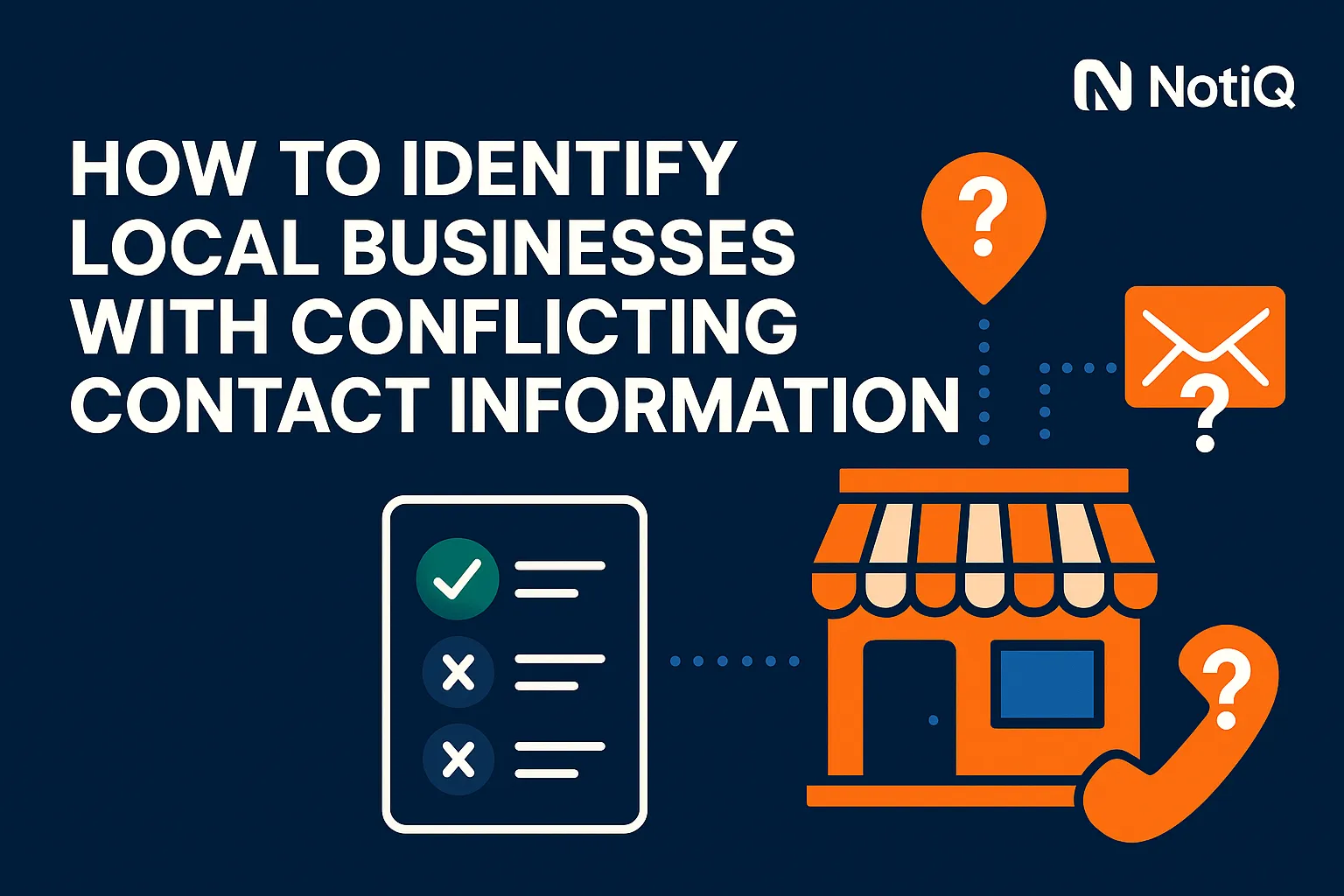
How to Identify Local Businesses With Conflicting Contact Information
Conflicting business contact details can break outreach, routing, and local SEO. This guide shows how to run a NAP consistency audit and build a repeatable workflow to verify local records at scale.
1. Introduction
In the realm of B2B data operations, few things are as frustrating as a practical data-quality failure where a single local business presents entirely different contact details across the web. You might find one phone number on their official website, a different number on Google Maps, and a third variation in a prominent business directory.
For advanced sales ops, data-quality, and lead-generation teams, this is far more than a simple local SEO citation issue. When conflicting contact information for local businesses infiltrates your CRM, the operational consequences are severe: failed call routing, bounced outreach, duplicate entities muddying attribution, diluted local trust signals, and wasted spend on faulty data enrichment.
This guide provides a definitive framework to identify local businesses with inconsistent business data, determine which sources to trust, and build a repeatable, compliant local lead verification process. Unlike generic "fix your listings" advice, this is a diagnostics-first methodology designed for teams that need to verify recordsbeforeinitiating outreach or synchronization.
As a platform experienced in identifying discrepancies across websites, Maps listings, phone numbers, and email records,[NotiQ](/)understands that effective data reconciliation requires evidence gathering, not just blind data overriding. By the end of this article, you will have a clear blueprint for resolving contact conflicts at scale.
2. Why Conflicting Local Contact Data Happens
To effectively resolve inconsistent business data, teams must first understand its root causes. Many data "conflicts" are not random errors or typos; they are the byproduct of complex operational realities. Source lag, corporate rebrands, physical relocations, the implementation of call tracking layers, complex franchise structures, and disconnected update cycles all contribute to business listing discrepancies.
Furthermore, inconsistent formatting can mimic conflicting data, creating the illusion of a mismatch even when the underlying business entity is the same. Recognizing these causes is critical because they directly impact operational outcomes. Stale phone numbers lead to failed sales outreach, mismatched addresses break territory routing, and duplicate profiles create uncertainty in lead ownership.
This diagnostic approach prioritizes evidence gathering. Rather than jumping straight to remediation or aggressively overwriting records to force NAP consistency, advanced teams must first understandwhythe data diverges.
The Most Common Conflict Patterns
Discrepancies generally fall into a few predictable categories. The most common conflict patterns include business name variations (e.g., "Smith Dental" vs. "Smith Dental LLC"), outdated business phone numbers left behind after a telecom switch, mismatched business addresses due to relocations, alternate domain names, broken email addresses, and duplicate business profiles.
Advanced data teams must also account for complex edge cases. These include suite number differences in multi-tenant buildings, call tracking numbers that mask the primary local line, service-area businesses (SABs) that hide their physical address, practitioner listings (e.g., doctors or lawyers operating inside a larger clinic), and multi-location brands.
It is vital to distinguish between a formatting variance (e.g., "St." vs. "Street") and a true contact conflict (e.g., two entirely different area codes). Furthermore, data ops must differentiate between "temporarily inconsistent" records—such as a business currently undergoing a rebrand—and "clearly stale" records that have been abandoned for years.
Why This Is More Than a Local SEO Issue
While local marketers obsess over NAP consistency for search rankings, contact data quality is a fundamental requirement for revenue operations. Inconsistent data impacts lead routing, sales productivity, enrichment accuracy, and ultimately, customer trust.
The same flawed record can trigger failures across multiple operational workflows. It can cause automated email verification to fail, misalign territory assignments in the CRM, prevent accurate CRM deduplication, and degrade local listing accuracy. For operations and lead-generation teams, the priority is securing reliable recordsbeforelaunching outreach campaigns, as low confidence in lead routing and outreach accuracy directly translates to lost revenue. Effective local business data reconciliation is therefore a core sales enablement function.
3. Which Sources to Trust First
When faced with conflicting data, the immediate question is: "Which source should be treated as the system of record?" The answer lies in establishing a strict source hierarchy.
A standard hierarchy prioritizes owned sources (first-party websites), platform-controlled sources (Google Maps), authoritative third-party references (government databases or major aggregators), and finally, lower-confidence directories. However, "trust first" does not mean "trust blindly." Every source must be evaluated for freshness, completeness, and consistency with surrounding evidence. Rather than crowning a single "winner" for an entire record, teams should create field-level trust rules. This nuanced approach fills a major gap in most business contact data verification guides, which explain where data lives but fail to explain how to rank source trust for operational decisions.
Build a Source Hierarchy for Local Business Records
A practical trust order for local business contact data should evaluate sources in the following sequence: the business website, Google Business Profile / Google Maps, major industry directories, and secondary citations.
The first-party website should generally be treated as the strongest evidence for branding and domain relationships, though it can sometimes be stale or technically incomplete. Google Business Profile serves as a critical validation layer, especially for public-facing local contact information. Following the Google Business Profile representation guidelines is essential for understanding how businesses are expected to present their legitimate, real-world contact details.
While lower-tier directories are less authoritative on their own, they remain highly useful as corroborating evidence. If multiple independent directories agree on a new phone number, and the first-party website looks abandoned, the directory consensus may outweigh the stale website, helping to resolve Google Business Profile inconsistencies, Google Maps business listing discrepancies, and overall local citation accuracy.
Decide Your System of Record by Field, Not Just by Source
Treating an entire data source as the absolute system of record is a flawed strategy. Phone numbers, physical addresses, email addresses, websites, and business names each require separate trust logic.
For instance, the company website may be the most reliable source for mapping domain-to-email relationships (email verification). Meanwhile, a highly active Google Business Profile may be the strongest source for public location and phone number verification. For address validation, standardized postal references are unmatched. Relying on USPS postal addressing standards and the federal address data standard ensures that address structure validation is based on authoritative frameworks rather than user-generated inputs. Implementing field-level trust logic drastically reduces false confidence in mixed-quality records.
4. How to Detect and Match Conflicting Records
Identifying local businesses with conflicting contact information at scale requires a highly technical, automated workflow. Comparison should never be executed on raw, unstructured data. To achieve accurate lead data enrichment, records must be normalized before they are matched.
The standard sequence is: collect publicly accessible data, normalize the fields, link the entities, compare the values, and classify the conflict type. This workflow prioritizes diagnostics before remediation. The goal is to identify whether disparate records reflect the same entity, a duplicate, a stale listing, or a false match. This methodology clearly differentiates professional entity resolution from basic data scraping; the focus is entirely on compliant verification logic and evidence-backed reconciliation, adhering strictly to platform terms of service and privacy regulations.
Normalize Fields Before Comparison
Before assessing conflicts, you must standardize business names, legal abbreviations, phone formats, addresses, and URLs. Without NAP normalization, a system might flag "123 Main St" and "123 Main Street" as a conflict, creating unnecessary manual review tasks.
Common normalization tasks include:
• Removing punctuation and standardizing casing differences.
• Normalizing legal suffixes (e.g., LLC, Inc.) and directional/address abbreviations according to authoritative guidelines like the USPS postal addressing standards.
• Converting phone numbers to a consistent E.164 or country/area formatting.
• Canonicalizing domains (removing "www" or "https://") to accurately compare contact pages.
Normalization ensures that your business contact data verification process catches true anomalies rather than mere formatting variances, drastically reducing false positives.
Match the Same Business Across Inconsistent Listings
Record linkage for local business listings is the process of determining if two distinct data points represent the same real-world entity. This requires sophisticated entity resolution logic.
To accurately match entities, systems look at overlapping signals: normalized name similarity (using fuzzy matching), address overlap, phone number matches, domain alignment, geolocation clues (latitude/longitude proximity), and category consistency. Because comparing every record against every other record in a massive database is computationally impossible, teams must employ blocking logic—pre-grouping records by state, zip code, or phone area code—to reduce noisy comparisons.
Ambiguous cases require careful tuning. Franchises sharing a brand name, relocations where the address changes but the phone remains, practitioners sharing a single clinic address, and businesses with alternate DBAs must be handled gracefully. As supported by this record linkage evaluation study, weighted review and algorithmic adjudication are critical for accurate local business data reconciliation.
Spot Duplicates, Stale Records, and False Positives
Once entities are linked, the system must distinguish between duplicate business profiles for the same business, stale but formerly valid listings, and unrelated entities that simply share similar names (false positives).
Indicators of staleness include disconnected phone numbers, outdated addresses lingering after a known corporate move, expired domains, sparse update histories, and direct contradictions from newer first-party sources. Advanced teams should never configure their systems to auto-merge all partial matches. Merging a stale record with a fresh one can corrupt the primary CRM entity. This diagnostic depth separates true forensic review from basic competitor-style citation audits that merely highlight conflicting website and map listing records without resolving the underlying entity truth.
5. How to Score Discrepancies and Prioritize Review
Not every data inconsistency deserves the same level of operational response. To turn raw business listing discrepancies into actionable decisions, teams must implement severity and confidence models.
By scoring discrepancies based on field importance, source agreement, recency, and business impact, teams can establish threshold-based handling rules. Records can be automatically accepted, flagged for manual review, or held back entirely from outreach campaigns. This transparent, logic-driven methodology elevates contact data quality far beyond standard local lead verification practices.
Create Severity Tiers for Contact Conflicts
Classifying issues by their operational impact ensures that data teams focus on the most critical errors first. A simple severity rubric includes:
• High Severity: Disconnected phone numbers, invalid addresses, wrong website domains, or duplicate entities causing CRM routing errors. These directly block outreach and require immediate intervention.
• Medium Severity: Suite number mismatches, alternate but working phone numbers, or slight naming variations. These may cause minor friction but rarely break a workflow.
• Low Severity: Formatting-only differences (e.g., "Ave" vs. "Avenue"). These should be resolved automatically.
Understanding severity allows teams to gauge the manual verification effort for SMB records and prioritize fixes that unblock prospecting, enrichment, and local SEO remediation, particularly when dealing with outdated business phone numbers.
Assign Confidence Scores by Field
Confidence scoring for business contact fields requires combining source hierarchy, corroboration count, freshness, and validation outcomes into a distinct score for each data point.
It is entirely possible for a record to possess a high-confidence address but a low-confidence email. Scoring signals might dictate that if a first-party website confirms a phone number, the confidence score increases. If a Google Business Profile matches the normalized address, confidence peaks. Conversely, if multiple low-quality directories conflict with one another, or if an email domain does not match the primary website domain, the confidence score for those specific fields plummets, triggering further email verification or phone number verification protocols.
Decide When to Automate vs. Trigger Manual Review
With severity and confidence scores established, teams can define rules for exception handling.
• Auto-Accept: Triggered when high-confidence sources agree and severity of any variance is low.
• Queue Manual Review: Triggered when high-value records exhibit unresolved conflicts across critical fields.
• Suppress Outreach: Triggered when critical fields are completely unverifiable or flagged as high-severity errors.
To optimize how to verify local business phone numbers at scale, prioritize high-risk or high-value leads first. Establish specific review queues for moved businesses, rebrands, duplicates, and multi-location ambiguity. For teams evaluating the balance between a manual local citation audit vs automated verification workflow, exploring implementation options at NotiQ's pricing page can provide clarity on scaling these local lead verification operations.
6. How to Build a Repeatable Verification Workflow
Translating this framework into an operational reality requires a step-by-step system spanning from data ingestion to review and remediation readiness. Because local business data changes frequently, this cannot be a one-time cleanup project; it must be a recurring audit process that simultaneously supports both local SEO initiatives and sales/data ops teams.
Step 1–3: Collect, Normalize, and Compare
The foundational workflow begins with data collection. Gather publicly accessible records from the business website, Google Business Profile, Maps, and major directories. Next, normalize names, addresses, phones, emails, and domains using the standard rules discussed earlier. Finally, compare the records field-by-field to identify mismatches.
Source coverage must include both owned and third-party records to establish a baseline of truth. Crucially, systems must preserve source-level evidence rather than overwriting raw inputs too early. If you immediately overwrite a Google Business Profile inconsistency without logging what it originally was, you lose the audit trail necessary for accurate address and email validation for SMB leads during a local citation audit.
Step 4–5: Score, Queue, and Resolve
After comparison, assign field confidence and record severity scores. Route the records into appropriate operational buckets: auto-approved, needs manual review, or blocked for outreach/remediation.
When a record is flagged for a human queue, the system must document exactlywhyit was flagged (e.g., "Website phone contradicts Directory phone"). This context allows future reviewers to understand the evidence at a glance, streamlining business contact data verification and maintaining strict contact data quality.
Build QA Rules and Reverification Cadence
Practical QA rules act as the safety net for your automated systems. Standard rules should include:
• Flag if the website phone ≠ GBP phone.
• Flag if the address fails normalization or geocoding checks (referencing authoritative tools like the Census geocoder documentation for location validation).
• Flag if the contact email domain and the primary website domain do not align.
• Flag if duplicate listings share core identity signals but diverge on contact info.
How often should local business records be re-verified? The reverification cadence should be defined by business value and change risk. High-value leads and highly volatile SMB categories (like local contractors or restaurants) require frequent checks (e.g., monthly), while stable, long-tail enterprise records may only require quarterly or bi-annual local lead verification.
Manual Citation Audit vs. Automated Verification Workflow
When comparing a manual local citation audit vs automated verification workflow, both have distinct roles. Manual audits are highly useful for edge cases, complex franchise hierarchies, and policy-sensitive records where human judgment is required. However, automation is absolutely essential for scale, consistency, and recurring checks.
Automated workflows excel in AI enrichment, rapid verification, and maintaining compliance with data privacy standards—areas where traditional listing management tools often fall short. Diagnostics-first verification proves which data is correctbeforepushing updates, standing in stark contrast to legacy sync tools that focus merely on data distribution. For deeper technical insights on data quality vs listing management, visit the NotiQ blog.
7. Tools, Resources, and Operational Considerations
Selecting the right business contact data verification tools requires looking past basic scraping volume and focusing on diagnostic depth. Advanced local citation management software should provide robust capabilities including field normalization, fuzzy entity matching, distinct phone/email/address checks, evidence retention, confidence scoring, and dedicated review queues.
When evaluating tools, prioritize those that offer transparent, documented rules for how records are accepted, flagged, or rejected.
Implementation Readiness Checklist:
1. Source Coverage: Can the tool compliantly access first-party websites, Maps data, and major directories?
2. QA Logic: Does it support field-level confidence scoring and severity tiering?
3. Manual Escalation: Is there a clean UI for human reviewers to adjudicate flagged records?
4. Audit Cadence: Can the system automate reverification based on custom schedules?
Maintaining high contact data quality requires a toolset built for evidence-based verification, not just blind data synchronization.
8. Future Trends in Local Lead Verification
As the digital footprint of SMBs grows more complex, local business data reconciliation is evolving rapidly. Several emerging trends are shaping the future of lead data enrichment and verification:
• Automated Entity Resolution: AI and machine learning are drastically improving the ability to match local businesses across wildly inconsistent datasets without relying on exact-match logic.
• Increased Reverification Frequency: The rapid pace of SMB turnover, relocations, and rebrands means static data decays faster than ever, necessitating continuous monitoring rather than annual cleanups.
• Convergence of SEO and Sales QA: The historical divide between local SEO citation management and sales-data QA is collapsing. Both teams require the exact same foundational truth to execute their workflows.
• Standardization of Confidence Scoring: Confidence scoring for business contact fields is moving from a niche advanced tactic to a standard operating layer in all modern CRM and RevOps tech stacks.
Advanced data teams must design workflows that support ongoing, compliant monitoring to stay ahead of these trends.
9. Conclusion
Identifying conflicting contact information for local businesses requires far more than checking a few directories. It demands a rigorous, evidence-based approach encompassing source hierarchy, data normalization, automated entity matching, and field-level confidence scoring.
By building a repeatable workflow—collecting evidence, standardizing records, matching entities, classifying conflicts, scoring confidence, and intelligently routing exceptions—teams can safeguard their operations against the costly impacts of inconsistent business data. The most critical takeaway is that discrepancy detection and local lead verification must happenbeforesynchronization, enrichment, or sales outreach begins.
If your team is struggling with fragmented local data, it is time to upgrade your operational infrastructure. Explore how[NotiQ](/)helps revenue and data ops teams compliantly detect discrepancies across websites, Maps listings, phone numbers, and email records at scale, ensuring your outreach is always powered by verified truth.
Frequently Asked Questions
- How do you identify local businesses with conflicting contact information?
- To identify how to identify local businesses with conflicting contact information, teams must execute a structured process: collect publicly accessible records from the business website, Google Business Profile, Maps, and directories; normalize the data fields; compare the values; and score source agreement to flag true conflicts for business contact data verification.
- Which source should be trusted when business phone numbers and addresses conflict?
- Determining which source should be trusted for local business contact data is field-specific. Trust should be evidence-based, heavily prioritizing first-party websites for branding, Google Business Profile guidance for public contact presentation, and authoritative postal standards for address validation and phone number verification.
- Why does NAP inconsistency hurt lead quality and local SEO?
- NAP consistency directly impacts both marketing and sales. Inconsistent data dilutes local trust signals resulting in lower search visibility, while simultaneously causing failed sales outreach, poor CRM territory routing, and inaccurate contact data quality, crippling local lead verification efforts.
- How can sales and ops teams verify local lead contact details at scale?
- Figuring out how to verify local business phone numbers at scale requires automation. Teams should implement normalization, entity resolution, and confidence scoring for business contact fields, paired with intelligent exception queues to minimize the manual verification effort for SMB records.
- How often should local business records be re-verified?
- When deciding how often should local business records be re-verified, teams should use risk-based cadences. High-value leads, volatile industry verticals, and businesses showing signs of recent relocations, rebrands, or duplicate profile activity require frequent, ongoing local business data reconciliation.
Continue Reading
More articles you might find useful
Google Maps Prospecting for Uniform and Workwear Suppliers
Learn a practical Google Maps workflow for finding and qualifying local uniform and workwear buyers. This guide shows suppliers how to spot recurring demand and prioritize better B2B leads.
Read the article →
How to Find Local Businesses With Very Few Website Pages
Learn how to find local businesses with very few website pages using a repeatable audit framework. This guide shows how to validate page count, spot missing pages, and prioritize the best outreach opportunities.
Read the article →
Google Maps Lead Generation for Window and Door Installers
Learn how window and door installers can use Google Maps to find, qualify, and prioritize better local prospects. This beginner-friendly guide shows a repeatable workflow for smarter local outreach.
Read the article →Popular industry lead playbooks
Maps search examples and niche outreach for the verticals teams prospect most.