Technology
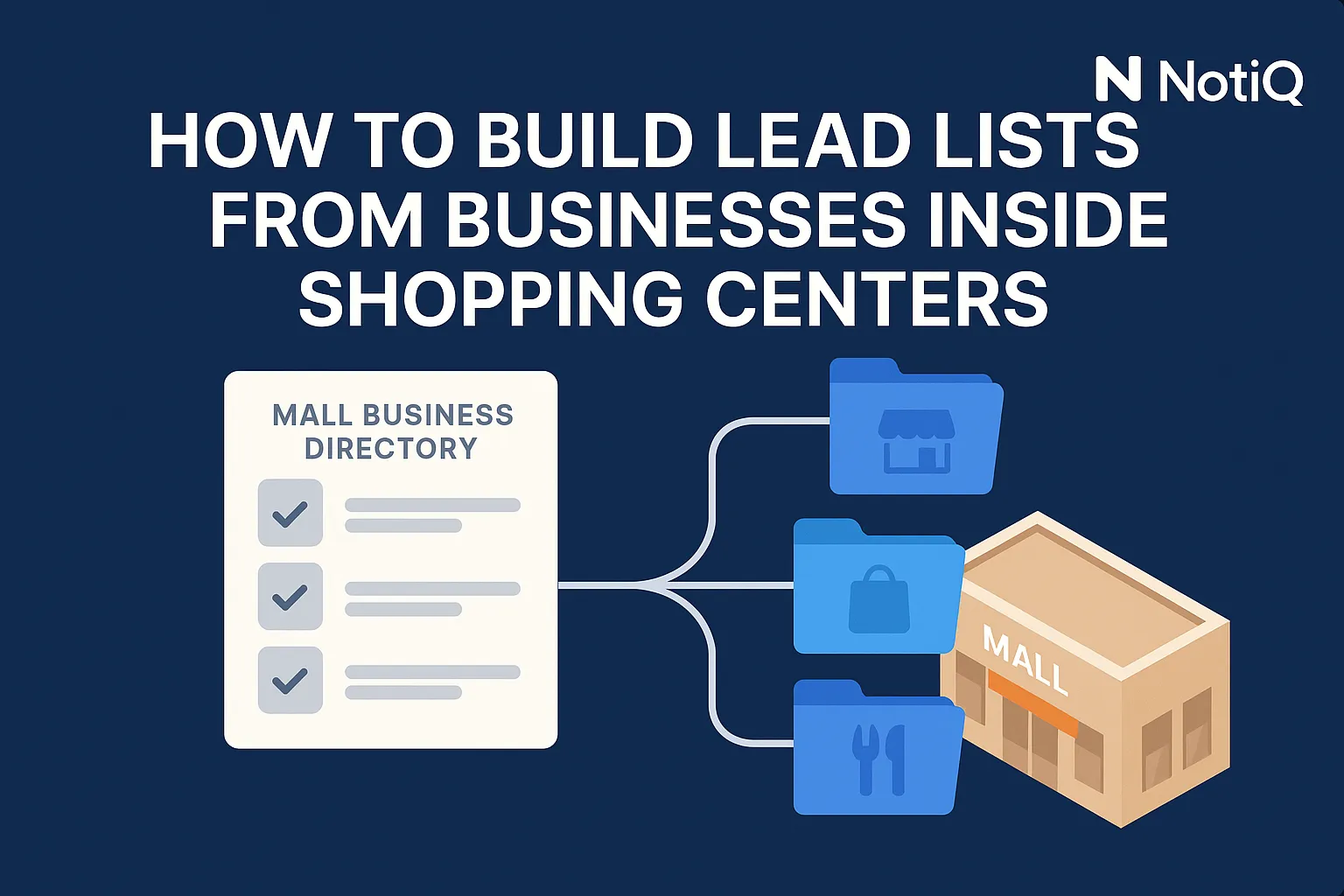
How to Build Lead Lists From Businesses Inside Shopping Centers
Learn how to build accurate prospect lists from businesses inside malls using tenant directories, place data, validation, and deduplication. This guide shows a center-first workflow for cleaner retail outreach.
1. Introduction
Most local business datasets are organized by city, ZIP code, or basic radius search—not by shopping center. For advanced sales, sales ops, and growth teams trying to prospect tenants inside malls, this creates a massive operational headache. Standard geographic filters inevitably pull in fragmented lists, duplicate chain records, and countless false positives from nearby, unrelated businesses.
This guide serves as a tactical blueprint for a center-first workflow. Building cleaner, more actionable shopping center business leads requires a specialized approach: sourcing from tenant directories, validating true in-center place data, executing category segmentation, and performing rigorous deduplication. We will cover the entire lifecycle of location-based lead generation, moving beyond raw data extraction into sourcing, validation, cleanup, segmentation, and enrichment.
Instead of relying on generic geo-filters, this methodology clusters businesses by the shopping center itself and verifies true mall membership before a single outreach email is sent. As a leader in advanced retail prospecting workflows,[NotiQ](/)provides the critical workflow layer for structured, center-first prospecting, specializing in mall-based clustering, category segmentation, and duplicate handling. If you are building retail prospecting lists at scale, this is how you ensure accuracy, compliance, and sales readiness.
2. Why Shopping-Center-Level Lead Building Is Different
Mall-based lead generation is a distinct, highly specialized workflow. It is not simply standard local lead generation with a different search filter applied. When your target is a commercial hub characterized by shared foot traffic, a curated tenant mix, and center-specific operational dynamics, city- or ZIP-based searches completely miss the actual sales context.
Generic place-based B2B lead generation often suffers from weak mall attribution, inconsistent category labels, and the erroneous inclusion of nearby non-tenants. Furthermore, national chains frequently generate duplicate records across different data sources. Shopping center clustering solves this by grouping prospects by their actual commercial ecosystem. It also allows sales teams to leverage crucial retail distinctions, separating massive anchor tenants from inline stores, temporary kiosks, and adjacent outparcel businesses.
Why City and ZIP Filters Break Down for Mall Prospecting
Most commercial datasets are not naturally grouped by shopping center. This forces revenue teams to manually reconstruct tenant groups from disjointed data. When you draw a radius around a mall, the query indiscriminately pulls in nearby strip centers, standalone big-box stores, and unrelated street-front businesses that happen to share the same ZIP code.
Center-level context matters immensely for outreach relevance and territory planning. When sales reps understand the specific commercial center tenant list they are targeting, they can tailor their messaging to the realities of that specific mall, rather than sending generic localized pitches. Location intelligence for sales prospecting must be precise to be effective, and radius filters simply lack that precision.
The Biggest Data Challenges Advanced Teams Run Into
When building retail lead lists, teams encounter severe data fragmentation across mall websites, map providers, local listings, and third-party vendor datasets. Chains frequently create duplicate business handling nightmares through naming variations (e.g., "Foot Locker" vs. "Footlocker #123"), suite formatting differences, and having multiple nearby locations.
Relying solely on tenant directory data can also be problematic. Outdated or incomplete mall directories can create false negatives, leaving highly qualified retail leads off your radar. Navigating these discrepancies requires a multi-layered approach to retail lead deduplication and validation.
What a High-Quality Mall Lead List Should Actually Contain
A sales-ready record is far more than a name and a phone number. To be truly actionable, a businesses in malls database must contain specific, structured fields: tenant name, normalized brand name, center name, full address, category, website, contact signals, a chain/independent flag, and a definitive validation status.
The concept of a business being "inside this center" must be treated as a structured, verified data field, not an assumption based on proximity. Understanding what data fields should be included in a retail lead list is the first step toward effective local business data enrichment.
3. How to Source Tenants From Directories and Place Data
Building the initial universe of prospects requires hybrid sourcing. Relying on a single dataset guarantees missing or inaccurate records. The most effective workflows start with mall and shopping center tenant directories as the foundational base for in-center business discovery, then layer in map and place data to fill gaps and validate names.
Directory extraction, map research, and store locator prospecting each serve a specific purpose at different stages of the workflow. The primary goal during this phase is not maximum volume—it is accurate center attribution.
Start With Tenant Directories as the Base Layer
Shopping center directories are the most direct, authoritative signal of which businesses are legally and physically intended to operate inside the center. Your first pass should always involve center websites, public tenant pages, and official directory-style listings.
These Shopping Center Directory tenant lists often contain vital nuances that map sources miss, such as precise category labels, suite references, and anchor tenant distinctions. While authoritative tenant directory data is the best starting point for shopping center business leads, it must be cross-checked against other sources rather than accepted blindly.
Use Map and Place Data to Expand and Cross-Check
Once the directory baseline is established, map data helps confirm naming conventions, exact addresses, suite information, and the active presence of business listings associated with the center. Map and place data can reveal crucial category details, websites, and nearby-location ambiguities that require human or programmatic review.
While tools like Google Maps provide excellent benchmarks for place-data capabilities, they are not enough by themselves for center-first accuracy. Google Maps shopping center leads are highly useful for discovery and validation, but they must be merged with directory data to definitively identify businesses located in malls and execute precise location-based lead generation.
Add Store Locator and Brand Website Checks When Coverage Is Incomplete
When dealing with a commercial retail location data vendor or incomplete directories, store locator prospecting becomes essential. Store locators confirm whether a specific national or regional chain actively operates within a target mall.
Chain websites help resolve ambiguous listings or naming mismatches found between maps and directories. However, be aware that the formatting used in a retail chain location database often differs drastically from mall directory naming conventions, making downstream normalization an absolute requirement.
Build a Source-Merging Schema Early
To manage this influx of data, you must build a simple, structured schema early in the process. Your schema should include dedicated fields for source type, source URL, center name, tenant name, raw address, normalized address, category, and confidence status.
Preserving source provenance makes quality assurance (QA) and duplicate resolution much easier later on. Add a “directory-confirmed” and “map-confirmed” status field from the very beginning. For a deeper look at source-merging and repeatable lead pipelines for your businesses in malls database, explore our insights on local business data enrichment at the NotiQ Blog.
4. How to Verify True In-Center Businesses
Distinguishing actual mall tenants from nearby businesses that merely appear in the same map area requires a multi-signal validation process. Exact-match checks will fail. The most accurate workflows combine center name matching, address alignment, suite data, map proximity, and directory confirmation to establish true mall membership.
Validation Signal 1 — Center Name and Shared Address Patterns
Recurring address patterns and center naming conventions are powerful tools to cluster tenants into a single commercial property. Because suites, abbreviations, and formatting differ wildly across sources, exact address matching alone is insufficient for mall membership validation.
Always preserve both the raw and normalized address fields for comparison. This allows your shopping center clustering logic to identify that "100 Main St, Ste B" and "100 Main Street, Unit 2" belong to the same commercial center tenant list.
Validation Signal 2 — Suite-Level and Unit-Level Evidence
Suite-level addresses provide critical evidence of in-center presence, especially when a directory and a map listing refer to the same tenant using different names. However, suite variation is also a primary cause of duplicate business handling issues if not properly normalized.
Keep in mind that kiosks, pop-up shops, and temporary tenants may lack consistent suite data entirely. These should be flagged for manual review rather than discarded, as they are still valuable tenant directory data points.
Validation Signal 3 — Geospatial Proximity and Address Geocoding
Geocoding and geospatial proximity support mall membership checks when center boundaries or shared commercial parcels create ambiguity. Polygon proximity or center-address clustering is a significantly higher-confidence method than a simple radius search for location-based lead generation.
Geospatial logic should always support—not replace—directory confirmation. When translating addresses to coordinates for validation, rely on authoritative, compliant tools. You can reference the U.S. Census Bureau’s Census Geocoder documentation or utilize the official Census geocoding API to ensure accurate, standardized geospatial mapping.
Decision Rules for False Positives and Edge Cases
You must establish strict decision rules to separate true in-mall stores from outparcel restaurants, attached but separately addressed pad sites, and nearby strip-center tenants. When a business has a weak map presence but strong directory evidence, it should be retained but categorized appropriately.
Assign confidence tiers to your shopping center business leads, such as "confirmed," "probable," and "review-needed." This systematic approach to verifying whether a business is inside a shopping center ensures your mall-based business leads remain highly accurate.
5. How to Deduplicate and Normalize Retail Records
Mall prospecting inherently creates massive duplicate risks due to source overlap, suite variations, renamed stores, and nearby same-brand locations. Normalizing and cleaning chain-heavy retail data ensures your final list reflects the right entity at the right center. Normalization must happen before outreach segmentation, distinguishing a professional workflow from generic scraper-led data dumps.
Normalize Brand Names, Addresses, and Suite Formats First
Before attempting to merge records, you must standardize brand names, clean up abbreviations, and apply strict suite formatting rules. Storing both raw and normalized fields is critical here.
For example, “Store Name #123,” “Store Name,” and “Store Name Outlet” require specific business rules to determine if they are the same entity, rather than relying on blind merging. Address normalization for local business data enrichment must preserve enough detail to distinguish between same-brand units located in different, but nearby, centers. This is the foundation of effective retail lead deduplication.
Separate Entity Resolution From Simple Exact Matching
Duplicate business handling requires true entity resolution, which considers multiple attributes simultaneously: brand, address, suite, center, category, and source confidence. Exact-match rules alone will miss real duplicates (false negatives) and incorrectly merge distinct stores (false positives).
Implement confidence-based matching and route ambiguous cases to review queues. For a deeper understanding of structured record matching and validation logic, refer to the NIST identity resolution guidance. To evaluate the quality of your deduplication efforts, the entity resolution evaluation guide provides excellent benchmarks for advanced data teams.
Handle Common Retail Duplicate Scenarios
Retail prospecting presents unique deduplication challenges: multi-mall chains, same-brand stores in adjacent plazas, kiosks versus permanent inline stores, and renamed or seasonal tenants. The goal is to preserve exactly one record per valid location, rather than one record per brand.
If a duplicate scenario is uncertain, flag it. Forcing a merge on ambiguous mall-based business leads will irreversibly damage the accuracy of your list.
Create QA Checkpoints Before Export
Before exporting your retail lead lists, establish mandatory QA checkpoints. Look for duplicate brand/location pairs, center mismatch errors, missing websites, and incomplete validation statuses.
A final review of high-density centers will catch the most obvious false positives quickly. Encourage your data team to add notes for stale tenant directory data entries or listings that could not be independently confirmed, ensuring transparency in your shopping center clustering efforts.
6. How to Segment and Enrich Leads for Outreach
A cleaned tenant list is only valuable if sales teams can act on it. The true ROI of retail prospecting lies in organizing these records to support personalized campaigns and strategic territory planning. By segmenting by center, geography, category, brand footprint, and tenant type, you tie data directly to outreach relevance and prioritization.
Segment by Mall, Geography, and Center Type
Grouping prospects by center creates natural, highly efficient clusters for account planning, route mapping, and territory logic. Segment your commercial center tenant list by region, urban versus suburban context, and specific center type (e.g., open-air lifestyle center vs. enclosed regional mall).
Location intelligence for sales prospecting allows teams to use prospect density metrics to prioritize high-opportunity centers first, maximizing the efficiency of their outreach.
Segment by Category Using Standardized Retail Taxonomy
Category cleanup dramatically improves campaign relevance. Pitching a B2B software solution to an apparel retailer requires a vastly different message than pitching to a food service tenant. Standardize your category labels across all sources before assigning outreach tracks.
Because directories and map listings use wildly inconsistent labels, applying a common taxonomy is non-negotiable for category segmentation. For best results, align your data with the official NAICS retail trade classifications to ensure standardized, recognizable category mapping.
Segment by Chain vs Independent and Brand Footprint
Outreach to a national chain requires navigating corporate hierarchies, whereas pitching an independent tenant often means speaking directly to the owner on-site. Your businesses in malls database should include fields for brand footprint, multi-location status, and center count across the target region.
This segmentation informs messaging, prioritization, and account ownership, ensuring your retail lead lists are routed to the appropriate sales motion.
Enrich the Final List for Sales Readiness
Enrichment transforms raw discovery into outreach-ready place-based B2B lead generation. Add websites, contact signals, category tags, center names, confidence scores, and contextual notes about the tenant mix.
Location context directly informs messaging. Referencing the center type, nearby anchor tenants, or local competitive density proves to the prospect that you understand their specific retail environment. For executing highly personalized outreach on these enriched shopping center business leads, platforms like Repliq can seamlessly operationalize your cleaned and segmented lists.
7. Tools, Workflow Design, and Source Tradeoffs
Advanced teams must carefully weigh the tradeoffs between manual research, directory extraction, map-led workflows, and purchasing static vendor datasets. The center-first method is a specialized, highly accurate approach that addresses the glaring gaps found in alternative methods: limited mall attribution, weak duplicate suppression, and poor center-level clustering.
Manual Research vs Automated Workflows
Manual review guarantees high precision but is impossible to scale for multi-center, nationwide campaigns. Conversely, pure automation can introduce errors if not carefully managed.
Automation is best deployed for source merging, text normalization, deduplication, and validation status tracking. The most effective location-based lead generation relies on a hybrid model: automation handles the heavy lifting and repetitive tasks, while humans review low-confidence edge cases and store locator prospecting anomalies.
When Map-First Workflows Fall Short
Map tools are incredible for discovery, but they do not inherently understand center membership or property boundaries. Generic local scraping workflows miss the nuances of shopping center clustering.
A center-first logic catches the gaps that map-first approaches miss. Unlike typical manual scraper tools, a sophisticated workflow emphasizes data enrichment, rigorous mall membership validation, and compliance-minded QA, ensuring you aren't just pulling generic Google Maps shopping center leads, but building a verified commercial asset.
What to Look for in a Repeatable Prospecting System
Advanced teams should optimize for list quality and repeatability, not just raw record volume. A repeatable system requires source provenance tracking, confidence scoring, strict normalization rules, a unified category taxonomy, and built-in review checkpoints.
Instead of treating this as a one-off research task, use a reusable template or Standard Operating Procedure (SOP) for each new center or region. To operationalize this as a repeatable, AI-assisted system for your shopping center business leads,[NotiQ](/)provides the infrastructure required to scale tenant directory data processing without sacrificing accuracy.
8. Future Trends in Location-Based Lead Generation
Shopping-center-level prospecting is becoming increasingly critical as revenue teams adopt advanced location intelligence and highly specific vertical workflows. The industry is rapidly shifting away from broad, generic local business lists toward context-rich, place-based B2B lead generation organized by commercial hubs.
Center-Level Clustering Will Matter More Than Broad Geo Filters
Dense retail hubs create logically sound prioritization units for sales teams. Center-level clustering provides far more utility than massive, unfiltered citywide business exports. As retail prospecting evolves, this localized, hub-based approach will become the standard for territory planning and highly targeted localized outreach.
Better Entity Resolution Will Become a Competitive Advantage
As teams increasingly merge public data with first-party CRM data, duplicate suppression and record confidence will dictate campaign success. Superior entity resolution and advanced duplicate business handling will become a massive competitive advantage, directly impacting data quality, sender trust, and overall campaign performance.
9. Conclusion
Building highly accurate shopping center business leads requires a dedicated, center-first workflow—not generic city- or ZIP-based prospecting. By starting with tenant directories, cross-checking with place data, and validating true in-center membership, you eliminate the noise that plagues standard location-based lead generation.
Once sourced, rigorously normalizing and deduplicating these records ensures data integrity, allowing you to segment and enrich the final list for highly targeted outreach. Cleaner mall lead lists directly produce better targeting, fewer false positives, and significantly more relevant retail messaging.
Stop treating mall prospecting as a one-off manual research task. Operationalize it into a repeatable, scalable system. To build structured, scalable workflows that support advanced mall-based clustering, category segmentation, and duplicate handling, explore[NotiQ](/)and transform how your team executes retail prospecting.
Frequently Asked Questions
- How do you build lead lists from businesses inside shopping centers?
- Building lead lists from businesses inside shopping centers requires a multi-step workflow: directory sourcing, map validation, text normalization, deduplication, segmentation, and enrichment. The key differentiator from standard local lead generation is center-first clustering, which groups and verifies businesses based on their actual presence inside the commercial property rather than just a geographic radius.
- Where can you find shopping center tenant data for prospecting?
- You can source tenant directory data from official mall directories, shopping center websites, place/map data platforms, and individual brand store locators. However, no single source is completely accurate on its own. The best shopping mall business directory lists are built by cross-referencing multiple compliant data sources to ensure comprehensive coverage.
- How do you verify whether a business is actually inside a mall?
- To verify whether a business is inside a shopping center, use a multi-signal validation framework. Check for center name mentions, shared address patterns, specific suite data, geospatial proximity to the mall's footprint, and official directory confirmation. Assign confidence scores to ambiguous cases to maintain the integrity of your mall membership validation process.
- What fields should be included in a retail prospect list?
- A highly actionable retail prospect list should include the tenant name, normalized brand name, center name, full address, suite/unit number, standardized category, website, contact signals, source provenance, and a definitive validation status. These fields are essential for effective local business data enrichment, accurate segmentation, and personalized outreach.
- How do you remove duplicate locations when collecting retail leads?
- Removing duplicate locations requires advanced entity resolution, not just exact text matching. You must normalize brand names and suite formats first. Effective retail lead deduplication accounts for common duplicate business handling scenarios, such as multi-mall national chains, suite-level variations, and same-brand stores located in adjacent but distinct commercial plazas. Ensure you are merging records based on a combination of brand, address, and center confidence.
Continue Reading
More articles you might find useful
Google Maps Prospecting for Commercial Kitchen Equipment Suppliers
A practical blueprint for commercial kitchen equipment suppliers to use Google Maps and Google Business Profiles to find, score, and target better local hospitality leads. Learn how to turn public business signals into CRM-ready outreach opportunities.
Read the article →
How to Find Businesses With Inconsistent Opening Hours
Learn how to spot inconsistent business hours across Google Business Profiles, websites, and directories using a repeatable audit workflow. This guide shows how to turn hours mismatches into qualified local SEO opportunities.
Read the article →
Google Maps Lead Generation for Commercial Flooring Companies
Discover a practical Google Maps prospecting workflow for commercial flooring companies. Learn how to find, qualify, and organize better local B2B opportunities.
Read the article →Popular industry lead playbooks
Maps search examples and niche outreach for the verticals teams prospect most.