Technology
The “Review-to-Rating Gap” Strategy for Outreach Opportunities
Learn how to use review-to-rating gaps to uncover hidden dissatisfaction in public reviews and turn it into smarter outreach opportunities. This guide shows GTM teams how to map, validate, and prioritize those signals.
1. Introduction
Many businesses look exceptionally healthy at a glance because their average star rating is strong, but a closer look at their written reviews tells a completely different story. Go-to-Market (GTM) teams often rely on these aggregate ratings, missing hidden dissatisfaction, active switching intent, or recurring operational complaints buried deep inside 4-star and 5-star reviews.
This article introduces the review-to-rating gap strategy: a methodology that shows you how to turn sentiment inconsistencies into a repeatable workflow for prospecting, competitor research, and account prioritization. This is not another guide on reputation management. Instead, it reframes public reviews as a high-value sales and market intelligence signal. We will move from defining the core concept to building operational workflows, executing outreach, and validating data quality.
While review data is inherently noisy and should never be treated as a perfect signal,[NotiQ](/)has extensive experience acting as the orchestration layer for turning fragmented review signals into usable, structured GTM workflows. By mapping rating gap maps properly, your team can pinpoint exactly where competitors are failing their customers—and where your solution can step in.
2. What a Review-to-Rating Gap Actually Means
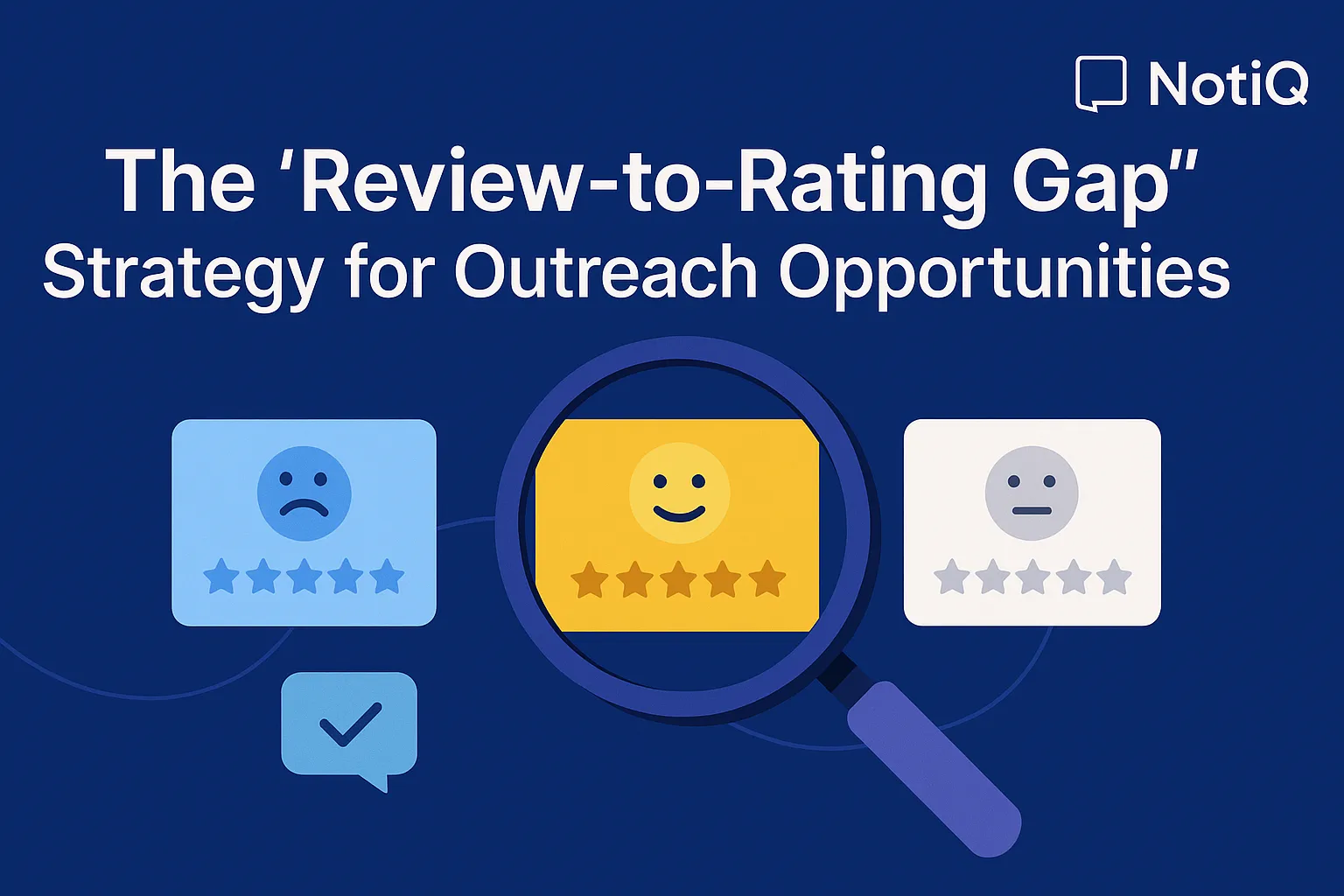
A "Review-to-Rating Gap" is the discrepancy between the visible star rating a user leaves and the actual sentiment expressed in the written text of their review. This gap can reveal hidden dissatisfaction, underreported praise, platform bias, or simply inconsistent reviewer behavior.
Unlike generic sentiment analysis or broad reputation scoring, finding a review-to-rating gap requires comparing two distinct data points against each other. The goal is not to overinterpret one angry customer, but to identify repeatable patterns across many reviews that signal a genuine market opportunity. Leveraging online review sentiment analysis to spot star rating discrepancies allows sales teams to find accounts ripe for disruption.
Why star ratings and written sentiment often diverge
Star ratings and written sentiment frequently misalign due to habit-based rating behavior, platform norms, or mixed experiences. A reviewer might give a "good overall" 4-star score to be polite, while simultaneously describing specific, severe frustrations with the product. Average ratings compress this complexity, hiding critical issues like slow onboarding, billing friction, weak support, or poor responsiveness.
For outbound research, these "positive-looking" ratings with negative text are a goldmine. They highlight accounts that are experiencing friction but haven't yet churned. It is important to note that some mismatches may result from poor data quality or user error rather than true dissatisfaction. However, a foundational study on review-rating mismatch confirms that review-text and rating misalignment is a widespread phenomenon that carries significant analytical weight. Recognizing these customer feedback signals helps teams look past vanity metrics to find real star rating mismatch reviews.
The two mismatch patterns GTM teams should care about
Not all gaps mean the same thing. For GTM teams looking for hidden dissatisfaction and outreach opportunities to fuel reputation intelligence, two primary mismatch patterns stand out:
Pattern 1 (High Rating, Negative Text) is the far better signal for outbound sales. It reveals a prospect who is actively enduring a pain point but might not yet be actively shopping for a replacement.
How this differs from standard sentiment analysis
Standard sentiment analysis summarizes the overall tone of a text. The review-to-rating gap goes a step further by comparing that tone against the explicit score. This comparison layer matters more for prioritization than sentiment alone because it highlights theunexpectedfriction.
GTM teams need context: review volume, recency, recurring themes, and competitor-relative patterns. Typical review dashboards stop at monitoring and broad review mining. A workflow orchestrated by NotiQ goes beyond manual scrapers by utilizing AI enrichment, verification, and compliance to detect sentiment inconsistencies. This transforms review sentiment analysis for sales from a passive reading exercise into an active, data-backed targeting strategy.
3. How to Build Rating Gap Maps
To turn scattered reviews into a usable map of opportunities, you need a repeatable methodology. Building rating gap maps allows you to structure the review-to-rating gap strategy by account, location, competitor, or vertical, turning review mining for lead generation into a predictable process.
Step 1: Collect and normalize review data
The first step is gathering publicly accessible data fields: business/account name, location, review platform, star rating, review text, review date, and review volume. Multi-platform collection is critical because review sentiment is fragmented and platform norms differ greatly. What counts as a 4-star experience on one site might be a 3-star experience on another.
Group the reviews by entity first, then by location or competitor set. Always flag low-volume samples rather than treating them as decisive. Platform differences, moderation standards, and sample sizes heavily affect interpretation; maintaining a cautious, authoritative approach to these review platform discrepancies ensures your customer feedback signals and online review sentiment analysis remain reliable.
Step 2: Score sentiment and compare it with visible ratings
Once data is normalized, assign a sentiment label to the written review and compare it with the star rating to detect a mismatch. You can use a simple, code-free scoring model by categorizing reviews into four buckets:
1. Aligned Positive
2. Aligned Negative
3. High-Rating/Negative-Text
4. Low-Rating/Mixed-Text
Recurring mismatches matter far more than isolated examples. Identifying sentiment inconsistencies and sentiment-to-rating mismatch relies on spotting trends. Foundational research on ratings discrepancy and fake reviews supports treating these discrepancies as meaningful analytical signals, provided you validate data quality first to rule out star rating discrepancies caused by spam.
Step 3: Cluster complaints into actionable themes
Abstract sentiment must be clustered into concrete themes to be useful. Group review text into operational categories such as responsiveness, onboarding, billing, support, staff quality, reliability, or communication. Theme frequency matters far more than the emotional intensity of a single angry review. Complaint clustering turns abstract customer feedback signals into concrete outreach opportunities.
Step 4: Map gaps by account, market, geography, or competitor
Create a practical "rating gap map" using rows for companies or locations, and columns for average rating, sentiment score, mismatch frequency, recurring themes, and a confidence level (based on review count, recency, and consistency). This allows teams to compare accounts side-by-side rather than reading reviews one by one.
You can use these maps to identify local markets with hidden dissatisfaction, spot competitor weaknesses, and prioritize outreach by vertical. While competitors often rely on basic dashboards that stop at monitoring, integrating a tool like[NotiQ](/)provides workflow orchestration, enrichment, and account-level mapping. This elevates competitor review analysis and online reputation intelligence from a passive dashboard into an active sales engine.
5. Prioritizing Accounts, Markets, and Competitors
Not every gap deserves attention. Prioritization is the decision-making layer of the framework, ensuring your workflow produces action by combining gap severity with business relevance.
Score opportunities by gap severity and confidence
Implement a simple prioritization model using mismatch frequency, complaint recurrence, review recency, cross-platform consistency, and total review volume. Differentiate between a "strong signal" (high volume, recent, consistent) and a "watchlist signal" (low volume, older).
A modest gap with strong, verified evidence is far more valuable than a dramatic gap supported by weak evidence. Scoring your review-to-rating gap strategy ensures that your reputation intelligence and sentiment inconsistencies data drive efficient sales motions.
Prioritize by geography, vertical, and competitor set
Location-based review clusters can uncover local market opportunities where a competitor is failing regionally despite a strong national rating. Vertical-specific themes also matter; a billing error in healthcare is a much more serious pain point than in e-commerce.
Conduct competitor-set comparisons to identify where rival providers are vulnerable. Creating a "market map," a "competitor gap map," or a "location gap map" allows you to visualize these rating gap maps and systematically dismantle competitor review analysis for targeted online reputation intelligence.
Use review gaps as one signal inside a broader GTM model
Review intelligence should complement—not replace—firmographic, intent, or account research. Combine review-derived signals with Ideal Customer Profile (ICP) fit and timing. A prospect with a high review-to-rating gap that also recently hired a new VP of Operations is a prime target.
This balanced approach improves trustworthiness and reduces false positives. Orchestration tools with AI enrichment and verification can consolidate these layers into one workflow, ensuring account prioritization and review sentiment analysis for sales drive highly qualified reputation intelligence.
Where this framework beats generic review management thinking
The standard reputation-management lens focuses on monitoring, responding, and score improvement. The strategic advantage of this framework comes from converting public sentiment into competitive and sales intelligence. While many generic tools are dashboard-heavy and disconnected from outbound action, a dedicated review intelligence workflow identifies active outreach opportunities and review management alternatives that directly impact revenue.
6. Validating Review Quality Before Acting
To build trust in this workflow, you must separate real signals from noisy or misleading data. Addressing fake reviews, outdated text, tiny sample sizes, and platform bias is critical before executing outreach.
Check recency, volume, and representativeness
A review-to-rating gap is only meaningful when it is recent, repeated, and supported by enough volume. A few outdated reviews from three years ago should not drive account prioritization. Furthermore, review mix can skew interpretation if one platform dominates the data set. Run a basic checklist: review count, date range, platform diversity, and consistency of themes to ensure high review quality and account for platform differences.
Look for suspicious or low-confidence review patterns
Watch for warning signs like unnatural reviewer patterns, abrupt rating spikes, duplicated language, or platform-specific anomalies. Suspicious reviews distort both sentiment analysis and visible ratings. Always triangulate across multiple sources before using a gap in strategic decisions.
Familiarize your team with the FTC guidance on featuring online customer reviews to understand moderation standards. Additionally, learning how to evaluate online reviews provides a practical credibility checklist for spotting fake review detection signals, ratings discrepancy, and verifying review authenticity.
Avoid overclaiming from imperfect sentiment signals
Review-derived insights are hypotheses, not absolute proof. Overconfidence damages trust in your outreach and strategy. Use softening language like "possible friction area," "likely pattern," or "emerging complaint theme." Document your assumptions and confidence levels internally to ensure your team understands the limitations of sentiment inconsistencies, reputation intelligence, and review quality.
Set ethical guardrails for outreach teams
Public reviews should be used to understand likely pain points, not to embarrass prospects or manipulate them. Avoid direct quotations unless context makes it clearly appropriate and non-invasive. Encourage respectful, insight-based messaging grounded in aggregate patterns. Ethical outreach respects customer feedback signals and utilizes review intelligence to offer genuine solutions, not surveillance-like behavior.
7. Tools, Workflow Extensions, and Team Adoption
Operationalizing this strategy across research, enrichment, and outbound execution requires the right workflow extensions. This framework supports sales, marketing, RevOps, and competitive intelligence teams when deployed correctly.
What the workflow needs to work at scale
To function at scale, your AI workflow orchestration must include review collection, normalization, sentiment scoring, theme clustering, confidence scoring, and downstream routing. The real value comes from linking insights to action rather than storing them in a dashboard. A minimum viable workflow component checklist includes automated extraction, AI enrichment for sentiment scoring, and API routing to your CRM to build effective rating gap maps.
How to move from analysis to execution
Insights must flow seamlessly into prospect research, account scoring, messaging prep, and content strategy. Cross-functional use cases include competitor positioning for marketing and localized campaign targeting for growth teams. The workflow should produce repeatable outputs, not just one-off discoveries.[NotiQ](/)serves as the central workflow layer that can orchestrate enrichment and action across all GTM steps, turning outreach opportunities and account prioritization into personalized outbound at scale.
8. Future Trends & Expert Predictions
The review-to-rating gap strategy is an emerging strategic category that will redefine how GTM teams utilize public data.
From average ratings to context-rich review signals
The market is shifting away from vanity metrics like average star ratings toward context-rich signals: recency, thematic volatility, and competitor-relative gaps. These nuanced data points create significantly more strategic value for GTM teams, turning rating gap maps and online reputation intelligence into actionable customer feedback signals.
AI will make review classification more scalable—but validation will matter more
While AI and LLMs make theme extraction and classification easier at scale, strong validation will become even more critical. Scale can amplify bad signals as easily as good ones. Ensuring review quality through rigorous AI review analysis and sentiment scoring will be the primary differentiator between teams that generate spam and teams that generate revenue.
9. Conclusion
A strong visible rating does not always equal a healthy customer experience. The gap between a star rating and the written sentiment reveals incredibly valuable outreach opportunities. By defining the gap, collecting reviews, comparing sentiment to rating, clustering recurring complaints, mapping by account or market, and validating the data, GTM teams can build a highly effective intelligence engine.
This framework turns review data from a passive reputation metric into an active GTM signal. Start small: pick one vertical, one competitor set, or one local market to test this rating gap maps strategy before scaling into a broader review-intelligence workflow. To operationalize fragmented public signals into repeatable research and outreach systems, explore how[NotiQ](/)can automate your review-to-rating gap strategy.
Frequently Asked Questions
- What is a review-to-rating gap in online reviews?
- A review-to-rating gap is a mismatch between the visible star score and the actual sentiment expressed in the written review. This metric matters more than the average rating alone because it exposes hidden dissatisfaction and star rating discrepancies that competitors often miss.
- How can rating gap maps identify outreach opportunities?
- Rating gap maps compare entities by mismatch frequency, complaint themes, and confidence levels. This helps sales teams spot accounts or markets where visible ratings hide real operational friction, creating highly targeted outreach opportunities.
- Why do star ratings sometimes conflict with review sentiment?
- Star ratings and text often conflict due to mixed customer experiences, habitual rating behaviors, platform norms, and low-quality data. Recurring sentiment-to-rating mismatch and sentiment inconsistencies are the signals that reveal true operational pain points.
- Which review themes usually create the best outreach angles?
- The best outreach angles come from recurring operational failures such as poor responsiveness, slow onboarding, billing errors, weak support quality, and lack of reliability. These customer feedback signals are far better for personalized outbound than isolated emotional complaints.
- How should teams validate review data before using it for outbound?
- Teams must evaluate recency, volume, cross-platform consistency, and watch for fake review detection signals. Understanding how to evaluate online reviews ensures that review intelligence guides hypotheses rather than making absolute, unverified claims.
Continue Reading
More articles you might find useful
Google Maps Prospecting for Commercial Waste Management Companies
Learn how commercial waste haulers can use Google Maps to find, qualify, and prioritize better local accounts. This guide shows how to build denser routes and improve outreach with waste-stream and service-area insights.
Read the article →
How to Find Local Businesses With Broken Website Links
Learn how to find local businesses with broken website links using Google Maps, quick validation checks, and proof-based outreach. This guide shows agencies how to turn visible site issues into qualified leads.
Read the article →
Google Maps Lead Generation for Signage Companies
Learn how sign companies can use Google Maps to find local prospects, identify visible signage gaps, and build a repeatable outreach system. This guide shows how to turn visual research into qualified leads without relying on paid ads or generic lists.
Read the article →Popular industry lead playbooks
Maps search examples and niche outreach for the verticals teams prospect most.