Technology
The “Review Momentum Shift” Strategy for Outreach Timing
Learn how to use review momentum and review velocity signals to identify active buying windows and prioritize outreach with better timing. This guide shows revenue teams how to turn review behavior into actionable account signals.
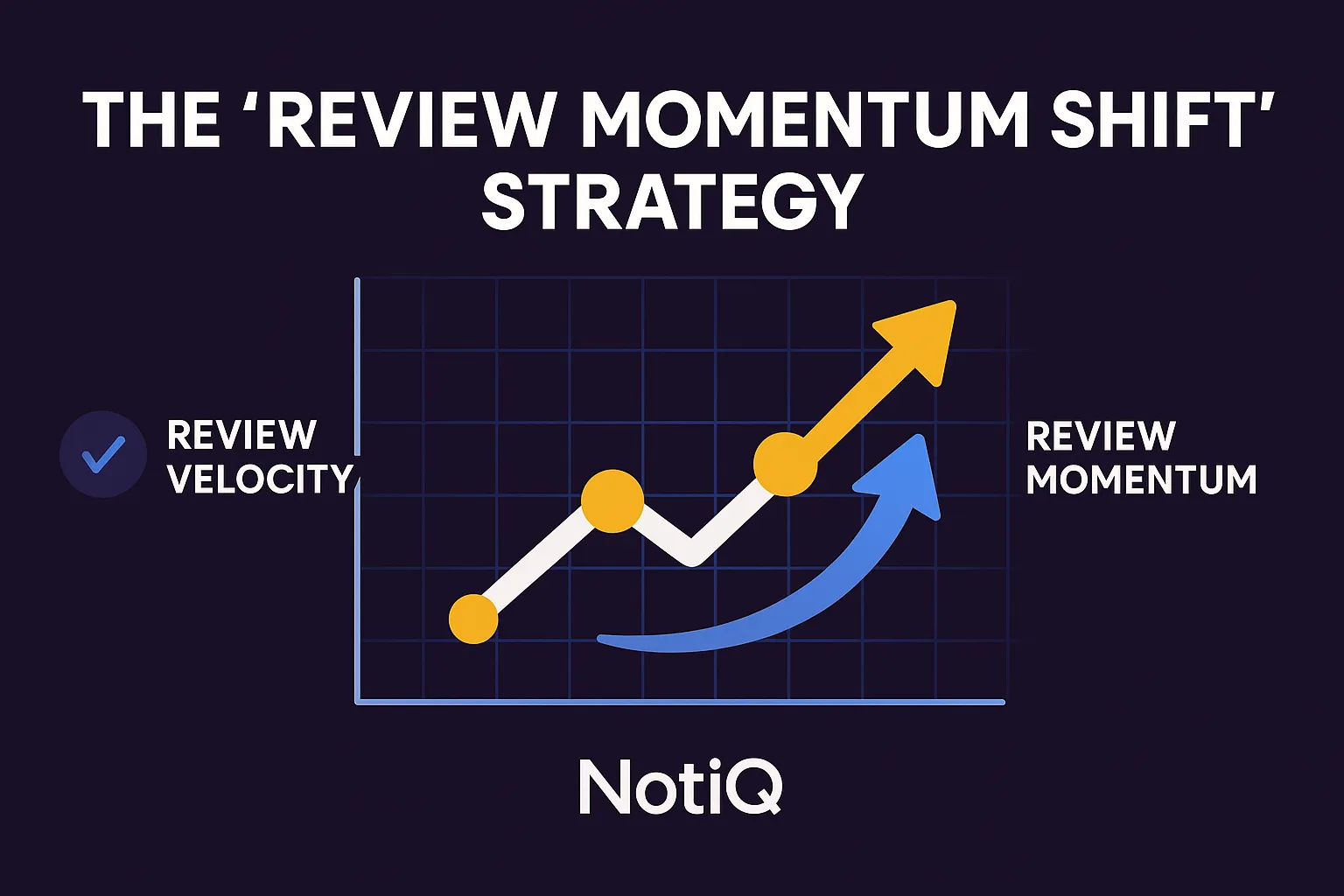
1. Introduction
Advanced revenue teams already have access to more data signals than ever before, yet they consistently struggle with the hardest question in sales:is this account actually entering an evaluation window right now?Traditional intent data can be overly broad, static lead scoring often lags behind real-world behavior, and absolute review activity alone rarely tells you exactly when to act.
This article defines the review momentum shift strategy and demonstrates how to turn changes in review activity into practical, highly accurate outreach timing decisions. Rather than relying on generic intent aggregation, we will focus on account-level timing, strict validation rules, dynamic prioritization logic, and specific outbound plays.
Review momentum provides a narrower, far more explainable signal than broad intent surges, especially when paired with CRM and first-party context. Platforms like[NotiQ](/), which specialize in momentum-detection approaches for revenue teams, showcase how tracking these behavioral shifts can surface highly actionable timing signals. If your team is ready to move beyond static scoring and reactive prospecting, mastering review momentum maps and timing signals is the next operational leap.
2. What a Review Momentum Shift Means
To understand what is a review momentum shift in B2B outreach, you must first distinguish it from generic review monitoring or broad buyer intent. A Review Momentum Shift is not a static measurement of raw review volume. Instead, it is a meaningful, measurable change in review-related activity over time that strongly suggests an account is entering, progressing through, or exiting an active evaluation cycle.
This framework relies on four core dimensions: acceleration, deceleration, recency, and competitor direction. Deltas matter significantly more than snapshots. An account moving from historically low engagement to rapidly rising review activity provides a much more actionable signal than an account with consistently moderate, unchanging activity. Tracking these buying intent signals allows teams to pinpoint precise B2B outreach timing, enabling dynamic account prioritization and highly effective signal-based prospecting.
As noted in peer-reviewed research on strategic behavior in B2B reviews, changes in how businesses interact with review ecosystems carry deep strategic meaning, directly reflecting shifts in operational needs and vendor evaluation.
The four components of review momentum
To accurately measure a review momentum shift strategy, revenue teams must track four distinct components:
• Volume: The total amount of review-related activity. While necessary as a baseline, volume alone is an insufficient trigger for outreach.
• Velocity: The rate of change in review activity across a specific time window. High review velocity indicates an accelerating evaluation.
• Recency: How fresh the change is. Recency dictates how long timing signals remain actionable before the buying window closes.
• Direction: The focus of the activity—whether the momentum centers on your software category, your specific brand, or your direct competitors. Effective review trend analysis relies heavily on understanding this directional intent.
What qualifies as a meaningful shift
Not every minor fluctuation in review activity warrants an immediate SDR sequence. To reduce false positives from low-volume review activity, revenue teams must build strict threshold logic. Low-volume accounts can easily trigger a 100% activity spike from a single user action, creating operational noise.
A meaningful shift is determined by comparing current review velocity against historical baselines, factoring in account size and category norms. Advanced teams use a practical methodology: identify the delta, compare it to prior periods, and then validate it with first-party engagement and ideal customer profile (ICP) fit criteria before taking action. A momentum window typically stays actionable for two to four weeks after a validated spike, making precise outreach timing signals B2B critical for conversion. Learning how to track changes in review velocity across accounts systematically is what separates top-tier revenue operations from the rest.
Why review momentum is useful earlier in the buying cycle
Review behavior frequently surfaces active evaluation activity long before a prospect submits a demo request or direct hand-raise. While website visits or content downloads often represent passive awareness signals, engaging with peer reviews—especially side-by-side product comparisons—indicates active vendor comparison behavior.
This connects directly to account-level buying windows rather than lead-level engagement. By tracking these signals, teams can execute momentum-based prospecting that aligns with the prospect's actual journey. According to Gartner research on the B2B buying journey, buyers spend a massive portion of their evaluation time conducting independent research online. Review momentum captures this critical phase, enabling account prioritization by buying stage before competitors are even aware a deal is in play.
3. How to Build Review Momentum Maps
A concept is only as good as its execution. To operationalize software review trend monitoring, revenue teams need to build review momentum maps. A review momentum map is a dynamic visualization or structured database that tracks changes in review activity across targeted accounts, segments, or categories over time.
The map is structured around an account's historical baseline, recent activity deltas, competitor activity, and supporting CRM context. The goal of this review momentum shift strategy is not perfect, crystal-ball prediction; rather, it is the rapid, systematic identification of accounts that are worth validating right now.
Inputs to include in a review momentum map
Building a functional map requires layering multiple data points. The minimum viable inputs include:
• Review-platform activity data
• Time-series changes (deltas)
• Account identity (domain/company)
• Category and competitor context
To make review intent signals truly actionable, teams must add enrichment layers: CRM stage, firmographics, territory ownership, recent first-party engagement, and open opportunities. Combining third-party signals with first-party CRM enrichment drastically improves account prioritization quality. Think of this as a layered operational model: Signal → Fit → Context → Action. Platforms that offer advanced workflow enrichment and signal orchestration excel at combining these multiple data layers into a unified, actionable view.
A practical mapping framework for advanced teams
For a highly functional mapping framework, structure your data logically. Use rows for individual target accounts and columns for:
• Baseline Activity (Historical average)
• Current Momentum (Velocity score)
• Competitor Direction (Who they are researching)
• Confidence Score (Signal strength + Account fit)
• Recommended Play (The exact outreach sequence to trigger)
Classify accounts into actionable buckets:Rising,Steady,Falling,Competitor-Led, andInconclusive. To maintain relevance in signal-based outreach, establish a strict refresh cadence—typically daily or bi-weekly. This ensures you catch shifts in review momentum maps without overwhelming your SDR teams with noisy, minute-by-minute updates. Above all, maintain explainability: every mapped signal must be easily understood by RevOps, SDR managers, and Account Executives to ensure alignment and account prioritization.
How to validate a spike before taking action
A critical rule of the review velocity sales signal is that not every surge reflects active buying intent. Spikes can be triggered by platform-wide marketing campaigns, aggressive vendor-side review generation pushes, or low-sample statistical noise.
To distinguish casual research from active evaluation, implement strict validation steps:
1. Check account fit (ICP alignment).
2. Confirm adjacent first-party engagement signals (website visits, email opens).
3. Review competitor and category activity for broader context.
4. Verify the recency of the shift.
When signals conflict—such as high review momentum but zero account fit, or strong fit but weak momentum—teams must rely on a "verify before sequence" rule. Knowing which accounts should be prioritized when signals conflict prevents SDRs from burning time on unqualified leads. Furthermore, ensuring your data comes from compliant ecosystems is paramount; always refer to FTC guidance on review collection and transparency to reinforce that trustworthy review data depends on transparent collection and moderation practices.
4. Using Review Signals for Account Prioritization
Translating momentum analysis into revenue requires integrating these insights into queue management and RevOps decisions. Review momentum helps teams transition from static scoring to dynamic account prioritization. The strongest application of a review momentum shift strategy is not to replace existing fit and engagement models entirely, but to inject temporal urgency into them.
This account-level prioritization empowers RevOps, SDR, and ABM teams to definitively answer who needs to be touchedtodayversus who can wait until next quarter, optimizing the overall sales timing strategy and fueling signal-based outreach.
Building a prioritization model around momentum
A robust prioritization model combines three critical layers: account fit, observed momentum shift, and first-party engagement. Review momentum should be used as a multiplier—it raises or lowers an account's priority rather than acting as a standalone source of truth.
For example, apply weighted logic: an in-fit account exhibiting rising review velocity alongside recent website engagement receives a Tier 1 priority score. Conversely, an out-of-fit account with a minor momentum shift is filtered out entirely. Establishing clear, automated decision rules ensures that buying intent signals directly inform account prioritization without requiring manual SDR guesswork.
Prioritizing active, passive, and at-risk accounts
To improve SDR focus and ABM campaign timing, segment your mapped accounts into three distinct operational buckets:
• Active Accounts: Accounts showing rising velocity or competitor-centered momentum. These are your immediate outreach targets.
• Passive Accounts: Accounts with limited change in review trend analysis and no supporting evidence of active evaluation. These remain in long-term nurture.
• At-Risk / Watchlist Accounts: Existing customers or late-stage prospects showing falling momentum, negative directional signals, or competitive review activity timing signals. These require immediate customer success or AE intervention.
This segmentation allows teams to handle account prioritization by buying stage dynamically.
Where static lead scoring fails
Traditional static lead scoring models fundamentally fail because they miss sudden changes in account behavior. They flatten nuanced, time-sensitive signals into a stale, composite number that quickly loses relevance. As a result, static lead scoring misses sudden changes in account behavior, meaning outreach happens too early or too late.
Event-driven prioritization based on momentum provides distinct advantages in explainability, verification, and timing precision. Unlike systems where intent signals are too broad to act upon confidently, a momentum-based approach tells a rep exactlywhyan account is surging. Tools like[NotiQ](/)specialize in these change-detection workflows, providing account-level alerting that static scoring simply cannot match.
5. Review Momentum vs Broad Intent Data
A common point of confusion is the difference between review momentum vs intent data. Broad intent platforms aggregate massive amounts of generalized research signals across the web. In contrast, review momentum isolates a narrower, highly specific behavior pattern that carries a much stronger evaluation context.
This is not an either/or scenario. Review momentum serves as a high-context timing layer that perfectly complements wider intent coverage. Understanding when precision matters more than breadth is key to maximizing buying intent signals over generic G2 buyer intent alternatives.
When broad intent is useful
Broader intent tools (like 6sense intent data or Bombora intent data) are highly effective for identifying general category interest, unmasking anonymous demand, and tracking market-wide topic consumption. These platforms excel at top-of-funnel awareness and wide-net account surveillance, helping marketing teams understand macroeconomic shifts and broad competitive intent data trends across their total addressable market.
When review momentum is more actionable
While broad intent showsinterest, review-platform activity often signals deeper vendor evaluation, active comparison behavior, and near-term purchasing timing. Changes in review behavior are fundamentally easier for frontline teams to interpret than opaque, black-box intent scores.
Explainability is the ultimate advantage here: an SDR can easily understand and act on the prompt, "This account’s competitor-focused review activity spiked by 300% this week." This makes the review velocity sales signal one of the most reliable outreach timing signals B2B teams can leverage, directly informing review momentum maps.
Best practice: use both, but for different jobs
The optimal strategy is to position broad intent as your market sensing layer and review momentum as your evaluation-window timing layer. You do not need to rebuild your entire system; simply layer review signals into your existing account orchestration workflows.
Integrating these timing signals into your outbound execution layer—such as leveraging modern personalization workflows seen on the Repliq blog—ensures maximum efficiency in account prioritization.
6. Outreach Plays for Rising, Falling, and Competitor-Led Momentum
Timing signals only generate revenue when they trigger a specific, tailored outreach play. Messaging, sequence timing, and account ownership must dynamically adapt based on the momentum pattern observed. This is where signal-based outreach transitions from theory into booked meetings.
Rising momentum: likely entering active evaluation
Rising momentum indicates fresh research or comparison activity, answering the question of which timing signals indicate a prospect is entering an active buying cycle. This should trigger fast, multi-channel validation.
Outreach must acknowledge likely evaluation-stage questions without overclaiming knowledge of the account's specific behavior. Focus messaging themes on evaluation criteria, implementation concerns, switching risk, and relevant peer comparisons. Because the prospect is actively looking, speed-to-action and high relevance are far more effective than long, generic nurture sequences. This is exactly how review momentum maps improve outreach timing and refine your sales timing strategy.
Falling momentum: deprioritize or shift the play
Declining momentum suggests an evaluation window is cooling off, a decision has been delayed, or there is simply insufficient evidence to justify active pursuit. SDRs must know how long does a momentum window remain actionable before pulling back.
When review trend analysis shows falling momentum, adjust sequence intensity immediately. Move the account back to monitoring status or switch to a lighter marketing nurture track. However, falling momentum in an open opportunity or an existing customer account should alert AEs and CSMs to potential deal risk or stalled momentum, requiring a different type of account prioritization intervention.
Competitor-led momentum: displacement and replacement windows
When competitive review activity timing signals spike, it indicates active comparison, widespread user dissatisfaction, or replacement exploration. This is one of the highest-value use cases for review intent signals because it is nearly impossible to detect through static scoring alone.
SDRs must personalize carefully to detect competitive evaluations before direct engagement. Focus messaging on business outcomes, known implementation pains of the competitor, or switching confidence. Never use surveillance-style observations ("I saw you looking at Competitor X's reviews"). Instead, position your outreach around the specific problems you know that competitor fails to solve.
How to personalize without sounding invasive
A critical rule of signal-based outreach and outreach timing signals B2B is to avoid sounding overly specific or creepy. Referencing review behavior explicitly breaks trust.
Instead, use the buying intent signals internally to shape hypothesis-driven outreach. Safe, highly effective message angles include referencing broader peer evaluation trends, addressing common category comparison questions, discussing recent industry change drivers, and sharing implementation benchmarks. Always ensure your data sourcing and outreach adhere to ethical standards, referencing FTC guidance on soliciting and using online reviews to maintain a compliant and trustworthy review ecosystem.
7. Tools, Measurement, and Operational Guardrails
A review momentum shift strategy without rigorous measurement quickly devolves into anecdotal guesswork. Advanced teams must instrument these signals into existing RevOps workflows, establish clear alerts, and design operational guardrails that prioritize compliance, data quality, and explainability from day one.
Tooling and workflow design
To effectively scale software review trend monitoring, your systems must automatically monitor review activity changes, enrich accounts, apply strict thresholds, and route actionable alerts to the correct sales pods.
Manual monitoring is unsustainable for larger account lists. Outbound orchestration is required. The primary gap in many intent platforms is that they surface signals but fail to convert them into timing-based action plans. Implementing AI-assisted account research and automated routing ensures that every signal-based outreach effort is executed flawlessly and instantly.
Measuring pipeline impact
To prove the value of your sales timing strategy, track core metrics: response rate by momentum state, meeting conversion rates, opportunity creation, velocity to first touch, and total pipeline influenced.
The most effective measurement model follows a strict linear path: Signal Detected → Account Prioritized → Outreach Launched → Outcome Tracked. Whenever possible, compare the pipeline lift of your timing-based outreach against static-score control groups to definitively prove the ROI of momentum-based account prioritization.
Data quality, trust, and compliance guardrails
Finally, revenue teams must acknowledge the risks of low-quality review data, platform anomalies, and overreacting to manipulated activity. To reduce false positives from low-volume review activity, establish strict governance rules: mandate acceptable data sources, require minimum confidence thresholds, and enforce human review for high-stakes enterprise actions.
Always rely on trustworthy review data and transparent data practices. Adhering to both the FTC guidance on soliciting and using online reviews and the FTC guidance on review collection and transparency ensures your operations remain legally compliant, ethical, and strategically sound.
8. Conclusion
The Review Momentum Shift framework provides advanced revenue teams with a significantly clearer, more accurate method for identifying evaluation windows than static scoring alone. By tracking changes in review activity, building dynamic review momentum maps, validating spikes with CRM context, and matching specific outreach plays to the observed signal pattern, teams can drastically improve outbound efficiency.
While review momentum is not a wholesale replacement for broad intent data, it is a vastly more explainable and actionable timing layer for account prioritization. Audit your current prioritization models today to identify where integrating review velocity, competitor direction, and strict timing thresholds can eliminate wasted SDR effort and accelerate pipeline generation. For teams looking to build event-driven workflows, exploring how[NotiQ](/)operationalizes momentum detection is the ideal next step in refining your review momentum shift strategy.
Frequently Asked Questions
- What is a review momentum shift in B2B outreach?
- A review momentum shift strategy relies on identifying meaningful changes in review-related activity over time. It suggests a definitive change in an account's buying stage or evaluation intensity. It is based entirely on the velocity and direction of movement, not just total static activity, answering exactly what is a review momentum shift in B2B outreach.
- How do review momentum maps improve outreach timing?
- Review momentum maps help revenue teams visualize precisely which accounts are accelerating into an active evaluation, which are cooling off, and which are actively comparing competitors. This visibility directly informs sequence timing, showing exactly how review momentum maps improve outreach timing.
- How is review momentum different from intent data?
- Broad intent captures a wide variety of top-of-funnel research behavior across the web. In the comparison of review momentum vs intent data, review momentum isolates a much narrower signal with significantly stronger evaluation and comparison context. The best practice is to use broad intent for market sensing and review momentum for precise buying intent signals.
- How can teams reduce false positives from low-volume review activity?
- To reduce false positives from low-volume review activity, teams must implement strict velocity thresholds, compare spikes against historical baselines, apply rigorous account-fit filters, and demand first-party engagement validation before launching outreach. Not every spike in review velocity warrants action.
- Which timing signals indicate a prospect is entering an active buying cycle?
- The strongest indicators include rising review velocity, competitor-centered research patterns, fresh recency, and alignment with first-party engagement data. When asking which timing signals indicate a prospect is entering an active buying cycle, remember that outreach timing signals B2B are exponentially more reliable when multiple timing signals align simultaneously.
Continue Reading
More articles you might find useful

Google Maps Prospecting for Commercial Waste Management Companies
Learn how commercial waste haulers can use Google Maps to find, qualify, and prioritize better local accounts. This guide shows how to build denser routes and improve outreach with waste-stream and service-area insights.
Read the article →
How to Find Local Businesses With Broken Website Links
Learn how to find local businesses with broken website links using Google Maps, quick validation checks, and proof-based outreach. This guide shows agencies how to turn visible site issues into qualified leads.
Read the article →
Google Maps Lead Generation for Signage Companies
Learn how sign companies can use Google Maps to find local prospects, identify visible signage gaps, and build a repeatable outreach system. This guide shows how to turn visual research into qualified leads without relying on paid ads or generic lists.
Read the article →Popular industry lead playbooks
Maps search examples and niche outreach for the verticals teams prospect most.