Technology
The “Review Depth Analysis” Strategy for Better Outreach Personalization
Learn how to turn public customer reviews into structured outreach signals that improve cold email personalization. This framework shows teams how to map buyer pain, tailor messaging by persona, and scale review-driven outreach.
1. Introduction
Most “personalized” outreach is fundamentally broken. Advanced outbound teams continue to rely on shallow company facts, generic AI-generated copy, or broad enrichment signals that fail to resonate with modern buyers. Stating that a prospect’s company recently raised funding or that they are hiring for a specific role is no longer a competitive advantage—it is table stakes.
To break through the noise, revenue teams must tap into a richer, higher-signal data source: public customer reviews. Unlike polished homepage copy or sanitized LinkedIn bios, public reviews contain unfiltered pain points, expected outcomes, raw objections, and the exact triggers that cause buyers to switch platforms.
This guide provides a practical, step-by-step framework for transforming unstructured review data into structured personalization signals through review depth maps. Designed for SDR leaders, ABM teams, and RevOps operators who already understand the value of personalization, this methodology moves beyond generic signal aggregation. By leveraging NotiQ’s analytical angle—shifting from basic data scraping to nuanced voice-of-customer interpretation—teams can build outreach that actually converts. As a foundational methodology and tooling layer,[Home](/)empowers teams to extract deep insights from public reviews and convert them into structured, outreach-ready review intelligence.
By mastering review depth analysis, your outreach personalization will finally align with the true voice of your buyer.
2. Why Shallow Personalization Falls Short
There is a massive gap between surface-level observations and true buyer insight. Surface signals—such as recent company news, job title changes, broad firmographics, or the classic "noticed you’re growing" intro—are easy to acquire but carry low conversion power. Deep signals, on the other hand, reveal implementation pain, support friction, unmet expectations, ROI concerns, feature gaps, and switching language.
Shallow personalization underperforms because it is easily replicated by competitors. Even when powered by generative AI, it sounds templated. More importantly, it rarely reflects how buyers actually describe their operational problems. For SDRs and ABM teams, this creates a frustrating dynamic: manual research is too slow to scale, generic AI messaging lacks credibility, and teams consistently struggle to identify real buyer pain before the first contact.
While typical enrichment-heavy workflows rely on appending hundreds of broad data points to a CRM record, a review depth framework prioritizes thequalityof the narrative over thequantityof the data.
What Most Teams Get Wrong About “Personalization”
Adding a company fact to an email is not the same as insight-led relevance. Many outreach strategies rely on broad signal aggregation, which creates the illusion of personalization without delivering actual message depth. A prospect does not care that you know their company recently opened a new office; they care that their current software stack is causing data silos. Advanced teams need better signal prioritization, not just an endless feed of cold email personalization signals.
Why Reviews Are a Higher-Intent Data Source
Public reviews capture voice-of-customer language in a way that websites and press releases deliberately avoid. When mining review datasets, teams uncover recurring pain points, expected outcomes, real-world objections, implementation friction, and direct competitor comparisons.
Reviews reveal the "why now" behind a buyer's dissatisfaction and evaluation behavior. Extracting structured insight from unstructured review text is a proven methodology for understanding market sentiment; as noted in a systematic review of social opinion mining, analyzing public feedback allows organizations to accurately map user dissatisfaction and feature demands. This makes customer review mining a highly potent form of review intelligence.
The Strategic Advantage of Review-Depth Personalization
Review-derived messaging sounds inherently more relevant because it mirrors the exact language buyers use to describe their recurring business concerns. When competitors rely on generic enrichment workflows, a team utilizing deep review insights can differentiate immediately. The objective is not to read every review manually, but to build a repeatable review depth analysis process that translates market feedback into targeted outreach.
3. How to Build a Review Depth Map
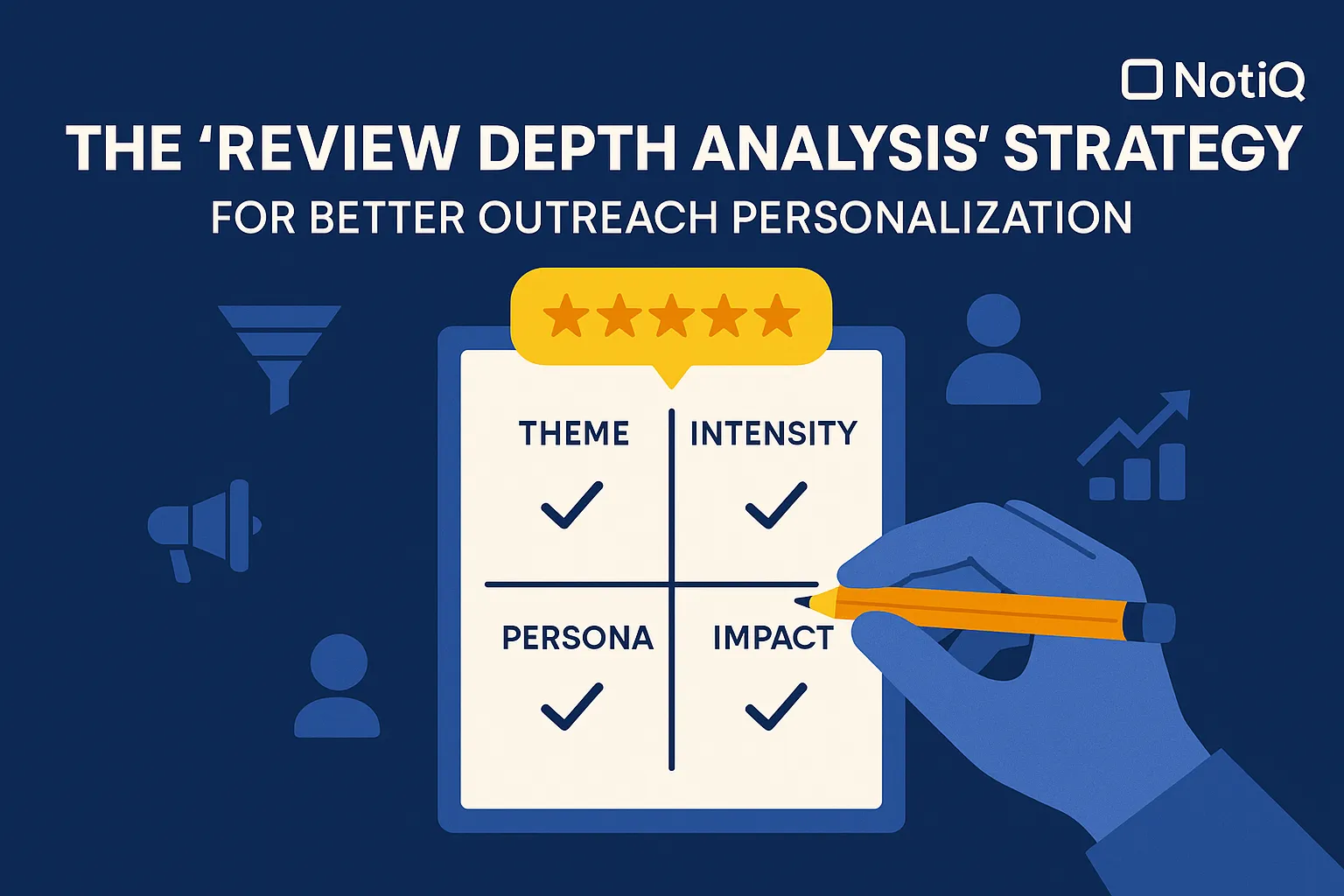
A review depth map is a structured model that organizes review insights by theme, sentiment intensity, persona relevance, and business impact. The goal is to convert public review narratives into outreach-ready intelligence, moving far beyond simple summary notes. Here is the repeatable workflow for customer review analysis for sales.
Step 1 — Collect the Right Public Review Data
Review inputs should be sourced conceptually from public review platforms, competitor comparison narratives, feature requests, support complaints, and ROI commentary. Focus on reviews that contain specific operational details rather than generic praise. When running ABM or vertical campaigns, aggregate these reviews across multiple target accounts or industry segments.
The quality of the source material matters significantly more than volume. Furthermore, data collection must always prioritize compliance. When handling public reviews, teams should adhere to FTC guidance on online customer reviews to ensure transparent, ethical, and non-deceptive handling of review intelligence.
Step 2 — Tag Reviews by Signal Type
To operationalize voice of customer personalization, define a practical taxonomy to categorize raw feedback. Standard tags should include:
• Pain points
• Desired outcomes
• Objections
• Implementation friction
• Service/support complaints
• Feature gaps
• Competitor-switching mentions
Tagging helps teams distinguish generic sentiment (e.g., "Great tool!") from actionable personalization signals (e.g., "The API rate limits break our syncing workflows every Friday"). Actionable signals provide a clear entry point for a conversation.
Step 3 — Score Themes by Frequency, Intensity, Persona Relevance, and Business Impact
What makes review depth maps superior to simple summaries is a proprietary-style scoring logic. Evaluate each tagged theme based on:
• Frequency: How often a theme appears across the dataset.
• Intensity: How strongly the issue is expressed (frustration vs. mild annoyance).
• Persona relevance: Which specific buyer or user role is most affected.
• Business impact: Whether the issue affects adoption, ROI, churn, or implementation success.
Step 4 — Turn Themes Into Message Hypotheses
Each scored cluster now becomes a direct input for outreach personalization. Translate themes into:
• A relevant hook
• Value framing
• An objection hypothesis
• A follow-up angle
• CTA framing
The goal is hypothesis-driven messaging. You are not pretending to know the prospect’s exact internal situation; rather, you are referencing a known industry challenge. Specificity must remain credible and non-intrusive to succeed in review-based account research.
What a Finished Review Depth Map Should Look Like
A completed map provides a clear translation from raw data to sales execution. It should include the theme cluster, sample review language, affected persona, urgency score, business implication, and the final outreach angle. Integrating this structured data into your prospect research automation ensures reps never start from a blank page. For a deeper look into repeatable outreach research and messaging workflows, explore Blog.
4. Turning Review Themes Into Outreach by Persona
The same review theme requires drastically different framing depending on who you are emailing. A complaint about "messy reporting" means something different to an SDR, a RevOps operator, and a VP of Sales. Voice-of-customer analysis is most valuable when mapped directly to who feels the pain and who ultimately owns the business outcome.
Persona 1 — Operational Leaders Focused on Efficiency and Scale
Operational buyers (RevOps, SalesOps) care about system design and repeatability. When public reviews highlight implementation friction, workflow sprawl, or manual research complaints, these become perfect hooks. Frame your outreach personalization around reduced preparation time, cleaner workflows, and better signal prioritization. Speak their language: focus on eliminating friction and scaling efficiency.
Persona 2 — Revenue Leaders Focused on Response Quality and Pipeline
For VPs of Sales and CROs, review themes must be translated into top-line outcomes: better reply quality, more relevant meetings, and improved personalization at scale. Frame the buyer pain points carefully. Instead of saying, "Your team is failing at outreach," use a hypothesis-driven approach: "Many revenue leaders we speak with are hitting diminishing returns with shallow personalization." A before-and-after comparison contrasting generic outreach with review-depth outreach is highly effective here.
Persona 3 — Users Closest to Daily Workflow Friction
Frontline users experience the clearest unmet needs. Deep review insights often reveal support failures, onboarding delays, or usability issues. These complaints create highly relevant outreach angles. However, these insights should be used to shape hypotheses ("Often, teams using [Competitor] struggle with [Specific Feature]"), rather than overstating certainty about their specific daily struggles.
From Review Cluster to Personalized First Line and Follow-Up
The conversion path from raw data to a personalized line is straightforward:
1. Review Insight: "Tool X takes 4 weeks to implement."
2. Persona Interpretation: RevOps is frustrated by slow time-to-value.
3. First-Line Hypothesis: "Noticed your team relies heavily on [Tool X]—often hear from RevOps leaders that the 4-week implementation time creates a bottleneck."
4. Value Proposition: "We built our system to deploy in 48 hours without engineering favors."
5. Follow-Up Reference: Share a case study of a similar company that switched for faster deployment.
Direct voice-of-customer phrasing always feels sharper than generic brand paraphrasing. To see exactly how review themes can be transformed into highly converting cold email personalization signals, check out Personalized Lines.
5. Scaling Review-Based Personalization With AI
Advanced teams must scale this framework without sacrificing signal quality. AI should be used to assist with extraction, summarization, and tagging—never to replace human judgment regarding relevance and message quality. This workflow is a synthesis system, not a cheap content-spinning shortcut.
What AI Should Automate vs. What Humans Should Decide
What AI is good at:
• Clustering large sets of unstructured review data.
• Extracting repeated language patterns.
• Surfacing candidate pain-point themes.
• Identifying likely persona references.
What humans must own:
• Interpreting the nuance of the voice-of-customer analysis.
• Prioritizing business relevance.
• Deciding whether a signal is credible enough to use in outreach.
• Final message quality control.
A Practical AI Workflow for Review Tagging and Summarization
A highly effective AI-assisted workflow follows these steps: ingest public reviews, summarize by account or vendor, tag themes, score intensity and impact, map to personas, and export directly to CRM or sequencing workflows. Orchestrating this flow requires the right infrastructure. To manage review extraction, tagging, and structured personalization workflows effectively,[Home](/)provides the ideal system layer. Always include QA checks so the automation does not flatten nuanced complaints into generic, unusable summaries. Preserving specificity is your competitive edge.
How to Preserve Signal Quality at Scale
When scaling review intelligence, teams often fall into failure modes: over-summarization, vague tagging, false confidence, or messaging that sounds creepy and overfitted.
To combat this, implement a strict QA layer. Attach a sample review excerpt to each generated theme, assign a confidence score, require a persona fit check, and maintain message-review traceability. Synthesis quality must always take precedence over automation volume to ensure deep review insights remain impactful.
Governance, Transparency, and Responsible AI Use
Any AI-assisted personalization workflow requires transparency, accountability, and human oversight. Utilizing public review data demands careful interpretation and non-deceptive messaging. To ensure trustworthy AI deployment, teams should align their processes with the NIST AI Risk Management Framework and the OECD AI Principles. Responsible AI scaling ensures that outreach remains ethical, accurate, and compliant.
6. Using Competitor and Switching Signals Ethically
Competitor-related review signals are among the most powerful tools in outreach personalization, but they are also the easiest to misuse. Ethical inference is paramount; the goal is relevance, not invasive surveillance.
What Review Patterns Can Reveal About Switching Intent
Review patterns provide massive clues about switching intent. Look for categories of switching-relevant language: recurring disappointment with support, onboarding friction, missing capabilities, integration issues, and unmet ROI expectations. These patterns inform segment or account-level hypotheses. They are not proof of active dissatisfaction inside a specific target company, but rather indicators of broader market vulnerability.
How to Use These Signals Without Sounding Creepy or Misleading
Never imply you have private knowledge of a prospect’s internal software struggles. Instead, frame your voice-of-customer analysis ethically:
• “A pattern we often see in teams using [Category/Competitor]…”
• “Many teams evaluating alternatives mention…”
• “One recurring challenge in this space is…”
Ethical sales personalization is about demonstrating industry expertise and relevance, not proving you read their negative G2 review.
Compliance and Trust Guardrails
Trustworthiness is a strategic differentiator. Practical guardrails include using only publicly accessible review content, avoiding deceptive paraphrasing or fabricated customer claims, separating market-level insights from account-specific assertions, and maintaining traceability back to the original review theme. Ensure all workflows comply with the FTC reviews and testimonials rule and broader FTC guidance on online customer reviews to maintain absolute ethical integrity.
7. Operationalizing Review Depth Analysis Across ABM and RevOps Workflows
To move from a theoretical framework to team-wide implementation, review depth maps must become reusable assets inside segmentation, account prioritization, CRM enrichment, and outbound playbooks. Insight must be standardized and distributed, not trapped in ad hoc SDR notes.
Build Reusable Review Intelligence Assets
Stop doing manual research for every account. Create reusable assets: persona maps, pain-point matrices, objection libraries, competitor-switching theme banks, and approved messaging angles by segment. These assets reduce repeated manual work while drastically improving the consistency and quality of outreach personalization.
Connect Review Signals to Account Prioritization
Theme intensity and business impact should actively inform which accounts you prioritize first. Combine review intelligence with other context signals (like hiring data or funding rounds) to sharpen your timing. Review-based account research should refine your prioritization models, acting as an amplifier for your broader GTM judgment.
Differentiate From Generic Enrichment-Only Workflows
Workflows that stop at broad data aggregation or generic AI-generated copy are inherently flawed. Generic enrichment prioritizes scale over nuance, lacks narrative interpretation, and fails to score themes by persona or business impact. NotiQ differentiates itself by delivering analytical depth, structured signal extraction, and deep review insights that generic enrichment tools simply cannot match.
8. Future Trends in Review-Driven Personalization
The landscape of outbound sales is shifting toward narrative signal analysis. The next phase of hyper-personalized outbound will rely less on demographic or firmographic trivia and more on intent-adjacent public signals extracted via AI-assisted voice-of-customer analysis.
From Generic Personalization to Insight-Led Personalization
The market is moving away from basic data points toward insight-led relevance. Advanced teams are realizing that relevance quality heavily outweighs message volume. Review depth analysis provides the exact narrative context required to transition from generic check-ins to highly consultative outreach.
Why Review Interpretation Will Matter More Than Raw Signal Volume
As AI makes basic personalization effortless for everyone, differentiation will no longer come from the ability to write a personalized sentence. It will come from human judgment, taxonomy design, and sophisticated signal scoring. Review depth maps provide a defensible operational advantage because they rely on interpreting the nuances of review intelligence, rather than just aggregating raw data points.
9. Conclusion
Shallow personalization is easy to scale but nearly impossible to trust. It yields low conversion rates and damages brand credibility. Conversely, review depth analysis creates credible, buyer-relevant outreach by leveraging the exact language of the market.
By executing this framework—collecting public reviews, tagging signal types, scoring themes by frequency and impact, translating clusters into outreach hypotheses, scaling responsibly with AI, and using competitor signals ethically—you transform unstructured feedback into a massive competitive advantage. The goal is not to generate more personalization tokens, but to extract better, structured insight from voice-of-customer data.
To stop guessing at buyer pain and start operationalizing review-depth personalization across your entire revenue team, explore the platform and methodology layer at[Home](/).
Frequently Asked Questions
- What is review depth analysis in outreach personalization?
- Review depth analysis is the process of extracting, scoring, and structuring nuanced signals from public customer reviews to fuel prospecting and messaging. Unlike generic sentiment analysis or basic company research, it categorizes feedback by intensity, persona, and business impact to create highly relevant outreach hypotheses.
- How can review depth maps improve cold outreach?
- Review depth maps help teams prioritize recurring pain points, desired outcomes, and persona-relevant message angles. By mirroring the exact language buyers use to describe their problems, cold email personalization signals become vastly more specific and credible compared to shallow, firmographic-based personalization.
- Which personalization signals from reviews matter most?
- The most impactful personalization signals are those that are both recurring and business-relevant. Key themes include implementation friction, feature gaps, poor customer service experiences, unmet ROI expectations, and competitor-switching language that highlights buyer pain points.
- How deep should review analysis go before it becomes inefficient?
- Teams should optimize for structured prospect research automation and signal extraction, not exhaustive reading. Once frequency, intensity, persona fit, and business impact are clearly established for a theme, further manual analysis yields diminishing returns.
- Can AI automate review-based personalization effectively?
- Yes, AI-assisted review analysis is highly effective when used properly. AI should be leveraged for data extraction, clustering, and tagging. However, humans must retain control over signal prioritization, persona interpretation, and final messaging QA to ensure sales personalization remains ethical, accurate, and trustworthy.
Continue Reading
More articles you might find useful
Google Maps Prospecting for Commercial Waste Management Companies
Learn how commercial waste haulers can use Google Maps to find, qualify, and prioritize better local accounts. This guide shows how to build denser routes and improve outreach with waste-stream and service-area insights.
Read the article →
How to Find Local Businesses With Broken Website Links
Learn how to find local businesses with broken website links using Google Maps, quick validation checks, and proof-based outreach. This guide shows agencies how to turn visible site issues into qualified leads.
Read the article →
Google Maps Lead Generation for Signage Companies
Learn how sign companies can use Google Maps to find local prospects, identify visible signage gaps, and build a repeatable outreach system. This guide shows how to turn visual research into qualified leads without relying on paid ads or generic lists.
Read the article →Popular industry lead playbooks
Maps search examples and niche outreach for the verticals teams prospect most.