Technology
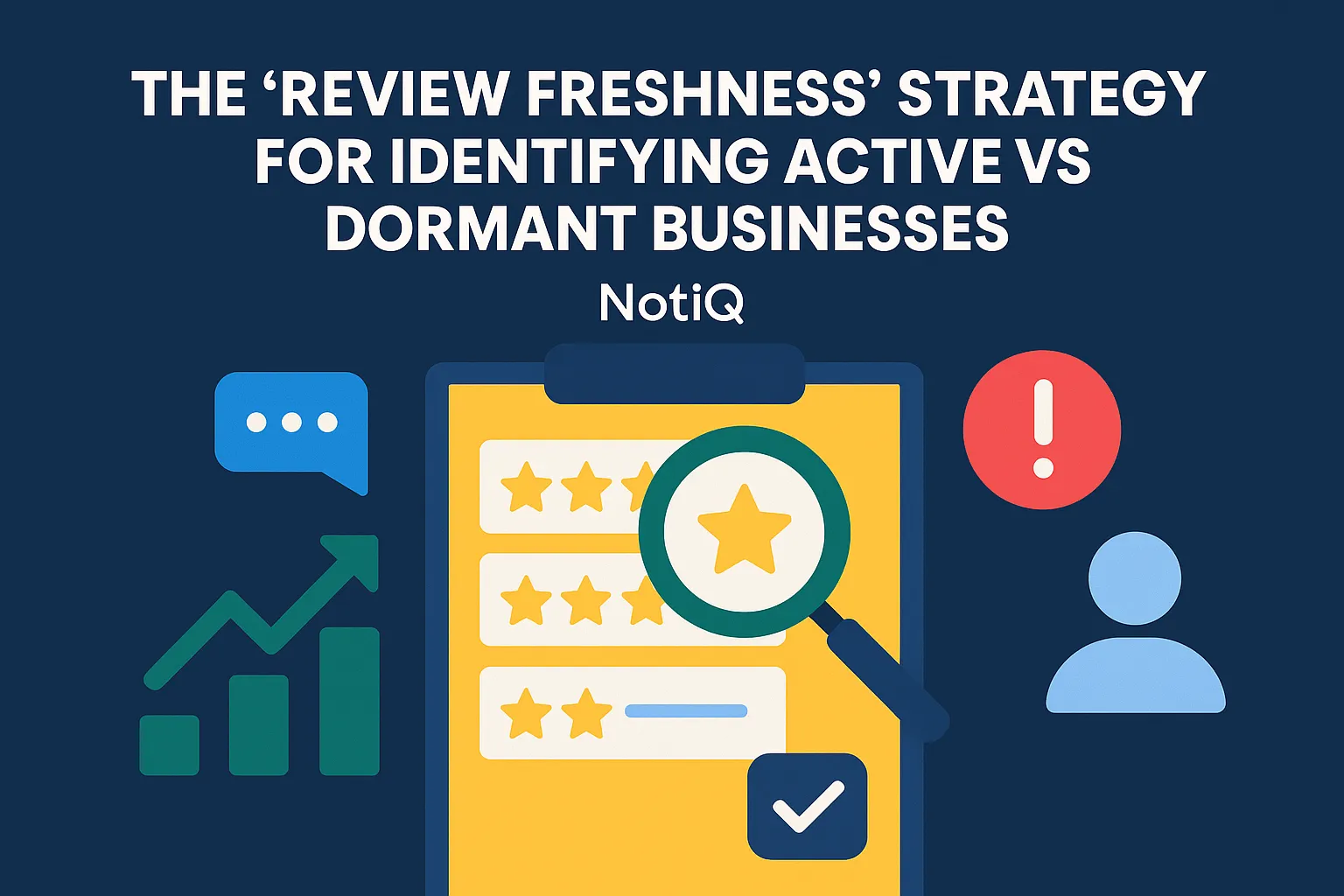
The “Review Freshness” Strategy for Identifying Active vs Dormant Businesses
Learn how to use review recency and Google Business Profile activity signals to classify businesses as active, slowing, or dormant. This framework helps sales and local SEO teams prioritize better markets and avoid stale accounts.
1. Introduction
Most local prospecting lists fail for one simple reason: they treat a business listing as static when business activity is anything but static. Outdated directories, stale lead lists, and manual verification processes create massive inefficiencies and wasted outreach. Sales teams and local SEO operators often find themselves calling closed businesses or optimizing for territories that lack actual commercial demand.
This article outlines a highly effective review freshness strategy to solve this problem. By analyzing review recency and adjacent Google Business Profile activity signals, you can reliably classify local businesses as active, slowing, or dormant. We position review recency not merely as a reputation or SEO metric, but as an operational intelligence signal for prospecting, territory planning, and market analysis.
In the following sections, we will break down a repeatable framework for measuring review freshness maps, the supporting signals needed to validate your findings, the mapping workflow itself, and the critical industry exceptions you must understand to avoid false positives.
For local SEO teams, sales prospecting teams, and market intelligence operators, this methodology offers a scalable way to judge whether a business is still commercially active. As a data-driven intelligence layer, NotiQ turns these public review recency metrics and related signals into legally compliant, actionable business-status insights, allowing you to focus your resources on businesses that are actively engaging with customers today.
2. Why Review Freshness Matters
Recent reviews are one of the most practical, publicly accessible signals for identifying whether a local business is active, engaged, and attracting customers right now. A robust review freshness strategy evaluates two main factors: the age of the latest review and the consistency of incoming reviews over time.
Raw review counts are inherently incomplete. A business with 500 reviews where the last one was posted three years ago is likely far less active than a competitor with 25 reviews, all posted within the last two months. Fresh reviews directly correlate with stronger buyer trust, better profile engagement, and a high likelihood that the business is operational and responsive.
Through a business-status lens, fresh reviews indicate current market demand. Conversely, long gaps in customer feedback often point to dormancy, operational decline, or a severely weakened customer flow. While industry consensus from platforms like BrightLocal, Birdeye, and Podium correctly emphasizes reviews for reputation management, we extend this data into operational scoring. Furthermore,Google’s local ranking guidance confirms that high-quality, positive reviews improve business visibility, making recent customer review trends a vital indicator of both digital presence and physical operational health. For a deeper dive into broader review and reputation insights, visit the repliq.co blog.
Review recency as a proxy for business activity
Frequent, recent reviews usually imply active, ongoing customer interactions. While review recency analysis is not a flawless measure of a company’s revenue or service quality, it serves as a powerful early screening signal to differentiate active vs dormant businesses.
Consider a simple visual example: a local plumbing service showing "3 reviews in the last 30 days" is demonstrably active. A competing listing showing "no reviews in 9 months" exhibits a silent review pattern. By tracking these local business activity indicators, you can easily categorize listings into active, slowing, or silent operational states.
Why this matters for SEO, sales, and territory planning
For local SEO teams, leveraging review freshness maps helps identify strong competitors dominating a market, neglected listings ripe for disruption, and highly volatile territories. Sales teams can use these same local lead scoring signals to avoid spending valuable time on stale accounts that are closed, inactive, or no longer customer-facing.
This approach is also foundational for whitespace analysis. Geographic areas heavily populated by dormant profiles often signal market gaps or replacement opportunities. Unlike standard review monitoring tools that focus purely on reputation, tracking fresh reviews and local rankings through an operational lens provides direct intelligence for territory planning and strategic resource allocation.
3. How to Classify Active vs Dormant Businesses
To effectively separate active vs dormant businesses, teams need a repeatable framework based on review age thresholds and review cadence. This model uses three primary labels: active, slowing, and dormant.
It is important to stress that these thresholds are not fixed universal rules. They must be adapted by industry, geography, and seasonality. By combining the age of the latest review with overall review velocity, you drastically reduce false confidence in your data. This framework is a practical operating model—not an official Google classification system—designed to be applied immediately to lead scoring and audits.
For teams looking to automate this process,[NotiQ](/)serves as the ideal orchestration layer, combining public recency signals into a usable intelligence workflow rather than relying on a single, isolated metric.
A simple active, slowing, dormant framework
A successful review freshness strategy categorizes businesses based on their review velocity and review recency analysis relative to their specific category:
• Active: Businesses with recent reviews and a reasonably steady review cadence that matches or exceeds category expectations.
• Slowing: Businesses exhibiting noticeable gaps in customer feedback, declining review velocity, or less consistent customer activity compared to their historical baseline.
• Dormant: Businesses with long review gaps and little to no evidence of current engagement. Note that "dormant" is a risk category indicating high likelihood of inactivity, not absolute proof of closure.
Example Scoring Rubric:
• Active: Last review < 30 days ago AND steady 90-day volume.
• Slowing: Last review 30–90 days ago OR a 50% drop in 90-day volume.
• Dormant: Last review > 90 days ago AND zero recent profile activity.
Suggested threshold logic by review age
Teams should set rough time bands—such as recent, aging, and stale review windows—to gauge business review recency. However, the exact threshold for a dormant classification changes drastically by vertical. A busy downtown restaurant might be considered slowing if it hasn't received a review in two weeks, whereas a specialized B2B service or boutique agency might naturally go months between reviews while remaining highly active.
Because of these variations, thresholds should be treated as ranges rather than hard absolutes. To accurately determine how to tell if a local business is still active, always pair the date of the last review with the total review cadence over the trailing 30, 90, or 180 days.
Why review velocity matters more than a single recent review
A single new review can create a false signal if it follows a massive historical gap. This is why review velocity by industry matters far more than one isolated data point. There is a distinct difference between a one-off burst of activity and sustained, organic review momentum.
By comparing recent review volume against a business's historical average, you can easily identify operational acceleration or slowdown. Furthermore, sudden, suspicious bursts of reviews without corresponding real-world activity require careful verification to ensure data integrity. As noted in the FTC guidance on consumer reviews, manipulated or incentivized review bursts can severely distort customer review trends and activity signals, leading to inaccurate market intelligence.
4. Signals That Validate Review Recency
Relying on a single-signal analysis is risky. Reviews alone can misclassify seasonal, low-volume, or recently restructured businesses. To build a reliable intelligence pipeline, you must validate review freshness by layering adjacent Google Business Profile reviews and activity signals.
This multi-signal model incorporates owner responses, profile edits, photo recency, and posts to confirm or challenge what review freshness implies. The most accurate business classifications come from signal stacking rather than overconfidence in one public metric. For a practical example of combining review recency with profile activity to flag active vs dormant accounts at scale, check out a NotiQ demo.
Owner response behavior
Recent owner responses are a powerful indicator of operational attentiveness and customer care. Fast, recent responses typically indicate active, day-to-day management of the business.
Response lag serves as an excellent supporting activity signal. While a lack of responses does not automatically mean a business is dormant, consistent and timely responses drastically increase confidence in an "active" status. When evaluating local business activity indicators, a profile with a "recent review + recent owner response" is substantially more reliable than one with a "recent review + no response history."
Profile updates, business details, and hours
A well-maintained profile strongly reflects active operational oversight. Edits to business hours, services, contact details, and general business information are highly useful GBP activity signals. Conversely, outdated details, broken links, or unverified holiday hours can reinforce a slowing or dormant classification. Maintaining accurate public data is crucial for business dormant detection, which is why keeping a Business Profile up to date is a meaningful adjacent activity signal validated by Google.
Recent photos and Business Profile posts
New photos, offers, or updates are direct indicators of current marketing and operational activity. In review-sparse categories, a business may have low review volume but still appear highly active through consistent visual updates.
This serves as a vital corrective signal for a review freshness strategy. If a niche B2B consultant hasn't received a review in six months but posted an update yesterday, they are active.Business Profile posts and updates provide visible evidence of ongoing customer engagement and business health.
Rating shifts and suspicious patterns
Sudden spikes in review volume or extreme shifts in overall star ratings often indicate unusual activity that warrants closer inspection. Review recency analysis must be interpreted alongside integrity signals. Watch for bursts of 5-star or 1-star reviews that do not match the business's normal cadence, as these customer review trends may reflect reputation attacks or manipulated campaigns rather than genuine operational momentum.
5. How to Build Review Freshness Maps
A review freshness map is a geographic visualization of businesses grouped by recency, cadence, and supporting activity signals. By translating the framework into a map-based workflow, readers can effectively prioritize territories, refine prospect lists, and conduct deep competitive research.
Map-based analysis reveals dense clusters of active businesses, slow zones, and lucrative whitespace opportunities. The true differentiator of this review freshness strategy is its ability to turn local review data into actionable market intelligence, moving far beyond basic SEO observation. Through AI enrichment, compliant data verification, and intelligent mapping, operators can visualize local market dynamics at scale.
Choose the geography, category, and competitor set
Review freshness maps are most effective when tightly scoped to a specific region, service area, or industry vertical. To avoid misleading cadence expectations, you must compare businesses within the same exact category.
Segment your local market analysis by city, ZIP code cluster, or specific service radius depending on your operational use case. Comparing the review velocity of a local coffee shop to a local roofing contractor will skew your data; comparing roofers to roofers within a 20-mile radius reveals true active vs dormant businesses.
Layer freshness status on top of location data
Once you have your dataset, tag each listing with a status: active, slowing, dormant, or uncertain. Using color-coding or status bands (e.g., Green for Active, Yellow for Slowing, Red for Dormant) creates instant visual clarity.
This layering technique is vital for review recency local SEO and business dormant detection. It allows teams to instantly spot dense geographic clusters of thriving businesses and neglected pockets filled with stale, aging profiles.
Turn map patterns into actions
The goal of a review freshness strategy is operational action.
• Sales teams can use local lead scoring signals to prioritize outreach and partnerships toward active businesses showing clear signs of momentum.
• Local SEO teams can identify vulnerable competitors exhibiting slowing signals, allowing them to capture market share.
• Market Intelligence operators can pinpoint whitespace markets where the majority of businesses appear dormant or weakly engaged, signaling a prime area for expansion.
This workflow relies on compliant, intelligent orchestration of public signals, offering a vastly superior approach to traditional, manual rank-tracking methods.
Build a refresh cycle for ongoing monitoring
Business activity is fluid. A business that is active today may become dormant in six months. Therefore, review recency analysis and business dormant detection scoring must be updated on a recurring basis.
Implementing monitoring dashboards with weekly or monthly refresh cycles—depending on market volatility—ensures your data remains actionable. Recurring refreshes help teams detect sudden closures, unexpected reactivations, and shifts in competitive momentum before they become obvious to the broader market.
6. Industry Exceptions and False Positives
To build a trustworthy intelligence model, you must understand where freshness-based classification can fail. Not all low-review businesses are dormant, and not all businesses with fresh reviews are healthy. Nuanced interpretation, guided by industry review cadence benchmarks and adjacent signals, is required to minimize false positives and accurately identify active vs dormant businesses.
Seasonal businesses
Tourism operators, tax prep services, educational tutors, and event-driven businesses naturally experience massive review gaps during their off-seasons. When analyzing seasonal review patterns, always compare current activity to the same season in prior years. A ski resort with zero reviews in July is not dormant; it is simply out of season. Seasonality should always downgrade your confidence in a "dormant" label until historical review cadence is verified.
Low-volume or review-quiet industries
Certain categories naturally receive fewer public reviews, even when they are actively and profitably serving customers. B2B services, specialized legal firms, or niche manufacturing companies operate in low-volume niches. In these review-quiet industries, you must rely heavily on adjacent activity signals—such as profile edits, photo uploads, and response behavior—to accurately gauge local business activity indicators.
New, moved, rebranded, or recently reopened businesses
A business can easily appear dormant if its digital history was recently reset, fragmented, or moved to a new listing. Rebranded or recently reopened businesses may possess high real-world operational activity but showcase a highly uneven review history online. To navigate these edge cases and prevent misclassification, always check for supporting signals and reference the Google Maps closed or reopened status to verify if the review freshness strategy is being applied to a newly transitioned profile.
Suspicious bursts and manipulated signals
An unusual flood of reviews does not automatically equate to healthy, organic demand. Suspicious bursts must be scrutinized for review integrity. Always validate customer review trends against normal timing patterns and supporting profile activity before upgrading a business to an "active" classification. Sudden spikes in review velocity often trigger platform scrutiny and should be treated with caution.
7. Tools, Workflow Ideas, and Operational Use Cases
Moving from observation to action requires a clear operational workflow: collect public signals, score them, map them, and route the insights directly to your frontline teams. By integrating a review freshness strategy into your daily operations, you transform raw data into a competitive advantage.[NotiQ](/)is specifically designed to orchestrate public review recency, signal enrichment, and market-mapping workflows compliantly and at scale.
Prospecting and lead prioritization
Sales teams can dramatically reduce wasted outreach by using local lead scoring signals. Active businesses with recent reviews and strong supporting signals should be scored higher and prioritized for immediate contact, as they demonstrate current market demand. Conversely, businesses flagged as dormant or uncertain on review freshness maps can be deprioritized, filtered out of call lists, or routed to a secondary verification queue.
Local SEO and competitive audits
SEO teams can leverage freshness maps to identify which competitors are gaining momentum and which are losing traction. Slowing competitors present immediate ranking and market-share opportunities. By connecting review recency local SEO data to broad territory-level monitoring rather than isolated listing analysis, agencies can deploy resources to the exact neighborhoods where competitors are failing to maintain fresh reviews and local rankings.
CRM enrichment and monitoring dashboards
Activity status should not live in a silo; it must be appended directly to CRM records for advanced segmentation. CRM enrichment allows revenue teams to track changes in review recency analysis, review velocity, response activity, and profile updates directly within their existing workflows. Monitoring dashboards help teams detect business dormant detection early, signaling when an account is closing, declining, or experiencing a resurgence. To see how a live workflow automatically surfaces active, slowing, and dormant businesses, explore a NotiQ demo.
8. Future Trends in Local Activity Scoring
The landscape of local market intelligence is rapidly evolving. The transition toward AI enrichment, compliant local data aggregation, and near-real-time scoring makes this framework increasingly valuable. As platform algorithms place heavier scrutiny on review manipulation, verified trust indicators and multi-signal business health scoring will become the standard for account prioritization.
From review monitoring to business-health scoring
The industry is shifting its core question from "Do we have reviews?" to "What do review patterns reveal about market momentum?" Isolated reputation metrics are being replaced by comprehensive classification models that create tangible business value. A mature review freshness strategy directly impacts prospecting efficiency, partnership development, and territory allocation by treating review velocity as a core component of business health scoring.
Why multi-signal models will outperform single metrics
The most robust intelligence systems do not rely on reviews alone. They combine review recency analysis, owner responses, posts, photos, and GBP activity signals into a unified confidence score. Moving forward, binary active/dormant labels will evolve into nuanced, AI-driven confidence scoring, allowing operators to make highly accurate, data-backed decisions about local market activity.
9. Conclusion
Review freshness is undeniably one of the fastest, most reliable public signals for judging whether a local business is active, slowing, or dormant. By adopting an operational framework that evaluates review recency, cadence, and adjacent Google Business Profile signals, you move beyond the limitations of raw review counts.
This strategy delivers immediate business value: more efficient prospecting, cleaner territory planning, stronger local SEO prioritization, and a drastic reduction in wasted cycles on stale accounts. However, always account for industry exceptions. Seasonality, low-volume categories, rebrands, and suspicious review bursts require context to prevent false positives.
NotiQ focuses exclusively on turning these compliant, public activity signals into actionable prospecting and monitoring intelligence. Don't leave this framework as mere theory—operationalize your review freshness strategy today.See a demo to discover how automated activity scoring and review freshness maps can transform your local market outreach.
Frequently Asked Questions
- How can review freshness identify whether a business is active or dormant?
- Recent and consistent reviews act as a highly reliable proxy for current customer flow and active business engagement. While a review freshness strategy is a strong indicator, freshness alone is not absolute proof of activity or closure and should always be validated with supporting profile signals.
- What are the best activity signals to assess local business health?
- The most accurate local business activity indicators include review recency, review velocity, owner response times, profile updates, recent photo uploads, and GBP activity signals like fresh posts. The strongest assessments always come from combining multiple public indicators.
- How often should a business receive reviews to appear active?
- There is no universal number, as review cadence and review velocity by industry vary drastically. A restaurant may need weekly reviews to appear active, while a specialized B2B consultant might only need one every few months. Always benchmark against nearby competitors in the exact same category.
- Can review recency maps improve local prospecting?
- Yes. Review freshness maps allow sales and intelligence teams to visually prioritize active territories, filter out stale or closed listings, and identify underserved whitespace markets. These geographic local lead scoring signals are significantly easier to interpret and act upon than raw spreadsheet data.
- What other signals besides reviews indicate business activity?
- To validate a review-based classification, look for the following activity signals that prove a business is keeping a Business Profile up to date: • Recent owner responses to customer feedback • Updates to business hours or holiday schedules • Edits to contact details or service offerings • Recent photo or video uploads by the owner • Fresh Business Profile posts, offers, or event updates
Continue Reading
More articles you might find useful

Google Maps Lead Generation for Window and Door Installers
Learn how window and door installers can use Google Maps to find, qualify, and prioritize better local prospects. This beginner-friendly guide shows a repeatable workflow for smarter local outreach.
Read the article →
How to Prioritize Businesses With Verified Google Profiles
A practical framework for ranking local leads beyond the verified badge. Learn how to prioritize Google Business Profiles using fit, freshness, completeness, and activity signals.
Read the article →
Google Maps Prospecting for Commercial Waste Management Companies
Learn how commercial waste haulers can use Google Maps to find, qualify, and prioritize better local accounts. This guide shows how to build denser routes and improve outreach with waste-stream and service-area insights.
Read the article →Popular industry lead playbooks
Maps search examples and niche outreach for the verticals teams prospect most.