Technology
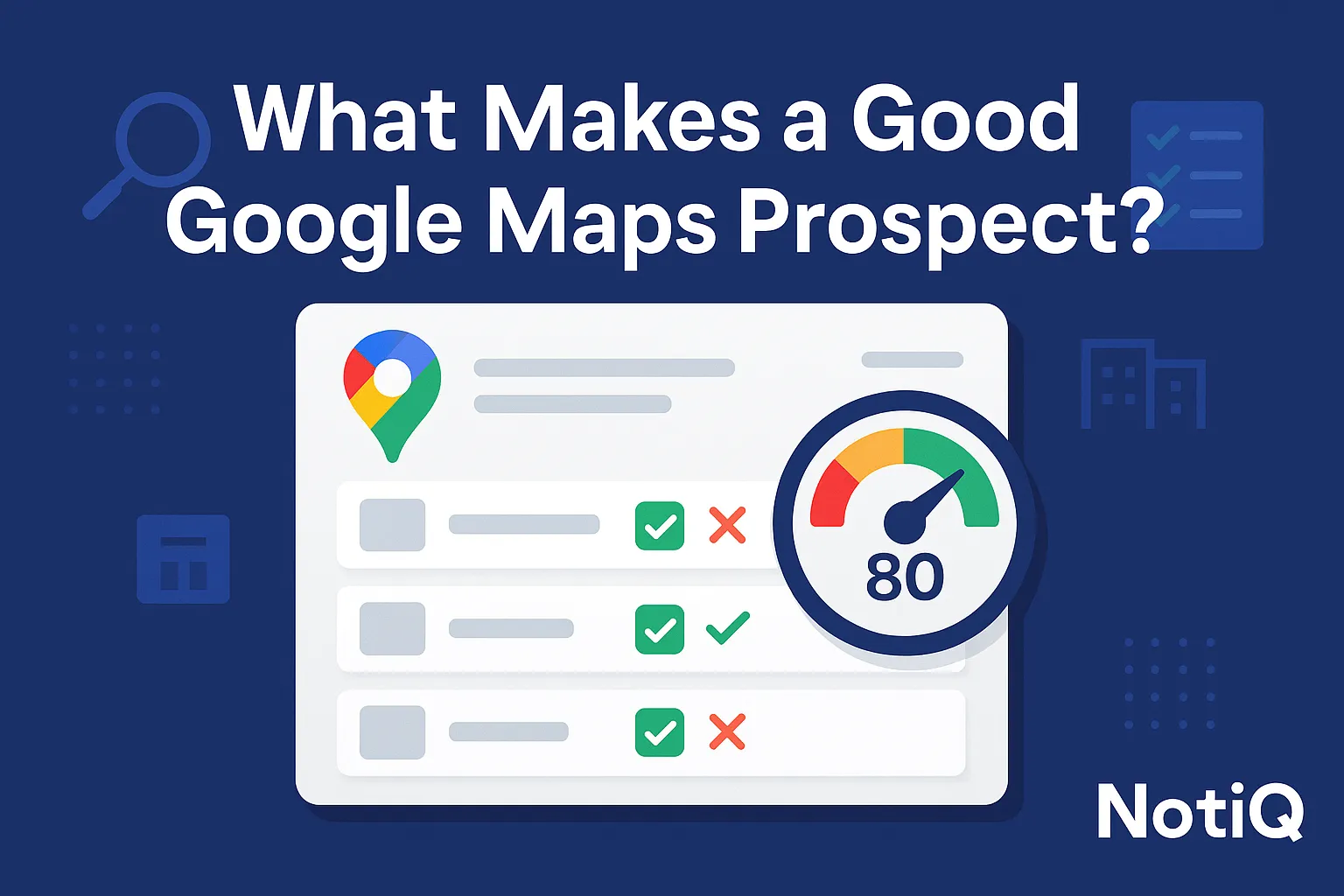
What Makes a Good Google Maps Prospect? A Complete Qualification Framework
A complete framework for qualifying Google Maps prospects using review patterns, activity signals, photos, and profile completeness to identify high‑fit SMB leads.
1. Introduction
The single biggest mistake in Google Maps prospecting is assuming every listing is a viable SMB lead. The reality is that most aren’t. In the vast ecosystem of local businesses, a significant percentage of listings are dormant, outdated, or simply not ready for B2B engagement.
When sales teams treat every pin on the map as an equal opportunity, they waste countless hours chasing businesses that have been closed for months or lack the digital maturity to respond. Inconsistent data leads to bounced emails, disconnected calls, and frustrated outreach teams. The key to high-performance prospecting isn't volume; it's precision.
This guide outlines a rigorous qualification framework designed to separate high-value opportunities from dead ends. We will break down the core signals of a healthy business, identify immediate red flags, and provide a scoring model you can apply today. At NotiQ, we have spent years refining these qualification rules to ensure SMB outreach campaigns hit the right targets with the right message.
2. Core Signals That Define a High-Quality Google Maps Prospect
To build a reliable pipeline, you must look beyond the business name and phone number. A Google Business Profile (GBP) is a treasure trove of behavioral data. It tells you not justwhothe business is, buthowthey operate. A high-quality prospect leaves a digital footprint that signals operational health, customer engagement, and potential budget for services.
These signals form the foundation of our scoring framework. By analyzing these elements, you can predict with high accuracy whether a business is active, growing, and responsive.
Reviews as Reputation and Activity Signals
Reviews are the heartbeat of a local business. They serve as a primary indicator of both reputation and current activity levels. A business with zero reviews is often a ghost town, while a business with hundreds suggests a deeply established operation.
However, total count is only part of the story. You must look at review velocity—the rate at which new reviews are acquired. A business that received 50 reviews three years ago but none in the last six months is likely stagnating or closed. Conversely, a business with only 15 reviews, but all received in the last month, is likely aggressive about growth and customer acquisition.
Furthermore, a balanced sentiment score (a mix of 4 and 5 stars rather than just 5 stars) often indicates a legitimate, high-volume operation. When analyzing these patterns, you are essentially vetting the business's operational maturity. For a deeper dive into how we structure these vetting processes, you can reference[NotiQ’s qualification frameworks](/)which rely heavily on these specific reputation metrics.
Photo Activity and Visual Proof of Business Health
Photos are often overlooked in lead scoring, yet they are powerful proxies for engagement. A high volume of photos correlates strongly with business legitimacy.
There is a critical distinction to make here:Owner-posted vs.Customer-posted photos.
• Owner-posted photos indicate that the business cares about its brand image and is actively managing its profile. This signals "digital intent."
• Customer-posted photos serve as proof of life. They confirm that foot traffic is happening and that customers are engaged enough to document their experience.
If a profile has no photos, or only the default Street View image, it is a low-quality signal. A profile teeming with recent images of food, projects, or team members is a high-quality prospect.
Posting Cadence and Owner Engagement
Google Posts (updates, offers, and events) are a direct line of communication from the business owner to the public. If a business is using this feature, they are in the top tier of digital maturity.
Regular posting cadence shows that the owner or marketing manager is logging into the backend of their profile frequently. This is a massive indicator for outreach success. If they are active on their profile, they are likely monitoring their email and phone lines. A business that posts weekly offers is demonstrating they have a marketing strategy and are likely receptive to tools or services that can enhance it.
Listing Completeness & Operational Accuracy
A fully optimized profile is a sign of a professional business. You should look for the presence of specific data points:
• Hours of Operation: Are they specific, and do they account for holidays?
• Categories: Is the primary category accurate, and are secondary categories utilized?
• Service Areas: Are they defined clearly?
• Contact Info: Is the phone number local or toll-free? Is the website link functional?
Completeness predicts responsiveness. An incomplete profile suggests an owner who is overwhelmed or indifferent to their digital presence. For reference on what constitutes a "complete" profile according to the platform's own standards, review the official Google Business Profile guidelines.
3. How to Spot Red Flags and Eliminate Bad-Fit SMBs Quickly
Efficiency in sales is about disqualification. The faster you can remove a bad lead from your list, the more time you have for a good one. Before you spend time crafting a pitch, scan the prospect for these immediate "kill signals."
Outdated or Inactive Listings
The most obvious red flag is a listing that looks abandoned. If the last review was from 2019, the photos look like they were taken on a flip phone, and the "Hours" section warns "Hours might differ," stay away.
These businesses often have disconnected phones or owners who have moved on to other ventures but never deleted the listing. Outreach to these profiles almost always results in a bounce or silence.
Mismatched or Spammy Categories
Be wary of listings that use categories that don't match their business name or website. For example, a listing named "Best Plumber NYC Cheap Fast" is likely violating naming conventions and may be suspended by Google at any moment.
Keyword stuffing in the business name or using unrelated categories to game the search algorithm indicates a "churn and burn" mentality. These are risky prospects. To understand the difference between legitimate optimization and policy violations, consult the Google Business Profile eligibility rules.
Missing or Low-Signal Data
"Ghost listings" are profiles with almost no data. They have a name, maybe a phone number, but no website, no description, no photos, and no reviews. Often, these are unverified listings that were auto-generated by Google.
Without a website, you have no secondary way to verify the business. Without reviews, you have no social proof. These leads typically indicate very low digital maturity or a hobbyist business rather than a professional SMB.
Signs of Operational Instability
Look for volatility in the recent history of the listing. A sudden surge of 1-star reviews often indicates a PR crisis or operational failure. Frequent changes to opening hours (e.g., changing from 24 hours to "Closed" repeatedly) can signal staffing issues or erratic management. These businesses are often in survival mode and are rarely good candidates for new B2B relationships.
4. A Simple Scoring Framework for Google Maps Lead Qualification
Relying on "gut feeling" is not scalable. To build a consistent pipeline, you need a numeric scoring model. This removes subjectivity and allows you to delegate list building to junior staff or VAs with confidence.
Step-by-Step Scoring Criteria (0–5 Scale per Signal)
Assign a score of 0 to 5 for each of the following categories.
1. Review Health
• 0: No reviews.
• 1: 1–5 reviews (old).
• 3: 10–50 reviews (some recent).
• 5: 50+ reviews, recent activity in the last 30 days.
2. Visual Engagement (Photos)
• 0: No photos / Stock Street View only.
• 3: 5–10 photos mixed owner/customer.
• 5: 20+ photos, high quality, recent uploads.
3. Activity (Posts & Updates)
• 0: No posts ever.
• 3: Posted in the last 6 months.
• 5: Posted in the last 30 days / Weekly cadence.
4. Completeness
• 0: Missing website or hours.
• 3: Basic info present, generic description.
• 5: Fully optimized, Q&A section active, detailed description.
Weighting Signals for Outreach Readiness
Not all signals are equal. If you are selling digital marketing services,Completeness and Activity are your most important metrics because they show the owner values digital channels. If you are selling operational software,Review Health(volume of customers) might be more important.
Recommended Weighting:
• Reviews: x 1.5 multiplier (Proof of revenue/customers)
• Activity: x 1.2 multiplier (Proof of engagement)
• Photos: x 1.0 multiplier
• Completeness: x 1.0 multiplier
Final Score Interpretation (Poor, Moderate, High-Fit)
Sum your weighted scores to categorize the lead.
• Low-Fit (Score 0–10): Do Not Contact. These leads will destroy your conversion metrics. They are likely inactive or too small.
• Moderate (Score 11–20): Tier 2 Outreach. These are valid businesses but may need more nurturing or education. Good for automated, low-touch campaigns.
• High-Fit (Score 21+): Tier 1 Priority. These are your "Golden Geese." They are active, established, and digitally savvy. Assign these to your best sales reps for personalized outreach.
At NotiQ, we have found that filtering lists using this logic reduces wasted outreach time by nearly 40% compared to cold-calling raw lists.
5. Industry-Specific Indicators for Strong SMB Opportunities
A "good" profile for a plumber looks different than a "good" profile for a coffee shop. You must adjust your lens based on the vertical.
Home Services (Contractors, Plumbers, Roofers)
For home services, trust is the currency.
• High-Value Signals: High review counts are non-negotiable here. Look for detailed "Service Areas" (e.g., specific suburbs listed).
• Responsiveness: These businesses live and die by the phone. If their hours are updated and they have a "Request a Quote" button enabled, they are prime targets.
Retail and Local Shops
• Key Signals: Visuals matter most. Look for high photo volumes showing inventory.
• Foot Traffic: Review velocity (frequency of new reviews) is a direct proxy for foot traffic. A shop with daily reviews has cash flow.
Wellness and Personal Services
• Key Signals: Look for "Appointment" links. Spas, salons, and gyms that use booking software links in their profile are operationally mature.
• Cadence: Regular posts about staff availability or seasonal specials indicate active management.
Professional Services (Agencies, Consultants)
These businesses rely on credibility.
• Key Signals: A polished website link is critical. The "Description" field should be keyword-rich and professional.
• Workflow: When building workflows for professional services, you need to verify they aren't just a freelancer with a laptop. Check for a physical address vs. a residential one. For more on structuring qualification workflows for professional sectors, you can find excellent guides at Repliq.
Categories to Avoid or Score Differently
• Seasonal Businesses: Ice cream stands or tax preparers may look "dead" in the off-season. Do not disqualify them purely on recent activity if it is currently their off-season.
• Lead-Gen Shells: Be careful of listings that seem to exist only to capture leads (e.g., "We Buy Cars [City Name]"). These are often not traditional SMBs.
6. Tools, Resources, and Process Tips
Scaling this process requires a mix of smart manual checks and ethical automation.
Manual Workflow Checklist
If you are doing this manually or training a VA, follow this exact order to save time. If step 1 fails, stop immediately.
1. Check Reviews: Are there recent reviews (last 3 months)? No? -> Skip.
2. Check Website: Does the link work? No? -> Skip.
3. Check Photos: Are there real photos of the business? No? -> Skip.
4. Check Completeness: Is the profile claimed and filled out?
5. Assign Score.
Ethical Automation & Compliance
You may be tempted to "scrape" Google Maps to get this data in bulk. It is vital to understand that unauthorized scraping violates Google's Terms of Service.
• The Safe Way: Use official APIs or verified data partners that source information compliantly.
• Privacy: Never use personal data found on Maps for marketing without consent.
• Resource: For guidance on leveraging digital tools responsibly, the SBA offers resources and workshops, such as their Google Maps and digital footprint workshops.
Integrating Scores Into Outbound Tools
Don't let the score sit in a spreadsheet. Map it to your CRM.
• High Scores: Tag as "Hot Lead" -> Route to manual email sequence/call.
• Moderate Scores: Tag as "Nurture" -> Route to monthly newsletter or automated drip.
• Low Scores: Archive.
7. Case Examples of High-Fit and Low-Fit Prospects
Example 1: High-Fit Listing Breakdown
Business:"Downtown Artisan Bakery"
• Reviews: 4.8 stars, 312 reviews. Last review: 2 days ago.
• Photos: 150+ photos. Owner posted a menu update last week.
• Posts: Active "Weekend Special" post from Friday.
• Completeness: Website link works, hours are confirmed, "Dine-in" attribute is checked.
• Verdict: Score 24/25. This business is thriving, cares about its image, and has a budget. Immediate outreach target.
Example 2: Low-Fit Listing Breakdown
Business:"Smith & Co Repairs"
• Reviews: 3.0 stars, 4 reviews. Last review: 2 years ago.
• Photos: 1 blurry photo of a van.
• Posts: None.
• Completeness: No website. Hours listed as "Mon-Fri" but unverified.
• Verdict: Score 4/25. This business is likely a sole proprietor with no digital interest or is no longer operating. Outreach here is a waste of resources.
8. Conclusion
Qualification is the difference between a spammy, ineffective campaign and a high-performing sales strategy. By applying this framework—analyzing reviews, photos, activity, and completeness—you stop guessing and start targeting.
A structured approach ensures that your team focuses only on SMBs that are open, active, and operationally ready for your solution. This increases your conversion rates and protects your domain reputation by reducing bounces.
If you are ready to move beyond manual checking and implement scalable workflows for prospect qualification, explore how NotiQ can streamline your data enrichment and lead scoring processes.
Frequently Asked Questions
- Frequently Asked Questions
- What is the fastest way to determine if a Google Maps prospect is qualified? Check the review recency. If a business hasn't received a review in 6 months, they are likely inactive or have very low customer volume. How many reviews are “enough” for outreach readiness? Generally, 10+ reviews indicate a baseline of legitimacy. However, velocity (new reviews coming in) is more important than the total historical count. Should I prioritize review freshness or total count? Freshness. A business with 50 reviews from 2018 is a worse prospect than a business with 15 reviews from 2024. Freshness indicates current operational health. How do I avoid contacting inactive or low-maturity SMBs? Filter out listings with no website and no photos. These two missing data points usually correlate with businesses that are not ready for B2B services. Do different industries require different qualification signals? Yes. High photo counts are crucial for retail and dining, while detailed service descriptions and website quality are more important for professional services and contractors.
Continue Reading
More articles you might find useful
How to Find Local Businesses With Missing Email Addresses
Learn how to find and verify missing email addresses for local businesses discovered on Google Maps. This guide covers enrichment, verification, and cleaner lead generation workflows.
Read the article →
How to Find Businesses With Strong Ratings but Almost No Reviews
Learn how to find local businesses with strong ratings but too few reviews. This guide shows how to qualify better review-growth leads using competitor gaps, recency, and activity signals.
Read the article →
Google Maps Prospecting for Commercial Kitchen Equipment Suppliers
A practical blueprint for commercial kitchen equipment suppliers to use Google Maps and Google Business Profiles to find, score, and target better local hospitality leads. Learn how to turn public business signals into CRM-ready outreach opportunities.
Read the article →Popular industry lead playbooks
Maps search examples and niche outreach for the verticals teams prospect most.