Technology
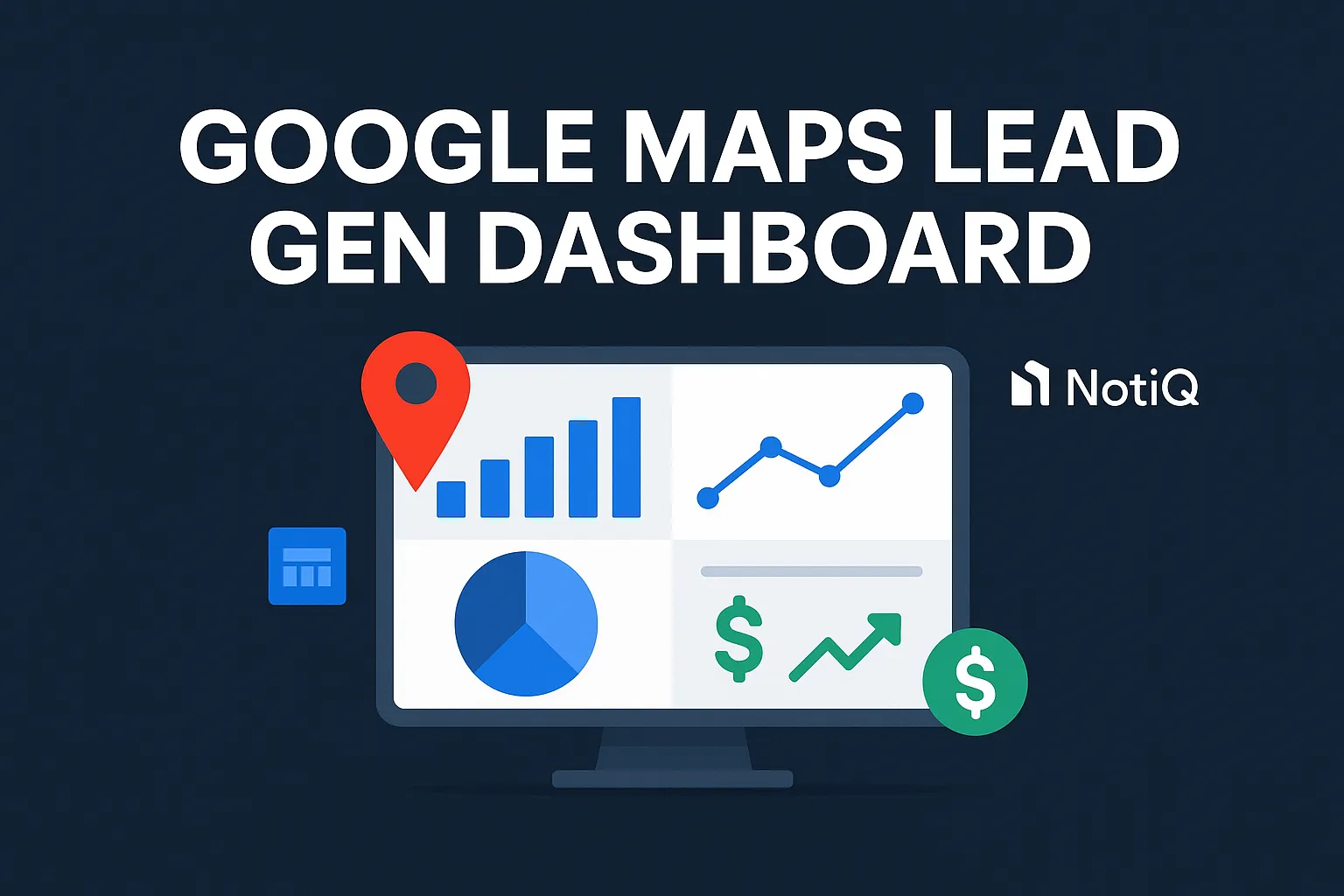
Google Maps Lead Gen Dashboard: How to Track Volume, Replies, and Revenue
Learn how to build a full‑funnel Google Maps lead gen dashboard that tracks everything from scrape volume to replies and revenue. Improve accuracy, attribution, and growth.
1. Introduction
Most marketers attempting local lead generation run into the same wall: the data is messy. Unlike LinkedIn or neat B2B databases, Google Maps outreach involves inconsistent scrape volumes, broken attribution chains, and significant difficulty in tracking revenue back to the original listing. You might scrape 1,000 listings one day and 600 the next using the exact same parameters. You might get replies, but fail to link them to the specific campaign or niche that generated them.
The problem is that most teams lack a unified KPI framework connecting raw listings to closed revenue. They treat Google Maps data like standard cold email lists, ignoring the geospatial and category-specific nuances that drive success. Without a dedicated dashboard, you are essentially flying blind, unable to distinguish between a bad list, a bad script, or a bad market.
This guide provides a complete visualization and KPI hierarchy customized specifically for Google Maps outreach. We will move beyond vanity metrics and build a system that tracks the entire lifecycle of a local lead—from the initial data extraction to the money in the bank.
At NotiQ, we have extensive experience building outbound dashboards that solve these specific visibility gaps. We understand that effective automation requires analytics-first thinking.
[Discover NotiQ, the analytics-first automation layer for your outbound workflows](/)
2. Why Google Maps Needs Its Own KPI Framework
Google Maps is not a static database; it is a dynamic, living ecosystem. This creates unique challenges for lead generation that standard outbound KPIs cannot capture. A generic "open rate" or "reply rate" metric does not account for the variability in scrape volume or the massive differences in data quality between niches.
For example, scraping "Plumbers in New York" will yield vastly different contactability rates compared to "Digital Agencies in Austin." The former relies heavily on phone numbers and generic emails, while the latter often has direct decision-maker paths. If you apply the same KPI expectations to both, you will inevitably misjudge campaign performance.
Furthermore, visibility does not equal lead flow. Competitors often focus solely on "volume of leads scraped," but this is a vanity metric if 40% of those leads lack valid contact info or belong to permanently closed businesses. A robust framework must account for business density. According to U.S. Census Bureau data, business density varies wildly by region; a rural county might have 5 businesses per 1,000 residents, while an urban center has 20+. Your dashboard must normalize for these geographic realities to provide accurate performance data.
Read more about how multi‑channel outbound strategies have evolved
Component 1.1 – Data Variability & Volume Constraints
One of the most frustrating aspects of Google Maps lead generation is the 20–40% variability in scrape results. Even with identical search parameters, the number of results returned can fluctuate due to Google’s load balancing, data center synchronization, or localized personalization.
The Google Maps Platform Documentation highlights that API responses are subject to query limits and ranking algorithms that prioritize relevance over exhaustiveness. This means a "scrape" is rarely a complete census of an area. If your dashboard doesn't track "Scrape Variance" or "Retry Success Rate," your forecasting will be unreliable. You cannot predict revenue if you cannot predict the raw material (data) entering your funnel.
Component 1.2 – Why Niche Differences Matter
Niche selection is the single biggest variable in local lead gen analytics. We regularly see 3–6x differences in reply rates between industries. A highly competitive niche like "Personal Injury Lawyers" is saturated with marketing offers, resulting in lower reply rates but potentially higher deal values. Conversely, "local fencing contractors" might have high reply rates but lower digital maturity.
A proper Google Maps lead gen dashboard segments data by niche. If you aggregate all your campaigns into one "Global Reply Rate," you hide the insights that tell you where to double down. You need to visualize the correlation between local competitiveness (service density) and your conversion metrics.
3. Core Metrics: From Scrape Volume to Closed Revenue
To build a dashboard that actually drives revenue, you need a hierarchy of metrics that mirrors the user journey. Most competitor content stops at "leads generated." We need to go further.
The Google Maps KPI Hierarchy:
1. Scrape Volume: Total raw listings found.
2. Valid Listings: Listings that meet criteria (reviews, status, website).
3. Contactable Leads: Listings with valid email/phone/social data.
4. Outreach Sent: Successful transmissions (bounced emails excluded).
5. Replies: Total responses.
6. Intent Scoring: Categorization of replies (Positive/Negative).
7. Booked Calls: Meetings scheduled.
8. Closed Revenue: Actual sales.
Scrape Volume, Valid Listings & Contactability
Scrape Volume is your top-of-funnel metric.
• Formula: Total unique Place IDs extracted per search execution.
• Note: Always monitor for sudden drops, which often indicate anti-scraping blocks or proxy failures.
Valid Listings filters out the noise.
• Definition: Listings that are "Operational" (not permanently closed) and meet your review count thresholds.
Contactability Rate is a critical efficiency metric.
• Formula: (Listings with Valid Email OR Phone / Total Valid Listings) × 100.
• Benchmark: Aim for >60% contactability. If it’s lower, your enrichment process or data source needs auditing.
Outreach Sent, Reply Rates & Positive Intent
Tracking "Outreach Sent" confirms your automation is working, but Reply Rate is where the human element enters. However, not all replies are equal. A "stop emailing me" is a reply, but it's not a lead.
You must implement Reply Attribution tagging.
• Metric: Positive Reply Rate vs. Total Reply Rate.
• Scoring Example:
• "Not Interested" = 0 points
• "Send more info" = 5 points
• "Let's book a call" = 10 points
According to analytics insights often discussed in Harvard Business Review, interpreting intent requires context. A neutral reply in a high-ticket niche is often more valuable than an enthusiastic reply in a low-value market. Your dashboard should weight these replies accordingly.
From Booked Calls to Revenue Attribution
The final mile is often where tracking breaks. You must track Lead-to-Close % specific to the Google Maps channel.
• Challenge: A lead might call you three weeks after the initial email.
• Solution: Ensure the original "Place ID" or "Campaign ID" travels with the lead into your CRM. If you lose this link, you cannot calculate the ROI of your scraping efforts.
4. How to Attribute Replies and Intent Accurately
Attribution in Maps workflows often breaks because of channel mixing. You might scrape data from Maps, enrich it with LinkedIn data, and email the prospect. When they reply, is that a "Maps Lead" or a "LinkedIn Lead"?
For accurate Google Maps reply attribution, the source of truth must be the origin of the intent. Since the targeting strategy was geospatial (based on the Maps listing), the attribution belongs to Maps.
See how NotiQ handles complex attribution logic automatically
Reply Tagging Framework
To make your data actionable, you need a standardized tagging framework for every incoming message.
1. Hard Bounce / Error: Invalid data (feed this back to your enrichment loop).
2. Not Interested / DNC: Remove from all future campaigns immediately.
3. Interested / Info Request: Top of funnel; requires nurturing.
4. Qualified / Call Request: Bottom of funnel; requires immediate sales action.
Mapping these tags to pipeline stages allows you to see where bottlenecks occur. If you have high "Interested" rates but low "Qualified" rates, your offer might be intriguing but not compelling enough to drive action.
Intent Scoring Models for Maps Leads
Advanced dashboards use weighted scoring.
• Service Type Signal: A lead from a high-margin category (e.g., "Emergency Roofing") gets a multiplier.
• Urgency Signal: Keywords in the reply (e.g., "cost," "how soon," "pricing") trigger higher intent scores.
• Competition Signal: Leads in low-density areas might be scored higher due to higher likelihood of closing (less vendor noise).
As referenced in Google Analytics attribution training materials, data-driven attribution (DDA) models that assign credit to conversion events based on how different touchpoints impact the outcome are superior to "last-click" models. Apply this logic to your Maps outreach: credit the initial scrape for finding the opportunity.
5. Building a Full-Funnel Google Maps Lead Gen Dashboard
A dashboard is only as good as the decisions it helps you make. A strong dashboard answers the question: "Is my Maps strategy profitable?"
The National Institute of Standards and Technology (NIST) emphasizes that metric consistency is key to reliable measurement. Your dashboard must use the same definitions for "Lead" and "Revenue" across all views to maintain data integrity.
Designing the Data Model
Your backend data model should look like a relational database.
• Primary Key: Google Maps Place ID (This is the unique identifier).
• Fields:
• Niche / Category
• City / Region
• Scrape Timestamp
• Enrichment Status (Success/Fail)
• Contact Info (Masked/Hashed for security)
• Outreach Campaign ID
• Reply Status
• Revenue Value
This schema allows you to query data in any direction: "Show me total revenue from Dentists in Florida scraped in Q1."
Visualizing the Funnel (Volume → Replies → Revenue)
Visualizing this data helps identify the "leaky bucket."
• Sankey Diagrams: Excellent for showing the flow from `Total Scraped` → `Valid` → `Contacted` → `Replied`.
• Bar Funnels: Great for comparing conversion rates between different niches side-by-side.
NotiQ takes a visualization-first approach, allowing you to see these flows without building complex SQL queries manually. By centralizing the data orchestration, you can spot if a specific city is underperforming in contactability or if a specific script is failing to convert replies to calls.
[Reintroduce NotiQ as the centralized data orchestration layer](/)
Niche Scoring & Opportunity Heatmaps
One of the most powerful views is the Opportunity Heatmap.
• X-Axis: Reply Rate
• Y-Axis: Average Deal Size (or Revenue Yield)
• Z-Axis (Bubble Size): Market Volume (Total leads available)
This visualization instantly tells you which niches are "Cash Cows" (High Yield, High Volume), which are "Question Marks" (High Yield, Low Volume), and which are "Time Wasters" (Low Yield, Low Reply).
6. Troubleshooting Low Volume, Low Replies, and Data Gaps
When the dashboard shows red, you need to know how to fix it. Here are the common failure modes and diagnostics.
Low Scrape Volume or Missing Listings
• Symptoms: You search for "Gyms in London" and get 15 results, or volume drops by 50% week-over-week.
• Causes: API variance, aggressive scraping triggering blocks, or overly restrictive search parameters (e.g., radius too small).
• Fixes:
• Retry Logic: Implement automated retries for searches returning <20 results.
• Proxy Rotation: Ensure you are using high-quality residential proxies to avoid Google blocking your requests.
• Category Targeting: Verify you are using the correct GMB Category names (refer to Google Maps Platform Documentation for category taxonomy).
Low Replies or Poor Intent
• Symptoms: You are sending thousands of emails but getting <1% reply rate, or replies are mostly "unsubscribe."
• Causes: Niche saturation (everyone is emailing them), low-quality contact data (emailing `info@` instead of the owner), or a weak hook.
• Solutions:
• Enrichment Upgrade: Invest in better waterfall enrichment to find personal emails.
• Angle Testing: A/B test your value proposition.
• Niche Switching: If a niche is saturated, pivot to an adjacent service (e.g., instead of "Realtors," try "Property Managers").
Revenue Not Tracking
• Symptoms: You are closing deals, but the dashboard shows $0 ROI.
• Causes: The CRM is disconnected from the outreach tool, or the unique ID (Place ID) was lost during the conversation.
• Fixes:
• UTM Structure: Use strict UTM parameters in all booking links.
• Hidden Fields: Pass the `Place ID` as a hidden field in your booking forms (Calendly/HubSpot).
• Event Automation: Use tools like Zapier or Make to update the dashboard row when a CRM deal stage changes to "Closed Won."
7. Tools, Resources & Future Trends
Building this infrastructure requires a stack of tools.
• Scraping: Dedicated Maps scrapers (ensure compliance with Terms of Service).
• Enrichment: Tools like Clay, Apollo, or specialized waterfall APIs.
• Analytics & Orchestration: NotiQ serves as the brain, connecting these disparate tools into a unified view.
• Benchmarks: Use BrightLocal or Local Falcon reports to understand baseline visibility and market density for different industries.
Future Trends:
• AI Enrichment: Using LLMs to analyze the business website and write hyper-personalized first lines is becoming standard.
• Niche Forecasting: Predictive models that tell you which city/niche combo to target next based on historical yield.
• Hybrid Outbound: Combining Maps data with LinkedIn automation for a multi-touch approach.
8. Conclusion
Building a Google Maps lead gen dashboard is not just about making pretty charts; it is about bringing financial discipline to a chaotic data source. By establishing a clear KPI hierarchy—from Scrape Volume to Closed Revenue—you transform raw data into a predictable growth engine.
Remember, Maps workflows differ fundamentally from standard B2B outreach due to geospatial factors and data variability. If you try to force Maps data into a generic dashboard, you will miss the insights that drive profit.
If you are ready to stop guessing and start tracking the full funnel of your local lead generation, it is time to implement a dedicated analytics layer.
Ready to see your data clearly? Try NotiQ to unify your scraping, outreach, and revenue attribution into a single, actionable command center.
Frequently Asked Questions
- What KPIs matter most for Google Maps lead generation?
- The most critical KPIs are Scrape Volume (raw potential), Contactable Listings (actual potential), Reply Rate (market fit), Positive Intent Rate (lead quality), and Closed Revenue (ROI). Tracking volume without tracking intent often leads to wasted resources.
- How do I attribute replies from Maps leads?
- Use ID-based tracking. Assign a unique identifier (like the Place ID) to every lead you scrape. Ensure this ID follows the lead into your email tool and CRM. When a reply comes in, map it back to the original ID to credit the specific campaign and niche.
- Why does scrape volume fluctuate so much?
- Scrape volume fluctuates due to Google Maps API variance, load balancing, and anti-scraping thresholds. A search that returns 100 results today might return 80 tomorrow. This is a normal feature of the ecosystem, not necessarily a bug, but your dashboard must account for it.
- How can I compare niches?
- Compare niches using "Revenue per Listing" or "Reply Rate per 1000 Contacts." Do not compare raw volumes, as some niches (like Restaurants) are naturally denser than others (like Architects). Normalized metrics allow for fair comparison.
Continue Reading
More articles you might find useful
How to Find Local Businesses With Missing Email Addresses
Learn how to find and verify missing email addresses for local businesses discovered on Google Maps. This guide covers enrichment, verification, and cleaner lead generation workflows.
Read the article →
How to Find Businesses With Strong Ratings but Almost No Reviews
Learn how to find local businesses with strong ratings but too few reviews. This guide shows how to qualify better review-growth leads using competitor gaps, recency, and activity signals.
Read the article →
Google Maps Prospecting for Commercial Kitchen Equipment Suppliers
A practical blueprint for commercial kitchen equipment suppliers to use Google Maps and Google Business Profiles to find, score, and target better local hospitality leads. Learn how to turn public business signals into CRM-ready outreach opportunities.
Read the article →Popular industry lead playbooks
Maps search examples and niche outreach for the verticals teams prospect most.